WeSurf: The Nautical Negro with Brian 'BJ' James
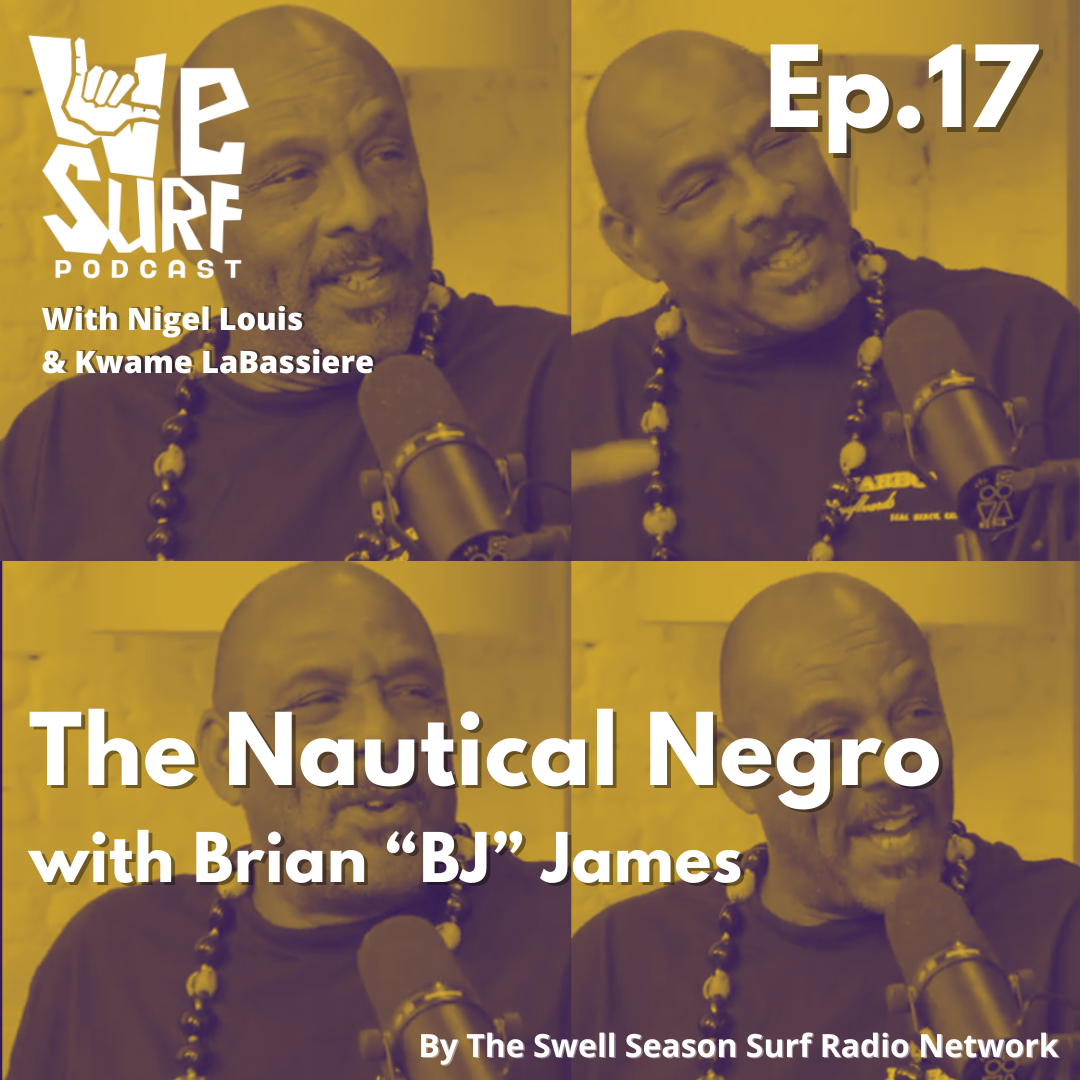
The Nautical Nego with Brian , BJ, James
[00:00:00]
Kwame: Hello everyone, and welcome to another episode of the We Surf podcast. I am your host Kwame Lab. Bassier. I'm flying solo today. Nigel had to do some [00:01:00] daddy duty, but you know, Ohana family comes first. You have to take care of the next generation of surfers, so, uh, he'll be here for the next one. But today I, I'm flying solo.
However, and I know I say this all the time, but we actually are again with another Rockaway legend, Mr. Brian, BJ James. Um, he's an author, a amazing surfer, and pretty much I know the term. Okay, so. I hate this term when people say, oh, that's an unc. I don't like that term. I prefer to keep with the surfer terms of an uncle, you know?
So somebody who's been, put their time in, in the water, somebody who's, you know, spent a lot of time there doing their thing, surfing, you know, bringing up the grounds, pointing out the good stuff, the bad stuff they're doing. So that's what BJ is. So he is one of the Rockaway OGs, one of the Rockaway uncles.
Bj, thank you for joining us. How's, how you going?
BJ: Oh man. Thank you, Kwame. Thank you. I appreciate you having me here, bro. Thank you.
Kwame: I appreciate the [00:02:00] kind words. It's a pleasure. I mean, this actually was, Nigel was again, and that's why we feel kind of bad because Nigel was the one that was pushing. It's like, Hey, we gotta get BJ in the show.
We gotta get BJ in the show. And last minute, you know, of course family first. So I'm gonna try my best to do him justice on this one. 'cause you, because he was actually like really excited to have this Yeah. To have you hit I
BJ: go back with Nigel a long ways. Oh yeah. Nigel's been around that beach a long time.
Definitely. Maybe even before me. I'm, he might've been out there surfing before I was. Okay. I got out there in like 96, 97. All right. So yeah,
Kwame: we'll, we'll, we'll look into that one and we'll see how, we'll, we'll do a little bit of digging on that one, so we'll put that in the show notes to see who was there first.
But, um, so BJ to the, to, to our viewers who are, and our listeners who are new to you, can you just sum yourself up in like 60 seconds?
BJ: Oh man. Brian, BJ James, little black kid from Portchester, New York who just loves the water. [00:03:00] Before I surfed, you know, I was very, very big in the water skiing. Mm-hmm.
Wakeboard, I was one of the first wakeboarders here on the East coast back in the early eighties. And, uh, I just, I love the water and I love to share it with everybody.
Kwame: Nice. I actually, so a quick story, I don't even know if you would remember this story or not. We were, I was surfing on Beach 69. This was, I don't even remember how many years ago this was.
You know, everything now is pre and post COVID. So this was pre COVID. So I was surfing on 69 or pre, or post C Sandy or COVID? Yes, exactly. In Rockaway. It's pre or post sandy or pre or post COVID. So this was between Sandy and COVID. Okay. So I was, um, I was surfing on 69 and you had paddled out. And at that point I'd already met you and I already knew who you were, but I was just so unaccustomed to seeing you surf on 69.
'cause in my mind you were like the guy, you know this mythical person who [00:04:00] surfs uptown 90. And I see you surf as you paddling out on 69. Oh. And I turn to somebody and I'm looking, and I was like, should we move? You know, do we need to, is this, is this his break? Do we need to move? And they're like, nah, nah, no.
He's cool. He's cool. Don't worry about it.
BJ: That's why I left 90th. 'cause it got too privileged.
Kwame: Yeah.
BJ: Oh, okay. It got, you know, it got too privileged and attitude up
Kwame: there. Mm.
BJ: You know, I, I, I like surfing with quote unquote kooks.
Kwame: Yeah.
BJ: You know, 'cause I'm the eternal kook. No matter what. I'm never too big, you know, I like surfing, you know, I like being around people that is just learning nice.
It keeps me fresh. Yeah. You know, when you hear them talking about the little increments mm-hmm. You know, like the best person to learn from like I did are the people that were just surfing a month or two before me.
Kwame: Mm-hmm.
BJ: Because they can understand what stage I was at.
Kwame: Okay.
BJ: So, even now that I, you know, I've been surfing for 30 years, pretty much, I still like being around that atmosphere Right.
To see how enthusia they are. I, I like that. You know, people up on [00:05:00] 90th, everybody's, you know, they think they're so great. You know, the Joe Pros. Mm-hmm. Mm-hmm. So I like, I like surfing with just, just those regular surfers. Yeah.
Kwame: You know, it's, um, somebody said one time, I forget who it was, but it said something along the lines of keep that, keep the beginner stoke.
Yeah. You know, so it doesn't matter if it's like a one foot wave, it doesn't matter if it's a seven foot wave. It doesn't matter if it's a 12 foot wave that's stoked that you have from just catching that one foot wave because wow. You know, I work with students and, you know, even today, you know, I pushed somebody into like this little dribbling and they were just grinning from air to
BJ: air.
Like I ca and when surfing 30 years mm-hmm. I catch a good long wave, two foot wave. I'm still yelling. Big dog style. You know, it's still, I love that I, I try to treat every wave like it's my first and my last Nice. Treat every wave. Like it like the enthusiasm you had when you caught your first wave. Yeah.
And catch it like it might be your last Yes. Treat it like, you know, you don't know what's gonna [00:06:00] happen tomorrow. I love that. So this wave, this last wave I caught might be my last one. I love that. I love that. So I'm, I'm enjoying it. Just like I did my first
Kwame: one. Yeah. We are definitely gonna, you know, we are gonna definitely gonna make that a clip.
Treat the wave. Like treat every wave like it's your first or your last. Your last. I love that. I love that. Alright. Starting surfing in Rockaway Beach, how did it surf your identity as a surfer and a storyteller? So like who were your early mentors when you paddled out, or how did you get into it?
BJ: Well, my first, my first mentor was a brother Okay.
Named Arnette. And it's just, the craziest thing is I went to California, I caught a wave and I came back, man at, at Manhattan Beach. I was moving a guy from New York to California and I told him, I'll drive you to la. And he went up north, but don't drop me off. La my kick, my family's there and I caught my first wave.
I came back and I was just bragging. Mm. In the gym up in Westchester, where I'm from to this, this brother Anette, [00:07:00] I didn't know Anette, that he was a manager. And uh, I saw him in the gym a couple times, but I just told him, yeah, I caught my first wave in California. And he said, that's nothing. I surfed right here in New York.
Mm. What's the chance of a brother in 1997? Right, right. Meeting another brother that surfs. Yeah. You know, and him being right in the gym and Arnette. Arnette, man, he is just the most stoked surfer who doesn't get to surf a lot anymore. Right. But he still stoked and he told me where to go. Back then there was nowhere to rent boards.
Mm-hmm. It's not like now where you go and everybody's renting boards. Right, right. All over in lessons. I had to go to Long Beach and get there early because they only had like two boards to two soft tops. And he gave me directions to a couple spots in Long Beach. And at the last direction he said, Rockaway Jetty on 99th Street.
Mm-hmm. He said, you'll probably like this the best. He wrote on the paper, you'll, you'll probably like this the best. [00:08:00] And when I got to Rockaway, I put my bag down, I looked around and I said, I'm home. Nice. And a year later I was living nice. Nice. Just a year later, so, and Anette, I still, you know, I, I, I try to get anette out once or twice a year and, uh, that, that, that's my mentor right there.
That's why a lot of people like to say, oh, BJ's the first black surfer. Mm-hmm. Which I'm not. I was just the first one to make some noise. Okay. I was the first one to make some noise. Noise and, and I was the first one not to, to take any shit. Mm. If you don't mind my No, please. Cursing a little bit. No, go ahead.
It, go ahead. It's just that, you know, Rockaway is an old Irish town, and the surfers were old school, and not even, quite frankly, they didn't like anybody that wasn't from Rockaway, black or white. Mm-hmm. They weren't, they weren't, it wasn't like now surf coffee and surf yoga and all of that for the local dudes and just everybody from Rockaway.
If you weren't from Rockaway, [00:09:00] they were leery of you and it took a lot to get in. With the neighborhood, but me, as soon as I moved there, I acclimated myself not just to the surf neighborhood, but to the neighborhood. Right. You know, brother was up in Hamills and stuff.
Kwame: Exactly. Did you do that? How'd you do that?
BJ: A bar called rbis. Rbis. BIS was up on the corner of 90th. I lived on 90th. Mm-hmm. My first, my first house was on 90th. I had a picture and uh, we had some great, great parties there, but I would just, when the beach closed, I would tell everybody, come to the house, come by, you know, and I'd go up to the bar and I started shooting pool up there.
And I just started, they thought I was police because I'm, you know, you could tell I'm not city. You could tell I'm not a city boy. Mm-hmm. You know, and back then, that's 30 years ago, I was really clean cut. And they were like, yo guy said bj, everybody thinks you're police. Yeah. He's got, he definitely, no, that's something with this
Kwame: guy
BJ: told.
So I told dude, I'm not a cop, I'm a crook. [00:10:00] I lot a cop, I'm a crook man, you know, and I just, some of the cats from, from the bar would see me at the beach and see that I wasn't, you know, that I wasn't full of shit, you know? And then I started, you know, I started an organization called Brothers on Boards.
When I moved back, that was when I moved back to Rockaway around 2005. And I started, I, I wanted to be for surfing, skating and snowboarding. Right. But it ended up being a lot of skaters and I started buying them skateboards. I don't know if you are Curtis. Curtis was a skater. Yes, I do. When I first saw Curtis, I asked him if he could do some tricks.
He was in the skate park. I said, can you do this? And he said, uh, no. I said, can you do a 360? I actually asked him if he could do a 900, which only like two people in the world could do then. And he said, no. I said, well, could you do a 360? And he said, I could if my board wasn't messed up.
Kwame: Mm.
BJ: And he showed me his board all cheesy.
And I thought how me, me and my friends used to always be like, you know, we could do [00:11:00] things if we just had the opportunity. Right, right. That the other people had. So I told him, meet me at the skate shop, and I bought him a new board. Couple weeks later, he won the contest. And you know, that's when then all the kids in the neighborhood, he was like running, hold on, he's got a new boy.
He was winning contest. Brothers on boards was born. And, uh, I start, all the other kids started coming, so I started ordering decks online and whenever their decks broke mm-hmm. Whatever broke, I could replace 'em. And they didn't have any slack in their game so they, they could keep progressing. But the funny, the craziest thing is that after I wrote my book, they asked me to speak at a school, junior high school in Rockaway, down in Far Rock.
And after I told, I told the story about Curtis winning the skate contest, everybody was happy. Everybody's thanking me for helping them. You don't know, realize how far your help goes. [00:12:00] Because one of the teachers came up to me after, and she said, I know Curtis. She said, he was in my class. She said, before he started skating, he was in a gang.
She said, but he started skating and he left the gang. She said, all the kids in his gang are dead. And it just, it broke me down. I, I really couldn't believe it. I was like, you know, I helped him. I thought I just helped him with a little skating.
Kwame: Yeah. I just thought you gave him a, uh, a deck,
BJ: you know, a little hand up.
But it might have, you know, it turns out it might have helped save his life. And it was, this was years after, maybe 10 years after or so that I found that out.
Kwame: Yeah.
BJ: And it just, it, it tripped me. I had to sit down, I had to sit down at the school. 'cause I had no idea that I had, that I might've had that much of effect.
Yeah.
Kwame: I mean, you just, you just really never know the effect you have on someone. I mean, like I said, you know, you know, I teach surfing and, but then in addition to that. Anybody that I see in the water, if they're struggling at any point I'm like, Hey, you know, [00:13:00] not trying to tell you you're doing something wrong, but hey, try this.
I try to help do this. Yeah. And just this, just, you know, like my mother always used to say, you know, just giving somebody a smile can change their entire day.
BJ: And especially a lot when I'd see any of the brothers especially Yeah. Come down the beach, you know what I'm saying? I'd, I'd rap to him right away.
Kwame: Yeah. Yeah.
BJ: I don't know if you knew Bert. Yeah. Bert lives in Hawaii now. Yeah. Bert's out in Hawaii, and when I first moved out there, you know, Bert was at the house and he was like, yo, BJ we're black surfers. He was like, we gotta be right. He was like, because people are watching
Kwame: us. People are watching. Yeah.
BJ: He says, if a white dude screws up, nobody notices. Mm-hmm. Because there's a hundred other white guys in the water. He says, but they're looking at us. Right. You know what I'm saying? He was like, so we always gotta be right.
Kwame: No, you, that that is a hundred percent correct.
BJ: You know, and he was, he was always, you know, he was a jokester and everything.
Right. But when he [00:14:00] laid that down to me, he was, that was his first time I, I saw him serious. Yeah. Yeah. And he was like, bj, I see you're gonna be out here. And that was looking my first year, but I let those dudes know I'm gonna be here.
Kwame: That make your presence felt, I'm not going anywhere. This, this
BJ: big wave buddy, right.
Betty Buddy knows Rockaway surfing old school, big wave buddy ran the beach.
Kwame: Mm-hmm.
BJ: 90th Street Jetty. He lives on 91st Street. That was his. And he was an, he was an animal. He was that, that was like in Rockaway. He was an idol. Mm-hmm. To me, because I saw how he ran the beach and he came, you know, he came up to me, like I says, I could, I couldn't even surf that first year, but he said, you talk a lot of shit for a guy who can't surf.
I told him, dude, get used to me. I says, I'm gonna learn this right. And I'm gonna be here. I'm.
Kwame: So
BJ: get
Kwame: used to me. So, so this what you've been, what you've told us, I mean, there's, there's like so much to unpack from that and a couple things, you know, just to let our viewers [00:15:00] know, just, I mean, I'm going way back to what you said in the beginning 'cause it stuck on my mind.
You went to Manhattan Beach in California? In California, yeah. And surf for the first time there. For the first time. And if you think there are not many people of color in the water In Rockaway. Yeah. Far less Manhattan than California Beach. And then how close Manhattan Beach is to Bruce's beach. It's right there.
Bruce's, Bruce's beach. The, the beach they just gave back to Oh, to the black folk people. Yeah. So I remember, 'cause when I went there, you know, I'm walking along the boardwalk and whatever, and it's a, it's a very nice area, really affluent area, at least when I went there and I'm walking along looking at people.
And then the next year I went back again and I went to stay in the same, the same place I, I stayed at the year before. The guy behind the counter, he looks at me, he goes, oh yeah, I remember you. So I'm like, how do you remember me? So he, he kinda looks at me, he goes, yeah, there are not many people. There ain't a lot of brother.
There's not many people walking around Manhattan Beach looking like you. Okay, come on. So, but yeah.
BJ: [00:16:00] California is funny that way. It's, you know, they're not used to seeing black people, but they're not, you know, they don't hate. Yeah. You know, they're just surprised. Yeah. You know, I mean, we have a lot of, um, the thing about surfing is surfers only care if you could surf.
Kwame: Yes.
BJ: For the most part. Yeah. There's always the asshole. Mm-hmm. Here and there. But surfers just care. If you could surf, are you, can you surf? Are you gonna be and are you gonna be outta the way? Right. Exactly. Are you gonna be dangerous or not? You're gonna be in the way if you're gonna be in my way. But you got fools.
I don't know if you remember Maya. She was an Italian lady and she had a half black son, Colin. She had a bar in Brooklyn. The surf. Bar. Yes. And he moved to, he went to California to school and she took off with him. Hadn't seen him in 10 years. I was in Huntington Beach and I hear somebody say, yo, BJ out in the lineup.
So I'm like, who the, who out here knows B? That was me, [00:17:00] bj. And already the New Yorker knew was like, who that? And he grew beard and stuff. He had a beard and I couldn't, I like, I recognized him, but I was like, mm-hmm. He's like, it's me, Colin. Remember my mother Maya? And I'm like, yeah. And we worked BSing it and a wave comes and I catch a wave and one of the Huntington Beach.
Huntington Beach is like known as Surf City. A lot of real localism. And one of the old school local dudes dropped in on me and then he tried to tell me it was my fault. And I told him, dude, I didn't just rent this board up at the freaking surf shack. Right, right. I've been surfing for 25 years. I was like, and you're wrong.
You know, I'm Josh and I'm this and that. And. I was like, look dude, there's one rule for everybody. You can't drop in. Mm-hmm. I told him, it doesn't matter if you're Sonny Garcia or, or Duke Kahan. MoCo. Mm-hmm. You dropped in on me and he just drop in and he cut back at me. So he's like, oh. And he's trying to explain, oh listen, listen.
I told all, listen. Then I told him, dude, what you're telling me you're full of shit. I'm [00:18:00] back surfing. All the excuse. And then his, you know, I told him, look dude, you tried to run your big kahuna game on me and it didn't work. Alright. So just, just keep it moving, dude. I know better. Yeah. And he kept talking.
So I kahuna him for about five minutes. Okay. Kahuna, whatever you say. Kahuna and his buddies all started, they, they all his buddies started chiming in. Mm. And I had to tell him, fuck all you dudes. Right. I was like, I don't care. You know, I'll beat you. Was all up on the beach. And that's what, even in Rockaway.
Yeah. Getting back to Rockaway and the locals, you know, you. There was a few of us that had to let them know.
Kwame: Yeah. Yeah.
BJ: Like I'll tell people I helped liberate that beach. Yeah. Yeah. That's why black surfers have a certain re for me, can't outta it out. Yeah. Because you know, a lot of brothers come to the beach and they're, you know, they even I did when I first got there 'cause I couldn't surf.
Mm-hmm. So I could held my peace. But things, you know, they, the locals started seeing that the lineup started getting change in complexion. Yeah. Yeah. A lot of brothers, a lot of Spanish [00:19:00] brothers. Mm-hmm. Dominicans, Puerto Rican, Catsman, my original crew out there, there was a lot of Spanish brothers, man.
Yeah. Boogie boarders, you know. But I let those local dudes know, bro, that I came out here to have a good time. I saw surfing on tv, it was all beach fun and parties and a good time. And I was like, if I can't have a good time, nobody's gonna have a good time. If I can't, I told him I came here and I'm the nicest guy in the world until.
You know, and I let 'em, a couple of them know early, but you know, we, couple of my friend Omar, Dominican brother, you know, you know, at one point we just, I stood up and I was like, you know what, I've been nice. Somebody called me a nigger, but he didn't say it when I was in the water. And someone, one of my friends came out and he was like, bj, you know, he called you nigger.
I said, you know, I was out there for two hours. He didn't say nothing. I said, so he really didn't say nothing. But then, then somebody, it was kind of built up. [00:20:00] Somebody said something to Omar, he came out mad and I just got up and I told him, you know what, this shit is ours now. Like, if anybody's gonna surf now y'all gonna ask us.
Kwame: So let's, um, I mean, I'd love to hear you talk about this some more. I want, I do wanna bring it back to that as well. Yeah. But I really want us to talk a little bit about the, about your book, because you are a published author, right? You know, the nautical negro, you know, I. Read the book. So the first time I read the book, somebody gave me a copy of it and said, Hey Kwame, you really need to read this.
And I'm like, okay. Oh yeah, okay. This is a great book. Then the next time was, um, someone else, I, I forget what was someone else was having a yard sale in Rockaway and I was walking past, I saw that they had the book for sale and I was like, Hey, can I get this? So I wanna get a copy for myself. So they sold it to me.
So now I have a copy sitting on my shelf. [00:21:00] So is it in green? Is the book green or is it blue and white? Blue and white. That's the better edition. Yeah, it's the blue and white one. That's the better addition. So that's the one I have. And so let's, let's, let's delve into that then. What made you say, Hey, I'm gonna write this book.
Or what started, or what started you on that journey for the book?
BJ: I knew I had a good story. Mm-hmm. You know, besides the surfing, like I said, I had a, like they say, they call me a legend, right? In surfing, but I'm known as a legend. On the boat. Right. Water skiing, like I says, I, I took water skiing in wakeboarding to a whole new level.
Kwame: Mm.
BJ: Where I lived. I changed the whole game, but I knew I had a good story. Mm-hmm. I'm not a great writer. Mm. But I have, I, you know, I had a good story to tell and I, I went to jail for the heinous crime of marijuana. Mm-hmm. Part of the reason I went to jail is local.
Kwame: Mm-hmm.
BJ: Local. Local by police. Right.
Jealous, mad. [00:22:00] You know, I come from a small town. Yeah. You know? Yeah. And I, I learned, you know, I didn't think about it till I got upstate. And some of the old brothers asked me, what are you here for? And I said, weed. And they said, no, you're not. No you're not. And I said, well, what do you mean? I said, no, no, no.
'cause you don't want 'em to think you're there for rape or something. Right, right. And I told 'em, no, no, you, you wanna see the paperwork. And the brother was like, no, we believe you. But that's not why you're here. He said, you live in one of those little small white towns and in Westchester I said, yeah. He said, you date those white girls?
And I said, yeah. He said, that's why you're here. That's why you're here. And I had, up until that point, I hadn't thought about it. And I went back to my bunk and I was just like, wow. Wow.
Kwame: Mind if I ask, how long were you
BJ: in for
Kwame: A year? I
BJ: think I did a couple times where it was a year. Really? No more than a year.
But while I was there I said, you know what, I'm gonna use this time wisely and I'm [00:23:00] gonna start writing. 'cause I had two different times I went. So the first time I went, I wrote what is basically book one? It's one book, but in the book, I call it book one or book two. Right. So you know the first term was book one, which was up to just about when I first started surfing.
'cause I was surfing for a year or two before I had to go away. And then, uh, I got in trouble again. I had to go back and one of the guys I surfed with original, my original crew, John v, wrote for High Times Magazine and I showed him some of my little stories and stuff. I wrote the first time I came back and he said, BJ, you never wrote before.
And I told him no. He said, this is good. He said, this stuff is good. And when I had to go back, which is maybe 10 years later or something, some time later, he came and found me. He found out I had to go, and he came and found me and he said, bj, finish writing your book. He said, don't waste your time while you're there.
He said, you had good [00:24:00] stuff. That stuff you showed me. He said, finish writing your book. And uh, that was, that was my whole impetus. That was the whole motivation. I got lucky. I got into a fight in county jail waiting to go upstate. The, uh, second, it's first time or the second time? It was the first time, first time.
Like, I, I can't get it mixed up, man. I'm not gonna lie, but I got put in a cell where they send you to like a unit when you have fights and stuff. And I got put next to this Jamaican brother who was getting paid for writing poetry.
Kwame: Mm-hmm.
BJ: While he was there in, in jail, he was getting paid for writing poetry.
And I told him I was writing, I was, I, you know, that I was trying to write this book. And he gave me a essay book, a book on how to write short stories and essays. And I just, I started reading that and writing at the same time. That's why my book is, [00:25:00] if you look at my book Right, it's, it's just a series of short stories, right?
Yes. And essays. Yeah. And it was just, you know, sometimes you gotta turn lemons into lemonade,
Kwame: right?
BJ: So I started writing a book. Oh, this, this guy was like, God bless me. I got into the fight, I got put into that unit. Now this guy shows me the book and now. I'm in a unit 18 hours a day locked in. So I got nothing to do except right in practice.
And, uh, that's basically that, that, that's, that was the motivation. And you'd be surprised. Jail's not like you see on tv. Mm-hmm. Especially when you go for marijuana. You're not, you're not in a maximum security, you know? But brothers respect you when they see you're true to something. Like, I let everybody know I surf and in jail, brothers like you, what?
You surf? I put my surf pictures up, people sending me magazines and stuff. I'm putting my little pictures up. That's my motivation to get out of there and not get no trouble. Right. I gotta get back to, I gotta get back the, I back to the ocean. I gotta [00:26:00] get back to the ocean. I gotta get back to the beach, man.
I gotta get back to the ocean. You know? And but dudes would see that every night. Boom. I'm to the library every break, whatever we got, boom. And when we come back, I'm doing work in the house. Mm-hmm. Not running around clowning. Mm-hmm. You know, I'm either reading or I'm writing my own stuff. Dudes are like, yo, bro.
They were like, you know, a lot of dudes come in here and talking that they're gonna write a book, they're gonna write rhymes, or they're gonna be rappers or something. They were like, but your ass is in that line every night headed to the library. They were like, you know, we see. They respect it. They respect you.
Like me. I tell you, I'm no gangster, but I know what, uh, whoever said it, I'm not far from a bully, but I ain't a punk.
Kwame: Yeah, yeah. I hear you. Oh, that's great. And I don't want you to, 'cause we want people to get the book and read the book, but what is your favorite part of the book?
BJ: Believe it or not, it's a story.
Before, in my early days when I was just fishing,
Kwame: mm-hmm. [00:27:00]
BJ: 12 years old, I played on a little league team. It was almost all black and it was called the Jewish War Vets, and it was run by a Jewish man who had polio cripples. His arms were crippled, his legs had braces, but he was a genius and there was one family that was the main.
Family, like the six brothers played on that same team. I played with the two youngest ones, and their father was the assistant coach, Mr. Faust, you know, black family. And Irv was the brains, Irv was the brains. And Mr. Faust, they had a grandfather, Reverend Smith. Now, like when you were on our team, you were like, I, you know, I was basically, you're family.
Mm-hmm. Our Jewish vet team, you're a family. So I was like a Faust and I, you know, I was kind of tired of baseball. My last year I was captain. I never missed a practice, never missed a game. But I was on the board on this bridge fishing, and I had decided that I wasn't [00:28:00] gonna go to practice that day. And the faus had a grandfather, Reverend Smith, cool old black man, short man, always had a brim, always had the feather in the hat.
The old cool looking old man. Mm. And he was a reverend. So he pulls up on the bridge one day. I'm catching these little fish snappers, baby blue fish. Mm-hmm. I'm snapper fishing. And I was like, you know what, I'm not going to practice today. And I'm fishing and here comes Rev pulls up on the bridge next to me.
Mm-hmm. He's like, how you doing Brian? And I was like, good Rev. He's like, how's fishing? I was like, good. I show him the bucket. Mm-hmm. He shook his head. Nice, nice. So I turned back and I'm thinking to myself, rev, don't know, we got practice. I turned back to the bridge fishing. He said, so you going to practice Brian?
And I was like, damn. He said, yeah, yeah. I'm going. I, that's when I lied right to the face of a man of God. Mm. I told him, yeah, I'm going. He looked down in the bucket again. He looked fuck at me. He said, if you say so. So I, I turned back around and kept fishing and the coach showed up. Pulled up [00:29:00] on the bridge.
He pulled up on the bridge, said, well, you going to practice? And I was like, and, and Rev looked at me. I was like, yeah, I'm going. And he was like, well, how was you gonna get there? Practice starts in like 10 minutes. You don't even have a baseball glove. So he was like, come on, put your bike in the car.
Mm-hmm. You know, and I'll take you to practice. And I just looked at Rev, you know, it was just, I loved the water. I love sports. Yeah. You know, I was the captain, I was the man, but I loved that water. Mm-hmm. And that one day I wasn't leaving the bridge. I wasn't leaving the bridge. Nice. Like I learned, I had an old black man that taught me the fish out on the bridge, Mr.
Washington. You know, he'd be out there, have his little bottle in his pocket, you know, taking his little nips, little sips every now and then taking his little nips. But he'd be teaching me, teaching me how to fish, teaching me what to do. Mm-hmm. You know, so I always, you know, I try to do the same thing.
When I see young brothers trying to surf, I try to give 'em some good advice. [00:30:00]
Kwame: What would, what is, what do you think of the direction that surfing is going right now? First in Rockaway and then on a whole, because you know, like you said, when you started out, it was, there was a lot more, it, it wasn't, it wasn't as popular with, with people of color, with black people.
It wasn't as popular with everybody. Everybody, exactly. But now it's just like, it's, it's like, I think, I wouldn't say after COVID, but it just exploded. Even before COVID. Yeah. You know, like we were, we were talking like before we started the podcast about, you know, um, where we, where I surfed during the hurricane Aaron.
And I was like, yeah, I couldn't go out on this beach 'cause there was just way too many people on this beach. So I had to find some tiny little corner that nobody knows. I'm not mentioning it because, you know, secret spot, but the tiny little corner that nobody knows. And that's where I surfed. Um, but at the same time, you know, I think it's this, it's almost like a double-edged sword.
'cause on the one hand, you know, you kinda want to have your, to have your space and surf with your people, right. And not, not have people all around [00:31:00] you. But at the same time, people need to see someone of color or black person surfing to say, Hey, you know, maybe I can do that. Yeah. And maybe I do get out there.
So what do you feel about the direction that surfing is going right now? I mean,
BJ: it's a beautiful thing, man. Mm-hmm. Because, I mean, there was, you know, there was times, you know, I, I would be the only brother in the water mm-hmm. Most of the time. Mm-hmm. You know, but to see. To see how many people, and like I said, I had brothers on boards and my mission statement was just that I wanted to give people of color.
Mm-hmm. The opportunity. The opportunity of when I water skied, I used to always say, man, like I'm not the greatest athlete in the world. I get by on heart. I'm not the greatest surfer, but when the big waves come, it's like, get outta my way. You come on a little day, you might say, oh, BJ sucks, but you come when our waves get overhead.
And I step up. But there are a lot of brothers. I used to say, man, like my best friend was the best athlete I knew. And I was like, man, if he water skied, [00:32:00] imagine what he could do. Right. Imagine some of these brothers that play basketball or that could jump, imagine if they was water skiing. Yeah. And it's, it's proven now that in all these sports, I mean look at, look at women's tennis just this week.
Yeah. About three or four sisters that are in the top 16 at Wimbledon right now. Somebody gave them the opportunity to succeed. Tiger Woods' father, he just gave him the opportunity, opportunity that with a little adversity, having to sneak onto golf courses at night.
Kwame: Mm-hmm. Yep.
BJ: Yeah. And now, you know, with surfing, you know, we're just getting the opportunity, man.
And man, I see some, some brothers and sisters out there that are just amazing.
Kwame: Yeah. It's funny you mentioned that because coming up pretty soon, I think it's the end of September, a great day in the stoke is what will be happening in Huntington Beach. So that's pretty much in Huntington,
BJ: California. Yeah.
Kwame: Oh, oh,
BJ: yeah.
Kwame: Yeah. You, they had that last year, right? Yeah. This is the fourth year or the fifth year they're gonna go. When is it? It's, uh, September 27th last time, like when I [00:33:00] see, you know, ADA. Mm-hmm. Who, so FAO started to cut you over, but FAO won the longboarding for the first one. She, she won the longboarding trophy at the first, a great day in the Stoke, didn't she?
Yeah.
BJ: See, I didn't
Kwame: know that. Yeah.
BJ: Because, but she, she reminds me of me
Kwame: Mm.
BJ: More than any of the brothers and sisters that I've, that I've been out there. Mm. And the fact that she's fearless, the best advice I gave her is I asked her, could do you swim? Yeah. And it made it even craz is that she couldn't, she barely could swim.
And I told her, you need to strengthen your swim swimming skills because these big waves, you're surfing, it only takes one time. Yep. To, uh, be wrong.
Kwame: Yeah. This one time I was surfing in Costa Rica and long paddle out, so I had rented a board, you know, so they just set the board on the side, you know, they gave me a leash, fine, I'm out there, take a wave, you know, just pull in a little bit.
Wrong. Fall off board goes flying. Flying back to [00:34:00] shore. Now I'm treading water out here. I'm looking at this. I'm like, damn. And I start swimming back. I start swimming, swimming back. My hair is starting to weigh me down and I'm swimming back. And the people who are surfing next to me, they just looking at me like, just gimme a hint.
They're like, you, we are gonna assume you can swim, because if you're out here, you should know what you're doing. I mean,
BJ: I thank, I've thanked myself, I've thanked myself for training. I have thanked myself that, as you see, you know, when you come down the beach, if I'm not surfing mm-hmm. I'm swimming. Yeah.
I train myself. I do my little training. I'm open ocean. Ocean swimming.
Kwame: Yeah.
BJ: And man, there was so many times where that least snapped. Sometimes I forgot to put the leash on. Mm-hmm. And I was like, oh my God. But I'm like, you know what? Thank God I've been swimming.
Kwame: You do not depend on your board
BJ: as your ation device.
My, my board broke and snapped up in Rhode Island on a 10 foot day at the caves. You've been to the cas? Yeah. Yes,
Kwame: I
BJ: have. I had to, you know, that CAS is weight. I had to swim in broken board at the caves. You know, that's, that's treacherous out there on point Juth [00:35:00] and point Judith can, can definitely be a little sketchy.
Kwame: I was down the line a little myself. I was down the line. It was funny, actually, we were just, the hurricane that we just talked about, hurricane Aaron that just passed by. I had this one guy hit me up and he's like, Hey, you know, I'll pay you to take me out. And I'm like, no, take him out. What? On a jet ski?
No, just take him out. Like, paddle out with her. Paddle out with him. And I'm like, no, I'm not gonna do it. No. He's like, no, no. So he says, you know, I'll, I'll, I'll pay you X amount. And I'm like, nah. I was like, he says, why not? I said, lemme explain something to you. On these waves when I'm paddling out, I can't be looking behind me to see if he are keeping up.
If I see something, especially Rockaway, you know, people joke and they're like, oh, it's Rockaway. I'm sorry. Rockaway has an Rockaway. Rockaway is the hardest place to get out anywhere. Surfing Rock is New York. It is point blank New York, there are days when it's just nice and mellow and chill and you put your feet up and you're just sitting down and you're like, yeah, you know what?
I'm just good. [00:36:00] I love this place. And then there's some days where it will just chew you up, slap you around, and Two Foot Rockaway could be really hard to get out. Thank you.
BJ: Thank
Kwame: you.
BJ: I haven't been saying this for years. A lot of times, big days we would go to Long Beach. Mm. Where it might even be a little bigger, but way easier to get out.
Yeah. Channels. Yep. You know, Rockaway's got no channels, man. Especially now is worse. I don't really surf Rockaway that often now because it's a closeout. Yeah. Those closeouts beat you down. They hurt. They, they, they beat you down. The
Kwame: thing is, again, when we have these storms coming through, it's long period swell.
So, and I was explaining this to the guy, like, look dude, I can paddle out there. My hair is dry. Because it's See that long period? Yes. Such long period. Yeah, long period. You paddle right out. Exactly. And then all of a sudden you're sitting down there and you just see this wall of water just heading straight towards you.
And then at that point it has to be instinctive. Either you turn around, you [00:37:00] go for it, you turn around and you paddle for it, but you cannot freeze. If you freeze, then you're done. I
BJ: tell people, your heart, your heart will tell you. Whether or not you need to be out in that water. Yeah. When you get to the beach and you look out there, your heart should tell you whether or not that you have the ability.
Kwame: That perfect way to say it, because I know I hear this all the time. You know, especially it's guy, it's a guy thing. Especially with guys like, oh, you know, don't, come on. Don't be a punk. Let's go. Let's go. When you're scared, when you, and I'm like, look, if I don't want to go out, it doesn't matter this size.
I could look at a two foot wave and go, you know what? Not today. That's not me. I'm good. Not today.
BJ: I like big waves. Yeah. But I'm older now. When I was young, oh my gosh. I would take closeouts. That was one of the first on the head. Like I talk about legend. One of the first things I was legend at is that I had only been surfing a year or two, and I'm dropping into the biggest waves coming through and taking closeouts.
Yeah. Me and Keoni, me and Keoni [00:38:00] would take beatings out there on giant waves, you know? But I tell people if their heart. If your heart is not in it. Yeah. If you get to that beach and you look out and your heart hesitates. Yeah. Sit down, sit down. Sit down and watch. No shame in it down. There's no shame. No shame in it.
'cause again, you only got one time to be wrong. There you go. What is,
Kwame: what's one wave? If, if, if it's a wave you've surfed already that you'd like to go back to, but if it's a wave that you've not surfed that you'd like to go to,
BJ: man, you know, you get those feeds every day from Uluwatu Atu. Yeah. Seeing that long wave at Uluwatu.
Yeah. But I mean, locally man. When Montauk is good. Mm. It it, there's, you don't need to go anywhere else. Anywhere else. Yeah. And when the Ks are good up there in Rhode Island. Yeah. I got two quarter mile rides out there. 400 yard rides, two years in a row, two years in a row. I got a [00:39:00] 400 yard rides. It is an amazing wave when it's working.
Right. But I, I love Santa Cruz, California. Pleasure point. Point, wave right-handed point wave.
Kwame: Well, you know, I, I have a very special relationship with right hand with, with rights. Yeah. So I'm goofy for this. So of course, you know, Rockaway's like my, so I go left. So, but the joke is, I remember one time I went to PR and I was surfing in PR for like about maybe three, four days straight.
Came back to New York, then two days later I flew out to Morocco for two weeks. So I was in the land of the endless rights, just going.
BJ: My problem is I can't go right. I'm regular foot. And there's so many, like, you know, used to so many lefts, right? That it's, it's, it's like
Kwame: hard for me to go, that's like a friend of mine.
So she is, she learned to surf on Rockaway. She surfs, mainly Rockaway. She's regular footer and she prefers to go backside. 'cause in her, and she said this, she's like, Hey. Yeah. The reason why is because if I'm going front side, I could see how big the wave is. [00:40:00] If I'm going backside, I can't tell. So I'm good.
BJ: I can't tell how big wave is. Yeah. I just, I just, my mechanics, the mechanics of it, it's like, I'm like the only regular footer who can't go. Right.
Kwame: I'll put you, I'll put you in touch with my friends. Just because she's, she's just like that as well. She's like, I, I don't like going. Right. I hate it. So, um, do you have any, do you have any words of wisdom or what would you like the readers of the book to take away from the book? Anything you would say, Hey, if you are skimming through the book, this is one your dreams.
Live your dreams,
BJ: live your dreams. I've never let anybody get in the way. Not even my parents. You know, I come from a black family, my mother and father, neither one of them could swim. My father had a boat. He fished, but he couldn't swim. But the water has always been my dream. I never let you know when I say I'm gonna do something, I do it.
I said I was gonna go to San Ry. Mm-hmm. My favorite. That's my, probably my favorite place for surfing [00:41:00] San is Santa Ry. Yeah.
Kwame: Somebody told me one time, if God was a long borderer, that's where he would surf.
BJ: That's where he would, that's where he does surf is ano just the nicest. Besides the war, the, the waves are amazing.
San O has like a really chill, it's the last chill place left in surfing. Yeah. 'cause the 80-year-old guys still run the lineup. Yes, yes. Because they
Kwame: still run the lineup. Yeah. You know, I remember I went there once, the, the one, the one time I went there, you know, I was a friend of mine who lives in San Diego, another friend of mine and I, we flew out and we're like, yeah, we're gonna go surf ano.
So he's like, all right, let's go. So we drove down there and we see these waves. This is my friend from New York, and I, we see these people we're like, we start frothing. We're like, let's go, let's go. And he looks at us, he goes, no, no, no. Just chill, calm down. Yeah. Like, no, we gotta go. We gotta go. We're gonna be here all day.
You know, we're, we're like, we're like in New York, state of mind here. We're like, we gotta go. We gotta go. We gotta go. And he looks at us and he goes, no, we're gonna be here all day. Yeah. Calm down. You know, let's walk up the beach. Somebody will give us some [00:42:00] food. You know, you hungry. I'm sure we can find some food.
And one of these RVs here. And it was just like a really mellow chill. I was like, I've had so many
BJ: good days at ano. Yeah. I had a, I had a, I had a goal. When I was in jail, people sent me magazines.
Kwame: Mm.
BJ: And again, those magazines, man, they got me through. Yeah. Those, all those surf pictures and mags. And I saw Santo and they had an article about the old guys playing ukulele, you know, and singing beat songs.
And I was like, I'm going there and I'm gonna freaking do that. And end up going.
Kwame: Next question would be, let's talk, because this is Nigel's portrait, so he loves to ask these types of questions. So what's your favorite board?
BJ: Man? Our old school logs. Old school logs. I'm a logger. I'm a single fin, single fin.
Kwame: Nice
BJ: old school.
Kwame: Bigger the better. Nice. Yeah, because that day I was talking about when I, when you paddled out on, in the sixties and I was like, you know, this is BJ coming. Do we need to [00:43:00] like, give him some space? Because you like BJ's. Like og. So, you know, like pull over. But you know, I never pulled that card.
No, that's the thing
BJ: you didn't, I, I let you know, I'm, I've never been one of those guys. Oh, I'm lo.
Kwame: Remember about the thing I remember about it so much is that you paddled up. So we are, we were at the, at the point by the jetty and you paddled up and you came along and you literally like went paddled past every single person and like you gave 'em like a fist bump or you're like, Hey, high five da da da.
People you didn't know. And you're like, Hey, how you doing? Da da, da. How you doing? How you doing? How you doing? How you doing? How you doing? You got to the point. Then you turned around and went back and that's what stuck in my mind. It is like, okay, he's coming to the point, so that means he's going to basically say, yeah, these waves are mine, but you came, you hail up everybody and then you're like, oh yeah, we good.
Then you went back and you just sat down and wave. Nobody likes a wave
BJ: hog. Exactly, and that's what, that's what, that's what stuck in my mind. Nobody likes a freaking, you know, you always hear these guys screaming, oh, this guy dropped in on me, this guy. Well, how many waves did you take? Yeah. Like I became a regulator at Rockaway.
Mm. I told you about Big wave buddy. [00:44:00] Right? Big wave buddy regulated. And it was like he turned it over to me. Uh, after he, you know, I, I told him I was gonna be, you know, he said, you know, you, you, you, uh, talk a lot of junk for a guy who can't surf. Mm-hmm. I told him, dude, I'm gonna be here. Mm-hmm. And he said, we'll see when winter comes.
Mm-hmm. And I told him, dude, I water ski until December. Mm-hmm. Until we have nowhere else to keep the boat. I said, so I'm not afraid of the cold. And I saw him on a cold November day. Nobody was out. There used to be a wave that ran off the jetty on 90th street when there was no waves. Mm. You could always get a little one foot kneehigh wave peeling off the jetty.
So when I first started, I surfed everything. And if I could stand up, I went out and he saw me on this day, nobody, I was in like E seven and he saw me out there and he was like, there's waves out, you know? I was like, not much. Mm-hmm. And he was like, it's cold out. You know, and I've probably. The first black person in his house probably, and he invited me in his house and he like gave me the history of [00:45:00] Rockaway surfing.
Kwame: Yeah.
BJ: Why things are the way they are, you know, he gave me a real background on it and he stopped surfing, but it was like he turned it over. He sort it. I was a true waterman. Right, right. Which is what I, you know, this summer I didn't, I wasn't on the beach all summer. Mm-hmm. I was at the pool every day.
Right. I was at the pool, you know, even taking my granddaughter to the splash pad. Mm-hmm. The last, the other day we went to the Yonkers, uh, it didn't even have a pool, like it had a lazy river, and I surprised her. I didn't tell her that. It had two slides, like three or four story high slides.
Kwame: Nice, nice.
Yeah.
BJ: Yeah. So like, I'm, I'm just a waterman, so I enjoy myself for in any water activity.
Kwame: And that's what I feel like, you know, like the, the true watermen and water woman and water people, they're the ones who are really like doing it for the love of it, you know? Yeah. I, you know, you've, they, they're people that I know, that I know who surf and, you know, I'm like, oh, this person is amazing.
But then the [00:46:00] only time I ever really see them is if I see them. I don't see any pictures of them. I don't see any, you know, huge videos of them anywhere. It's just them because they're like, Hey, I'm just coming to surf, you know? Yeah. If anything, I wanna stay away from the cameras. I'm just coming to surf.
BJ: There was a little time when they first, when people first started showing up in Rockaway cameras, it was nice.
Kwame: Mm-hmm.
BJ: It felt good. Like I had, I might've had one of the first pictures on Surfline for Rob.
Kwame: Mm-hmm. Okay.
BJ: And they made a big deal of it. Uh, Lois.
Kwame: Mm-hmm.
BJ: And Scott, you know, uh, if you remember Tim,
Kwame: yes.
BJ: Tim had had a party and my picture had been on Surfline. Like I said, it was, you know, one of the first. Pictures from Rockaway that made it on Surfline. Mm. And they took a picture. They, uh, they, they framed it, they made a picture and framed it and like presented it to me on one of our parties. You know, what we had on the weekends, man.
And, you know, that felt good. It felt good. But now it's just you, it's a two-edged sword. I, I love everybody. I I'm not gonna tell somebody you can't come surf.
Kwame: Right.
BJ: Right. It's [00:47:00] just that there needs to be just a little order. Yes. You know, people teaching lessons and teaching these surf camps, they need to explain to these people that you can't be on the peak.
You know, you can't just go surf on the main spot. Mm-hmm. You're just learning. But nobody wants to go to the kiddie pool. Nobody wants to go to the kiddie pool. It's with me. I don't, a lot of guys scream, oh, you, I'm gonna get hurt. You could hurt me. You're dropping in. I don't look at, I'm gonna get hurt. I don't want to hurt somebody else.
I surf big boards, 10 foot boards. Yeah. My vey that broke was probably 70 or 80 pound board. And man, if I hit somebody, I they're gonna be,
Kwame: yeah, a hundred percent.
BJ: So when, when I tell people that they shouldn't, I always, I never tell somebody, you can't surf here. Right. I just, I'll try to politely tell people, you know, you might wanna be down, down, that's, you know, you don't want to get hurt, you know?
'cause, you know, I try not to be [00:48:00] the asshole in the water. Yeah.
Kwame: I mean, and I won't lie, you know, sometimes not to be, you're trying not to be the asshole and, but then like, because like you, you know, if, if I see something I'm like, Hey, you know, this might be a little bit like, again, hurricane Aaron, you know, on Thursday morning I just went to the boardwalk just to look at it and I was like, you know, I gotta get to work, but I'm just gonna go take a look at it in the morning and then head into work and we'll see what it's like.
And maybe I'll surf in the afternoon. I'm walking on the boardwalk and I see three guys walking down to the beach with wave storms. And I look at them, I tilt my head and I was like, Hey, you know. You guys going out and they look at me and they're like, yeah, we're going out. It's like on those. And I'm like, yeah.
I was like, are you sure? Can you
BJ: surf?
Kwame: I was like,
BJ: are you sure? You know, because there's some good guy nowadays, that's the thing, get caught, right? Because there's some good guys who really rides the
Kwame: soft top a line. And that's the thing. So, 'cause like, shoot, I have this pink, I have this pink odyssey that, I mean, most of the pictures you see of me is on that pink odyssey, and I will take that thing out on like a eight to 10 foot day.
I can't, I [00:49:00] have no problem with it, but I'm watching them. I'm like, all right, you know what? So I don't wanna be that person that just assumes that you can't do it right? And they're like, yeah, we can do, we good, we're good, we're good. I was like, okay. I stood up on that and this is just the way I operate.
So I stood up on the boardwalk and I watched them and they got rejected so quickly and one of the boards broke and then the other came, the others came back in. So I stood up and I watched them and I was like, are you guys okay? And I wasn't like laughing. I was like, Hey, you guys okay? Yeah. And they're like, yeah, yeah.
You know, it was, I said, the thing to remember is it's not just the size. It's the power and the energy in that ocean right now. It's a lot of energy and a lot of power in that.
BJ: Yeah. That storm had a lot of energy. Yeah, it did. And that, that storm had a
Kwame: lot of energy. Yeah, it definitely did. It definitely did.
So speaking of with that, what advice would you give to somebody who is says, Hey, I wanna start learning how to surf, or I want to learn how to surf. You know, what advice would you give to someone who's just stepping into the water?
BJ: First thing is, like I said, swimming. Make sure your [00:50:00] swim stroke is up to par because you only get one chance to be wrong.
And, uh, just one thing I do is visualize, and it's hard in Rockaway, but when I go to California, or even when I go to Montauk, there's a lot of good surfers. Mm-hmm. Way more than in Rockaway. And I'll spend a lot of time just watching. When you go to every spot. 'cause I surf a lot of different spots now.
Wherever it's good, I try to surf wherever it's good. Wherever the best conditions are. From Jersey to Rhode Island, you know, I wanna surf where, where it's the best. And every wave has a different approach.
Kwame: Yes, a hundred percent.
BJ: Every wave has a different way to approach it. So I sit out and I'll just kind of sit and watch the locals, the regulars, and see how they approach the wave.
How, just how do they go about their start their, when they stand up and extra paddles or something, you know? Yeah, yeah. Some waves, [00:51:00] you know, you could stand right up some waves you need to Extra paddle.
Kwame: Yeah. And just, just the approach. It's funny you say that because, so on Beach 72nd, right now, just because of the way the storms and everything happened on a high tide, there's one spot that's like a line going across that.
You can look at it and go, okay, this is where, this is your takeoff zone on the high tide. And it is very, very obvious because it's marks with a, with a stone that is shaped a certain way on the jetty. So you see all the locals and literally like, they see them line up that one spot and they're like, all right, am I in line with this rock?
I'm good. Everyone else is like way out there waiting to try to like, you know, scrap into it. But everyone just, everyone else just sits into it and they're like, Hey. But then the question now is, do we help them out? So my question to you is, as a community, what do you feel is our responsibility now to the new surfers?
How, how much should we be helping them?
BJ: Oh, definitely to, you know, [00:52:00] because the quicker they learn, the the quicker they'll be outta the way.
Kwame: Good point. Good point.
BJ: Yes. And the less chance of them are getting hurt.
Kwame: Yes.
BJ: So that they can come and enjoy it.
Kwame: Yeah.
BJ: You know? Yeah. You want people to enjoy it. Yeah.
You know, so I try to help 'em so they don't get frustrated. Right, right. And you gotta let 'em know that, look, none of us were born surfing. Exactly.
Kwame: Yeah.
BJ: None of us were born surfing. A lot of these guys act like they weren't kooks at one time. Exactly.
Kwame: A hundred percent.
BJ: They all act like me. Like I says, I'm the eternal kook.
Kwame: Mm-hmm.
BJ: No, I, I'm always gonna be a
Kwame: kook. I love that. I love that. One last question after you surf, what's your favorite meal? Actually in Rockaway, actually. What's your favorite meal before you surf and what's your favorite meal after you surf?
BJ: Well, breakfast man, I, I'm, right now I'm loving some grits. Or if I'm, if I'm in Rockaway, some Aki.
Kwame: Okay.
BJ: Some Aki. And, uh. The dumpling Nice. But after, and I'm in Rockaway after I'm going right to goodies. Nice. [00:53:00] I'm going right to goodies, gimme some chicken on some oxtail, some oxtail. Love that. Love that.
Kwame: Okay. So is there anything else that you're working on now that you want to promote or push?
BJ: Well, right, right now me and my daughter are working on rewriting the book.
Kwame: Mm-hmm. Okay.
BJ: We're gonna, there's some, some, some things I want to add to it. Mm-hmm. I wanna, uh, the beginning. Mm-hmm. I want to add a lot more context. Right. Like, you know, uh, like I don't write really about, I try to keep this to a nautical, my book to a nautical biography. Right. So I don't go into a lot of the business things.
I did the hustling, but there's, you know, I, there's just like, I, I did a lot of stuff. Like, it almost looks like I glorify the hustling and the marijuana dealing and stuff, but there was a lot behind that. I started off at like 17. I took off the responsibility of raising my niece, my sister got pregnant, and, uh, you know, my niece's father wasn't in the picture, so I just [00:54:00] took up the responsibility.
And when I started hustling, I took the responsibility of helping my mother and father a lot, a lot. And even people in the neighborhood, you know, I was like, you know, sort of what, what do you call that, uh, Peter Pan. Not Peter Pan, Rob from the rich and give to the court. Robinhood. Yeah. You know, people on my street and in my neighborhood kids, I saw a kid playing hockey.
A young brother, he had a broom smashed down, and he was playing hockey. The other kids had sticks, so I went right to the freaking sports store and bought 'em a hockey stick. Right. Right. Come back. And I do that for, for all the kids, you know, anytime I see a need, I looked out for people. Yeah. Because it just, it's my nature.
Yeah. My, it's my mother. My father was the same way. Nice. You know, my father was an, an, an organiz auxiliary policeman, so we were always, you know, for out.
Kwame: Okay. Um, with the, so you're revising rewriting the book? I'm not rewrite Add it on. Yeah. But
BJ: we're gonna gonna put some, some different stuff in and, and it's been about 10 years.
Okay. I've got, uh, like a [00:55:00] lot of things happen. I, I'm in the Guinness Book of Records in California. I was out there when they had the largest paddle out.
Kwame: Yeah, yeah. In Huntington Beach. Yeah. And I was in it. So do you think you may add on, so we have book one, book two. Do you think like, since book two ended you may add on like a book three?
Yeah. I don't,
BJ: I don't know we're gonna call it yet. You know, I met, I've got Man out in California one the day I did that paddle out, I met, uh, woman named Jericho Poplar and anybody in surfing, she was like one of the first world champions. Yeah. She was like the last longboard world champion and the first shortboard.
Yeah. Woman's world champion. And I met her, she was at the beach giving out shell necklaces. Mm. And I was with a little black girl. I met her and her mother. Mm. That morning. And the mother was bringing the little sister around. She was surfing. The little black girl said, I'm gonna be the first woman's black, black woman's surf champion.
Nice. She's probably about eight or something. Um, I saw Jericho and I don't know [00:56:00] how Mm. But I just, when somebody said That's Jericho Poplar and Justin, I said, she was woman's world champion. Mm. And I went over and I introduced, we all took pictures and I ended up seeing Jericho at one of the things. Long story short, her and her family like took me in.
Kwame: Mm.
BJ: I met Jerry Lopez. Mickey Munoz. Nice. Nat Young. Yeah. You know, she invited me into her induction into the California Surf Hall of of Fame. Wow. Her and Jerry, and I've, you know, I've gotten to meet all these people in Huntington. Yeah. Like all of these legends mm-hmm. That true legends of surfing that I've seen in magazines.
Yeah. Yeah. And her and her family, they just really took me in. Her son Rolfe, her daughter Rocky. You know, they, they, they just, whenever I'm out in California, last time I was out there, she let me borrow a car. I was only gonna stay a couple days. I ended up staying two weeks. Wow. I ended up staying two weeks and she's just, you know, her and her [00:57:00] family, they've just opened up doors for me.
Great. Where I've been able to, and she tells everybody about the book, you know, so, so I, I've had, you know, it's been a long, good couple years since I wrote the book because the book helped. Yes. You know, I, I told her, I wrote a book, the article Negro, so she just started helping me, getting me in touch with people to try to help me promote it.
Nice. I've gotten to meet, man, I went to Hawaii. She invited me to the Duke Fest. Yes. You know, and I got to meet like Paul Troub and all these other great, what's uh, man, uh, the guy from the Chart house. Oh, I'm trying to think. He, he had his 80th birthday. I got to go to his 80th birthday party. You know, it was just amazing.
Cabbel, you need to, you need to expand the book then Joey. Yeah. Joey Cabbel. Yeah. Had his 80th birthday party and I got to go to his 80th birthday party. Mickey Munoz. We, I was with Mickey and uh, he was 81 years old man. He was one of the first guys to surf y aea. He was there the first day. Anybody [00:58:00] surfed YA mayor and he's a small guy.
He was a little guy, Mickey. He jumped up on the table, 81 years old, jumped up on the table and started dancing with this young girl and taking off his clothes. You know, you see how those, like, that's, that's when I, when I got into surfing it, 'cause I like seeing those parties and, and man, when I first moved to Rock Rock, I said my parties were legendary.
Kwame: Well, what we're gonna do is I will, uh, once we're done here, I'll just have you send me some of these pictures and I'll put them up on the podcast. Okay. So people can see some of the pictures. So, all right. 'cause I know we've great. A lot of the pictures I just have been talking about. I want see, I want, yeah.
It's the one
BJ: black and white picture I showed you of my house. That was one of the best weeks. That was like New York's surfing coming out party. Nice. Was 1998. The summer of 98 was Hurricane Bonnie. The week of Hurricane Bonnie. First of all, that was my first hurricane surfing for one year, and I was out catching 10 foot bombs.
But that week [00:59:00] they had a surf party at this place to bank in Manhattan. And when I got to the party. This guy buddy who had taken the picture, he showed everybody at the party. He was like, when I got there, he had been showing this part, this picture around of my house in In Rockaway, of how nice it was to hang out in Rockaway and have a house.
And when I got there he was like, yo, that's bj. This is his picture. This is his house. You know? And people mobbed us. And then a couple days later, Kelly Slater, Rob Machado and another professional surfer, had a band and they played at the wetlands, the worst garage band you ever heard. They saw they were terrible.
But it brought out all of these surfers from New York though. Everybody that surfed in New York, a lot of people were there to see him. Yeah, I actually, I was, I was, man. I had a little bit of tequila. I might have talked a little to the junk. This Kelly Slater, I got a little loud with [01:00:00] Rob Machado. Oh. I got a little rowdy with Rob Machado.
Oh man. My boy, my friends, they got me all hyped up. I was, I wasn't even listening to their band. I was downstairs. They had a funk, fusion salsa reggae band downstairs. That was really good. And we were down there and then we were, you know, we were puffing and having a good time. And then we come up and these, you know, my friend Adam, he gets me all, you know, Kai Kai's father, and he, they get me all psyched up and, and, and start talking about Kelly Slater was looking at his girlfriend or something and we got a little Rockaway and we, and we acted a little Rockaway on him.
So old. That
Kwame: was old school Rockaway. Yeah. So I think right now what we need to do is put up, although in my book, I
BJ: apologize to those guys, I told, you know, it was the tequila and Adam. Yeah, sure. It was the tequila and Adam right. It, the tequila and
Kwame: Adam. So I think, because I know I want to hear more about this story, but, so I'm thinking we may have to do like a part two to [01:01:00] this interview.
Sure. And bring you back. Sure. And just like focus, like on the stories and so on. Because it's starting to get good. 'cause now we want to hear about the
BJ: stories with Kelly Slater.
Kwame: But I know
BJ: we're running low. We're running the arm on time. Was that week of Hurricane Bonnie was like, that was when New York surfing
Kwame: was good.
BJ: Kind of got its, it opened up. It opened up that picture. I had all of those dudes in my picture ended up moving to Rockaway the next year. Nice. That's when the settler, what I call the settler movement happened. Started in Rockaway and
Kwame: then, then, yeah. We'll in the, we'll pick it up on when we do our part two on that one, hopefully Nigel will be here for that one so we can, we can kick it in.
But in the meantime, bj, thank you so much, man. I appreciate
BJ: it, man. I
Kwame: really appreciate it. I really enjoyed listening to you listening
BJ: right out there. Shout out to the old school crew, Adam and Casey and Vinny Rich. Two dog, you know, two dog. Everybody knows Two Dog. All those guys. Carl, I got a shout out by, by Mo.
Arnette, [01:02:00] Pepe, all you guys. Jose out in Hawaii. Bird out in Hawaii. You know, he was asking me about my, my original crew. Mm, that was our original crew. Nice. Some were gone. Sideshow, Bob, rest in peace. Uh, rich Rest in Peace. Tim Dog, Rockaways Rock, Rockaways, Rockaway been, he is been good to me. Getting a lot of good people out there.
Kwame: But thank you though. So thank you again so much for, for joining us. I, you know, you have a lot of knowledge and a lot of history and for our viewers, if you have not picked up the book, then please go ahead, get the book. It's an amazing read. If you see BJ hanging around, then just feel free to go up and, you know, stop talking story and you know, it's all good.
And yeah, we definitely wanna bring you back for a part two because I want us to speak, keep this, keep this flow going because I know you the wisdom. A lot of wisdom to share with us and with with our viewers as well. Thank you all for, uh, tuning in. I wanna thank, uh, WTF [01:03:00] studios for having us here. As always, thank our engineer Wolf.
Thank you so much, dude. Appreciate it. And uh, and of course, like I said, thank you viewers. Nigel's not here with us today, but he will be next time. So until then, daughter, shout out to my
BJ: daughter and my granddaughter, my daughter Christina, also my media consultant and my granddaughter Sara.
Kwame: There you go.
Can't forget. Can't forget the ohana. Can't forget the founder. Can't forget
BJ: them.
Kwame: All right, so again, thank you all. You are our ohana. Appreciate it and we'll see you next time
BJ: You.