Blue Prescription with Demaris Morales
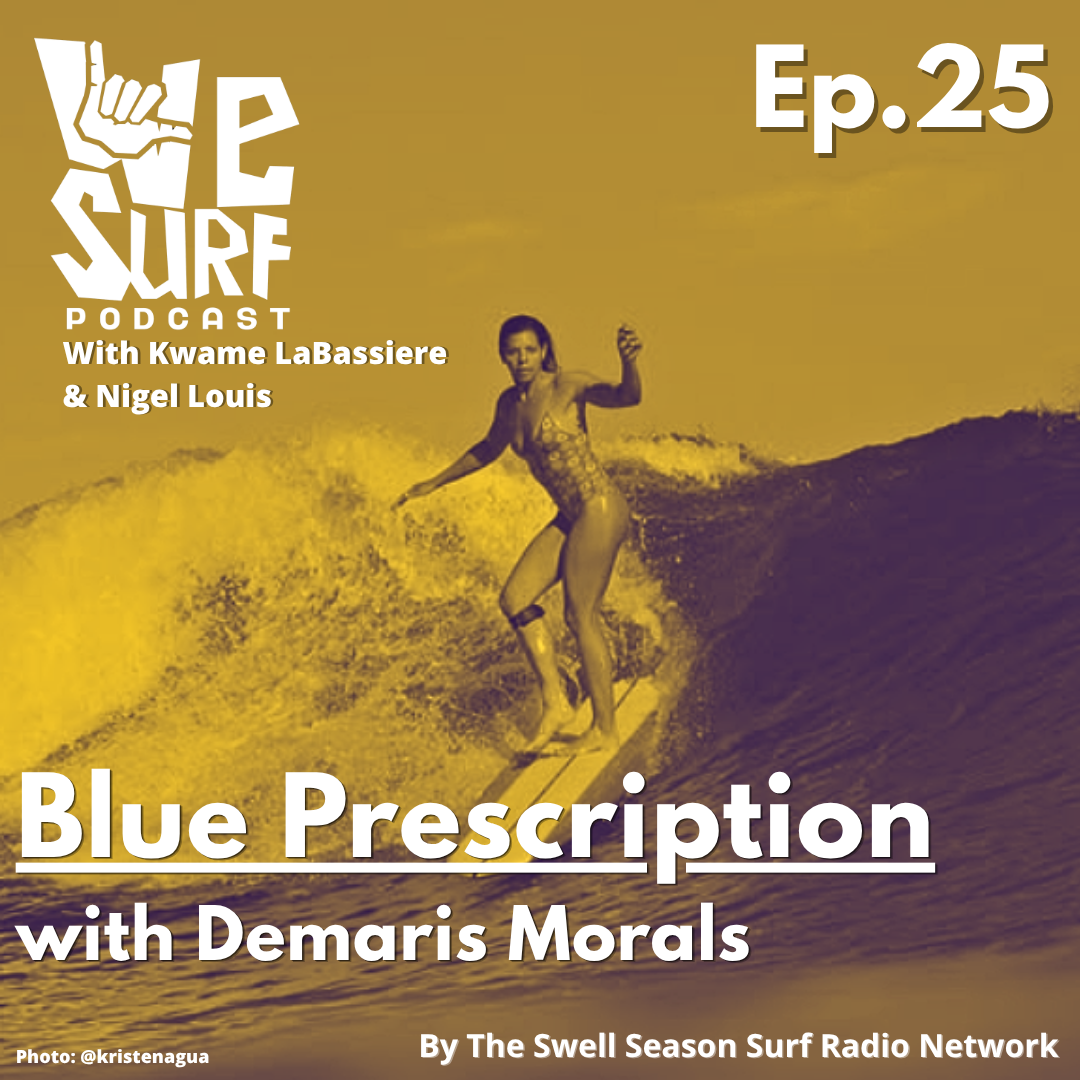
WeSurf Demaris Morales
[00:00:00]
kwame: Hello, ladies and gentlemen, and welcome back to another episode of the We Surf podcast, brought to you by We Surf Media and distributed by the Swell Season Surf Radio. [00:01:00] This is a space where we explore surfing, not just as a sport, but also as medicine, as research, and as a ritual, and as a way of remembering how to be in our bodies.
Today's conversation sits right at the intersection of science and saltwater. Our guest today is Damaris Moraves, a surf health researcher, PhD candidate, and advocate working to understand surfing as legitimate public health intervention. Her work looks at what happens in the body and the mind when people surf, heart rate, intensity, mental wellbeing, but also what happens when access to water becomes part of the care.
Damaris is helping to push surf out- surfing out of the margins of lifestyle into conversations about prevention, healing, and equity. From blue prescribing to surf therapy programs, her research asks a powerful question: what if the ocean wasn't just for recreation, but also part of the prescription?
This episode is for surfers, clinicians, [00:02:00] researchers, therapists, and anyone who's ever felt different after having some time in the water and wondered why. So let's paddle into it, and let me welcome you, Damaris. Welcome, and thank you for joining us.
Demaris: Thank you, Kwame, for creating this, this space to discuss something that I think and, and feel is so important, um, not just in, in one community, but across the world and, and we're seeing that, no?
kwame: Yes, definitely. Uh, so just for our viewers and listeners, um, I'm gonna give them a little bit of a background. I met Damaris at a surf conference in a place normally that you would not think about or doesn't come first to your mind when you think about surf. We met in Scotland. In Edinburgh, to be exact, at a surf conference, sitting down in...
I wouldn't- it wasn't a classroom. It was a conference room or a, a presentation hall. And that's where we met first. And she gave this amazing [00:03:00] presentation on the topic that we're gonna talk about today, and I will place all the links in the show notes to, um, to her work. And, um, we're gonna- let's just jump straight into it.
So Damaris, can you share with our listeners how you first connected with surfing and what it means to you personally before we get into your research? Uh,
Demaris: yes, yes, of course. Um, so I mean, surprisingly, I- when I grew up, I was never really into surfing. Um, I- my first boyfriend was a surfer, and I generally, I just could never understand why after an argument, he would say to me, "I need to go surfing.
It just makes me feel better." I didn't get it. I just wanted to stay there and then talk about it. Um, I went off to study in the States and, and didn't really come back to live in Dominican Republic for about 15 years. Um, and then fast-forward during the pandemic, I moved from the States to Switzerland.
And [00:04:00] at the time, I owned my own business, which actually allowed me to work remote. And I mean, we all remember those lockdown times, right? There was just, like, no interaction with other people. Mm-hmm. And I was, I was just in a really low point in my life, so I decided to, to push the brakes on, on Switzerland and come back home for just a month.
Um, that's when I started surfing every day. Um, between meetings, I actually found myself in a parking lot in my bathing suit at 8:00 a.m., uh, just making up an excuse- ... as to why my camera was off. And and that's really when it hit me, like, what am I doing? You know, I just want to be out in the water. I wanna be surfing regardless of rain, too sunny, windy.
I think that's when I felt it. You know, th- that thing that I didn't understand before, um, it just... I just felt it. Um, so all in all, [00:05:00] Kwame, it was just giving me back so much what I... so much of what I felt I had lost. Um, I felt closer to myself. I felt closer to my family. Um, I felt closer to my brother who passed away in our late teenage years.
I, I felt closer to home all in all. Um, and at the same time, to be honest, I felt away from that chase, you know, the hunt, that, that, that hustle, that, that, that corporate world in a day-to-day- Mm-hmm ... um, had me in, and, and also felt away from the need for more. Um, life just all of a sudden became a little more simple.
Um, so that was that. I, I decided to stay home for good. Um, I never went back to Switzerland and, and that's really when I think my connection with surfing began.
kwame: Nice. Epic. Uh, it's funny you mentioned the- I think we've all, all surfers... Uh, no, let me rephrase that. All s- people who were [00:06:00] surfers during the pandemic experienced something similar to that- Oh my God
where we were in the parking lot either in a wetsuit or a bathing suit, and we're supposed to be on a call- Oh my God ... or in a meeting, and we're trying to fi- and we have the camera off and yeah, I remember one time I was literally sitting down in the... I mean, I'm, I don't work at that job anymore, so I can say this.
I was literally sitting down in the parking lot, and I took a call, and my boss at the time says, "Well, Kwame, why don't you turn your camera on?" So like, "Okay, sure." So, you know, I pulled my hair back really quickly, tied it up, and I'm sitting down in the car, and he says to me, "Why are you in your car?" So I said to him, "Oh, it's, it's, it's our tu- it's our time to go get groceries."
'Cause remember you had to, in the US you had to get groceries at a certain time. Oh, yes. That's true. So I said, "Oh, I'm sitting down in the parking lot." And as we're talking, somebody comes to my window and taps on the window and says, "Kwame, what are you doing? Let's go."
I was, and I'm, and I just turned my camera and I looked at him, I'm like, [00:07:00] "Dude, stop. I'm on a call. Stop it. I'm in a meeting." Yes. Yes. But no, surfing definitely, like you, surfing, I don't wanna say it saved my life because, you know, there were a lot of other things that, and, you know, having people, loved ones and family around me at the time helped.
Um, but it, surfing definitely assisted and helped keep me sane during that time. Yes. Um, like, like many, like many other people, you know. Um, so what inspired you to pursue research in surfing then after you realized that, hey, I want to, this, this is helping me out. H- what helps you, what made you inspire, inspired you to, to research in surfing?
Um,
Demaris: and I, I will try to keep this one short, but the- there's so much synchronicity that came together to, for me to be where I am right now looking at something that I'm actually passionate about. Um, I think you're familiar with Cabarete. I, I think we discussed this in, in Scotland. Um, for li- Yeah ... for the [00:08:00] listeners, uh, Cabarete's a surf town in the north coast, um, where for years many people from across the world travel there to, to kitesurf and windsurf.
Now more and more people are coming down here to surf. Um, it's actually been called the wind and surf city. Um, it's about 45 minutes away from my actual hometown. Um, it's a hometown, it's a town called Puerto Plata, where there's almost no surf culture, I would say, or very, very little, but there are lots of waves to surf.
Um, as soon as I felt more confident in my surf, I, I started surfing here right at home Um, in a, in a point break by the port, um, which is where I met this, this wonderful group of kids who had already been surfing there for a couple of years. Um, they, they actually started surfing, and I told this story during my presentation because I still- I'm still fascinated by it.
Um, they started surfing with broken [00:09:00] fridge doors that floated down the river, and they, they were interested in learning English, so I started teaching them English every Monday evening. Um, we started with three kids, and at the end we were a larger group of about 16 to 17 kids. Um, in class, the interesting thing was that we had those kids who surfed and those kids who didn't surf.
They hadn't been in the ocean before. Um, both of the- Mm-hmm ... both of- both groups had aspirations, dreams, you know, um, but there was always that visible distance of how far the- those dreams reached, you know? The kids who surfed, they, they spoke- Mm-hmm ... about their future with a different kind of confidence.
Um, you could hear in the way they described what they wanted for themselves, how much they wanted to give back to the community. That was always something really interesting to me. Mm-hmm. Um, I won't share their personal [00:10:00] stories, but, uh, you could just- Uh-huh ... tell how, how much more those who surfed wanted and how far they saw themselves going.
Um, and honestly, it was them who told me they wanted their friends to get in the water and get outside the, the hood, you know, um, where every single day they're exposed to drugs, prostitution, you know, that cycle that keeps generations and generations in that same loop. Um- Mm-hmm ... I would say, Kwame, that their, their potential was my biggest inspiration.
Um, I started- Mm ... looking up ocean therapy, that term, um, where I bumped into- Mm-hmm ... into the work of, uh, Dr. Wallace J. Nichols. Uh, his book Blew Mind, actually blew my mind, honestly. I- I bumped into the International Surf Therapy Organization and, and later, uh, the works of Dr. Jamie Marshall. Big, big inspiration as well.
The [00:11:00] interesting thing is that all of that put a lot of sense into my own feelings. It was kind of like a mirror, you know? Um, I knew I was- I wanted to do something, to build something in my hometown. I really wanted it to be replicable and measurable from the beginning. Um, it couldn't just be something, you know, beautiful.
I wanted it to, like, stand and, and be sustainable. Um, in the midst of it all- Uh, life put in front of me a beautiful human, my mentor, Ernesto, whom I met, um, at my best friend's wedding in Spain. He was her former boss when her and I met while living in Washington, DC. The odds. When I say synchronicities, this is what I mean.
Um- When I told him about this project I had in mind, he said one thing to me. "If you're gonna do this, um, you can't do it halfway. You have to, you have to just go 100%." And what he pretty much meant is you [00:12:00] can't do both things, like keep your company and start this, this project. Um, and- Right ... and that's where it all began.
We, we met at a coffee shop in Madrid. He came in with a couple of pages printed out where he had laid out a, a path. He did a lot of research around Jamie's work and, and Isto, actually. And he just showed up with all these pages. And Jamie, at the time, had recently completed the first PhD in surf therapy.
So yes, the kids, the kids inspired me, and Ernesto gave me the confidence to do everything that I, that I did in the last two, two years.
kwame: Yeah. There's so many takeaways from what you just said. Um, I mean, I think the first one is, uh, uh, the Blue Mind by, by Jay Nichols, by Dr. Jay Nichols. Um, and I think you said it so perfectly, blue mind will blow your mind.
Oh my God. So when you, when you read it, I, I swear by that book. I, I tell anyone and everyone. You don't even have to [00:13:00] be into surf therapy or think that way. Just, just pick it up and read it. And it's such an amazing book. And then, you know, again, um, let's, let's, let's give him his, let's give him his full title, Dr.
Jamie Marshall, who as we all know as we know him, Jamie. Dr. Jamie Marshall, yes. Yeah. Well, as we know him, Jamie. Again, amazing individual. Um, I had a conversation with him,
Demaris: mm,
kwame: like two, three days ago. He and I were talking about some, about something, about some stuff. And every time I speak to Jamie, no matter what we're talking about, I'm just always, like, amazed at just what he brings to the conversation.
Yes. And, you know, again, the third thing that brings to mind, because I know there are people out there who are interested in doing their own research and doing their own projects, but I think you said it very succinctly that, and what your mentor said, that, you know, you're either all in or you're not. If you truly believe in this and you truly wanna get the work done, then you, you can't, you [00:14:00] know...
I mean, I guess you can, but you'll be very distracted in getting your s- your, your work done or getting the research done and getting it out there if you are trying to divide yourself into like, you know, 15 different places- Right ... that way. So yeah, I think a lot of people need to take that lesson, um, from that, 'cause I know there are a lot of people who speak about research that they wanna get done.
And my, my response to them is pretty much similar to yours. Like, okay, well, you realize you're gonna have to make some sacrifices. With this
Demaris: I mean
kwame: So, um, so we've spoken, uh, we've spoken a little bit about your, about your research and, but we haven't mentioned exactly what the research is just yet.
Mm-hmm. So can you give us an idea or can you... I'm not asking you to give the whole presentation, even though it was an amazing presentation. I'm always telling people that find the links for this 'cause it was an amazing presentation. But can you give us an idea of what exactly your research is? We'll go into what you found a little bit later on, but let's give us an idea of what your research
Demaris: is.
Mm-hmm. Um, so what [00:15:00] we looked at during, uh, my, my research project- ... where Jamie was a, a big part of, uh, as well as Dr. Brendan Ferrier, who will be part of, uh, a longer term project, which we'll, we will discuss. Um, we looked at the energy exertion. There's something that physical activities are measured by, and it's called METs, um, metabolic expenditure of task.
And what that tells us is how much your body is actually doing, how much energy is costing that activity and to your body, right? Mm-hmm. Um, so we looked at that part. We wanted to, to see where it fell, um, within the MET classification. Um, anything from one to three METs is, one to 2.9 METs to be more accurate, it falls under light exercise.
Anything from- Huh ... three to 5.9 METs falls under moderate exercise, and [00:16:00] anything above six falls under vigorous exercise, vigorous physica- physical activity. So one really interesting thing we saw was that surfing fell under moderate physical activity right alongside, um, brisk walking, for example, or, or gardening, which we've, we've...
I talked about during my presentation, where anybody who surfed before, you know that, that your body is doing way more than it is doing when whilst it's gardening, right? So, um- Mm-hmm ... that was the first question. What is the energy expenditure, um, in surfing? And then the second research question we asked is, uh, well, what is the perceived exertion?
How do people feel whilst they're surfing? How much energy do they think they're, they're spending while in the water? Um, so we, we did the experiment in a controlled wave pool in, in North Shore, and we looked at, um, different, different scenarios. We, we wanted to [00:17:00] map, like a, create a map of what happens to the heart rate while measuring as well oxygen uptake in a lab using a SkiErg- Um, it's the closest that comes to activating similar muscles, um, while we're paddling.
Um, so when we looked at- Mm-hmm ... oxygen uptake, heart rate, um, and we kind of calibrated what that would mean inside the water. We then did a surf session, um, measuring people- participants' heart rate, um, and we used a GPS to track the activity so we could understand when the surfer was, um, on the wave, paddling, and waiting for the wave.
Those were three different phases of- Mm ... of surfing we looked at. Um, so when we mapped out, um, lab activity and then mapped out surfing activity, we could then pull out how much energy expenditure actually, um, was spent during the surf [00:18:00] session. And with that, we were able to identify the amount of Mets per activity, meaning per if, if you were paddling, uh, the Met value was around 9.2 Mets.
Um, if you were- Mm-hmm ... riding the wave, it was about 9.1 Mets, and while people were waiting for the wave, it was, um, 7.6. And one of the most interesting things about the research, and I know I'm tapping into the findings already, is that, um, while people were going back, this will happen in a wave pool, right?
Because you have a certain amount of time for the next wave to come. Um, and that differs- Right ... in the ocean where you have way more variabilities. Um, so when you, you're waiting for the wave, you paddle, you take on, you're paddling back, and that time is not enough for your heart rate to [00:19:00] go into recovery phase is what we found.
Um- Mm-hmm ... so the overall Met value of a surf session came out to be 8.5 Mets, which is quite vigorous, right? Um, if we, if we think about where we saw surfing classified in the Compendium of Physical Activities, which is the place where researchers go to to s- research, clinicians, um, people in funding and sports, they go to this compendium to look at where each activity falls to then be able to either prescribe it- Mm-hmm
or, or just to see, you know, where, where's running? What does, what is running, running's energy expenditure? And to see that surfing is today listed as a moderate physical activity, you know, it's, it's kind of like when we think about that, the potential of where surfing actually is, and the potential for it to become, um, a preventive medicine, you know, a tool that could be placed in healthcare systems.
So, [00:20:00] uh, that was the research, um, and a little bit of the findings as well.
kwame: That is, I mean- It's, uh, I find that so interesting because again, as surfers, we know how we feel afterwards, after a good session. And, you know, it, it doesn't even have to be a, it doesn't have to be a pumping session. It doesn't have to be anything where we're, you know, just back to back to back to back to back waves.
But I can almost guarantee that after a session, you know, the first thing you wanna do is eat. Because you wanna replenish anything and everything that you just lost while you're out there. And then, and you know that you, you can fee- sometimes you can feel your heart just, like, beating and, and you're just ready to go.
And now you mentioned during your presentation in comparison, um, the number that came up in, in comparison to what the WHO- Mm-hmm ... had for the minimal, or minimal amount of, um, exercise you should get. Can you speak a little bit [00:21:00] about that?
Demaris: Yes. So in, in, uh, the, the World Health Organization, their physical activity guidelines recommend, um, either 75 minutes of vigorous activity or 150 minutes of- Mm-hmm
moderate physical activity per week for adults.
kwame: Uh-huh.
Demaris: Um, and that is based on research. So one of the ways- Mm ... that we could, I don't wanna call it fast track, but one of the ways we could get surfing, because there is a lot of research around mental health and all the benefits, and Jamie did a lot of that work, and many other researchers around the world have touched upon the mental health, uh, parts of surfing.
However, the physical activity part of it is something that there's a lot of room for growth and room for exploring. And, um, when we see that and we look at the findings we have, this is definitely, uh, the beginning of that type of research. We, we plan on doing way more [00:22:00] in it. Um, but when we see that it falls into vigorous physical activity, if you're out there for an hour, you're already covering about 80% of the recommended WHO, uh, guidelines.
And that is just- Mm ... in, in one day, one session. Um, if you're in the ocean, you, you know this, especially in warm water. Uh, I mean, cold water, there are a lot of- Mm-hmm ... surfers who will be there for about two hours because of that stoke, right? But, um, there's some surfers who are out there for three hours.
And, uh, I mean, it's, it's massive. Right. Um, one of the things, and if we're tapping already into the findings, that really surprised me, um, was how much time participants spent above their 85% of their maximum heart rate. Um, 40% of the session was spent above 80% of maximum heart rate- Mm ... which is high intensity cardiovascular effort.
[00:23:00] You know, it's- Yeah ... you're just out there and- To think that we did this with recreational surfing in a controlled wave pool, I mean, no competition at all, um, it's, it's still very, you know, surprising. So that the idea that surfing is a moderate activity just doesn't match the data at all, let alone- Yes
you know, um, what we, what we now know. So, so yeah.
kwame: So anyone who's ever, um, worn like a smartwatch or whatever when they're surfing, I remember one, um, time I was, I was speaking with some individuals, and they were, they were beta t- they were beta testing a new app, and they said, "Oh, yeah, you need to wear your smartwatch while you're surfing."
And I said to them, "I wish I could, but I can't." And they're like, "Why not?" I said, "Because my watch cannot keep up with me." And I didn't mean that as a, "Oh, yeah, look at me go," type of deal. But it's like by the time I get out there, and I start paddling, and I hit the button to say, "Okay, record how many calories I am burning, record how much [00:24:00] energy I'm using," after about two to two and a half hours, the battery goes dead.
Mm. So I literally said to them, "I cannot use this particular brand of watch to, to record anything because the watch cannot keep up with me." Right. Um, so, so I began to use a solar-powered one, used that, and then I gave them back some of the findings that I found, and I said, "Okay, well, for in a s- in a, in a regular session," and by regular session I mean, you know, you paddle out and, you know, it's a good session, so you're out there for about two and a half, maybe three hours.
You know, half t- not tide to tide, but mid-tide to whatever the tide is. And I said, "Roughly about 2,000, 2,100 calories." Wow. And they didn't believe me. And they said that, "No, this, this, this, this can't be right. It's, your watch is flawed." I said, "Well, give me another one, and I'll, I'll prove it to you, and we'll do it again."
Right. And, you know, we did it three separate times, and then they were like, "Oh, okay, we believe you now. We see what you're saying." Right. [00:25:00] Um, but surfers, we understand that, and, and I think the general populace, part of the cons- part of the disbelief comes from the t- that comes from the general populace is that, one, surfers has al- have always had the reputation of being slackers.
So, you know. Yes. You know, we, we would much rather go surf than work. It's true. Yes, we would rather go surf than work, but it's because it makes us feel good. Right. But not just that, but then you... And so many times, I also work with students, and I teach students and so on. And so many times they say, "Oh, you guys make it look so easy."
So in their minds, there's really not that much hard work- Mm ... that goes into it. It's just, you know, you, you're just little on the little foam toy. You see something coming. You turn your back. You start, you know, a little paddling, and you just jump to your feet, and then you ride. Right. That's it. That's all you do.
Then you turn around, you do it again. So it's, it's, it's easy. So they see, you know, accomplished surfers doing that. By accomplished surfer, I mean anyone who's been surfing [00:26:00] for more than a year. You know, they can relatively make things look easy. So the general populace sees that and goes, "Oh," you know, "How hard..."
'Cause we've all heard it, "How hard can it be?" Right. It's not that hard. Right. And they don't see j- how much work and energy goes into just doing that. Right. Um, and 'cause I- I've spoken with a lot of people and done a little bit of research and, um, given some talks on this, that part of the... When a surfer is on their board and standing on their board, there is a lot going on.
Right. But the better the surfer is, the less it looks like anything is happening. Mm. They just looks like they're just standing there. Meanwhile, their feet are moving, you know, they're trying to keep their balance with their toes, their core is engaged, their eyes are flying, like, down the line. They're looking for anything that's in the way.
They're trying to judge what's happening with the wave. They're trying not to the same time... The, the wave is changing, so they are making micro adjustments- Mm. -to their muscles. Right. Like which muscles are working, [00:27:00] slow twitch muscles are working, and that's just physically in their body. Then the mental piece of it that's coming into play- Mm-hmm.
Mm-hmm. -is also, "Oh my God, I'm supposed to be having fun. So this is fun. So let me relax." Right. Right. "While all this is going on." So yeah, it is, it is... When you said it during the, during the pre- presentation, I almost stood up and cheered. I was like, "Yes. Yes. Finally, it's there." Someone else, the, the research- I mean-
is there. It's not just me talking. Yeah. Right.
Demaris: I'm not making this up, huh? But, um, just to elaborate on that, I mean, it, micro movement is so important and, and m- in, in our study, we, we didn't- we looked at the physiology part, not the mental health outcome directly, but when- ... when we saw that combination of vigorous cardiovascular load with blue space exposure, with that social connection, you know, you're stacking multiple protective factors at once, right?
Um, and I think that's what makes surfing different from other physical activities, no? Like [00:28:00] when we measured our second question, we measured perceived exertion. Now you're talking about how it actually makes you feel, right? Um, which it, it came out- Uh-huh ... to be way lower than objective measurement. It actually came out to be a moderate physical activity.
It's, it's what's perceived. It's essentially your body's working harder than you think. Um, but surfers- Yeah ... perceiving that, um, the assumption we, we made is that the enjoyment just has a lot to do with it. Um, unlike other- Yes ... a- physical activities, surfing is intermittent. Intermittent, right? So you're reading the wave.
Mm-hmm. You're... What you said, perfectly said, you're adjusting position, you're anticipating so that your mind is, your attention is outside of you. You're not really thinking about how- Mm-hmm ... hard it feels. You're thinking about whether you're going to make that section, right? So it's interesting- Yes, yes
because I think that's really, really powerful, if not the most powerful thing in, in my research. [00:29:00] Um, because it's- If something is good for you and it doesn't feel like you're suffering, you come back to it, right? And, and it's- Absolutely ... just really interesting because your friends will ask you, "How hard was it, was that se- section, eh, session?"
Yeah. And you're like, "It was just fun."
kwame: Yeah. So ... Yeah. And th- and that, that actually is a really good point because I've d- I've said that, and I know lots of people who say it as well. They're like, when they say, "Oh, how, h- you know, how hard is it to surf?" Uh, not, it's
Demaris: not
kwame: that hard, you know?
Demaris: Right. That's our feedback.
kwame: It's not that hard. Yeah, it's not that bad, you know? 'Cause in your mind you're thinking about the joy that you receive- Exactly ... from this, not the, "Oh my God, my back, my back. Oh, it's 25 degrees outside, I need to go put on a 6/5 wetsuit and squeeze into this thing." Right. And, ugh. No, all you're thinking about is, "Oh my God, that was such a good session.
I'm happy now."
Demaris: Yes.
kwame: It sounds great. Um, can you tell us a little bit about the different phases of the project, from, so the [00:30:00] controlled wave pools, um, I mean, you mentioned, um, the natural ocean as well, and I mean, we understand why, of course, you are doing a controlled environment because all the, all the, um, you want all the parameters to be exactly the same.
But you also mentioned about, not just about the outside parameters, but also the individuals that you got to- Mm-hmm ... surf, to take part in this, in this, in this, uh, project. Can you speak a little bit about them? 'Cause I would imagine you wouldn't just grab anybody just off the street and say, "Hey, can you surf?
Okay, come with me."
Demaris: Yeah. No. Okay. So that, that's really, that was really key in, in us selecting, you know, participants. Um, when, when I first started getting into research, it's not my background at all, I really didn't understand all, all that it takes to put a study together, and how, how much almost precision you need in order for, in order to reduce error, I would [00:31:00] say.
Um, not even to be- Yeah ... exact or 100% accurate. I, my research is definitely a hun- not 100% accurate at all, but you want to just reduce the limitations and reduce the errors to be as accurate as you can get. Um, so with the project, we, we worked with recreational surfers, and we selected participants in, in a little bit of a, an, not an easier way, but a way we could segment, um, the experience of that surfer.
We said recreational because there is no study around recreational surfing itself. There's a lot around elite surfers- Okay ... and competition. Um, so we wanted to really look at- Okay ... you know, your, the, the bigger, the bigger crowd of surfers, especially nowadays, it's just a growing, growing s- physical activity.
Um, and we asked participants to be those who worked at the surf pool and have been surfing for at [00:32:00] least six months Sorry, six months. Um, that gave us the confidence- Mm-hmm ... that they, they were safe in the water, right? We used, um, a wave setting, uh, called maneuvers. In other wave pools, I know- Mm-hmm ... this is called different waves.
Um, and that just means that the wave is about shoulder, shoulder to head high. I believe shoulder-high, right? And- Yep ... it has that level of difficulty. It remains the same. It's the same consistency in a wave pool. So we just wanted to make sure we ha- we were removing all those variabilities that you see in the ocean.
Um, we looked at 11 to 12 participants. We had one drop out. Um, so the idea is to extend this research into a bigger, um, participant base and into a bigger crowd. We want to start including beginners. So when I say we, I mean I'll be working this next project. This is k- a little bit of what follows after the findings [00:33:00] we just discussed.
Um, I'll be working the project with Dr. Jamie, Dr. Jamie Marshall and Dr. Fa- Brendan Ferrier, um, both lead researchers at the Surf Lab in Scotland. The Surf Lab is a pioneering research partnership between Lost Shore Wave Pool and Edinburgh Napier University, where this bigger project turns into a PhD, and that's where it'll, it will be taking place.
Um, so the project is structured in three different studies, um, that build on each other. So it's a little bit of an extension of what we saw of the initial research, um, that has been done and we have the findings, you know? So this is gonna extend on that. We're gonna be looking at both the wave pool and the ocean, um, what happens whilst you're paddling, wave riding, and recovering, which means waiting for a wave.
Um, the [00:34:00] idea is to still dig deeper into what is that intensity and energy cost compared with other recognized physical activities. Um, and then there's a secondary study that actually delivers a surfing structured program. We wanna track, uh, outcomes like physical activity, um, mood, stress, resilience, uh, while also assessing cost effectiveness to show what it actually takes to deliver and what value it provides.
You know? And then there's a third phase to that, uh, project, which is, uh, a study that translate these findings into- Practical tools for policy where we're going to be including, you know, policy briefs, commissioning, uh, guidelines and toolkits for clinicians and other practitioners. Uh, we want to provide surf schools and wave pools, uh, models and, and guidelines so that they can [00:35:00] operate as recognized wellbeing hubs.
And, and then all together, you know, create a complete case for surfing within, uh, this growing surfing, uh, blue health prescribing. Um- Mm-hmm ... so this all the idea is to open up a prevention pathway for health systems, especially, you know, nowadays we're facing rising costs of physical inactivity, and there is definitely a pandemic of mental health.
We're seeing a lot more anxiety, depression, perhaps disconnection amongst, uh, the youth. Um, so the idea is to provide the government with a scalable model linking sports, wellbeing, and prevention targets if, if I should say.
kwame: Right. No, that's-- I, I mean, listening to you speak, I look forward to the day [00:36:00] when my doctor says to me, "Yeah, you know, I'm just gonna write you a prescription for you to go surf."
So I'm say, "Okay, great. I will take it." I'd actually call into work and say, "Hey, look, I would love to come in today." And this is not an excuse you trying to give, but I really believe because again, and you know, we know this and the majority of our listeners who are surfers know this as well. But to our listeners, if you don't have, if you have someone in your life who doesn't surf, then, you know, try your best to explain to them what surfing can do for you.
Um, you know, it's, it's, it's like you started off the conversation with when you said, you know, your boyfriend or your ex-boyfriend, excuse me, would say, "Oh, I need to, I need to go surf." And you're like, "Well, I'm trying to discuss this, and you're telling me you need to go somewhere." Right. Like, you need to go surf.
You know, it's, it really does. I can't speak for everyone, but I know the, the, the research has been there and it's also been stated in, in Blue Mind, um, that the ocean does help you do a [00:37:00] reset, whether not just mentally, but then also physically you do a check-in. For sure. Also, like when you're, when it's not just laying on a, on a, I mean, laying on a surfboard helps, but then additionally, like when you walk into the water, you, you ca- 'cause at that point you're almost weightless, so you really cannot help but to do a physical check-in on yourself and say, "Okay, what exactly hurts?
Does everything hurt? Does nothing hurt? Where's my brain? What's happening here with me?" Right. Um, so it, so it does, it does, it definitely does help out a lot. And I think this research and the projects that you guys are working on, I can't wait to- To get further and further into this because, I mean, I am a surf geek.
I'm a really big surfer. I, I love this kind of stuff. Uh,
Demaris: yeah, just to, you know, be able to, to work with, with people like Brendan and, and Jamie, you know, who have spent years looking at surfing. And, and honestly, for ISTO, for example, for all the, the surf programs [00:38:00] out there who are already working, um, so hard and creating so much impact and just not being recognized in that equation of, like, WHO, the WHO's, um, prevention strategy.
There's so mu- so many communities nowadays just, like, tapping into that, um, strategy- Mm-hmm ... you know, helping those numbers, and they're just not being recognized. So all in all, you know, the, the ultimate- Yeah ... goal and objective of, of everything that this project entails is to create that evidence, you know, build frameworks that allows those health systems to prescribe, as you said, hopefully one day.
Fund, um, which is really, really important to keep all these programs afloat, and to deliver surfing as a safe and measurable public health intervention. Yeah. So, um, that's, that's the north. That's where we're heading. Yeah.
kwame: And that's the thing. It's not like, you know, I mean, we are the... What, what is it? Um, Earth is covered [00:39:00] by 70% water- Right
72% water. So it's there. It's accessible, you know. It's available for individuals. I mean, yes, there are people who, uh, who live inland and have, uh, um, issues getting out to the coast- Mm ... wherever they live. Uh, but it can happen. It can make, it can make this work. Once the policies have been set, it, it can, it can definitely happen and we can make this work.
Um, I would like to ask you, what is in y- within, in your research, and I imagine you probably may, may have come across some of this, what's one myth about surfing and health-
Demaris: Mm ... that you would
kwame: love to just say, "Why do, why is this out there? I would just love to debunk this and just rip the paper and say, 'Look, I have the proof here.
Here it is.'" What's one myth that you've come across?
Demaris: You know, that's a, that's a v- very interesting question because I, I also... When I, when I try to understand the feelings, and I think [00:40:00] this, this just comes across in, in many other areas, when, when you're passionate about something and you try to explain it and describe it, it's really hard.
And, and I think those who don't surf or has, have never gave, been in the water surfing, there's just no words. You can try all you can. Mm. You can tell the story. You can- You know, get personal with it, get mystical with it even, and it's something that's going to be really, really hard to explain in words what that experience feels like.
So I think that all in all, there's a myth around surfing, that surfing is, you know, you said it at the beginning, you know, like in, in Dominican Republic, and I'll, and I'll speak on behalf of just, like my experience and what I lived here. Dating a, a surfer at a younger age, you know, my parents were always just like, "Surfing is just for lazy people, beach bums," you know?
And, "There's no future in that," and- ... "You're going nowhere [00:41:00] with that." So all in all, it's just coming all together because... And the other day, I mean, he's someone I, I deeply admire, and he is a physical activity trainer in, in Canada, though. Um, but I did reach out to him and I was like, "You wouldn't believe the work I'm doing today," you know?
I get it. I understand, years later. Maybe, um, 15 years later, you know? Um, so it's really hard to define a myth. Um, my parents, they... Probably the community itself. That's why surfing is not that big in, in my hometown. Um, they- it's always thought that surfers are lazy. I mean, we mentioned this in the beginning, that there's no future there- Mm-hmm
that surfers aren't working or studying, and- Mm-hmm ... there's a lot to debunk there. Um, but one thing that for me is just a recent experience, um, in Dominican Republic, in the island, there's a lot of fear around the [00:42:00] ocean. Many people drown because there's- Mm-hmm ... limited access to, um, safety education, um, lifeguard programs.
There's, there's very little of, of that here. Um, also access to swimming classes. There's very little to the regular, to, you know, the general population or, or community. Um, and, and there's also this generational trauma around the dangers of the sea. Um, when I started- Mm ... surfing at the port- Yes ... there were two little girls, uh, around 9 and 11, who used to go to work with their mom.
Um, her mom was in charge of, like, the public bathrooms around that area, and they would just stand there ev- anytime I arrived in my car with my board on the top of the car. They would just stare at the re- my, I have a red board. They would just stare at the board and just kind of like so curious. [00:43:00] So one day I was like, "I'm gonna ha- I'm gonna ask their mom."
So I asked their mom, "Can I take the girls surfing one day?" And she was delighted at the time when I asked her. She said yes. Uh, the, the girls were super excited about it. We set up a time, a day. We exchanged contact and- And she went back home and I guess asked the girl's grandmother, who said absolutely no.
It, it's not gonna happen. Uh, the ocean's dep- is dangerous- Yeah ... and they can drown. You know, you could tell that there was some trauma around there or, you know- Yeah ... like a cousin or someone they knew had drowned. Um, so I ended up going to their house. Uh, I sat down with the grandma, and we had coffee. Uh, we talked about the ocean and I kind of explained everything.
We talked about safety. I told her I would take care of the girls, which also was a lot of [00:44:00] responsibility, you know, but I was just sure we were going to, to a safe place. Um, and we went out there. Their mom came. Uh, both girls stood up on the third wave. Uh, I cannot explain in words their faces. It was just, you know, the best.
Um, so all in all, that is what I want for all. You know, the access, the, the option and the opportunity for them to decide whether that's something that they want to, um... If, if it's something they want for themselves, you know? Um, I don't think this is a myth. I mean, there's already evidence that shows how regular physical activity can prevent, uh, or reduce so many diseases.
I mean, there's already- Yeah ... a lot of evidence that shows that regular physical activity can prevent or reduce so many different diseases, like obesity, high blood pressure, you know, some cardiovascular
kwame: diseases.
Demaris: [00:45:00] Mm-hmm. Um, so I think- Yep ... all in all, surfing offers- Yeah ... a lot of potential and, um, debunking these little, not little to many people, but these myth around each community.
I think it's gonna be very independent and individual of each country. Each, um, community, they'll have their own myths. So, you know, it's, it's a step by step, and I think evidence is one way to start.
kwame: Yes. Perfect. Very well said. Very, very well said. Mm-hmm. Um, so we have two more sections that I'd like to just breeze through really quickly. First one is a fast fire questions. So are you a longboard or a shortboard? You know, when you start surfing,
Demaris: uh, there's always this, this idea that you want to ride that shorter board, right?
Um, so-
kwame: Yep ...
Demaris: I had that little-
kwame: Mm-hmm ...
Demaris: [00:46:00] competitive, uh, with myself- Absolutely ... type of vibe at the beginning. Up until- ... surfing really, really clicked for me, I was like, "Wait a minute."
kwame: Mm-hmm.
Demaris: Um, if I take the longboard out, I'm taking more waves. I'm on the wave for longer. My arms don't hurt that much- Yeah
which means I could be in the water for a longer time. What am I doing in a short board? So, I love longboarding. I love it. It's, it's, it's more feel for me than, than- Yeah ... that rapid hustle from the short board. But, um, two days ago I was on my short board, so, uh, I- it depends on, on the wave, it depends on the day.
Um- Mm ... but longboarding is- No, I hear that ... I, I would, I would call myself- Yes ... a longboarder.
kwame: Depends on how you feel. It really depends on how you feel. So, like for example, you know, as we were talking before we hit record and I said- Oh ... you know, we're getting ready to have potentially two feet of snow in New [00:47:00] York.
But we were out surfing yesterday- Wow ... and I was wearing, I think I was wearing my 6'5", my 6'5" wetsuit. And I had, I brought a- Mm ... um, fish and a longboard down, and I was on the fish for about maybe 10 minutes, and then I brought it back to shore and I brought the longboard out. Not because the waves were different, but just because on the fish I was sitting so deep in the water that I just kept freezing.
And I'm like, "You know what? No, I want a longboard so at least- The bat too, right? ... I can get some part of my body out of the water while I'm waiting for my wave." So, yeah. It, it, exactly. So it really depends on what... So I, I can absolutely respect that. Um, what is your favorite pre-surf meal and favorite post- Curious
Demaris: enough-
surf meal? ... I, I love surfing on an empty stomach. I'm, I'm that type of, uh, I'm
kwame: Everybody says that. Everybody. Sorry to cut you off, but everyone says [00:48:00] that. Um, I'm... Okay, we're gonna say everyone- I, yeah ... but nine times out of 10- No, I feel lighter ... that's the answer. People say, "Oh, no, I never eat before"-
Demaris: If I have anything before, I'm just like, I feel heavier in the water.
Yeah. And, and I can be there for hours on an empty stomach. I love it. I love
kwame: it. Ah, thank you. Yes. That, that's exactly it. And you know, they're also, again, speaking of research- Mm ... there's been, there's research that's done about fasted cardio and exercising and on a fasted, in a fasted state, and you actually have, not just burn more calories, but you're also clearer of mind.
You're not thinking to yourself- Yeah, yeah, yeah ... "Oh my God, my stomach is heavy," and so on. And also kind of like- And so, yeah, so I'm- Yeah ... right there with you on that one. You know- So- Mm-hmm.
No, I was just saying that I had a student one time who sh- who walked up and he was eating a bacon, egg, and cheese on a bagel. And I looked at him- ... and I just tilted my head and I'm like, "You [00:49:00] sure you wanna do this now? We can wait a couple hours." He's like, "No, I'm thinking about you should wait two hours before going in the water."
I was like, "No, that's not what I'm concerned about. I'm-" Okay, let's go. Mm. He lasted, I would say, about half an hour maybe. Adel, he was just like- Right ... "I feel so sick." I'm like, "I told you. Let's, let's, let's go back to shore." And- Right ... he just comes like- Right, right, right ... "I, I, I ate too much." Right.
Demaris: I mean, immediately after I leave the water with the salt water and with the s- you know, uh, I need, like, coconut water or- Mm-hmm
a banana or something, you know, filling. But immediate hunger- Yeah ... starts, ki- ki- kicks in. So, uh- Yes ... yeah.
kwame: Yeah.
Demaris: The second your
kwame: feet hit this, hit dry land and you're like, "I'm really hungry." You... I remember one time, um, a couple... It was late last year, before we went, before we met in Scotland. But, um, we were out surfing, and that day was a holiday and the waves were just good.
Wow. So I literally went [00:50:00] tide to tide, plus an hour. So I was in that water for almost- Oh my God ... just over, um, seven hours. And I got out, I'm like, "Okay, guys, I'll see you later." And I started walking back and I took, like, three steps onto the s- onto the sand, and that's when it just hit. I'm like, "Oh my God."
Right. "I am so hungry right now." Ran up, changed out of my wetsuit, and was like, "Okay, you know what?" But then I, but then the piece of that now is when you're that hungry, at least for me, you wanna, I wanna remember- Mm ... not to grab the closest thing that I have, 'cause chances are it will be something sugar loaded, you know, um-
donuts, 'cause there's always a Dunkin' Donuts somewhere. Um, or something that's, like, pure sugar. For sure. And then eat that, 'cause then that'll just make me feel worse in about two hours. So trying to find something that, you know, even, even if- Oh, yes ... 'cause it's [00:51:00] the first thing that you're putting into your mouth after a long period of time.
So, you know, you want something good. You know, after your stomach has started the digestion process- Right ... and so on, yeah, then go have a slice of pizza or burrito or something. But before that, you know, like, the first thing to do, to inhale, like, you know, you know, a, a, a, a, like, half a, half a s- half a New York slice- For sure
half a New York pie, pizza, whatever. So, um, no, that's, that's great. And finally, do you have any questions for me- Y- yes ... that you would like to- Yes,
Demaris: yes. Actually, actually, I would, I would love, um, to learn more about, you know, how do you see that development within ISTO? What, what are things that you, that excite you?
Um, the changes. Mm-hmm. Where do you see, you know, the, the organization going? And, and what's something that has, you know- called your attention in the last couple of years that a, a trend that you've seen in, in programs around the world? Uh, [00:52:00] that's a
kwame: great question. I, I mean, so I'm gonna start at the beginning.
Um, I mean, many people, and if you listen to the podcast you know how I started working with ISTO. Um, I was invited to come speak with, um, Dr. Elizabeth Bishop on a, on a, um, in, in, at, I think it was like three or four conferences ago. And then I spoke, and then Chris Promossio, who's the head of ISTO, she asked me to join.
I joined the board. But I've always said, and I said this to Chris at the time, that when I first walked into the room at, to, while they were giving, during the conference, I actually thought to myself, "Oh, okay. So as cheesy as it may sound, I'm actually home now," because these were academics who were sitting down and speaking about surfing.
And they, not just, uh, what the general populous thinks about, like, "Ah, dude- ... you know, I'm not even wearing shoes, but even my shoelaces are untied, bro. Ha ha ha." So these were people who are actually [00:53:00] sitting down and speaking about the research and the, um, the academia and the- Mm ... and breaking it down to basically a science for it.
So at that point I was like, "Oh, you know what? Might actually be people I can, I can hang with." Um, and what I've found recently... Well, I'll, I'll approach this from two, from two aspects. Globally, what I've found globally is that more and more people are starting to understand what we mean when we say or why we feel the need on a pole to go surf.
So it's not just a, "Oh, you just wanna go slack off," or, "You just wanna go play in the water." You know? There is this, the understanding by people who are not surfers, it's becoming more and more clear to them on a, on a, uh, on a global scale. And, um, on a more local scale, because I'm based out of New York, I think then because New York is not really the first [00:54:00] place you think of- Right
second, third, maybe even the fourth place you think of when you think of surfing. Um, and now what I'm seeing is more and more that actually is beginning to change, where it's not just people think about, people are starting to realize that, 'cause there are New Yorkers- Right ... who to this day I still get that question.
Like, "Where you, where do you surf? In the, in, in the Hudson River? Ha ha ha." So, but more and more, even native New Yorkers and people in the tri-state area are coming and say, "Oh, we, you can surf in New York?" Yeah. "Oh, I'm, I'm interested in this. How do I get involved in this?" But then we're at a point now where it's not just surfing that's coming up in New York, but also surf therapy and the physiology behind surfing.
So the two of them are rising really in tandem with each other. At least on the, at least what I found in the Northeast. So it's, we're at a very key point and pivotal point, and I'm actually really excited to see where it goes with the organizations [00:55:00] that are actually serious about it and how they, and how they're working with, um, the not just on the local stage, but also on the global stage.
And the organizations that are part of this though, the work that I see them doing, because it runs, it, it, it, it amazes me just how wide it is. It's not just, oh, you know, you can say surf therapy, but then there's so many things underneath that, that, that come into play with it. Whether you talk, whether you're talking about, um, I know there's Surfiver, where they, they work with veterans, and you have, um, organizations that, ah, can't think of it off the top of my mind.
Chris, I am so sorry, but I cannot think of the organization right off the top of my head. But they work with autistic kids. Um, there's organizations that work with, um, work with people who have, uh, disabilities, you know, uh, people who have mental concerns, mental health concerns. So it just runs the gamut of it, and it's just such a wide thing that there's always, there's [00:56:00] something and there's an organization for everyone that works with them.
Um, people who have, like you, you mentioned water trauma and hydro trauma. I am doing a serious research study and, and my, the project that I'm working on is, is involve, involves that piece. So I'm really excited to see the direction this goes, and I think that right now we are at a place where with the, and I don't mean to be, um, a pessimist about this, but with the good, there's always like 99% good, but there's always the 1% not so good.
And that's really where we have to keep an eye on because, you know, there's always, um, not saying anyone in this though is doing this because they're not. But, you know, we wanna keep an eye on organizations that will come up and go, "Oh yeah, you know, we can do surf therapy. Yeah, come with us." And just like take people out into the water.
You know? Um, it's, it's to me it's kind of like with surf instructing, 'cause anybody can say, "Oh yeah, I can surf. I can teach you how to surf." And then, you know, you're, "Okay, what are you certified? Are you [00:57:00] CPR certified? Do you have insurance? You know, what boards are you using?" You ask all of this from a surf instructor, so you kind of wanna ask the same thing from someone who is portraying themself as a practitioner or a researcher of, um, of, of surfing.
So I'm excited to see where it goes. We just have to keep our eye on it, but I'm really excited to see it, to see it move forward. And like I said, I'm looking forward to the day when my doctor says, "Yeah, you need a trip to Fiji. Go." I'm just looking forward to that day, you know?
I'll put it this way
Yes. Ab- happily so. So, um, gonna wrap up now. Damaris, thank you so much for sharing your work, um, your curiosity, and just your general care with us today. Uh, I know conversations like this remind us, like reminds me and hopefully us, [00:58:00] that the feelings that we experience in the water aren't just, you know, in our heads.
It's not just imagery. They're measurable, they're meaningful, and because of that, they actually-- the research is worth protecting. So to our, uh, viewers and listeners, if this episode resonated with you, we invite you to sit with it for a moment, think about your relationship with water, uh, think about who has access to water, who doesn't, and think about what it would mean to f- to treat the ocean not just as an escape, but also as part of our collective, um, wellbeing.
You know, um, you can learn more about Damaris and her research, and I'm gonna spell it out, but the link will be in the, in the show notes. D-A-M-A-R-I-S-M-O-R-A-L-E-S-S-U-R-F-H-E-A-L-H-E-A-L-T-H.com. And we'll, like I said, we'll drop the links in the show notes. Damaris, did I get that right? It's damarismorales-surfhealth.com, correct?
Okay. Perfect. Um, so if you enjoyed this episode, please share it, uh, leave a review, send [00:59:00] it to someone who needs a reminder that healing does not always have to happen indoors. Um, until next time, stay curious, stay connected, and we'll see you in the water. Thank you for joining us. And you, the viewers and listeners, thank you for joining us on this, on this session, on this Paddle Out session.
See you next time. Yew! Have a good one. [01:00:00]