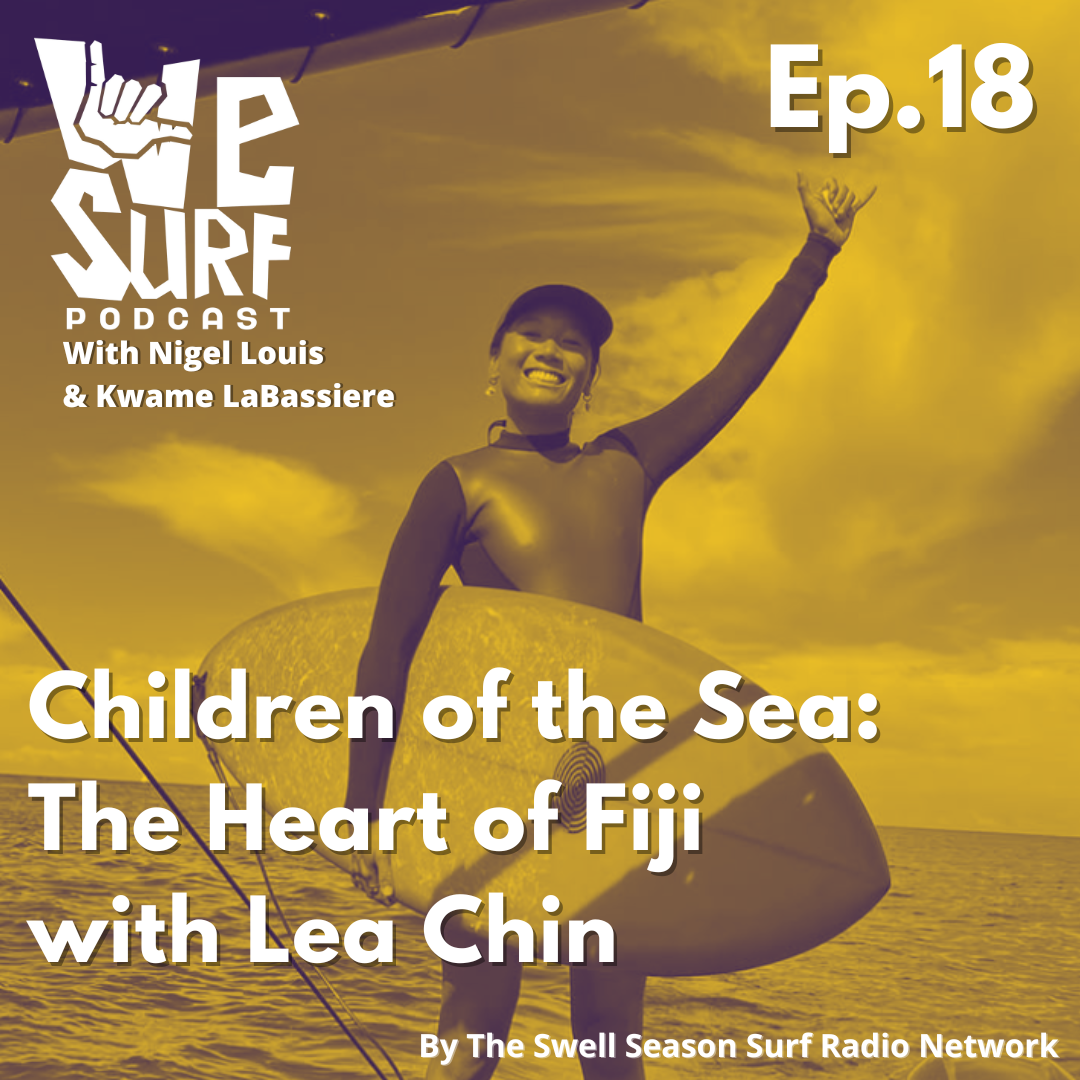
Children of the Sea: The Heart of Fiji with Lea Chin
Surfing and Community The Heart of Fiji
[00:00:00]
Kwame: Hello, ladies and gentlemen, and welcome to another episode of the We Surf Podcast. I am your host, Kwame Lab Bassier, and this is, like I said, this is the We Surf Podcast, where we share stories of [00:01:00] ocean lovers, surf leaders, and water healing visionaries from around the world. It feels so good to make to say the next statement.
We Surf podcast is brought to you by We Surf Media. Uh, we're recording at WTF studios in Manhattan and distributed by the fall season surf radio. So I wanna make sure I get all of that out now because I tend to forget that stuff at the end. 'cause, you know, I get so excited when I'm speaking with our guests.
Okay, let's get right into this. Um, today we are gonna be doing a little bit of traveling, at least through conversation. To the islands of Fiji where community and ocean life are deeply intertwined. So for those of you who don't know, I had the amazing opportunity and the fortune to go visit Fiji back in April.
Um, I got to stay on Namu Island and while I was there, I met our next guest. We really didn't even speak for that long. It was like we sat [00:02:00] down and we had, I think we had like one meal together, and then it was like. Talking and she, she ran off to go do something again. But her energy right then and there had me thinking, okay, I need to get this person on the show, because it's, it became obvious to see that they really care about what they're doing.
So my guest today is Leah Chin. She's the founder of Children of the Sea, a program that introduces kids to the ocean, not this as a playground, but also as a teacher, healer and protector. Today we hope to get to talk to Leah about, uh, how children of the sea began, the role of Fijian culture and ocean education, and how the next generation has carried on the torch of surfing stewardship.
And see knowledge and hopefully we'll see if we can pry some local stories out of her as well and get her to talk a little bit about her surfing. 'cause I have actually seen her surf and an amazing surfer. So Bolea, thank you so much. We are very, um, we're very happy to have you here.
Lea Chin,: Will Kame. [00:03:00] Thanks.
Thank you for having me on the show and yeah, I'm excited to be here today.
Kwame: Okay, excellent. Okay, so let's jump straight into it. Can you tell us a little bit about Children of the Sea and how it began and.
Lea Chin,: Sure Children of the Sea started, actually, it's been a year now. Um, it started with my really good friend, Nia, Nia Nvu.
He's a local legend, surf legend. He's was a wild card, I think on the WSL, the WCT, um, maybe a couple years ago. And, um, so we, we've known each other for a few years now and we started surfing together. We also did surf and yoga retreats together. And um, at one point, uh, we talked about how our goal and our vision is to do something for the youth and to give back to the community and to help empower, um, local [00:04:00] Fijian youth through surfing.
And last year. In September, he asked me, oh, do you wanna help out with some of the kids surf stuff? And, and we did a session together and we ended up sitting down and talking about, okay, well what do we wanna do? We wanna try to make this a thing, or are we just focusing on our own jobs and whatever.
Because I told him I didn't wanna do retreats anymore. And, um. Yeah. And then he, and, and then we decided to try to aim for Saturday, every Saturday to take the kids surfing and also to do surfing leadership development camps. And so we kind of had our first camp, um, last year in December. And that's kind of the fir and then, and then that's kind of how it, it all, um, started the ball rolling and becoming more consistent with the program.
Kwame: Okay. Excellent. Um. I [00:05:00] apologize to our viewers and our listeners right now because I'm so excited to speak to that actually jumped the gun a little bit on this one, so my apologies. Let's do a quick little backtrack here. Leah, tell us about yourself first. So tell us about you.
Lea Chin,: So my name's Leah. I'm from New Jersey.
Uh, I was born and raised in New Jersey. My parents are immigrants from Taiwan, but we are originally from China and I moved to Fiji. Well, I studied abroad in Fiji in 2013 and absolutely fell in love with Fiji. I ended up doing the Peace Corps right after graduating. College, um, in Vanuatu, which is the country just west of Fiji, and there was doing, um, teacher training and, um, literacy, teaching literacy.
And after, after. The Peace Corps, I decided I didn't wanna go back to New Jersey and I wanted to move [00:06:00] back to Fiji. So I moved to Fiji and started teaching yoga at a luxury resort. And, um, during COVID I started my own business, which allows me to do contract work and the businesses, yoga, wellness, um, sports education.
Um, so yeah. And then that's. That's where my, kind of, my story of how I, how I came to Fiji and um, yeah.
Kwame: How long have you been surfing and how, how did you learn to surf?
Lea Chin,: So I was learning to surf because my ex, I had an ex-boyfriend who surfed and he'd always be off surfing and I get. Upset because I'd be like, where are you?
Where are you? What are you doing? And then I was teaching yoga at a, a backpacker surf hostel on the Coral coast in Fiji called Beach House. Mm-hmm. And there was a wave in the front and you [00:07:00] can paddle out. And so I decided, well, I'm gonna learn how to surf. And yeah, no, that's kind of when my journey started.
And that was around eight years ago. And ever since I started surfing and then I understood, oh, okay, yes, this is why you spend hours at a time in the ocean because it's. Amazing.
Kwame: I don't think you realize just yet, and I'm sure we'll find out eventually, but I don't think you realize just yet. Just by the, you said two things, which I think will give so many of our listeners and viewers.
Hope one, you're from New Jersey and you now live in Fiji. So I think so many people will hear that and think this was, oh. Okay, it can be done. All righty. And then secondly, like, oh, well, you know, I had a, my ex used to just go off and surf and, you know, I mean, I, I'm going to learn how to do this. And you picked it up and now you know you're this amazing surfer.
So folks, as you can see, it can be done. You know, [00:08:00] those, I, I hear it so many times. She's like, oh, I want to go surf somewhere else. I'm tired of surfing this place. I'm tired of the cold weather. You can move. Okay, it can be done. Let's, let's East coasters. Let's stop complaining about it. It can happen. That is great.
That is great. Um, okay, so we're gonna go back to where, where we were before with the, with the questions. Um, so what The children of the Sea, so how, you said you started in December, was it
Lea Chin,: September last year?
Kwame: September last year. Okay, great. So September of last year. And what impact, if any, or have you seen so far with the, with the kids that you've been, um, working with?
Lea Chin,: So, two weeks ago we had our, I believe it's our third, it was our third surfing and leadership development camp, but mm-hmm. This one was different because we [00:09:00] decided to do girls only. Mm-hmm. So we had nine girls on the camp and. It was amazing to see the progress of the girls and just not just from surfing, but um, also their leadership skills and their confidence, and it was really awesome to see.
Our youngest one is, she started when she was six and now she's seven and. It's pretty cool watching her 'cause she's got no fear and she's the granddaughter of the first Fijian surfer in, in Fiji. So, um, and they, their family's like part of the landowners of Cloudbreak and so it's really cool to see she's just got this natural ability and no, no fear.
This little girl has no fear. She wants the wave, she wants to catch the wave. So it's been pretty cool to see. All of their surf progression and all of their confidence coming out and their little [00:10:00] personality starting to shine. Yeah. And I think that's been kind of the most progress throughout the, throughout the year and, and having that separate space for girls I think was really special because, you know, inevitably whenever there's boys around, there's a bit more.
The girls kind of get less, less, mm-hmm. Attention. Mm-hmm. And so for the girls to be kind of the, the shining stars in this, in this last camp that we had was, I think really allowed them to come out of their shells. So that was pretty cool to see and to see them progress like that. Yeah.
Kwame: Nice, nice. Yeah.
Just before we, um, connected, I was speaking with our engineer Wolf and I was telling him about when I was in Fiji and I was surfing, um, I think it was swimming pools, and it was like a five to seven foot day. And this kid paddles out and he paddles past me and he just grins at me, you know, and of course he's like, he's like missing his bottom teeth because his baby teeth fell [00:11:00] out and he just like paddles away.
He smiles and he waves at me. He goes, and then he. Drops into this wave at the last second. It wasn't a paddle dropping. He literally just cocked his board and then went, and I'm like, you ha, this kid has no fear whatsoever. And I was in awe of him. So I can just imagine what, what that would be like for you seeing that like on a daily, on a weekly basis with them.
So you spoke a little bit about the leadership and you know, you said you had the, the leadership program with the, with the girls. Can you give us an example a little bit or speak a little bit more about that? 'cause I know especially some of the, I dunno about previous guests. One of the things that they've speak, they've spoken about, excuse me, is, you know, especially when with, um, women and girls being in the water, they always have to feel like they have to battle against the boys or, you know, do be twice as good for half as much type of situation.
So how do you, can you speak a little bit about that and how you get the girls, you know, basically let [00:12:00] them feel empowered in the water.
Lea Chin,: Hmm. Well, speci maybe outside of the water. Just to touch on like what kinds of workshops we talk about is, so this, this work, this week, we focused on like communication skills, like learning to say no and actually like teaching the girls how to say no.
Mm-hmm. And, um, teaching them how to use I statements and like understanding emotions and learning. Yeah, understanding about emotions and, um, and I think having ania in, in the water, he's. The best at what he does with mm-hmm. Mm-hmm. Making, helping people feel comfortable and, and in the water and in giving the girls confidence as well.
Um, so having his leadership in the program is, I think, helps the girls feel confident in the water. And then also, um, [00:13:00] yeah, I think just being, I mean. I'm trying to think of how we give them confidence in the water. I think you know them, them. Learning, learning the skills over the past year, like right. We don't usually take them out to the reef, we'll take them to a smaller wave where it's just us in the water and you know, we teach them about the surf etiquette, surf rules, and so they know the rules.
They know how to keep themselves safe in the water. They know how to get out of the way. So I think that kind of gives them confidence when they have the knowledge of, okay, what am I doing in this situation? Right. So, yeah, I think just. Them having knowledge on, um, how to, how to look after themselves in the waves and what the rules are so they know, and that gives them confidence.
Kwame: Do you see any, or can you think of any differences in the way the, let's say the way the boys, um, are [00:14:00] progressing and the way the girls are progressing? Or are they just, you know, what, what are what The children, just having fun.
Lea Chin,: I've definitely seen progress in both the boys and the girls. Mm-hmm. The boys.
So usually we split the boys and the girls up like it's most of the time, boys, girls, and then a beginner's group, um, when we do our Saturday programs, and it's been cool to see. Especially the boys, their leadership skills, because a lot when we first started, the boys would not listen and be like mm-hmm.
Always trying to like, fight each other for waves and not listening. But over the year, um, we've definitely seen leadership skills come up from the boys, um, listening more, encouraging each other, helping each other in the water, which has been really cool to see and the boys progressing in their surf.
Being able to surf better. And I think the boys have more confidence and they can, [00:15:00] you know, they, they don't need to be told, they just kind of try to do their own thing, but Right. They, whereas the girls, they listen a lot more. They listen to the feedback and actually like, try to get them to, okay, go down the line, try to learn how to do a turn, and then they'll listen.
Whereas the boys kind of run out and, and do their thing and the girls will kind of. Wait and listen for feedback. Um, but also seeing the girls step up as leaders as well, like when we do warmups or when we do like packing down and to go home. Like they're, you know, the older ones are assigned to take, take charge and, um, like lead do some leading in the program.
So that's, um, yeah. That's cool to see how they've, um, progressed in that way.
Kwame: Nice. Excellent. No, I mean, I'm, I'm smiling and laughing 'cause I'm thinking back about when, like myself and my friends, when we were, you know. You know, [00:16:00] Kneehigh to nothing. And that kind of what it was like as well. You know, you go to the beach with your friends and the boys are the ones usually on the jetty or on the wharf trying to play King of the Hill and throwing each other off.
And you know, and the girls are the ones looking at us like, God, you're stupid. Why would you do that? But they said it was dangerous and you still want to go and do that. Why would you do that? Why would you do that? So, um, but now looking back and I was like, yeah. Obviously the ones that had more sense, so.
Okay. But, um, it's just, no, I think, I think it's great that they're actually signed a form. And bring forth, you know, their own personalities and as they're surfing and, you know, um, with the leadership and that's coming through and that's starting to shine through not just, uh, collectively, but I'm sure on an individual basis as, as well.
So I think that's, that's, that's great. So speaking, uh, still sticking with the children, you know. Um. What role do you see? Or do you [00:17:00] guys cover this with them? Um, not just surfing and leadership, but then just also, um, leadership in Fijian culture. Uh, what role do you see the children play in, in projecting Fiji's reefs, coastline, and just in general Fijian culture?
Lea Chin,: Well, right now I think it's an interesting time. Um. You know, with, there's a massive, uh, HIV and meth problem in Fiji mm-hmm. With drugs and, um, I guess maybe out starting with alcohol abuse. Mm-hmm. And that's, I believe, due to the lack, sometimes lacking lack of opportunities for youth and. Um, yeah, it was pretty hard to see once I was dropping some of the staff off from TU and heading back home and in, in one of the villages where the kids come from and I saw a few of the young, like maybe 12, 13, 14-year-old boys just kind of like walking with their little backpacks and I stopped to say [00:18:00] hi, and one of them was really drunk and mm-hmm.
I was just kind of. Uh, pretty heartbroken to see that just how young, um, young this kid was and that he, you know, and, and he was hanging out with the older boys who Right, you know, are drinking. And I guess, I mean, thinking back when I was young, I'm like, oh, I also got into. Some no good when I was younger as well, but I think, you know, here it's different because sometimes there aren't any more opportunities and it's not just a phase.
Mm-hmm. Mm-hmm. And so hope, we're hoping that, you know, having this connection to the ocean, having this connection to surfing where, you know, you have a passion, you have a desire to, and it's an avenue for work, um, as well to work whether at the resorts or have your own little business in the future. Um.
But it's an avenue where, um, yeah, hopefully to, to [00:19:00] keep kids motivated and passionate about something. And also, you know, the, their program. We do want to incorporate, um, some of the environmental education. Um, there's a girl, her name's Lisa, she interns with Travel Well, which is one of our sponsors who accommodate and support us through our camps, accommodate and feed us through the camp.
And she's done some environmental education with the children on, you know. Rubbish and you know how to take care of the reefs. And I think that's a big part. 'cause sometimes even the parents are, it's, it's hard because there's no public rubbish collection, especially in the villages. So it's, you go into the village and it's like, well, what do you do with your rubbish?
You have to Right, right. You have to burn it or pile it up or throw it in the river. Yeah. And so. They're, what the [00:20:00] solution for that? Not sure, but I think with the kids being, you know, seeing their ocean and connecting with the ocean and, and learning about these things, they hopefully will, you know, realize like, okay, we, we are the ones responsible for taking care of our environment.
And, and maybe one day, you know, with. Education and knowledge, then they can come up with an idea of, okay, how do we look after our environment better than what's happening now?
Kwame: Right. Yeah, that's, that's great. Um, I'm pausing because I'm just remembering like growing, even growing up. So I was, I was born in the, in the Caribbean, so.
I was born on an island that at its max had 72,000 people. And for all intents and purposes, that's tiny. That's nothing. Mm-hmm. So. I remember, you know, if basically, so on the good side, I grew up in a [00:21:00] place where if you did something, chances are your parents knew before you got home that you did something stupid because it would just pass down the line and before you got home, your parents knew you were doing something ridiculous or something stupid.
So it kind of, I think that kind of kept me on the street and narrow a little bit. But then also on the flip side, you know, when something bad did happen, it really like sensed shockwaves through through the community because we were so small and there were a lot of challenges that people, people had as well.
I remember, um, having a conversation with a friend of mine one time. Yeah. And they said that they went on, they went to vacation. They went on vacation to Hawaii and they also went to the Caribbean and a couple of places. And they asked me like, why is everything so expensive? And I said to them, you realize we have to pretty much import everything, right?
Mm-hmm. Like, what do you mean? I said, do you see any toilet paper factories around here? No. We gotta bring them in from somewhere else. So we, yes, we have our local products and we make do with what we have, but at the [00:22:00] same time. You know, and a lot of times there's only so many jobs to go around. So, you know, that's, that's one of the pitfalls I think a lot of people don't realize about living in a, living in a small island community because there's only a certain amount of jobs to go around and mm-hmm.
You know, people, people are looking for those jobs. Um, so. Definitely kudos to you guys for, uh, working with the kids and saying, hey, and letting them know that you are the next generation to, to, to make, make, to get this, to keep us moving. So con congratulations on that right there. Um, you mentioned the parents.
So do the parents get involved or how much do the parents, do their parents get involved with what you guys do with the kids?
Lea Chin,: Well, so India's got four boys. Mm-hmm. So three of his boys who are old enough, they, they're part of the program. Mm-hmm. So he's also, he's one of the fa he's the founder and, um, but also, uh, the surf coach and also one of the parents.
[00:23:00] And her, his brother is also one of the coaches, and he's got his. Two daughters and one son who comes to the program. And then, yeah, and then there's two parent vol or maybe three parent volunteers who, one a mom will always come. So it's either Nina or Nono that they've both got kids in the program, so they'll always come and help make lunch for the kids.
Um, and, and then there's always, um. One of the dads, he's the father of the 7-year-old girl. Mm-hmm. He always comes and supports and is always there, um, every session to help keep an eye on the kids. And so he's very involved as well. And one of our. One of the dads Ulai, he works at Na motu and he's not physically, uh, able to help out, but when we need his help, especially with boats, he always gives his boats, [00:24:00] um, to help us out and to take the kids out surf surfing.
So there's a lot of support from the parents who are, who are involved, and, um. And, but yeah, the, and it's, it wouldn't work if the parents didn't trust us. So the parents are always, when we say to send the kids, they send the kids and trust us and, and, and yeah. So I think there's, um, that, that trust there.
Kwame: Yeah,
Lea Chin,: which I'm very grateful for.
Kwame: And I think from what I'm hearing as well, it's um, there's a lot of trust happening here because the parents trust you guys and then. The kids trust you as well because especially young kids, if they're like, I don't trust this person, they would let you know in a heartbeat.
I don't wanna go anywhere with this person. I don't think they know what they're doing. So they would let you know, like really quickly. So you know, you are really work, you, you. Brought that trust and, you know, developed that trust with all [00:25:00] parties. So I think that's, um, that's what's, that's probably what's helping you guys as well, a lot to us.
Again, that's also great. Uh, what challenges though, have you faced with it, um, with Children of the Sea?
Lea Chin,: Um, a few challenges. Um, I think one of the main challenges is just we're kind of winging it and just trying to figure it out as we go. And. I think that's kind of one of the challenges of just knowing, okay, what, what we're, what are we doing and how are we gonna progress?
So the goal for this year was kind of just be as consistent as possible and be consistent. Every Saturday or most Saturdays, we take the kids surfing just to prove to the kids and prove to our sponsors and that we're serious about what we're doing. And to do the camps, because that's kind of the. The time where we get the most time with the kids and get to do a lot more of the leadership stuff.
Um, challenges as well, um, [00:26:00] safety and just being, you know, managing, um, managing the amount of kids that are on the program and, you know, just a challenge to. Figure out how, what do we need to do? What do we need to be aware of? And so that's a learning progress of like, okay, what, what do we need? How do we, how do we accomplish this?
And keep everyone safe. And that's something that is always on, on in our minds. And another challenge, um, I think coming up will be. You know, maintaining the sponsorship. So we raised, I think it was around. $16,000 last year mm-hmm. For, for this year. And so we're gonna, we're coming up to the end of that amount now.
And then, so this year was about proving that we're consistent and [00:27:00] then, so now we are in the process of setting up a charitable trust, which in Fiji to everything takes a very long time. So that's a big challenge to try to get that sorted. Um, and then. Hopefully we can start looking for grants and, and yeah, so a few challenges.
Safety, funding and, you know, having enough coaches that's always, um. Train qualified coaches. Yeah. That's always a challenge.
Kwame: Yes. That, that is, that's key. I'm glad you said that as well because I know I've said this to many people, you know, just because you took a surf lesson from your girlfriend's brother's cousin who goes to Baja once a year doesn't mean you, you took a surf lesson, you know, and people come out and they go, oh yeah.
You know, I've been surfing for two years, so I know how to push somebody into a wave. I, I'm a coach. Like, no, they're not. You know, if you would, they know what to do if you got hurt, would they know what to do [00:28:00] if you got caught in a rip current? Would they know how to do a proper rescue with you if you, if they riding in a shortboard or a long board or so, you know, do, do they have license?
Are they licensed? Do they, are they trained? So there's a lot that goes into it. Um, and I think that there's a lot of organizations and individuals out there who are just like. Winging it. And because of that, you know, reputable organizations such as yours and others are kind of suffering a little bit because then now they really have to prove that, okay, yes, we do hire, or we do have people volunteering with us who are, you know, who know what they're doing.
And they, they're actually water people, not just, you know, somebody who woke up and bought a. Bought off of eBay and decided to paddle out. Yeah. And so, yeah, so I think that, yeah, that's actually probably be a big challenge as well, so. Mm-hmm. Um, how do you guys measure success in the program? [00:29:00]
Lea Chin,: Well. I've been compiling all the data of like who's attended and mm-hmm.
From this year. So I haven't done anything with that data, just for record keeping, but I think at the end of the year that'll be good to see like who's attended and, and for attendance wise and what we've done for each, um, each. Session, but out in the water to see our progress is definitely to see how the kids, um, follow surf etiquette because some, there's other kids who surf as well in Fiji and you can just see them dropping in paddling past and which is, you know, it's, they're learning.
But it's cool to see our kids who, um, will follow surf pro surf protocol and like. You know, have the confidence. And we went to pools one day with the, with all the girls, and it was probably like three to four foot and it was big. Definitely bigger than anything they've ever surfed. Mm-hmm. But just to see them, you know, know what to do.
[00:30:00] Okay. Paddle up to the coach, pa stay in the channel. And then just to see them know how to handle themselves in, in waves and, and in the surf. I think that's so far how. I see the progress and also their, you know, their listening skills have gotten much better. It's used to have to tell them five, six times.
Now it's maybe just three times, three to four times. So, you know, so it's, that's how we're looking. I can see the success, but, or see their progress, but I haven't, you know, with data and stuff haven't Hmm. Figure out exactly how to measure what the success is.
Kwame: Okay. And what's, so what is your, so then what would be your hope for, if you had a crystal ball or a genie or whatever, what would be your hope for the next, I would say five to 10 years.
So [00:31:00] 2030. 2035.
Lea Chin,: Yeah, well, definitely to see the girls rip and charge at Cloudbreak. Mm-hmm. Like I wanna see, I wanna see that little 7-year-old girl getting barreled at Cloudbreak. Like that is the dream. And also for them to have opportunities, you know, to be able to, you know, if they wanna work at Na, motu or tap that they, they're kind of the first.
First dibs because not only are they good surfers, but they're well spoken. Mm-hmm. And they've got con, they've got confidence and they can talk, you know, talk in the crowd and, and that's, and handle and hold themselves right. In a, in a leadership way or whatever they wanna do. And also to hopefully see some more entrepreneurs in Fiji because there's a lot of opportunity here.
And to see, to hopefully for these. The ocean to inspire the kids to somehow, you know, I think the ocean has lost so [00:32:00] much inspiration and creativity and, and for them to, you know, think differently and, and yeah. And do different things. So that's kind of the hope. And, and maybe see some more, you know, pro sponsored.
Fijian surfers. Mm-hmm. Badass Fijian surf guides, you know, or you know, a little, yeah. Yeah. So that's kind of the vision, just to see these kids succeed and, um, take the opportunities that are here for them. Yeah.
Kwame: I have a story that few people know the story because I kind of. Was very selective about who I told the story.
And I think I'll, I'll tell it at the end of, um, at the end of when we're done here at the end of this podcast, but to me it shows just how. Amazing the people of Fiji can be and [00:33:00] are and 'cause I felt at that, I'll, I'll tell the story afterwards. I'm not go too much into it. I'll tell the story. But, um, just speaking about like, has seen, you know, the girls, the girls charge and rip at Cloudbreak, you know, do you guys are, are the kids aware or do they.
Even if they're away, do they realize the impact of this? That there was a point not that far ago, I think it was like 15 years ago, where they would not have been able to surf cloudbreak? Mm-hmm. Or, um, TAVI rights or NATO lefts. And do they like, understand just. What a heavy deal that was. What a big thing that was back then.
Lea Chin,: I'm not sure if the young, the younger kids know, because I think, yeah, it was like maybe 10, 10 or some years ago where the waves were privatized. Mm-hmm. Um, I think, yeah, I don't, I don't know if they realized that they, a lot of the kids before them didn't have that [00:34:00] opportunity. Um, but, um. I think, you know, the, some of their parents would know because a lot, most of their parents work at Roo or Na motu mm-hmm.
And or within the surf industry. And so I think that's maybe why there's a lot of, um, support as well, or, or to see these kids, to see these kids shine. And, and I think for, not just for girls, but for the boys as well, it's an opportunity that might not have, that wouldn't have been there. For the generation just before them.
And we've got our, the first sponsored pro surfer in Fiji now. His name's James. James, uh, Cino. Cino. Sorry if his pronounce his last name wrong.
Kwame: James Cino.
Lea Chin,: Yeah. James Cino. Yes. Yeah. And, and it's been cool to see, watch his journey as well. Yeah. Um, but yeah, I think. Now Fiji is, and [00:35:00] now the, the tour is coming back to Fiji.
So it's like a very exciting time for, for this generation of kids.
Kwame: That when I, when I realized that and I read the history about it, I couldn't, I mean, I could believe it. 'cause there it wasn't black and white. But at the same time, I could not believe it because again, for our listeners and viewers, for those of you who surf in Rockaway, that's pretty much the equivalent of.
If you couldn't surf on Beach 1 0 8, because the Rockaway Beach Hotel is right there, and they took over that, that, that break. For those of you who are out in LA or in California, let's say in, in Manhattan Beach, you couldn't surf there because there's a hotel up the street and the hotel says, oh, now this is ours.
You can't surf there, no matter how good the waves are, and you've lived there your entire life, your parents are from there, your grandparents are from there. And now, but you can't, you're not allowed to. Not that you can't surf it, you're not allowed to surf it. And this was. About 10 to 15 years ago that this, that this was, that this was repealed.
So [00:36:00] that really blew my mind. I'm so grateful and so happy now that the Fijian government was able to say, okay, hold up a second. You know, this isn't fair to our folks, our people. And yes, they need to be able to. It's, it's our breaks. They need to be able to do this. So I think that's, that's, mm-hmm. Yeah. I was really happy to, to, I was, I was pissed off when I read it the first time and I was happy.
I was like, okay, great. It's been, it's been resolved somewhat Great. What has been the most rewarding part of this journey for you personally?
Lea Chin,: Um. Yeah, I think that day of taking the girls out to swimming pools, it was the day of the WSL finals. Mm-hmm. Okay. And so the waves were projected to be kind of big.
So I was a bit nervous to take the girls out and. We got to swimming pools and there was like maybe three people out, and two of them were [00:37:00] my friends. Mm-hmm. And so, and then we just had this perfect session and the waves hadn't quite picked up yet, so it was, you know, three to four foot and there was a few sets and just.
How well it worked. It was me and Nia and Keisha, Keisha. So she just won, um, the specialty event in, uh, that was during the WSL. There was like a specialty event where four local females and four local males surfed. Mm-hmm. And actually it was really cool because. We took three of the girls from Children of the Sea for the Rising Tides Program with the WSL.
Mm-hmm. And then, so we got to watch Keisha win the specialty event. Oh. And Keisha's one of our coaches who comes and helps with the, helps out with the kids. Nice. And social media. And so watching her and being there to cheer on the girl, cheer her on was awesome. And then the three girls and a few other girls from the community got to surf [00:38:00] Cloudbreak by themselves.
We were out there by ourselves and with like safety, and it was like three foot low tide cloudbreak. And the girls were like, we wanna catch waves, we want waves. So that was, that was probably like the coolest. And then, you know, coolest situations being part of that. And then also then that next week of being like, okay, girls, now we're at pools.
We've got empty pools to ourselves, three to four foot, everyone's watching the finals. So, you know, we had it. There was nobody there, which was awesome. Right. And the girls just were able to catch waves and like, and just how well, and how well the team worked together. Like the coaches, me, Keisha, and Nia, like we each had a group of girls and then like we would switch the girls and just, you know, we had nine girls with us.
So being able to handle that and, and just to see how well we worked as a team and how well the girls did at like, co in at like. Making it all flow and progress [00:39:00] and work. And that was just, I think, the, the most rewarding day so far. And just, just how smooth and how perfect everything went and how well, like the girls surfed and yeah, and how well we did as a team.
So I think that was kind of the most rewarding, um, rewarding day so far.
Kwame: As working with them, um, not just working with the kids. I know you also do yoga as well as working with them, not just in the ocean, but has it changed the way you view the ocean working with the kids? I,
Lea Chin,: hmm.
It definitely makes me, uh, very grateful for my personal time with the ocean because when I'm, when I'm with the kids, it's like all about them. Um mm-hmm. Which is really nice. Yeah. Which is awesome. And trying to get them to the level where it's like, okay, you guys can have your own, like, you know, you can have your own confidence with the [00:40:00] ocean, so, but also just really enjoying that time where it's like, oh yes, like.
I love my personal time with the ocean as well. Working. You know, it's me in there.
Kwame: I'm right there with you, trust me. Because I actually had this conversation with someone today and I was telling them that, so I have tomorrow and the day after off of work and we're getting a little something from, I think it's cap.
Gabrielle, hurricane Gabrielle's gonna come through. So we're getting some, we're getting some waves from that. Uh, but by Wednesday, today's Monday, so by Tuesday evening it should have dissipated. So Wednesday we'll be able to teach classes, but I was asked, oh, do you wanna teach on Tuesday? I'm like, no. I need my time.
I, I, I, I need to surf. I, I need some time for myself right now just to remem see if I remember how to do it for one and two, just to just be able to do my own reconnect. My own reconnect there. Yeah. So, yeah. I, I, I [00:41:00] understand. I hate what you're saying completely. If you could leave, if you could leave the kids with one message, what would it be?
Let's say you completely lost your mind and said, I'm moving back to the freezing cold of Jersey to go surf Belmar, you know, in 35 degree weather, and you need one to leave the kids with one message. What would it be?
Lea Chin,: Dream big. I think. Dream big. You know, my mom, my mom was always been like. No, there's no sky, there's no limit.
You can do, you know, whatever you wanna do, go out and do it. And I think that's been such a amazing way of like, you know, there's no limits, there's no, like, there's nothing that you can't do. And so I think for the message for the kids would just be, be unafraid to dream big.
Kwame: Mm-hmm. [00:42:00] I like that. Be unafraid to dream big.
I like that. Okay. Let's go into some like fast fire questions and we'll just keep talking for a little bit. My first question to you is, what's your favorite surfboard currently that's your, that you're riding in?
Lea Chin,: My favorite surfboard is I've got a sharp eye, a plus 77 model, and that is my like favorite board.
It just works on anything.
Kwame: Okay. I saw your Instagram page. Um, you are on a longboard and you said, I'm trying to write a longboard, like a shortboard. I keep trying to write a longboard, like a shortboard, but that, that, that wasn't that one, right?
Lea Chin,: No, not that one. No. Okay. Yeah. Okay.
Kwame: So, yeah, 'cause I thought I was like, uh, I would just like, I don't care what that wave is doing.
I don't care the boy, I'll take a boogie boy out on those. 'cause those waves are, um, those waves look amazing. [00:43:00] And what is your favorite, what's your favorite Pres surf meal and your favorite post surf meal?
Lea Chin,: Hmm. I think it's the same smashed avocado on toast. Anything with avocado toast and poached eggs, that's, oh, if I could,
Kwame: if I could reach to the television right now and give you a fist bump, I would, I, I, I mean, take out the eggs on it for the vegan piece, but yeah, I will, like, I, anything that has avocado on it, I think just generally tastes better.
Yeah,
Lea Chin,: so good.
Kwame: It's so, um, yeah, I'm, I'm a hundred percent there with you. It was actually funny. So when I was, um, when I was staying at nmu, the, the, the staff actually got, almost got yelled at one time because they told them that I was vegan and I reached for something like, that's not for you. That is nothing.
I'm like, okay, I'm sorry. I'm sorry. So they were like taking care of me, making sure I didn't eat anything that I wasn't supposed to eat. And so I was, I mean, we were laughing about it, but yeah, it was just, it was just like really funny to me at the [00:44:00] time. What's it like to, I mean, and this is, this may not be a question other people wanna know, but I'm asking this question.
What's it like to have like. Epic surf breaks pretty much almost, I won't wanna say in your backyard, but you know, to, to have access to these like epic surf breaks like Cloudbreak and nato lefts. I mean, I'm goofy footed, so lefts was like my favorite. But while I was there, I focused mainly on going, right?
Because I hardly ever get a chance to go. Right, because our break is mainly left. So what's it like just having like those. Epic surf breaks where even if Surf Line says, oh, it's only two to three feet, it's still an amazing two to three feet.
Lea Chin,: Um, I think definitely spoiled because, well, I didn't surf in New Jersey either, so it's not like I know Oh, right.
What cold water surfing or surfing small waves is really, or like, you know, on whatever [00:45:00] not great waves is. So, I think very spoiled and to, to have, you know. Really perfect waves out here and yeah, and just, I think the only word I can say is spoiled. Feel very spoiled. Yeah.
Kwame: Yeah, I can imagine. Because even for.
Very weak and some that I was in Fiji and then when I came back I kind of was like turning my nose up a little bit at some of the waves that we had out here. And you know, uh, like people ask me, like my friends would say, Hey, let's go surf. Let's go drive to blah, blah, blah. I'm like. I don't know if I wanna do a two hour drive just for, you know, two to three feet and pay and lemme give you a story about a wave I got in Fiji instead.
So, yeah. So I can imagine, I can just imagine what it's like. Yeah. Um, yeah, I, I'm making it a point to I have to come back, um, and not just come [00:46:00] back for myself, but in my mind I'm like, there are. So many of the people who are such amazing surfers who I know would appreciate, like, truly, truly appreciate not just the wave, not just the ocean.
Mm-hmm. But the Fijian and the Fijian culture as well. You know, so it's not just, oh, we we're gonna go surf and then we are leaving, you know, and not, and to completely forget about it. No, there are anyone and everyone I've spoken to about it, you know, they are. They are like type of people who are like, oh yeah, we know we want to go, but at the same time we do wanna just go grab a board, jump in the ocean surfing and then leave.
Mm-hmm. We wanna actually talk to people and sit down and, you know, explore and understand, you know, what it's like and yeah. Because again, divided by land, but connected by, by salt water, so mm-hmm. We believe that. This is the point where, which I personally don't like this section, but you know, we throw it in anyway.
Do you have any questions for [00:47:00] me as the, so you can, you can now interview the host. Do you have any questions that you'd like to ask?
Lea Chin,: Um, let's see. Uh, what was your favorite wave in Fiji?
Kwame: I. Like I, I split my time mainly between swimming pools and, uh, NRO left, so, and, um, restaurants. But out of the three, my favorite was, um, lefts.
Lea Chin,: Lefts
Kwame: because I got to, so for the majority of the time I was there, like I said, I was at swimming pools, which was a right, but then. When I finally said, okay, I'm gonna go do the left, and I remembered what it's like to go front side and actually be able to drop it on a wave, come back up, actually do a full cutback, and then come back again and then do another cutback because you know, in, in Rockaway to do two, to do two or three cutbacks and that's unheard of.
So to actually be able to pull that off [00:48:00] was like one of the most amazing things ever. For me. So I loved on the middle left, and it's actually on that wave where I had one of the worst and one of the best simultaneous experiences I've ever had in my life. Hmm. So I caught a wave, came down, went up to the top of the wave.
Lea Chin,: Hmm.
Kwame: Was almost the, the nose on my board was literally almost at like 12 o'clock coming up the wave. And I was gonna like, just come back, do like a snap and just come back down. And there was a guy sitting down right underneath me as I came back around,
Lea Chin,: ran
Kwame: him over. I came up, looked at him, I looked around, I said, okay, there's no blood in the water.
He's fine. I'm not gonna deal with this. So I just jumped on my board and I started paddling away. And he began to yell and scream and shout and yell at me. And I'm looking at him like, [00:49:00] okay. So I paddled back to him. 'cause I'm thinking, okay, at this point now maybe something is wrong. Maybe he hurt himself, or I heard him and he's yelling, like, really, like yelling, yelling, telling me, you know, you, you don't know how to surf.
And he was a, he was a, um, a tourist. And he's yelling at me saying, you don't know how to serve. You need to learn how to serve. Get outta the way. You know expletive, expletive, expletive. And I just looked at him and I said, look, guy, you know you were in my line. You should have moved. You know, you saw me coming, you should have moved.
You chose to sit there, you should have moved. And he's still yelling, yelling, yelling. So then I said to him, um, okay, look, you need, you know, I'm not gonna say it because we may have to bleep this one, but you know, I, I'll say it, but I'll bleep it afterwards. So pretty much I told him, look, leave me alone.
You can go suck a, leave me alone. And then I started to paddle away, and then he yells out.
Lea Chin,: Mm.
Kwame: And I paused. I, [00:50:00] my left hand began to turn my boat around and my right hand began to paddle towards the boat. So I just went to the boat and I got on the boat and I was just shaken. And I said to the guy who was um, uh, captain, I said, can you do me a favor?
Just bring me back to the island. Please. Just bring me back. Just bring me back. Just bring me back. He brought me back to the island. I got on shore, I looked at my board. My fin had been torn out. Hmm. Um, and one of the other fin was just like hanging off the edge. So I put my board down gently. I just sat down, I put my head in my hands.
It took about two minutes before the staff of the island on the island came to me and they were like, who was it? You tell us who it was. Do you know who he was? Can you recognize him? And I just was like, no, don't worry about, it's like, no, no, no, no, no, no, no. Nobody should talk like that ever. Mm. Usually I'm the one defending [00:51:00] people.
I don't usually have people defend me, so, but the fact that they literally like jumped to it right away, and one of them, his name is Leon. Leon Mosher. Shout out to Leon. They found out he was staying on a boat. So Leon took a boat, a standup paddleboard went out there, uh, went to the guy and said, Hey, you know, here's what you said.
You shouldn't have said that. You know, you shouldn't have said it, so you need to leave. At which point this gentleman says, oh, I didn't realize, I thought he was a local, which to me says two things. One. You must have thought I was really shredding because I've seen the locals in Fiji and they, they really shred.
And two, you think it's okay to speak to the locals like that?
Lea Chin,: Yeah, that makes zero sense.
Kwame: Exactly. So they, but then they told, they pretty much told him he needs to leave and they, he left. Um, yeah. But then for the rest of the time, people were coming up to me and they were [00:52:00] just like, Kwame, we are so sorry that happened.
We're so, I'm like, this wasn't your fault. This had nothing to do with you. Mm. They said, absolutely nothing to do with you. Don't worry about it. I'm good. I just need to shake it off. And they're like, no, no, no. This happened to you on our island while you were surfing in our waters. So we feel responsible for you now.
Lea Chin,: Mm.
Kwame: So, and that sense of community right there, it really, I mean, I was tearing up because, not because of what he said, but just because I felt at that moment everyone was just, was so close and the community just like gathered around. So I'm like, you know what I, that is the best and true localism. Hmm.
Not the, oh, you know, this is my wave chest beat, blah, blah, blah, blah, blah, blah. Yeah. You know, Hey, this is, we, you respect us, we respect you. But if someone disrespects you, then that person has to leave.
Lea Chin,: Hmm.
Kwame: So long story short, that was my best, that was my favorite wave. Yeah. And then we've left, I went back out the next day and I [00:53:00] surfed it and I was like, okay, I'm great now.
Uh, I, I couldn't surf the board because the board was shot. Yeah. But, um. I borrowed a, I borrowed a board from, from the, from the island. And it was just like, yeah, everything was, everything was good at that point. So yeah, it was amazing Trip.
Lea Chin,: Yeah. Well, I'm stoked. You got your epic wave and did a sick snap and, and that you got to experience Yeah.
What Fijians are like, and I'm sorry that guy was a dickhead. Yeah. Um, that's, so that's not okay. And, and. That's, I think that brings back to how amazing Fiji and the culture is because Yeah, in the, in the water, like there, the localism here is like, bah, how are you like, yeah, exactly. Come, come, come. Share out.
Let me, yep. Experienced some joy as some of this happiness, which I've heard Ula say, you know, ULA is always trying to share ways with people and mm-hmm. EA is like the king, like always makes [00:54:00] people feel welcome in the lineup. And yeah. Guilty of me. I'm in New Jersey, some, I definitely still got New Jersey in me.
Mm-hmm. I'm like, don't talk to me. I don't wanna talk to nobody. But, um, but yeah. And so I'm, yeah. I'm glad that. You know, the Fijians, you know, they're so loving and warm, and I think that's kind of the number one thing in the culture where sometimes can be kind of a whole, like a setback in my eyes. Mm-hmm.
Where it's all about community, all about like, so much like we are in this together and like we're, you know, we're, we're one and we're never gonna make someone feel like an outcast. Mm-hmm. Yet. So like that's a really big part of the culture where it's like you respect like, respect. Others and it's like, it's all about community, right?
Um. So I'm, I'm glad that, you know, you had that funny you
Kwame: mentioned, um, them calling somebody over. 'cause I actually witnessed that, you know, while I was there. [00:55:00] Again, you know, one guy was out and he was like sitting off on the shoulder and he was struggling a little bit. And I don't know who it was, but it was one of the locals.
He literally turned to him and he said, oh no, you're strike. Come, come, come, come, come. And he, like, he brought him over to the peak and he goes, sit right here. Stay right here. Do not move until I tell you to. And he just starts yelling. Go, go, go, go, go, go, go. And then the guy paddles, he. Pops up and then as he pops up, just yell and like the whole line of just like started yelling, I was like, and cheering him on.
And so I was like, yeah. And like you, you know, the New Yorker in me is like, like you, the New Yorker in me is kind of like, oh, okay. What's going on in here? Hmm. I'm not sure if I'm comfortable with all this happiness here, but, but anyway, so, um, but yeah, so it, it was, it was, it was definitely an amazing trip and I highly recommend anyone.
If you can, you know, to get out there and, you know, not just, but as always, [00:56:00] as always, I always recommend don't just go there, you know, just to serve, grab your board and disappear. You know, you want to check out the community, you know, reach out to, um, to locals, um, you know, reach out to Leah, children of the, see, you know, if you guys see how you guys can help out.
Because as with any community and any not-for-profit, you know, help is needed wherever and whenever. Right. So, um, Leah, thank you so much Baka. Thank you for sharing your story and the amazing, amazing work you're doing, um, what you and your, um, co-founders are doing with the, with, uh, children of the Sea.
From Fiji. Uh, it is, it's really inspiring to hear, to hear what you guys are doing, um, and how the ocean can shape not just the in individual lives, but also like the whole communities. So for our listeners, if you'd like to learn more and support the program, you'll find we'll put links in the show notes.
Um, and as always, thank you for [00:57:00] tuning in to the We Serve Podcast. Do not forget to subscribe. I see you listening, but I do not see you subscribing. So do not forget to subscribe. Uh, share the episode with a friend who loves the ocean, and leave us a review to help more people discover these stories.
Until next time, stay stoked, stay salty, and keep riding the waves of life. Leah, do you have anything to add really quickly?
Lea Chin,: I just wanna say thank you so much Kwame, for having, um, having me on the show. It's been a pleasure and hopefully, yeah, hopefully we'll see you back in Fiji. And Fiji is very small surf community is really small, so if anyone has any questions about Fiji or anything they wanna know, feel free to reach out and, and yeah.
Kwame: Okay. And one last thank you. Thank you Wolf, as always, our engineer. Helping us out. Okay. Like I said, stay stoked. We'll talk to you guys later.
Lea Chin,: You awesome. Aka. Aka.
[00:58:00]