Salty Confessions and Sunny Perspective with Laura Day
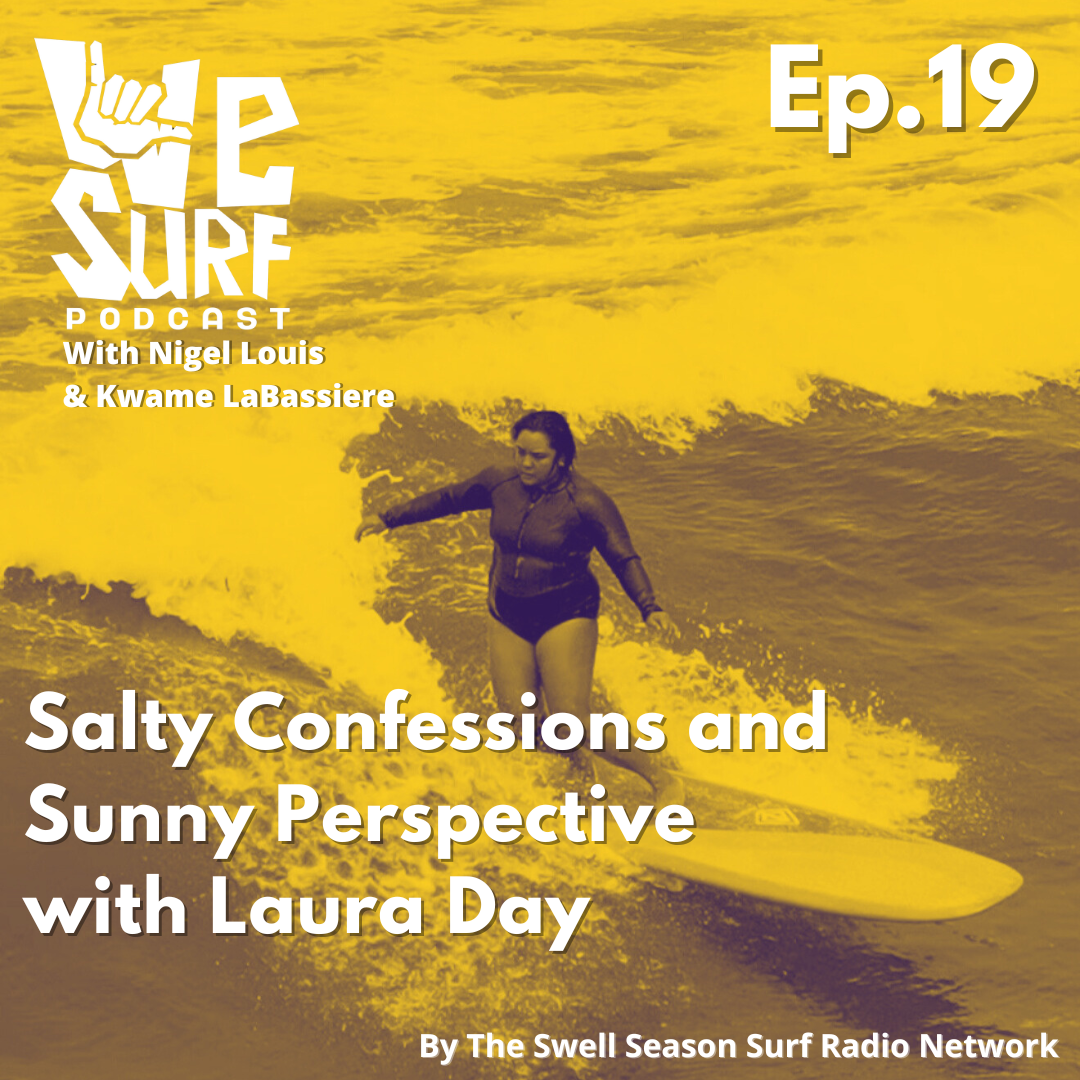
Salty Confessions and Sunny Perspective Confessions of a Surf Lady
[00:00:00]
Kwame: Hello, ladies and gentlemen, and welcome back to another episode of the We Serve Podcast, where we share the stories, voices, and journeys that connects us through the ocean. I'm your [00:01:00] host, Kwame Lab Bassier, and I owe you a bit of an apology. We had some technical difficulties with the recording for today's guest, and as a result, we didn't get the first five or six minutes of the conversation.
Um, I suppose I could have asked her to re-recorded. But I would've lost the spontaneity of the introduction since this guest is someone I had not spoken to. And this was the first time and I was really looking forward to speaking with her. So we decided to just go with it as it's, um, but either way, I know you're gonna enjoy it.
So our guest today is Laura Day. She's the creator and host of Confessions of a Surf Lady, a podcast at up uplift women's voices in surf culture, an open space for honest conversations about what it really means to be in the LightUp. And she also runs an online community called the Surf Society. That's S-O-C-I-E-T-E.
She's a surfer, a storyteller, and a community builder who's helping reshape the culture around surfing. In this episode, we'll dive into Laura's personal surf journey, the inspiration behind her [00:02:00] podcast and the Serve Society, what she's learned from creating a platform for women's stories and a vision from a more inclusive serve community.
So grab your board, grab your headphones, and let's paddle into this one together. We'd like you with us Day. Welcome.
What was the moment when you decided, you know, I'm not just, you know, doing this as a pastime or as a hobby, and now it's okay, I'm actually a surfer and I'm gonna surf.
Laura: Oh man. So when I first got a surfboard from my cousin, she was moving to Germany and she's like, you, you can have this. And I was like, oh, this is cool.
I've, I've always wanted a surfboard. I'd go out, had no idea what I was doing. Luckily, back in the day, it wasn't as crowded as it is now. So I either I, I coed out and don't remember, or there wasn't anyone to yell at me at the time. I don't know. I don't remember. [00:03:00] Think there wasn't like camera or footage, any of it into that anyways, but, uh, I surfed a little bit with my roommate, had no idea what I was doing, and then it kind of dropped off, right?
Because if you don't really have that tie and that confidence of going by yourself, it doesn't really happen. Um, then I was working at a CrossFit gym for a while. Uh, and I met a, a guy that surfed, I hate to like accredit it to him though 'cause the passion was there. Mm-hmm. But I knew he surfed and I dated him for a while.
So I started surfing with him and his friends, and I hit a point where I was like, Hmm. I would really love to just surf with like women who maybe like are in my level. 'cause these guys were mm-hmm. Paddling out the back. I was stuck inside. Uh, and so I found a local surf group here in San Diego. It doesn't exist anymore, but it was such a catalyst to helping me find people that I could surf with and that I could trust.
And then I could like build my confidence enough to go by myself. And I think that's the first hump you have to get over when you're learning how to surface. Like being able to, to know [00:04:00] that you can go to this break at a certain condition and surf by yourself. Um, and then from there it's just, I don't know, I was just going three times a week and eventually I was creating a women's surf wear line.
And then I guess I was just like so roped in. I can't get out of it. So
Kwame: who is it that said I, I, I think if it was Kelly s slate or I forget who it was, they said that, you know, it's like the mafia. Once you're, once you're in, you can't get out. Yeah. You know, I don't, to my students, I don't say it that way. I pretty much tell 'em, you know, once that salt water gets in your veins, that's.
Laura: I always say it's
Kwame: kind of like, welcome to the first day of the rest of your life.
Laura: I didn't choose the surf life. The surf life chose me.
Kwame: Chose me. I like that. Yes, yes, definitely. And I've been trying to get so many people every single time like you, you need to go surf. We need to go surf. Even if you just, you know, boogie board your board in, and you know, take that little, that little ride in, then trust me, that's enough to, to catch, to get you, because I remember when I got my first.
I don't [00:05:00] even wanna call it a wave because it's kind of like, was it really a wave? But you know, the first little ripple that I caught and I stood up for, for like what 0.5 seconds. And for at that moment I'm like, okay, that's it. This is exactly what I thought it was gonna be like that. I'm doing this moving forward.
I'm gonna figure this out. I don't care. It's gonna happen.
Laura: It's crazy because I, I just got the Don Patrol app and so it tells you how long your session was and how long each of your waves were, and like the cumulative amount of time that you were standing on a wave. And it is so fractional compared to like the two or three hours you spend out there.
It's like two minutes.
Kwame: Exactly. Exactly. You know, you paddle out, you spend, what about, I would say 70% of to 80% of your time paddling. Then another 10 to 15 just chatting it up with people in the lineup if there's someone else there, and then you know, another what of. 3% missing the wave you went for, and then 2% actually [00:06:00] riding
Laura: if you get lucky.
Hopefully. Yeah, yeah. No,
Kwame: and if it's a, if it's a good day, then you know, you're already like battling people for the waves. But, um, but along, but again, speaking of, so what kept you motivated? Because I would imagine, like you said, you know, you found a group of folks and then you were going three days a week, but you know, like as since you are a surfer, you know that for those people who are listening.
And you don't real, you are not either not surfers or don't really get out into the water that much. It can be a very humbling and frustrating experience. You know, I have students who are at that point now where I'm no longer pushing them. They're paddling for their own waves, and I let them know from the beginning, you're at the most frustrating part of surfing right now because I'm no longer pushing you.
You are now paddling for your own waves and you are the one you're gonna be miss. You're gonna be missing more than you actually get. So what. Kept you motivated and, and and going.
Laura: It, it's so interesting 'cause I see sometimes on the forums people will be like, [00:07:00] I really, I think I wanna quit. And I, I reflect on that and I'm like, I never had that feeling.
I, I'm not saying I didn't have a lot of tough days. We all have really tough days. Even when you get better, even when you're intermediate or better, you always are gonna end up having a tough day. Um, I think I was just. Fascinated with the process of learning as I still am now. And I would come home and whatever wave it was, I'd, I, and I, I keep a journal now, like very diligently.
Before I would just like scratch notes and I would think about it and remember it. And I think that's what kept me motivated, just like holding on or remembering like the last good feeling. Mm-hmm. And just feeling really inspired and challenged to improve, uh mm-hmm. Yeah. Mm-hmm. I, I just, I never had a moment where I was like, I don't wanna do this anymore.
Kwame: No, I, I, um, yeah, I think that, like you said, you know, the thing that's the most, that can be frustrating, but if you like, really stick with it and you know, I like the fact that you said, you know, you [00:08:00] journal and you write down, you know, best wave, not so good wave. This is what the conditions were like, this is what I did, this is how I felt, this is what happened.
So I think that, you know, and then you can go back and look at it and even like, so when you can't get in the water, you look at it and you're just. Just start smiling because you remember it or it brings back the, uh, the memories. You know, there's a picture. I will not put it in the show notes people, 'cause I don't like this picture, but there's a picture of me after we, I went on a, um, I went on a surf, uh, session, a strike mission to Dr.
With some friends. And, you know, strike missions can go either way. Either you score or you get sked. And we scored. And they took a picture of me sit laying on the couch. I was dead asleep, but I was still smiling in my sleep after that session. And they were like, what were you thinking of? I was like, dude, I was just thinking of the waves, man.
And I fell asleep thinking of the waves and the smile just [00:09:00] stayed on my face for the entire time.
Laura: Again that you're not sharing this picture
Kwame: because I don't like that picture. I'm not a, I'm not a fan of it. And any picture with me, just sleep it. Okay. You know what, so this is kind of what it was like with the cameras.
This is kind of what it was like. I was like this and I was just like. Doing that, laying on the couch. You know, I had, um, my, my hand was like still off to the side and there was some food on my hand. I had my hand on the food and I just passed out and yeah. And I was just like smiling in my sleep with that picture.
So, and I, I still remembered. It was like, it was one of the, it was one of the most epic trips we ever had for a strike mission.
Laura: I think I'm gonna need that picture for like my vision board. Like this is goals like me. Syrup is good.
Kwame: Uh, yeah, that's that. That's woo. You see I'm smiling about it now, even thinking about it.
Okay. Um. So with all of that then, then what, or what was the impetus and then how did you make the next step [00:10:00] to, Hey, I wanna form, um, this podcast. I wanna start this podcast. Confessions of a Surf Lady.
Laura: Yeah. So back in 2016, 17, I was, I was sewing a lot of clothing. I was making a lot of my own, like surf clothing, rash guards, bikini bottoms, and I turned that into a business.
And at the time I was very interested. Did in like other ways to reach like audiences, other ways to talk to other women who surfed. And I had put out a, a Google form, just like for a market research thing, asking women, I think it was one question, how do you feel about the way women are represented in the surf industry?
'cause really, like the whole crux of my, my business plan was that women are not represented how they wanna be represented 'cause they don't have the clothing. That makes them feel represented. Um, and also that all the marketing is so aspirational because you don't have clothing that fits women of diverse bodies, different ages and all of that.
So that was kind of like the, the drive for the clothing. And when I got that form back, I [00:11:00] got like, I think like a hundred or more responses within half an hour. Just so many responses. I was like, wow, this is, this is really interesting. Um. And a year or two later I was listening to, you know, some entrepreneurial podcast and they were talking about starting a podcast and I was thinking back on this Google form, like, wow, like people wanna talk about this, like some, mm-hmm.
We have something to say about this. And especially back then, I mean, it didn't seem that long ago, but. The voice of women surfing wasn't as confident or developed, I would say, and especially like in the lineup. Um, so I thought that calling it Confessions of a Surf Lady kind of made it free for people to express themselves and yeah.
Mm-hmm. And it was just like, all right, let's do this. Uh, I think it was Thanksgiving 2019. I was like, I'm gonna start a podcast. And I'm gonna launch it on January 15th, 2020. Um, yeah. And I just, I went for it. I recorded the first five episodes under a blanket. Um, I had no, [00:12:00] yeah, I was not in a cool studio like you or anything.
Um, but thankfully, like the equipment's a lot better now. You know, I have, I've got a mic that's studio quality right here, and I'm, I don't have to be under a blanket. Uh, yeah. And it just went from there. And I just, little by little. It is kind of crazy. Time just passes. We just released the 75th episode, uh, 61,000 downloads, uh, tons of conversations, and you just like, how did it just snowballed into its own thing and it was meant to just really be a marketing, uh, arm.
Uh, and it, it really became probably more of my passion than, than anything is having these conversations. Okay.
Kwame: No, I think, I'm trying to remember how I found out about the podcast. I believe, you know, I'm not, I, I, I firmly believe in the evils of social media, but this time it actually did some good, and I think I ran across it on, in the, in the social, in the, uh, social media [00:13:00] algorithm.
Yeah. And it popped up, and then I started listening and I listened and I was like, oh. Okay. And at the time, um, I had a lot of friends who are female and, you know, we would, we were, we were having a lot of conversations around representation in the lineup and how to feel safe in the lineup and some of the things.
And I actually did this one, um, uh, zoom webinar with a bunch of them, and it really was just like, you know, I started it and I said, Hey, just, just so you know, I'm only here to ask questions. I'm not gonna try to say anything about, oh, this is how it should be. You know this because. My experience is completely different from you.
So I'm gonna start a question and then you guys do your thing. So they started talking and, um, well actually even before that, it was, I, I was just like on Instagram, just doing like, just messing around with it and then, you know, hey, ask me a question, blah, blah, blah, blah, blah. And one of the questions that came up was.
What would you say to a woman who feels unsafe and, and [00:14:00] unrepresented in the lineup? And I'm like, oh shit. I am not qualified to answer this question at all. So that's how we ended up with the, that's how we ended with the webinar. But until that point, I was doing like a lot of research and like on ig, just like trying to find stuff.
And then that's how I ran across, um, confessions of a, of a surf lady. Yeah. And I've been listening to it ever, ever since. You know, like I said, there'll be times when, you know, because it's, it's. It's podcasts. So there'll be times like, I'll stop and then I'll come back and just binge like four episodes and then come back and then stop, and then binge another four and then just, but keep going.
So yeah, I have listened to all 75, um, episodes, definitely. And, um, it's, it's, it's an amazing podcast. So again, folks, you know, I will put everything in the show notes, but even as you are listening to this right now, I know technically you're not supposed to do this because I'm trying 'cause that will take away from this.
But even as you're listening to this right now. Go on Google. 'cause you know you're at work and you know you have your headphones in you, you know you're not supposed to be doing that. So go on Google, [00:15:00] find it and put it into, and then make sure that right after this one you listen to the, you listen to Laura's podcast.
So do you feel though then that, that the podcast helps or helps perpetuate the oral tradition of. Surf stories because you know, I mean, we're surfers, so everybody has sat down with that one or 12 people and they're just like, dude, lemme tell you what happened to me the other day. So we, so the stories just get passed on that way.
But now you are actually bringing in, you know. Guests, so, and guests who have a story, um, female guests who have a story and, uh, actually letting the world know what their experience is.
Laura: I think I, with this podcast, I feel very right time, right place, right idea. Mm-hmm. Uh, I, you know, it was kind of right before women were starting to get represented on social media and surfing.
I would say like Brianna from Sea Together, she's another one that. Was starting [00:16:00] to make publications, a different representation of women surfing. And I love that. I have like, and I'm honored to have had the opportunity and the platform to document how that's changed even over the last six years. 'cause E, even as me, who I am as a surfer and my confidence level, if you listen to the first couple episodes, you know, compared to like where I am now and how I articulate.
How I move about the lineup, it's different and I really hope that people can follow along that journey. And I, I have like a, a vision that, you know, one day the, the show will be important enough to be like in the archives of when you look at what women's surfing history is like on a, on a very everyday level, because I think there's a lot of documentation.
Not enough yet, but a more documentation of like women's professional surfing. Mm-hmm. Um, but not like what the everyday, what the everyday woman is facing and there's so many women just in their own little communities doing, uh, amazing things, um, that deserve the recognition and the [00:17:00] documentation.
Kwame: Yes. So.
One thing which you do, which I, I personally like, I dunno if you've gotten flack from anybody about this. I can't imagine why, because I think this is amazing that you also bring your stories to it. So like, I'm not just on, not, I don't just follow the podcast. I also follow you on Instagram as well. And if I'm like scrolling through Instagram and I see something like, ooh.
Somebody done piss Laura off. Damn. Oh, we going to hear about this one. I'm here for it. Okay. Where's the, where's, where's the tea? Where's the popcorn? Let me sit down and, and if I can get the full story on this one before it disappears off, off of my, off of my arm Instagram story. So you walk a, you do a very good balancing act of, um, of.
Being able to say, okay, hey, you know, yes, I'm here to, you know, give women a platform as well, but at the same time, hey people, I'm keeping you engaged and letting you know that it's not [00:18:00] all sunshine and lollipops and you know, this stuff still happens. So how do you keep that, how do, how do you keep, I guess, the it from being too much almost?
Laura: Um, so first off, I'm a Scorpio, so apologies off the bat. Uh, can't be helped. Uh, no, but no, it's, it. I think that also goes through like my personal journey. Uh, I have like very, the developed kind of values and stuff, and I'm, I'm Filipino, so I, different times in my life, I've been much more of a quieter person, maybe when I was younger.
And so growing up and kind of learning how to utilize my voice in a way that is gonna be proactive, I think it's important. And, and I think, you know, there's always a story of like, be the bigger person, don't say anything. And I'm like, but how are you gonna change? The lineup. Mm-hmm. How are you gonna make that person think any different if you don't say anything, if you don't stand up for yourself?
So there are [00:19:00] absolutely things that I, I, I let kind of pass now and I've kind of grown to choose a little bit better. Um, but the way I see it and, and I still get that moment of like, should I share this? Mm-hmm. Are people gonna get too, like, um, is it gonna feel too triggering if I share this? Am am I gonna lose followers?
But. At the end of the day, now I really think about is this a scenario that an everyday woman's surfer might go through and not know how to confront and deal with. And because of my life experiences, the hardships and challenges I've been through. I am now a lot stronger to deal with certain scenarios.
So if I can confront it and show an example of how to like stand in your power, then I think it's worth it. And for some people that might be too much. But I've already, you know, I've, I've, I've absolutely learned that, you know what, like if it's not too much for me, then. It's gotta be okay. You know? And if it's too much for some people, they're not ready for it.
Um, but that, yeah, like why have a podcast if I'm not gonna, if [00:20:00] I'm gonna just keep everything super, super light
Kwame: work
Laura: and not real, you know.
Kwame: Yeah. No, no, I, I agree with you. And that, that makes perfect sense. You know, and I can, I just think of a lot of, um, my female surfer friends who, if you, this one of our episodes with, um, the Salty Sisters, so that's Autumn Kitchens and from.
And they don't hold back. They literally went and said point blank, like, yeah, you know, the men in the lineup and this guy was doing this. And this guy took a picture of me and he would call me a Karen because I just happened to be on a foamy at that point. And he was on a shortboard and he was way in.
And I'm like, dude, go get a foamy if that's your problem. And you know, so it, it's, it really is a real thing and I always remember, um. This was maybe like four. It was during COVID when we pretty much could surf whenever we wanted and go home and pretend to do work, but we were, I was out surfing one morning and I joined two friends of mine.
And then while [00:21:00] we were out there, about six other folks, slowly but surely, you know, kind of got out there and they, they joined us and we, we started like near about an hour and a half, two hours. Then I left. I said, okay guys, I gotta go, gotta go pretend to do work. So I paddled in and I turned around. It's only when I turned around, I realized that I was the only Y chromosome out there.
It was all, it was all women. It was all double X chromosomes. And then I sent each one of them a message that day saying, thank you so much. I had the, I had the most amazing time surfing with you guys out there. Thank you so much. And their response to me was, we didn't even notice. And I'm like, great, because I didn't even notice.
So neither one of us, neither group really noticed like, oh yeah, I'm here with all women. Oh yeah, okay. Kwame is the only guy out here. It was just surfers. We were all literally just surfing at that point, you know? Yeah. Um, yeah, so I. You know, and I think, and we know we've all seen it, um, people try to either mansplain or professional splain, whichever one you [00:22:00] wanna look at it as, because you have people who are better surfers who are like, oh yeah, this is how, this is what you're doing wrong.
I'm just trying to help you out and whatever. But people have to learn somehow, so let them learn, you know, give them a chance to let them learn. How do you see women's shaping surf culture differently than men have historically?
Laura: That's such a good question. I think that women are really opening up what it means to be a surfer.
Women are more diverse and I think for men in surfing, and I observe this a lot in the lineup, it is such, I don't know if it's a survival instinct to really be in the boys pack to all to be homogenous in your way of moving around. Like even though mm-hmm They're not talking to each other, they're kind of in this, I need to be accepted by everyone else.
Um, and I think that women already know what it's like to be like on the outside of something. So we've already mm-hmm. [00:23:00] Already fighting for our place most of the time, maybe not even know, knowing that that's how we had to navigate our lives, uh, and we're more willing to speak up. One example is I was surfing at, at a break, uh, that is known for people being angry.
Uh, up in LA people can guess what joy it is. But you know, I had a guy just totally picking on me, giving me trouble, whatever, and I was out, I was standing up for myself. I was saying stuff, but I had a guy come up to me later and kind of whisper, like, Hey, hey, are you okay? And I'm like, what? I'm, but that's the thing, like.
I think in some scenarios where these guys are out there that're trying to look big and tough and so mm-hmm. Cool in the lineup. They're actually, they don't, they don't wanna confront any of these things. They don't wanna confront the bullies. And I find that women are, are more, I mean, it is, it is intimidating.
It can be an intimidating sport, but there are women that are opening that up and also maybe redefining, making men think about how they should [00:24:00] act in the lineup. Um, and I, I think it's a really, it's a really great thing.
Kwame: Yeah. What any myth, myths or misconceptions about women serving that, um, you've come across and you're like, well, that makes absolutely no sense.
Why would you even think that?
Laura: I think generally. I don't wanna say for everybody, but there is still an idea that, oh, she's a woman. She's not gonna go for that wave. Or you can just feel it, right? Yeah. Or that, that, like, they're not going to be as strong at doing one thing or the other. Uh, I think that's absolutely misconception.
Like, so for me, if I go out and it's like a bigger day or a little bit more technical, I, I will, like, just for example, I will take a bomb wave that's gonna close out just to show that I would do it. So don't, so don't even try to, so, you know, I will do it. Um. Mm-hmm. But I, you feel that when you're in the lineup and, and there's certain breaks, you kind of like can already feel the respect [00:25:00] or there's other breaks where you already feel like you're being questioned.
Kwame: What is one of the, what's one of the favorite stories that you've heard of or people have called you if you can share? Of course, that, um, someone has said, Hey, you know. I'm confessing, this is my confession, uh, to you that you've, that you've able to share, um, with us.
Laura: So there's two episodes I can think of.
One was, uh, I had gone through like a major breakup in 2020, and so I did an episode about that and it was really about like, how would you. Surfing to get you through like something major in your life. And the women that submitted confessions, uh, it just was really heartfelt. Like, oh my gosh, I, you don't feel alone.
Mm-hmm. Um, a lot of support going around, which was, I think was just so amazing. And then there was another episode we did that really along the same lines, it's called, how Has Surfing Saved You? Mm-hmm. Um, and same thing. Women that had talked about going through [00:26:00] cancer or addiction or heartbreak, uh, and those were all like really beautiful stories.
I, every once in a while in like different forums and stuff, someone will say like, oh, I just broke up with my partner and I don't know, I think I'm just gonna go for surf camp or do whatever. And I always drop that episode in there for them. I'm like, okay, listen to this. So I, I think those are, those are like some of my favorite and most impactful episodes that we've done.
Kwame: Yeah, surfing, I mean, at, at, at least to me may not be for everyone, but I don't think I've ever found a surfer that disagrees with this, that surfing pretty much cures all, you know, um, I always use the example of anytime I've had something that's like really sad happen to me, like my, um, what's, oh, wow.
It's already been three years. Yeah. So my, my, uh, my mother passed away three years ago, and the day she passed away, I went straight to the ocean. And that's why when I just sat down in there and it was was, it was while I was there, I realized that, you know, the tears coming [00:27:00] from down from my face and the tears and the salt water in the ocean, it's the same thing.
So I, and I just felt so much better afterwards. And, you know, so many things that have happened. You know, and when people, I mean we are from, so you know when you live in the Caribbean and when you live actually even from an in an island, you know any, anything that ails you go to the ocean, you have a cold, go take a dip in the ocean, you have the flu.
I'll look. I know you could barely walk, but. Go take a dip in the ocean and come back. You'll feel better. You'll feel better. So that's that, that has always been like part of our heritage. And I think surfing just makes that increases, that makes that even even better, um, for us. And I think more people, if they just embrace just that one portion of it, you know, it will, everyone will just be a happier.
Person, you know, I know Nigel, my co-host, he used to say, he said one time that if you are, if you go into the ocean and you surf and you come back out and you're still pissed off, you're doing it wrong.
Laura: A hundred percent love it. So that's, I [00:28:00] have a, I have a thing, my, my pet peeve and like I know a lot of people do, but on Instagram, there'll be like surfing as my therapy and I'm like, no, go to real therapy.
And then come back
Kwame: and then come back
Laura: and then come back and it's like surfing is part of your wellness plan? Yes. Um, only because I'll see people be like, well I have to, uh, you know, surfing is dah dah. And I'm like, I think you're coming at it from the wrong place, sir. No.
Kwame: So yeah. So I sit on the board of, um, in fashion surf therapy organization.
And that's actually one of our things like this is you. Definitely come to the ocean and surf and it will help you. Yes. But if you need therapy and professional therapy, that's what you need to have. It's not just come and dip in the ocean and go, okay, I'm great now and then come running out. You know? So yes, it can heal.
It can heal what ails you, but it helps. Yeah. It's not the end all be all. It helps
Laura: that hand kind of that hand in hand and really amplifies like the personal work that you do on [00:29:00] yourself.
Kwame: I. If you could design the ideal surf community, what would it look like?
Laura: Ooh, I like this question. Uh, I love it is just like the diversity, um, you know.
Mm-hmm. I'm Filipino. I surf with a, a couple of Filipinos. Uh, I, I love that. It's very familiar. So, uh, just having a lot more of a diverse cultural, uh, community, men and women. Mm-hmm. I. Uh, people that share and learn from each other, probably closer to what maybe surfing in Hawaii used to be like. And then when I think about, when I think about surfing community, I, I like wanna imagine like what kind of food is like at the potluck?
How many different Yep. How many different cultures are there, what kind of food, what kind of music you're playing and celebrating. Uh, I think that would be a beautiful thing. And that's, that's a hundred percent why we need more diversity in the lineup because it just like makes, its. So much more of this lifestyle experience that's [00:30:00] enjoyable for everybody versus just kind of homogenous.
Like, I go to the beach, I surf for myself, and I leave and I go home. Okay. Yeah.
Kwame: Yeah. I mean, it's very interesting. So New York is a, I don't wanna say the East Coast. I'm gonna speak up, speak about where I serve. We have a dichotomy. So on one hand there definitely is that community sense where, you know, in the summer there are bonfires happening on the beach.
People bring food and they sit down and you chill. And you may hear a guitar playing, you may hear an ukulele playing. You may hear someone just like, uh, streaming something Bluetooth. And that happens. But at the same time, it's also New York. So we have that, okay, I need to go, go, go, go surf, and I gotta go.
I gotta go, I gotta go, I gotta go. And nothing hit me more than one time. I was out in, uh, San Diego with a friend of mine and another friend of ours who lives out there. He took us to San Ano for, and we got there and we looked at the waves [00:31:00] and I'm like, okay, we gotta go. So we were just like grabbing boys and getting ready to just charge out.
And he looks at us, he is like, no, no, calm down, calm down, chill. Let's go get some food. Like, no, look at the waves. He goes, no, let's go get some food. We can walk up this way. We'll find somebody to give us something to eat. And then we come back this way and we'll find, and then we, then we can go surf. So that whole idea of community and just like, you know, taking it easy and you know, it's make the time for yourself and make the time for your community as well.
You know, it doesn't always have to be the just go, go, go. I'm not, I'm not telling anybody to quit their job. And not go and then just go surf. No, you did not hear me. This from me. I'm putting this out there 'cause I know y'all, y'all will say, oh, Kwame, you said no, I did not say that. Okay. But again, we're all surfers.
We all have done this at one point or the other. My surfers flu is acting up, so I can't come into work today. We've all done it. So if [00:32:00] you need to take the time for yourself, then take that time, but at the same time, just remember you're not surfing in a vacuum. You know, you have, there are other people around you and there's a community around you and try to be part of that community, you know, so, and it'll just make life so much better and so much easier, I think,
Laura: so much more enjoyable.
Uh, so much more. I love, I love, you know, I do go and surf solo surf, but the weekends and the times that I get to surf with my friends and connect, um, and even like with the women in the community, it's, it's beautiful. It's just, it takes this cool experience and just brings it up here in
Kwame: Yeah.
Laura: In a, in a different level.
It's amazing.
Kwame: Okay, so time, machine time, wave the magic wand or jump into your DeLorean five years into the future. What do you see happening or what would you like to happen for both? Uh, confessions of a Surf Lady and uh, surf Society. So you spoke a little bit about Confessional Surf Lady and end up in the, um, surface Hall of Fame as, hey, this is where it started.
[00:33:00] So. Do you wanna speak a little bit more about that? But also where would you, where do you see the Serve Society going?
Laura: So it, it's interesting 'cause I used to think before, like, oh, you know, I'm gonna do a commitment. I'm gonna do this for at least five years, like when I first started, because to make a breadth of content and like a library, you gotta put some time into it.
And now we're at six years, so I'm like, I guess it's 10. I don't know. It's moving really fast. Um, surf Society has been such an amazing. Space. So it's a women's community online and we do workshops. We just finished a challenge called the nos, right Blueprint Challenge. So demystifying, surfing's most iconic maneuver, brought on women mentors.
Uh, and just really cool to work on it together because you'll hear one of the girls say something or go out and take her first cross steps, and now you are like, oh, I'm gonna go do that. And we just, for example, did, um. We're actually ending today. This is our last day on the challenge, and the women did, uh, vision boards for like their nose right goals.
And [00:34:00] just the other day, one of the girls posted a quote on there and I was out surfing, reading, thinking about her quote like in my mind, and I loved that. Because we were in it together, you're really empowering each other, even if you don't realize it. Like, oh, I just posted this one thing and now somebody else is, is taking that and like feeling empowered by it.
And I want more of that, um, my vision for surf society and like, oh, I get, I'm gonna put it out there and now it's like I have to held, be held accountable. It's, it's always been two. Not just have that, that, um, global community that's digital, it's online so we can be together, but to, to bri, uh, branch that back into the, in real life, um.
Community. So having like live workshops here in San Diego live, you know, things that get shared. I don't know, maybe there's a, some workshop we put together where you're at and girls here in LA get to watch it and you start bridging this community from [00:35:00] different parts of the world. And the thing, you know, we talked about cer, like talk story and the like mm-hmm.
Tradition of passing down. Through talking. And that's something I love with Surf Society. It's not just watching a video and doing the tutorial. It's, we've got a mentor who's been there, done that and gives us their take. So I would love more of that swapping and knowledge, uh, passing down and just. I think the better surfers that everyone becomes, especially women and, and people of color, the more it just lifts up the entire lineup, you know?
Right. And I have this, uh, like one of our, part of our mission is that the, in order to challenge. A white male dominated surf culture, you can't do it without becoming a better surfer, without having like that respect for that process. Um, and in order to like make the greatest possible, possible impact is, is to do it together.
To do it as a community, right? Yeah. [00:36:00] So that's my vision. So, so more in person, hopefully a space here in San Diego at some point. You know, we'll see what real estate looks like in five years, but, you know, I'll dream.
Kwame: No, it all, it all starts with a dream. Uh, have you have. Have you ever, or have you come across any males, men, why chromosomes?
However you wanna phrase it, who are like, oh, why is it only, why are we left out? Why is it confessions of a surf lady? And you know, we have stories to tell and how do you respond to that?
Laura: You know, thankfully. I don't think I've had that response. I, I've had other responses that maybe that's what they were thinking underneath and they just said something more mean Like f you or just, um, I, I, early on when I started
Kwame: I was trying to be polite.
I was trying to be polite for my junior. Okay.
Laura: Are you, you're giving them a chance, so you're giving them a, a shot? No. So like earlier in my journey, I was talking about [00:37:00] some this to somebody just yesterday. 'cause she's, she's, uh, has her TikTok account. She's making, uh, content. She was posting kind of like all the mail comments that come off of it.
Mm-hmm. And. And she was just like asking me like how I deal with it. But in the beginning with confessions of a Surf lady, I would get weird messages all the time and I'm like, huh. And for me, I, I started to realize like, why are you taking your time over here? Like, to harass me? I had one guy send me like a seven paragraph message about how the surf industry did not wanna see diversity, diverse women and diverse bodies in the lineup.
And I, I just, I like didn't even go into it. I just said, thanks for that. I'll, I'll ponder it or something like that. I was just like, I'm not even gonna give you what you would deserve, but I will screenshot this and share it with everybody so they can see. Um. But I haven't, I, I mean, I have friends that are like, oh, that's so cool.
I, I wish I could be a part of that. And I don't know, maybe in the future there is an avenue for that, but [00:38:00] absolutely women are the one that usually don't have those kind of resources or those ties. Um, and I think that when you uplift women, then you uplift everybody. It's that trickle effect. So.
Kwame: Nice.
Thank, we're not trying to exclude you, I
Laura: promise.
Kwame: No, no, no. Um, trust me, I am fine with it. I'm completely fine with it. Besides some of the guests that you have had on, I mean, you've had Dr. Aki, Bri, and I'm like, I'm, I might see her in Scotland pretty soon and I'm, I. I think I might actually be fanboying when I see her, um, at the conference.
Uh, you've had the original Gidget, uh, Kathy. Oh,
Laura: yeah, Kathy. Yes. You know,
Kwame: you've had like, some amazing, amazing guests on, so yeah. It, it is, it's again, folks, if you, if you do not know, go and just like. Browse through, you'll find something a hundred percent in those 75 episodes that will catch your eye.
You'll start listening to it, and then before you know it, you're like, okay, I, you go back and listen to episode one and then just work your way up from there, [00:39:00] because that's, that's how it started with me. Well, maybe we need to
Laura: be the next guest on my show.
Kwame: Maybe we'll see how it works. We'll see. I'm, I'm, I'm, I'll be happy.
And I'm here. I mean, I'm not sure we can get this studio, but you'll probably see my car, me sitting down.
Laura: It's okay. I like, we're good.
Kwame: Yeah. I'll have the typical Rockaway surfer passing by, like, call me. What are you doing? Are you on camera? What's going on? So
Laura: we do a day in the life of Kwame.
Kwame: There you go.
Typical. I just, you, you can't help it. Uh, okay. So next question. So we're gonna, I'm going to, um, send this over to some fast fire questions. What's your current favorite board? Actually, even before we say that long board or short board?
Laura: Well right now I'm a long boarder, um, by just the fact that the song right now.
Kwame: Okay. And what's your [00:40:00] favorite board then?
Laura: Uh, so I am currently riding a nine foot nose rider and right here, up here, I also have a ninth. Six nose rider. That's a really beautiful hobie. Um, and, and, and I take it at least less than the ninth footer because it's heavy. But my friends are always like, why don't you surf it more?
You look way better on that one. And so I think it's gotta be that one.
Kwame: Yeah. I, I mean, everyone, everyone I feel has their, has their trusty dusty that they go through. So no matter what it is, you're like, that's the one I'm reaching for. And you just go with it. And then when you have to talk and think about it, yeah, it's already there.
Like, I have two boards in the car right now, and no matter what it is, I'm like, those are the boards that are in the car. So that's the, I guess that's what I'm using at the time. Um, what's your favorite pre and post surf meal?
Laura: Oh. Oh man. Okay. Post surf meal is like breakfast. I just got a waffle maker. So that's gonna be, that's gonna be, [00:41:00] yeah.
So I'm not, I don't really eat that much before surf. If it's in the morning, maybe like a little bite, but not really. I can, I can run on, on empty, maybe a sip of coffee. But uh, yeah, post surf is definitely some kind of breakfast. Um, just even cook that home. Yeah. I don't even go out for breakfast anymore 'cause it's so expensive here.
So, got myself a waffle maker. Bacon, eggs we're good.
Kwame: I think that's like one of the, there's so many surfer myths, but I feel like that's one of them because usually when I tell people pres surf, they're like, is it dawn patrol? Yeah. A sip of coffee, some water maybe. And that's it. Yeah, because those people are like, yeah, we paddle out on an empty stomach and we're good to go.
Yeah. I hardly, I mean some, I had this student one time who showed up eating a bacon, egg, and cheese on a bagel, and I looked at him, I'm like. It is seven o'clock in the morning and, okay, let's see how this works. After about half an hour, he's like, I need to go to sho. I was like, huh, you lost it 15 minutes longer than I thought you [00:42:00] would.
Okay, let's go. Let's go back. I took him back to SHO and I just sat with him and I was like, next time. A sip of coffee. If you drink coffee, sip of tea. If you drink tea, maybe some water with some lemon in it. But you definitely do not want to eat a heavy breakfast before you, yeah. Before you paddle out. If you could, if you could relive one surf session, which one would it, what would it be?
Laura: Oh my gosh. I need to pull up my journal, write, um, for me. Make it easier.
Kwame: Then what's, what would be the one sort of spot then?
Laura: Ooh. Know, I, it's a secret
Kwame: spot. You don't have to tell us. You don't, you don't have to name with my name. It's a secret spot.
Laura: Yeah. I'm, I'm Filipino, so I, you know, it was really cool in 2016 was the first time, so surfing was never really a big thing that big over there.
Now it's blown up. But, so in 2016 I went back and I surfed there and then back again in 2022. [00:43:00] Um. And there's a couple spots there. I think it's because of the cultural tie and the heritage mm-hmm. That make it feel like, oh, this is, this is like the land that I was meant to like be brought up in, you know?
Mm-hmm. Uh, and, and it just feels different. It feels different when you're, you're in this, a place where you're like, this feels like home. And these are, these are, I don't know, beautiful place, beautiful ways, clear water. So yeah, it's somewhere in, in the Philippines.
Kwame: Nice. If you could share a wave with anyone right now, past, present, future, if a little grom you see like just been shredded or someone you can think of from the past, or this is someone like, Hey, every time I'm out in the water I have the most amazing time with this person, who would it be?
Laura: So if I could share with anyone I thought of too. Um, one would be Rel Sun. She's just a incredibly beautiful surfer, but also Kathy Ner Zuckerman Gidget. Mm. Um, she's just like so [00:44:00] sprightly and so, uh, like her spirit is just so sweet and you've gotta love, like, the Gidget story, the way that she kept her journal, her dad turned that into a book and a movie.
Um, and I feel like, you know, the times that I've met her, she's, she's that same, that same like, just. I don't know. Gutsy energy. I love it.
Kwame: Yeah, she has a lot of energy so. Story about that episode. I was heading to work and it was early morning 'cause I had to be in early and I just, that's the episode I just happened to be listening to on the train.
So I got onto the train, hit play, and by the time I got to work I was wide awake. Because she's just like, just the energy that she was given throughout the, throughout the episode just had me like, Ooh, I, I can't fall asleep on this. You know? I was like, wide awake listening to this one. So, and I, then I walked to work and by the time I got it, had finished the episode, finished up.
But yeah, she rarely has a lot, a lot of energy, uh, as well, and. It [00:45:00] actually. So I never read the Gidget book. I'd of course seen the movie, but I'd never read the book. And it made me go out and add the book to my library because I was like, I want to be able to, I wanna read this, you know, firsthand, not the Hollywood version of it, not, not anything wrong with it, but I wanted to actually be able to read it and then.
Put into my imagination and the places that she spoke about. So I'm like, oh, I've been there. I know this spot. I know, yeah, I know this spot. So then, yeah, I was able to do it. So that was like, yeah, it was, it was definitely a great episode. I loved it. It's
Laura: a, it's amazing how her just story of resilience of being of 15 to however young she was, just going out and surfing, carrying this huge board.
She couldn't carry that. That really like. Brought like more attention to other people about surf culture and beach culture and, and all of that. And it's, it's really cool. I, I love how she's embraced it and, and just, yeah. She became gidget again after, however, however many year, years, I think they rereleased the book and she came back out and.
And [00:46:00] was more present as gidget and she's so sweet. Yeah.
Kwame: Nice. So, okay, so this is the part of the episode, which I personally do not like,
Laura: but we have to, is it my turn?
Kwame: Do you have any questions for, for me?
Laura: Yeah. Where do you see the surf culture going and with your work, how do you feel it's influencing like the diversity inclusion in the lineup?
Kwame: Um, I think right now we are walking a very fine line, and we can go on either, we can fall on either side because by that I mean, on one hand, you know, I will, I can go out and surf and just literally be a surfer and have no problems at all, and people just like, oh yeah, you know, it's, it's Kwame. He's a, he's a surfer, but then.
Let one small thing [00:47:00] go wrong or by one small twist of fate, and I'm gonna bleep it out, but let that happen and I will be called, and it has happened at least three times this year already. So we are walking that very fine line of it's happening where people are like, oh yeah, no, this is, this person's just a surfer.
Or, oh, you know, she's just a surfer. Or he's just a surfer. No, no issues at all. But then the minute something goes wrong, what are you doing out here? You don't belong in the lineup. You shouldn't be here. Or, and then it, that just becomes the, the go-to. At that point. So I would really like us to get to a point where the people who, people of color, um, uh, indigenous people, female surfers, they know their history and understand that they, and they understand their history and know yes, you know, we have as much right and space in the lineup to take up space in the lineup as every other [00:48:00] person that is, that is out here.
And on the flip side, you know. If I do something completely stupid and I drop in and I kick my board at you and it goes flying towards your head, then yeah, curse me out and tell me whatever you need to tell me. But don't go to the racial epitaphs at that point.
Laura: Yeah.
Kwame: You know? Yes, I'm a fucking idiot. I'm an asshole.
I'm a jackass. Go learn how to surf. Fill in the blank, but. Don't reach out for the, for the racial epitaph. Right.
Laura: And
Kwame: if it's a woman who does it, then yeah, tell her, you know, you, you shouldn't have done this. What's wrong with you? You saw me coming. You shouldn't have seen me coming. It's this human who did something wrong, not this, fill in the blank.
Whatever they are. So I really would like, and maybe it's a weird way to say it, but I would like to be cursed out as, as a human, I guess. You know, yell at me like I'm a human. Don't yell at me. Like to be race. I'm bringing race into it. Yeah. You know? Um. But yeah, so that's, that's, and if we're gonna be judged, you know, judge us on, out in the line, on our, on our surfing ability.
Laura: [00:49:00] Yes.
Kwame: You know, there are people out there who they completely shred. And I'm not looking at them like, oh, this guy shreds. I mean, I may say this guy, if it's a guy, but if it's a woman, I'm like, oh, look at her. Go, dude, you know what, let her stay over there and I'll stay over here because. Just making me look bad at this point.
I'm gonna stay at this point. So, yeah. Long, long story short, I really would like us to be at a point where, you know. Not just to say, oh, everyone's equal in the water, because no, we're not. We have different levels of, um, of skill. But at the same time, you know, we are who we are. We're surfing. We came out here to be human and to enjoy the sport and the activities that we all love.
But then at the same time, to those of us who are different from what the mainstream media would have you believe, know your history. Yeah, and know where you came from and recognize that you are not the only one. We just need to, you just need to find your community, and the community is there to find.
You just need to do a little bit of looking and a little bit of digging. I
Laura: really wish that for people who [00:50:00] see differences in the lineup, they could see that as an asset as, mm-hmm. An a, an open door to a new culture or a new way of thinking. I think for people of color, like particularly for me being Filipino, it's like when I surf with other Filipinos, it's very.
Family oriented we're, we're not family, but that's just kind of how we always operate anyway. And I think a lot of other cultures are like that too. And for the cultures that are a lot more singular, not really realizing how much they could really be invited into a space, that it could be very supportive and loving and cultural and have good food and good memories.
Um, and instead of. Ha open, you know, coming to that invitation. They're, they're really like blocking it off by unfortunately having like racist slurs and stuff. It's just really, it's unfortunate. I have, um, this one episode on the podcast and it, and it was recorded I think the first year. So, so really di interesting for me to think back on [00:51:00] my.
My mindset at that time. But I went out to surf and, you know, there was a young fit guy just kind of just cornering me out of every single wave. And he even said it in in, in the session. He's like, I'm on a mission. And I was feeling so discouraged. Yeah. I was feeling so discouraged. He was taking every wave and I walked away thinking like, you know what?
I grew up in this huge family where there were always other kids to play with, where in Christmas time we were. We'd, we'd have to line up with big garbage bags to get gifts, you know, from all the aunties and uncles and stuff. Mm-hmm. And so I grew up in a culture where it was not acceptable to, to not share.
You could not serve, right? No. You, you wouldn't survive if you didn't share. Um, yeah. And I just kind of looked at this person and I was like, I guess he never had that, he never had a full house in. Other kids running around, someone to always call up and I feel, I feel bad for him, but I hope for those people to be like a little more open-minded to other cultures and see like [00:52:00] the real beauty Yeah.
That, that we have with cultural and what, what other, what women can also bring to the table too. I think a hundred you guys are missing out. Like
Kwame: no, I speak with my, well again, when I'm. I'm teaching, I'm working with my students and I tell 'em, okay, you pa, you popped up, but I need you to put more weight on your front foot.
The example I always give them is, have you ever seen the silhouette of the women's surface when their nose riding and they have the kind of like the hip thrust forward and like, yeah. I said, okay, that's what you need to do. 'cause they're using their hips to push forward, not stomping on the front of the board.
They're using the hips and that's what gives you that flow and that's what gets you into it. And they're like, oh. Now I got you. And nine times outta 10, they get it right away. They, they move on with it. And you know, it's community's big with us and it's big with me. You know, I, um, again, I'm from the Caribbean, so whenever I know we have like a long day of teaching or I know it's gonna be a, not just from the surf school, I work with just people in general.
I. I will [00:53:00] make up, I will create this food that we call doubles and I will bring them down to the beach and I'm like, Hey, who wants one? And just hand them out to people and like, thank you so much, Carmen. We've been in the water since six o'clock this morning. And I'm so hungry like here, eat, eat, eat, eat, eat.
We gotta go. We gotta go. We run on our stomach. Let's go. Let's go.
Laura: We get along well.
Kwame: There you go. You know, people need to be fed and they need to 'cause a fed person while you're surfing is a happier person.
Laura: Absolutely. So
Kwame: anyway, any other questions?
Laura: How has your experience been as, um, as a black man surfing in the water?
Just generally speaking. And have you seen, have you seen how, maybe how has, like you, you showed up differently from when you've started till now?
Kwame: Um, it's gotten a lot, I would say, at least for where I learned to surf. It's gotten a lot, um, more diverse. I begin to see a lot more people of color and a lot more, um, on different genders coming out.
And at [00:54:00] first when I started it was just like myself and maybe two or three others, and we would give each other the head nod, like, yeah, I see you black man, and okay, yeah, I don't know your name, but I see you type of thing. Um, and, but now it's. Like, it's gotten to the point now where people see me and they're like, Hey, Kwame, like, Hey, I have no clue who you are, but hey.
Okay. You know, so it's gotten like real, it's gotten a, a better, I think the concern, not concern, the difference that we have within on the east coast, from the west coast is that we are more spread out. On the West coast, you have, um, black Surf comm, uh, community, the Black Surface Association, and you have, I'm like, I actually joined the, um, not joined, but I follow the, uh, the Filipino surfing in on Instagram.
That's, that really doesn't exist out here. So we're a little bit more spread out. I mean, we know each other, but there's no like, let's come together and, and do this. So it's getting better. We'll get there. A professor of mine in college used to say [00:55:00] everything flows from the west to the east, so hopefully we'll get there at one point.
Laura: Yeah. Well, thanks for sharing. I appreciate it.
Kwame: Oh, appreciate. Thank you. All right, so I think we are coming close to time right now, and I just wanna remind our, you, our viewers and our listeners, well, you know, go, we'll put it all in the s in the show notes, but please definitely come out. I'll go and listen to, uh, confessions of Surf Lady, follow them on Instagram.
Um, follow Laura on Instagram Surf Society. You know, they're doing amazing work and the podcasts, the episodes are amazing. Podcasts. You will find an episode at least five episodes that speak directly to you. Don't, doesn't matter what gender you are, you will find an episode that speaks directly to you.
Okay? So Laura, thank you so much for joining me on the podcast. Um. No. And being so honest and storytelling, you know, your vision for more inclusive to society. Really inspiring. So Mahalo, thank you so much. Appreciate it. [00:56:00] To our listeners, if you haven't done so already, like I said, check 'em out. Um, powerful stories, conversations, and as always, thank you for paddling out with me here on the We Serve Podcast.
If you enjoyed today's episode, I don't know why I have to keep saying this, but share it with your friend. Um, leave us a review, do your part, leave a heart, make sure you're subscribed. Um, don't miss the next waves of con uh, conversations. And until next time, keep chasing your waves. Keep building community.
And remember, the ocean has space for every single one of us, and you can quote me on that. All right? So till next time, have a great one. You talk to you later. [00:57:00]