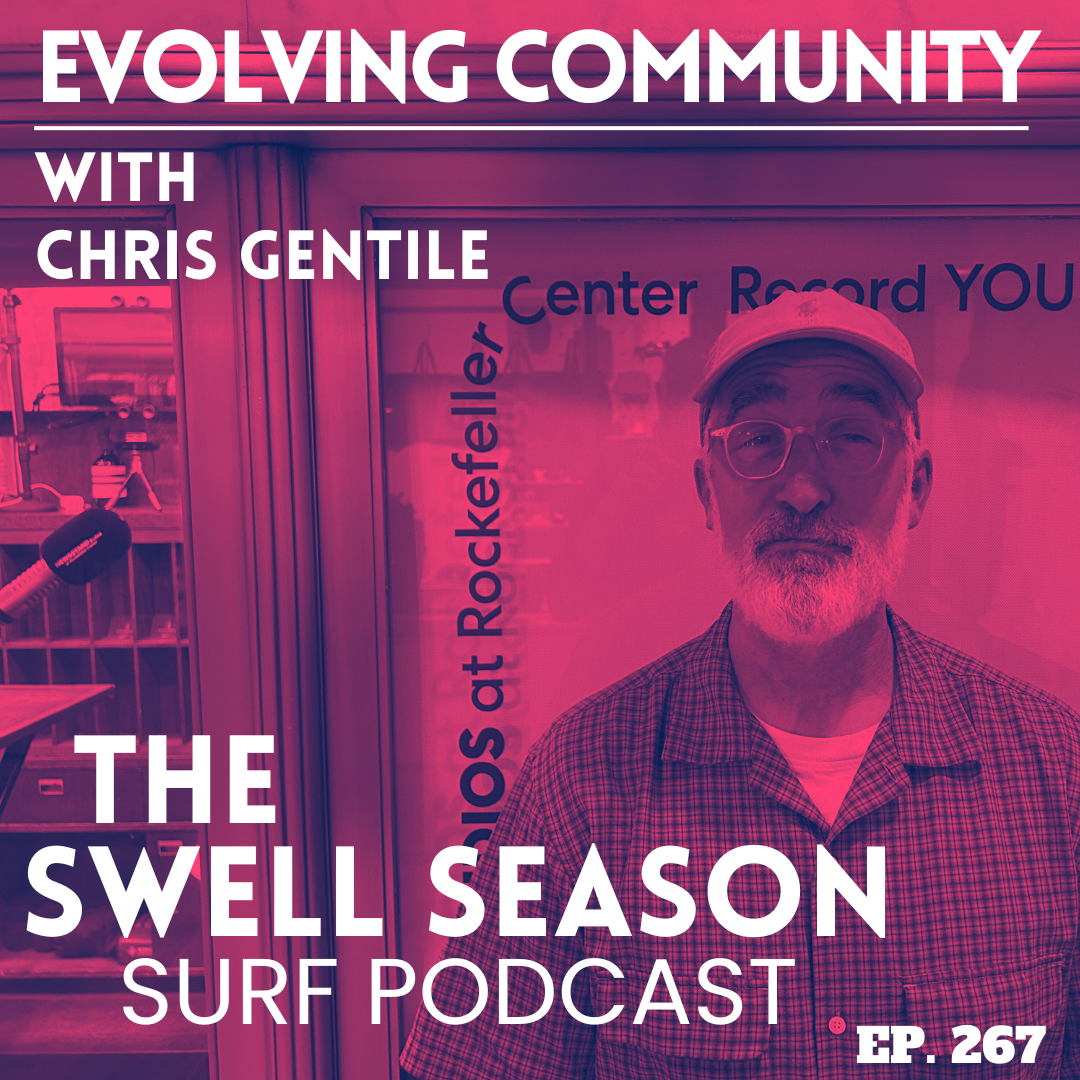
Evolving Community with Chris Gentile
[00:00:00]
Tyler: [00:01:00] Hello and welcome to the Swell Season Surf Podcast. I'm your host, Tyler Brewer. Our guest needs little introduction, but here we go. Anyway, he is the proprietor of Pilgrim Surf and Supply Store in Williamsburg, Brooklyn. He is a skilled woodworker, a studied photographer and artist, and in an apparel aficionado.
He also worked as creative director for Conde Nass Photography studio, he's also a very stylish, regular foot who has mastered the art of passive aggressive lineup regulation. I could go on with the accolades, but I think I've butter up enough.
I am of course, talking about Mr. Chris Genteel [00:02:00] Pilgrim Surf and Supply has recently announced their upcoming Shaping residency program with names such as Malcolm Campbell, Christian Beamish, Rachel, Peter Stro, JSA Vincent, and many, many other incredible shapers. If you love surfboards, this is probably one of the coolest things happening in the US among surf shops right now, and it's definitely worth checking out and I highly recommend stopping by Pilgrim and just say hello to Chris.
Uh, and, uh, yeah, well he's been a guest on the show before, but this is probably the first time we've both been sober for it. So Chris, welcome to the show. Thanks, Tyler. Oh man, that's, um, yeah, it's true. You like the passive aggressive, uh, lineup. I just, I have this memory, uh, from last summer where we were out and that guy kind of like paddled around you and then, but you kind of, you guys kind of went and then you paddled up to him and you're like, did I do something to you?
Did I do something to [00:03:00] upset you? And the guy's like, no, no, I didn't mean to. And you're like, well, why'd you do that? And it was like amazing because then you ended up becoming friends with him instead of like yelling and barking. It was, I was like, oh, that's what I need to do. I just need to be my myself, you know, from like all the stuff my mom has given me.
I needed to just pass that on into the lineup.
Chris: Well, when, when I surf with you, like my blood. Pressure goes way down because we tend to like just laugh and have a very good time. But yeah, that's a rare moment for me. Um, I mean, maybe back in the day I maybe did a little bit more of that, but, um, I don't, you know, it's just when someone's behaving badly and it's actually ruining everybody's time, uh, it's, uh, it's, yeah.
It's such a buzzkill. I mean, you know, people spend all their energy to get out there and be in the water, and then there's just one fly in the ointment. Yeah. You know, that's, it's just not cool. Um, yeah, and I, I, that's my way of dealing with it now, just like, maybe there's an opportunity to be friends. If it's, if it [00:04:00] turns into a, like a fight or some frustrating situation, then we're, mm-hmm.
Uh, then everyone's gonna suffer, you know? So I, and me, I'm, I'm, I don't want any of that. Yeah. I'm not out there for that. I just wanna get a few ways. And I used back to the grind.
Tyler: I used technique. I used the technique after that, and it worked and it was great. And I ended up becoming friends with a guy, you know?
Perfect. It was
Chris: like, it's way easier to be friendly and, and kind of cut to the chase and, and, and then to like have some stupid battle out there with somebody. It just, uh, yeah. Ugh. I
Tyler: love that you're just like, wasted time. Did I do something to you? Do you not like me? Is there something about me that you're upset?
Like, my Jewish self comes out in that, you know, and I wanna be like, Hey, what, what we, what do what? Why would you do this to me? I just wanna catch some waves with you. You know? Well, I'm, you know, I'm a recovering
Chris: Catholic, so I, I've, I've got all of the techniques that my grandmother used to, uh, inflict on me to get me to do what I was supposed to do.
So that's, uh, that was one of 'em.
Tyler: Um. Let's talk about the [00:05:00] residency here real quick, because I, not real quick. I've, I wanted to talk about this for a while, but like, I, I love this and it's really fun. I want to know, like, where did the concept come from? What did you, how did you, how did it start and how has it evolved since you kind of started doing this?
Chris: Well, I mean, as you know, um, shapers going around the world to build surfboards is nothing new. Yeah. Um, it's been going on since the, the dawn of, uh, modern, modern surfing, you know? Mm-hmm. I mean, people are going to Hawaii and shaping boards there to charge big waves, you know? Mm-hmm. And, um, yeah, it's nothing that's particularly new about that aspect of it, but what I don't think has been really explored much is this idea of, um, kind of bringing people to a place like New York that's so incredibly rich with mm-hmm.
Culture. With so many different things, filtering through it, um, all the time, [00:06:00] um, and letting there be some kind of, um, uh, exchange and interaction, um, between our community here. Yeah. Um, the other, the, the board building community that exists in New York, which is thriving and, and getting bigger. Um, and then these luminary shapers.
Um, some are young, some are absolute legends. Uh, come here and, and, um, and you know, like literally have, uh, a dialogue with, with, um, you know, everybody and anyone who wants to be a part of that. Um, it's based more on like, um, uh, an artist residency program. Yeah. Um, than it is really like, uh, something that is solely focused on making people a bunch of money.
Yeah. Um, it's funny because, uh, you know, the, the, I had to bring this up 'cause it's, it, I, I found it. Go on. I, I, it made me laugh, but it also was like. Sometimes it's like, these are opportunities for me to kind of like give some information vent. So, so, vent, vent. No, no. I don't [00:07:00] wanna vent. Venting is, is a waste of energy and, um, maybe I'll vent a little bit, but, uh, it's constructive criticism.
Yeah. Negative neuro pathways. Man, what I try and keep those, those pathways clean. Um, no, but the, um, the, the, uh, the only two sort of like niches I think in the, in the world that still use message boards are the, the deadhead community and surf community. But in the surf community, it's like the, the, the, the board nerds, like, yeah, like us.
Uh, those are the only people that use message boards anymore. So there's jam boards. Yeah. Which I think is an amazing, really useful, uh, space for people, especially like people who are backyard shapers. Yeah. Uh, trying to exchange information, people trying to understand board design better. Um, it's, it's super, super cool.
And then there's, you know, the, the people who like to vent and, and yeah, control. But, um, you know, somebody um, uh, posted about the residency in a very nice way. Like, oh, what, you know, what board would you, would [00:08:00] you get? Um, and I don't look at jam boards unless somebody tells me there's something to look at.
Um, George who works for us is Yeah. Um, a, um, I think a subscriber and pays attention. Um, he's like, oh, it's really cool, someone, you mentioned it. And uh, and I went on and we looked at it and somebody on there wrote like, uh, um, sales tax plus Pilgrim tax equals, uh, the cost of shipping. So in other words, like just order it through the shaper, and I'm like, wow, what's the pilgrim tax?
Our, our, oh, you mean supporting a small business, our incredible 20% markup on the surfboard. I mean, yeah, that's, I just, I just laughed. So I just want everyone to know, uh, um, yeah, that's the markup guys. Yeah. So it's pretty, pretty brutal. And, um, you know, it, if I had a, like a retail analyst, you know, a guru come into my store and look at what we were doing, they would go, what the fuck are you doing with this massive [00:09:00] wall of these hyper, you know, expensive, massive things that like yield barely anything in, you know, in return.
Um, it's not, it's not for, it's not why we do it. It's obviously like a, a part of, you know, the, um, uh, the culture of our brand and it's what we. Derive a lot of our inspiration from and get a lot of our direction from. So, um, I thought that was funny and to the person who wrote that note, I'm, I'm, no, I'm not, I'm not offended.
I just would love you to know that we don't really have a big markup. Anyone who
Tyler: thinks you, you know, surf shops are making money off surfboards is kind of clueless, I think. Yeah. I just don't think
Chris: they know. I mean, I just, uh, really, um, uh, but it, uh, but the, the idea, um, really around this was to give people an opportunity also to meet some of these people.
I mean, to have Neil Purchase Jr. Here is kind of dude, you know, or, and guys from Australia, Alice and Za, and, uh. You know, um, these younger guys, Kobe Hughes and Tom Moat, uh, Derek Disney. Um, and then to have Alex [00:10:00] Villalobos come out as well. Yeah. You know, um, it's like an actual board building, you know, um, kind of, uh, program.
Not just, not just Shapers too. Yeah. So Tom Mora, it's a really good Glasser. Um, I've seen a bunch of his work and it's really, really good. So, um, this gives the customer an opportunity to have like a face-to-face with people. Yeah. Which I think is really unique and, um, and dial in a custom order. Um, and I think there's, you know, a h shaped surfboard, like any H shaped object or a handmade thing in my, in my opinion, it's like the Walter Benjamin, uh, art and the age of mechanical reproduction essay where he kind of like talks about this concept of, of aura and how objects that are made by hand tend to have that or that you associate.
Um, the energy of that person with this thing that you're Yeah. You know, using to drink your coffee out of, or, or, you know, or ride a wave on. Um, so there's something, you know, it's kind of, I mean, it might might sound corny, but I, there is something spiritual about it. There is [00:11:00] something else. There's something else there that I think is, um, really important to preserve.
Um, and in my research, in, in, in, in my opinion, I, I, and I, when I think about surfboard shaping in the, in the, in the culture, the history of board building, it has all the underpinnings of what we would call a folk tradition. Yeah. And I think that is really, uh, unique and, and uniquely kind of, um, you know, it's, I mean I, modern surfing really was started kind of in America.
I mean, yeah. You know, Hawaii obviously is. Our, our, the motherland, but the, the the, um, um, the tradition of building boards Australia and here really where, where it happened. And it's a master to apprentice relationship, right? Yeah. It's like you don't go to school to learn how to shape a surfboard. Yeah.
You don't go to school to learn how to glass. You gotta push a broom around a shop, work your way in and put in the time, put in the time and Yeah. And learn from somebody who has also learned from somebody. [00:12:00] Yeah. Um, those templates, templates are amazing. It's just like, I, I wanna do, I'd love to do a whole thing on template stories and like how templates went from one person to another person.
Um, uh, it's, uh, it's so unique. Um. And it's something that, you know, I, I'd love to write a thesis on if I could go back to, you know, school Yeah. And do a PhD and, uh, but no, and I would never do that. That would be painful. Um, but, um, I've already, but a book would be nice. I mean, or just a template book or just a, or just a story about, you know, or just a, you know, uh, an essay about, um, surfboard building as a folk, as a folk tradition.
Um, and it's vernacular design too. Like if you think about how every important sort of, um, movement in, in surfboard shaping Yeah. History. It's happened in people's backyards, it's happened in their garage. And it's been by people who again, are like, you know, sometimes amateurs or Yeah. Are, or are just trying to make something work for the specific wave that they're riding, right?
Mm-hmm. I mean, that's the fish with [00:13:00] Steve Liss, uh, the Campbell brothers with the first three film board. Yeah. Um, trying to ride, you know, steep waves and Oxnard, like putting those stabilizer fins on. Yeah. Like, that's, that's vernacular design by, by definition. Um, so I just think there's like so many things to kind of like unearth and, and, um, unbox in, in surfboard shaping and board building that really still, uh, it just hasn't had, um, I don't know, like an anthropological or like a, a focus on it.
I mean, maybe it has Yeah. In, in ways that I haven't seen, but, well, it feel
Tyler: like I remember, um. And this is funny, but like Surf tech did this Oh well I have the, well, so this is that, that the fa The Family tree. The family tree,
Chris: yeah. Surfboard shaping, which is, describe it for our listeners here. Well, it's perfect thing for you to bring up, because one of the special things about this, this residency program, um, this year is the, I started having conversations with, uh, this fellow named Brock who works with the, [00:14:00]um, sunscreen company.
Yeah. Sun. Uh, we were doing an event in the, in the wintertime with mm-hmm. Uh, Jeff Mc, Fredrich and j uh, Alex Yoder. Um, and Jeff was doing this project with them called Acid Snow. It's like a sunscreen for people that are like top of mountain, you know, nice snowboarding and, and, and skiing and back country.
Um, there's a lot of sun in the wintertime, so, um, and it reflects off the snow. Oh, man. Yeah. So it's, um, it was a, a cool event and Brock came out for it and we hit it off right away and, um. I was thinking, I've been trying to get like Stanley tool and skill and other people Yeah. To kind of like come in as a, as an underwriting partner to help us just float some of the, the big expenses of like getting people here Yeah.
And putting them up, which is a lot. We couldn't do it just by selling the boards because that 20% margin, sorry to tell you guys, it's like it barely keeps our lights on. So, um, the, uh, the idea was like, let's find some help. Yeah. And then we can bring more people here and we can bring 'em [00:15:00]here comfortably and we can lessen the burden Yeah.
On them. That won't come into their margin making the board to pay for a flight from Australia. So, um, it just went, light went off in my head and I went, oh man. Like they have all these young shapers Yeah. Shaper surfers on their team. They just signed izea. Wow. So, um, I just kind of like mentioned it to Brock and then Brock started thinking about it and next thing I know, like.
Um, I'm on a call with him and Evan Slater, who's the nice, the, the, the, I believe the, the marketing director. Um, and had this great chat and then Evan came out, uh, for an event that we did, and he, and like we just, we just hit it off. Evan is such a, like, such a special guy. Yeah. So humble and like what a legend he is.
Like people Oh my God. Yeah. His,
Tyler: his early maverick days. Oh my God. He's fucking crazy. Dude and editor of Surfer Magazine. And surfing. And surfing. Yep. You know, and then Hurley marketing director. Um, hard cloud at one point. Blue [00:16:00] Torch, all those, you know,
Chris: man,
Tyler: you, you've done your homework. Um, I've
Chris: stu I didn't know that.
I
Tyler: studied the guy a little bit, you know. Yeah. I followed his career.
Chris: He's, uh, he's, he's, he's, uh, really cerebral but also very humble and, um mm-hmm. Um, apparently like he serves. Uh, in La Jolla every single day. Wow. Like, no matter what's going on, he'll be, he's in the water. So, uh, he's super committed, um, and dedicated, but he loved what we were doing and what what we were proposing.
Yeah. And what I'm talking to you about now. So, uh, they said, Hey, we'd love to, you know, nice. We'd love to contribute. So they, their generous contribution has really set us up to bring this many people this year. That's amazing. Um, and, you know, we're gonna build, um, like a series on each shaper. Um, that's little, little podcast too, to accompany it.
Maybe. I don't know. You know, throw there, you know, a hundred percent. This is, this is why, you know, we do this and I, I mean, I always try to, like, if anyone's coming to town, do I always try to flow 'em in here? I love it. Um, which, you know, [00:17:00] I mean, I do too, because you do a great job of drawing great things out of people.
So I'm not able to do that. Not shucks. Um, I don't have these nice microphones in this, this, you don't have Joe here. This, I don't have this awesome guy, Joe. You know, that can legend, uh, can just do the frigging with the rigging and next thing you know, you know, we're like on the air. Um, no, but the, um. The relationship with Sun Bum is, is great because they have a, um, a really nice mineral based sunscreen product that fits perfectly into what we do.
It's really good, um, at their generosity. Um, and what we're going to do with building assets from this thing that are, I, I kind of like wanna make them into these little mini docs, like 20, 30 minute long about the shaper, about them being here and the kinds of things that, uh, happen in that, you know, exchange I was talking about.
Yeah. So, uh, hopefully. You know, we'll, we'll get some really, uh, like good kind of historical things out of this to document it. Um, yeah, and the boards obviously, and, um, and that whole process of like, you know, the start to finish [00:18:00] board and documenting that really well. So, um, yeah, that, that was, um, that was a, a great surprise.
Back to the family tree though. Oh, so, so this is the funny part. Yeah. So thank you. Keeping, I needed that. Keep on point. Um, I was, I was searching for it. The gears were spinning. Um, so when Evan came out, he, we, we were talking about that. He's like, I was at. Surfing. When that shaper tree thing came out, I'm like, oh my God, I remember that.
He goes, and ironically it was surf tech who paid for it. Yeah, I know, I know. You know, and if a lot of people probably don't know what surf tech is that are like Yeah. In their, in their twenties, which it was like the, it was like the first sort of, uh, multiple model Yep. Pop out boards that made in Thailand.
Yeah. And same factory, I think probably as the Slater designs in the Cobra. Cobra. Oh, Cobra. Right. Cobra.
Tyler: It's, um, but it was, some people poo-pooed it, some people looked at it as retirement fund for many Andrs who put in time, you know, like Donald Takayama was yer, [00:19:00] yer all of those guys. Like a hundred percent.
They were able to junior comfortably because of that. Yes. Um, you know, but it was, it was controversial in some ways that people felt like, oh, it's, it's not being hand shaped or it's not. Uh, you know, locally made or whatever argument they wanted to have against it. But yeah, dude, they put their money where their mouth was on certain things.
Chris: And, you know, to be fair, those guys, because the way that the, um, the evolution of the surfboard, um, and the fact that, you know, we're, we've, we've all been conditioned to pay a certain price. Yeah. I mean, there's really not like a, a, a good number in it for anybody. Yeah. And it's hard to do at scale, right?
Mm-hmm. As soon as you turn into a big. Uh, company. Yeah. As a surfboard building company, then you lose that like niche cred. Mm-hmm. And then you have to appeal to this bigger market. Right. So that, and all of that's hard. Yeah. I mean, it's, and people think, oh, like, you know, channel Islands, they're just massive.
No. Channel Islands small is small, and they're all guys that are still building those things in the United States. There's nothing [00:20:00] wrong at all with like that, you know? No. And, um, it's, you know, it's the. The people going to Costco to buy the wave storms and that kind of thing. It's just an environmental and social nightmare.
Um, but, um, yeah, I, I think, um, I'm sorry if you No, um, I, I really don't have a lot of love for that stuff, but that, but the tree that you, but the fam but this, this surfing family tree, um, was made and it was like a four page, like, I think it was like a four pages, like gift pullout, pull pullout. Like a, like a double gate fold.
Yeah. Um, in the magazine. A centerfold
Tyler: spread, if you
Chris: will. Yes, yes. Uh, um, yikes. Um, yeah. I don't think people even know what a centerfold is. I know. Isn't that sad? Um, I mean, maybe it's good. Um, but the, uh, the family, this, this family tree, this shaping tree is really unique. Um, and. It's wild when you start following it around.
So Evan, he's like, I am, I'm like, I think I might have that issue. And I went and dug around. I didn't have either one of those surfing issues. Ah. [00:21:00] 'cause they made it, they made one. Yeah. Like one year. Mm-hmm. And then they made an update Yeah. To it, I think in like the, like maybe mid, maybe like 2010, something, something like that.
Yeah. Um, so anyway, like Evan goes home, we, you know, about a week later in the mail he sends me to the two issues. I'm like, oh man, this guy's too, too, too good. That's awesome. So, um, we've got, we've got it. Uh, we printed and, um, tacked to the wall in the shaping room. And what I want to do. Is have newer people add to it, kind of like add to it.
Um, what's cool is that many of the people, like, I think maybe half of the people are in the, in the, um, uh, in the residency are on it. That's amazing. Just kind of cool, like shr obviously, and, uh, you know, um, Malcolm and I think Neil's on it. Uh, so anyway, that, that, that's exciting. But, so yeah,
Tyler: listeners, if you like, just to mention like, basically what this is, is like, it starts with like some of the first surfboard shapers and it just.
[00:22:00] Becomes this tree, and you see all these offshoots, and then you have all these disciples of different shapers throughout the years, and then their disciples and their, you know, influences. And some people who may not even have trained under a shaper, but they were influenced by that shapery. Yeah, exactly.
And have like certain DNA in their boards, like San Diego can be traced, you know, like to skip and, and uh, you know, a whole crew there. And those boards are made specifically for those waves. And, and so that kind of then spread and someone took a little bit of that and mixed a little bit of someone else.
Chris: Like, and then you can see some of the shapers back in the day. Um, their, their influence is Yeah, huge. Like Quig obviously. Oh gosh. Yeah. Um, and, and Simmons and. Um, I mean, those two and, and Matt Kivlin are kind of the architects or the modern surfboard, you know, they're the root, they're part of the roots, you know, or the base, their contribution.
It's like when Combined Trunk are the, are the, are the modern shortboard, you know? Um, it's pretty wild. It's,
Tyler: it's awesome. I wanna ask then, [00:23:00] like, have you found then, over the last few years, like the Shapers who come here and then surf our waves and ride the boards that they've shaped here, do you feel like the ones that have come back have, have changed up what they shape for here because of the conditions?
Oh, that's a good question. I mean, or if it influences them at all, I wonder.
Chris: Hmm. Yeah. I mean, I don't think we've had enough time for that to really like, take root in a, in a, in a really visible way. I, I do feel like. Tristan MAs, uh, who's a fantastic acid. I feel like Tristan's boards that he made the last time around had a little more volume in the rail, like a little bit more forgiving for beach breaks.
'cause he tends to make these very foiled, uh, you know, uh, displacement hall. Yeah. Um, uh, style boards that have, they're, they're way more forgiving. They're way more user friendly. Most of his boards. Yeah, some have a little down rail and an edge and, um, in the tail. So, but, uh, I do feel like his boards [00:24:00] have, he's, he was, he's been influenced by it.
He's, yeah, he's, he's served, he's now three times now, right? This'll be the third time. Yeah. He's comes in late October and, um, I'm, I'm excited he's gonna bring his family. Uh, and Nicholas, who's his Glasser, he always comes as well. And, um, Maxim came with him the first time. And Maxim is, uh, beds. We have Sokoto surfboards, we have a couple boards of his in the shop.
Um, they're all incredible craftsmen and so humble and there's no, no beefs, no bravado. Yeah, it's really interesting. I think maybe France, it's maybe kind of the way it is there. Mm-hmm. Um, it, there's not like, um, um, um, a mean-spirited competitiveness there. It's like, uh, very different.
Tyler: It's because they're social, social democracy, you know, they don't, they got a really good safety net and stuff, you know, they don't have to, it's not so cutthroat as it is in the US I guess.
Yeah, I guess so. Yeah, we need a little bit of that.
Chris: Um, but yeah, there, uh, he's, he's been here three times and, um, he's a joy to have here and he's such a, um, uh, historian, um, very well studied [00:25:00] and mm-hmm. I mean, he, he loves art. He loves avant garde jazz, like Avantgarde jazz. He loves, um, you know, to be, to see live performances.
He likes to. Make music. So he gets a lot from New York when he's here. Like he take, he gets, he takes the opportunities to like, you know, get outta the shaping bay, go to the museum, we go to galleries, we go see, uh, you know, shows at the stone, you know. Yeah. And, and, you know, places, you know, that, um, he's gonna gets some fuel from.
Is there,
Tyler: um, do you find, like you've been in the shaping room with all of them, and I'm wondering, like, do you see, and you, you know, all their personalities and I wonder like, do you see any commonality amongst any of the shapers or any, any traits that you see? As like a through fair with them, that, that like kind of links them at all, like, oh, it's interesting.
Hmm.
Chris: No, I, you know, I, what's interesting to what I've, like, what I've observed is that everybody has their own way of approaching mm-hmm. [00:26:00] The blank, you know? Um, they're like chefs, you know? Yeah, yeah. You know, everyone, you know, has their way of going about ma you know, give them the same dish to make, they're all gonna go at it, you know, slightly differently.
Yeah. Um, and I think that's what's fascinating is like, like what their technique has become and evolved into. Um, one thing I feel like is a, is a constant that I've, I've noticed and the people who are really proficient. Is that they do almost all the work with the planer. Yeah, with the biggest gnarliest scariest tool.
They, they get the work like, you know, 80% of the way there, sometimes even further. Wow. In the case of like Ryan Birch Ryan, just like, you know, and it's incredible to watch how much, how much, um, the tool is like a part of their body, you know? Yeah. They have so much command over the, over the tool, uh, and they have such an affinity for the materials.
It's like, you know, it's like second nature, but they just put the time in and it's, you know, it, it's, it's [00:27:00] spectacular to watch, man. I'm like mesmerized by it. Um, so that would be the one thing that I, I feel like is, is a constant, is that the, the planer work is the, and I think as they all say, the more you do with the planer, the better the shape turns out, the more ac, the more accurate.
It's soon as you start going at it with sandpaper and you know, screens well, it's the only
Tyler: real constant, right? Like you put hand on there, like. Your pressure's gonna be different. Yep. Your hand pressure's gonna be different from the front to the tail. Mm-hmm. In some way. And there's gonna be an imperfection.
Totally.
Chris: And I think other, also, every board is slightly imperfect. Yeah. It's hand shaped, which is part of the, the charm.
Tyler: Whereas I like
Chris: to call 'em perfectly imperfect. Perfectly imperfect. Well, you guys had a whole like, show you did about it. It does not work. It does not work. Yep. Which is true. I mean, if it floats, you know, I mean, it's gonna go,
Tyler: um, it's, it's, I think it's like such a cool concept, like what you're doing and like, it's something like, [00:28:00] as a kid we would've freaked out over, like would've been stoked on.
And now it's just awesome to see it. And I'm kind of surprised, like I don't see that more from other surf shops around that are, uh, encouraging that, you know, like that to me is like a great way to keep your store relevant almost.
Chris: Mm-hmm. You know? Well, I mean, I'm, I think we're really fortunate that my, my studio is across the street from the shop.
Yeah. And I was able to build that bay there, you know? Yeah. So it's, it's adjacent. It's like having a, uh, a shaping room in on the waterfront in Williamsburg is kinda weird. You know? It's like, um, uh, it's not something that you could probably go and, and plug in. Um, so we're, we're very lucky to Yeah. Have the, the opportunity and the facility to do it.
Um, and I think it, like, it's, it's hard to run a, a surf shop. It's like, as, you know, your parents were in one for how many years? 60. 60 years. Yeah. It's, I mean, uh, if you're like a mom and pop, like, you know, um, kind of [00:29:00] core surf shop. Yeah. Um, it's, it's hard. It's a, it's a grind and it just never ends and.
Like throw a shaping room in there on top of it would be extra hard. Um, I think, I think, I think we're just in a, in a situation where we have, um, the right elements and, um, I humbled by that. You know, we, we have a great landlord, uh, across the street, our friends that own that building, and they, they, um, they knew I needed my a studio and they offered it to me and, um,
Tyler: nice.
Chris: Uh, so we're, and they, and they love that we have this thing going on too. Yeah. So, you know, we're, we're fortunate. It's, it's really, you know, again about being a part of a community. You know, we've been in that neighborhood for, God 24 years now and, um, it's crazy. And, um, had to shop there for 17. Yeah. And, you know, we, we have a lot of great people in, in our, in our, in our world and around us, and we're, we're lucky.
I don't think that could have come about without kind of putting that time in, you know.
Tyler: Well, it's, I'm curious, like, what have you learned over the [00:30:00] past 17 years, like, of running a surf shop? Like what are some of the. Lessons you've learned to keep, keep it relevant, right. Because you, you know, you're in Brooklyn, which is not easy.
Um, you know, to, you know, especially like when you first started, it was wasn't easy 'cause there was no one there. And now it's not easy because there are so many people there and it's hard to keep, uh, that authenticity, you know, and it, and I imagine it must be tempting at times to want to sell out or want to like, kind of ditch the boards and just focus on clothing or something like that.
Or even like, just ditch the events and all the other stuff and just focus on, you know, the, the apparel side of things. Uh, which is probably way more lucrative. And I'm curious, like, what, what have you learned over the years to keep yourself relevant and keep the store afloat basically? Um, besides robbing
Chris: banks?
Yeah. Which, that's why I have a beard. 'cause if I have to, then I have, I can shave it off. [00:31:00] I just kind of blend in. Exactly. Um. No, I, that's a good question. Um, well, I'll just say, I, you know, fashion is funny. We're kind of ignored by the fashion industry and we're kind of ignored by the surf industry. Yeah.
Which is great. Yeah. You know, because we kind of do what we are doing. It's, we do our thing and, and, um, I don't really pay attention to like any of the sort of make-believe contests that Yeah, some people feel like they're in, it's just not, uh, interesting to me. Um, so, you know, I what I, what I've, what I've come to figure out is that the, the in fashion or brands, the, the, the brands I tend to get excited about or drawn to, um, they're, they're designed and, and they're conceptualized.
Um. Uh, in in reaction to culture? Yeah. Some niche, part of culture, some subculture. Um, you know, there's, uh, you know, engineer garments, you know, for example is like, you know, the dikes, uh, [00:32:00] obsessed with, um, with like military and work wear and the, and, and, and the history of, of, of those garments and, um, and why they were made and what they were made for.
And that's kind of how his brand. Started, right? Yeah. And I, and I, and I love it. He's obsessed. Um, and for us, like that's the, that's surfing, you know, and the, the, not just the act of surfing, but like what goes into being a surfer mm-hmm. And the commitment that it takes and the, uh, and the travel and the exploration and the, um, disappointment and disappointment and the, and the discipline and the, yeah.
And, and also like the, the, the board building part of it, which is craft. Yeah. So we're, we make clothes that have a, have a high degree of craft in the materials that we use and the construction. That's, that's a very important part of our, our process and our, and our company, our brand. And the surfboards, in my opinion, are just a direct reflection of that.
And that's, and a, and a huge point of inspiration for me personally. [00:33:00] Um, so, um, yeah, I've, I've learned to like, like stay the course. I mean, surfing's really not cool right now, you know, like I, and it's funny because like. 10 years ago, you would go up and down Madison Avenue and Yeah. And every single luxury brand's window, there'd be like a, a, a branded surf surfboard, you know, a gold surfboard with, with Chanel, you know, seas on it, you know?
Mm-hmm. There'd be a, the, the board in Louis Vuitton, you know, it was, um, it was cool. Yeah. Like it was fashion. It was a, it was fashionable. It was a cool, it was cool to be a surfer. Now it's moved on to running or something. Yeah. I don't know. It's just, it's, it's shifted, which it does and it always happens.
It's happened to skateboarding, it's happened to surfing many times.
Tyler: Yeah.
Chris: Um, and it's great.
Tyler: Yeah.
Chris: It's like, okay, you know, like now we're kind of like, you know, we're in the shadows a little bit and it's, it's good. I, I enjoy being there and it's not like our, our sales are, have, have, have slumped or anything like that.
It's more about, um, us just kind of staying the course, doing what we're doing and, and being relevant [00:34:00] and being there for the people who, who are actual surfers. Um,
Tyler: well, it's interesting,
Chris: like your
Tyler: clothing. Uh, which is beautiful and, and you can tell it's extremely well built and will last a long time. I mean, shoots, I even have t-shirts from you that, you know, from like 17 years ago.
Well, that's cool. I wanna see those. You know, I mean, I, they don't fit me as well, but I still got 'em. But they, you did trim out. Well, thank you. I saw those, like, those like, you know, kettlebell thrusters you were doing. Yeah. Oh yeah. You know what, you know, full squat. That's pretty impressive. Gotta give, uh, Lois credit on that one.
Uh, um, but it's, it's interesting, like your clothing though, if you were to look at it, it wouldn't be like, oh, that's a surf brand either. You know, like, it, it, it is, it's something that I find to be relatable to a wide range of people. Mm-hmm. Like, anyone could wear it. Right. You know, it's not like, um. A surfer uniform that I think we grew up with, right?
Yeah. Like it was all Billabong Quicksilver logo and you know, and the [00:35:00] two thousands, it was a stretch board, short and whatnot. Like it's something like, I feel like what you've done is you remain true to who you are and what you vision is of, of surfing, because there are influences of surfing in it.
Don't get me wrong. Like, I'm not saying it's not, it's not obvious. Yeah. It's not, you know, but it, for the, the discerning eye it is, right. Like one can see like the sixties influence of like in the women's clothing and some of the bikinis or bathing suits you've carried in over the years or, uh, the, the work wear that shapers probably would wear, you know, back then and they wear now.
Like it's you, you know, you pull from all these different places and I, I was curious, like what do you, what are you pulling from for influence? Like every season must be really difficult and I'm curious like where do you go to, to restore that creativity and that energy and
Chris: influence? Well, I mean, I always joke that, you know, you don't wear clothes when you're surfing.
Right. So, so, you know, you're not making clothes for, for surfing. Exactly. Um, so, [00:36:00] you know, what are, what are you making it for? And I don't, I just, I don't really think that like our brand is limited just to like, like as you said, to like, uh, the surfer. Yeah. I mean, if we were ad be a pretty tough place to be, you know?
Yeah, yeah. In Brooklyn, New York. So, um, you know, our inspiration get, we, I draw a lot of inspiration from, um, the outdoor world. I mean, we got coined as being like one of the epicenters of Gorp core, whatever that, you know, back in the day. I mean, I think that's so funny. The Go Core. Um, uh, it's such a funny, the GOP is such a funny word.
Um, I remember like, trying to remember what it, Gore-Tex Pull? No, no. It stands for, uh, granola. Granola, raisins. Oh, what? God damn. I mean, I wish we had granola outdoor. We shoulda. No, it's like, it's, it's like basically like, you know, like you're a, you're a, you're a, you're a crunchy granola, hiking person that wears the wears outdoor gear.
Yeah. But like, there's so much, um, about that, that world and, and those designs and so much [00:37:00] about, um, work wear, uh, and, and also, you know, military, although we try not to draw too much from that because I, yeah. There's, I don't know, I feel two ways about it. It's like, kind of feels kind of weird to make. Uh, I mean, I'm wearing a, um, um, I'm wearing a, a baker pant right now.
Yeah. Which is like a, the Vietnam era fatigue Yeah. That my father wore when he was in Vietnam. Um, there's a subversiveness to wearing it. Yeah. To wearing military. Of course. Like what? The beat the surfers. The beat the beat Nick did in the, you know, um, exactly. They were, they were wearing the fishtail parkas with all the Sharpie.
Mm-hmm. You know, like peace signs and, and, and poetry written on them. Um, and then you have like the, you know, the, the guys that wear all the stuff to, you know, like play, play, play, play cosplay, play cosplay, military guy, military. Yeah. That's terrifying. Um, but this, this, you know, the, the utility of, of those garments and also the, the looseness of the fit and the, and the, um, and the fabrics that were really burly.
Um, it's relevant, I mean, to [00:38:00] the kinds of things I'm involved with. And I think a lot of people that live in the city, I mean, I always joke that like outdoor gear and that kind of gear, it's more relevant to us as, as city dwellers. Than it is to someone that lives in, in suburban America. Yeah. Because we're like schlepping 40 pound bags of shit around with us up and down the grossest subway stairs.
Mm-hmm. And the worst weather. Um, um, there we go. There we go. Good old raisins and peanuts. That's what go stands for. Thank you. Thanks, Joe. Joe. Oh man. Are the researcher on, on, on premises researcher? Are you the
Tyler: new, are you the new Jamie from like Joe Rogan or whatever? That's amazing. What was the, what was the Howard Stern woman's name?
Oh God. Oh my shit. Why? Can't
Chris: remember. She's so good. Damn. Can't Marsha. No, no. Oh, dammit. Rob, Ross, Robin, Robin, Robin, Robin, Robin. Yes. She's still, they're there. Their thing they still doing. I don't listen to it, but, but, but I, I've seen it and I'm like, wow, she's still, they're still there busting each other up.
Um, [00:39:00] anyway, um, where was I? We were talking about outdoor influence. Yeah. The outdoor influence. And then all that stuff comes into play. Um, and, you know, at the end of the day, like most men's brands are just riffing off of classic American casual wear, right? Yeah. I mean, that's really what it is. A button down shirt.
Mm-hmm. Uh, pair of plain fronts, slacks, you know, like, uh, it's, it's not rocket science. Um, but the where the, where the nuances and where the, um, and where the subtleties are, are in the fabrics and in the fits and in the construction. Um, and then there's, you know, there's some people that are designing some really.
Interesting. Yeah. Stuff too. It's like, you know, um, borderline avant garde. Um, we have a little bit of that. Um, but, you know, the majority of what people are gonna wear is, uh, hasn't dramatically changed. No. You know, it's, it's the subtle, subtle shifts in, um, in fit, really, you know, um, and, and, and fabric and, and, you know, color and uh, [00:40:00] and then footwear trends.
There are all sorts of things. Um, but it's like being in New York and being around all these interesting people and having really interesting employees, young employees that are really smart and have a really strong sense of personal style and are interested in like, other things outside of surfing.
Mm-hmm. Like art and design and music. Their energy is something that I, I need, I draw off of them, um, and get influenced by them. Um, you know,
Tyler: I've noticed that, and like, I was curious like, what is your hiring process like, because. From experience for me working, you know, running, managing my family, retail, like it was the hardest thing was finding good people to work and to reliable people.
And obviously being on Long Island I think is different than being in New York City. Your, your talent pool is different, but it was fucking hard. It was really hard to find good people. It would be like 20% of the of them would be good and the rest would be kind [00:41:00] of middling and not really excitable. Yeah.
And when I come into your store. I always greeted really nicely, even if they don't know who I am, you know? And, and I don't go in there and be like, do you know who I am? You know, I, you should. The only, the only time I do that is if I have to go to the bathroom and I'm like, I'm like, dude, Chris said I could use the bathroom.
It's fine. No. Um, but like, that is fair. But you, they're great. You have, every year it's always someone who's really smart, really knowledgeable, or at least hungry for that knowledge. Uh, they're respectful, but also they're all like, you know, when you get to talk to 'em, like they're all really interested in something creative or doing something unique as well outside of their, their job and they all go on to do incredible.
You have like, I dunno if you ever looked back at your past employees and then see where they are now and, and look on a little bit
Chris: with pride. Oh, I mean, I'm just, I, it makes me really happy to see, I mean, I, I get a, I get like a [00:42:00] buzz out of seeing people. Um, just climb and, and, and chase their passions and actually, you know, arrive.
Yeah. It's, there's, uh, nothing greater than that. And I mean, I think in the case of everybody that's worked for us, I mean, I'm, I might be like a, a small little step for them, or they mm-hmm. I might've given them a little boost here and there, but it's all them. It's, they, you know, they, they're, they've done it.
Um, in fact, in a lot of cases I feel like I've gotten more from them than they've gotten from me in a lot in on, in, in, yeah. A lot of instances, a lot of people I feel that way about. Um, and, um, yeah, I get really, um, happy when I think about all those relationships that I, we've cultivated with these young people that have come through the store and they're still our friends.
Yeah. And we still, some of them we still do projects with and they still come back to see us. Um, and I know when we hire these, we're lucky. Like I, and I mean, I feel like we're fortunate I should say, because yes, we are in New York City. Um, you know, we, [00:43:00] we. Uh, you know, we're our influences in the things that we're engaged in are, you know, range from surfing to mm-hmm.
Fashion to art, uh, design, um, uh, music Yeah. Is a big part of our, our world. So there's a lot of different things that people come to us being, you know, in terms of being attracted to us Yeah. And wanting to work for us. There's like, you could be like a, you know, a combo platter of, you know, two or three or all of those things.
Um, and what's happened now is that those people have friends that they're like, Hey, if we, if we're looking to hire, it's like word of mouth. We, we will put it out there every now and then that we're, we're looking to hire and we'll get a lot of Yeah. Applicants. And, uh, it, the, it's, it's hard sometimes because you just, you know, it's hard.
You can't give people a personality test. Yeah. You have to kind of feel them out. And, you know, there's only been a few people in the 17 years of having a business in, uh, in, um, in Williamsburg and having our business, uh, that we've had a, a. [00:44:00] People who are problem.
Tyler: Yeah. Mike Matcher we're talking about you.
Oh yeah.
Chris: Mike is, he is good friend. Listeners. No, Mike. Mike is actually like, um, I mean, yeah. Mike has, has, uh, so much of him himself in our business still to this day. He probably doesn't even realize it. The DNA is definitely, yeah, man. He's, um, he's a such an important person and he's the one of the, one of the most important and, uh, people in the surf community that people don't know.
Yeah. You know? Yeah. Yeah. He's in the shadows. He is. But he's, uh, the stuff he's contributed and still contributes is, uh, you know, it's, it's, it's really special. Mike Mike's awesome. We could, we could have a whole episode about Mike and we should have Mike on here. We'll, one
Tyler: day. One day. One day. We'll get him from downtown here.
Get him from up uptown down here to come Trying
Chris: to come back to your thing. Yeah. So I'll just say this. Yeah. Uh, our, our employees have, um, are everything. Yeah. You know, you can have the coolest. Store the coolest. Build out the best stereo. The coolest [00:45:00] records. And the coolest brands. And the coolest surfboards.
And have the, you can all, all of the trimmings. Yeah. You can have all the ingredients of like, something that could be good, and if the people there aren't good, you can just light it all on fire. Yeah. Like literally. Like it, they are the ones that make people feel, um, connected, welcomed, uh, and comfortable.
Yeah. Um, and as we were growing up, when you walked into a skater surf shop, you were vibed to them the second you stepped in the door, you know, and it's like fucking hilarious. And, and when you're a kid that, that's so almost like a rite of passage, right? Yeah. And that kind of is, I kind of like it in that space.
Yeah. But not when you're a fucking adult, you know? I'm sorry. When you go into a store and, and people act like they're, they're too cool for school. They're too good. They're too good to be there. Yeah. And like, you're, you're bothering them. I, I, I don't understand that. I, and I, I don't see those places lasting.
Yeah. But, um, we rarely are conscious of that. Like people. That we hire have to [00:46:00] have a personality that we feel like is going to be that like welcoming and, and, and also are, they're gonna get along with everybody else on the team. 'cause when that, we've had a few instances of that where there's like a, somebody who brings a level of negativity and drama into the mix and then it starts to poison the, well you gotta cut that out immediately.
Yeah. Like, that's what I've learned.
Tyler: Well, curious then, like your management style must have like really evolved as well. Um, yeah. You could talk
Chris: to some of my employees about
Tyler: that. Well, it's interesting 'cause you, you, you, it feels like now, um, you know. Or over, however. However, for many years, like a lot of your employees have certain skill sets and you almost like let them run loose on certain projects, you know, or do certain things that they're good at.
Like Chelsea Slater's a a, a really good example of a former employee of yours who I feel like you kind of just gave her certain opportunities to go run wild with [00:47:00] certain things at Pilgrim and produce some amazing, you know, uh, content and marketing and branding, and also gave her like incredible experience as well.
Yeah. Chel. I
mean,
Chris: if I, if I could have Chelsea back. Yeah. If I could have Chelsea. If you could afford her. If I could have had her all these years, I'd be, yeah. Um, never. No, but she's, she's, uh, she and her husband Sebastian are doing incredible things. Yeah. They have, they're own production companies. They make, they make films together.
They make, um, you know, they, they're guns for hire. Yeah. Like a cameraman and a producer, like director. Uh, they're incredible. Um, and yeah, I mean, that was, Chelsea's a great example. Chelsea was a part of the first kind of like studio Yeah. Uh, that we had. Um, and, um, yeah, she, she, um, she, she's just become a good friend.
And Sebastian too. I mean, then I, I hired them when we started making ours. Yeah. Like when we made self discovery, um, we, uh, we hired them, um, Sebastian to be the dp [00:48:00] and, and Chelsea was producer. Yeah. That was, uh. It's awesome. And I've, I've hired them since to do a, a bunch of different stuff for us. Um, so,
Tyler: but your style of management then, like where did that come from?
Because it, it's definitely changed, you know, from, from, uh, kind of a little bit more hands off, you know, with, uh, mollusk days and then mm-hmm. Like now it seems like, um, almost, uh, this encouraging figure, it feels like, you know, it feel like from the outside looking in, it looks like, um, you don't, you're not doing a lot to manage them, like they're just doing what they need to do.
Like, I very rarely see you like directing and telling people to do things. Like they just kind of intuitively do it. And I'm just curious like how you get employees to do that.
Chris: We have very smart people working for us, so, you know, it's like you give them direction and they, they, they, they do it, you know, um, it's.
Um, I, I feel like when you micromanage people and you're like hovering [00:49:00] over people, it just doesn't work, you know? Yeah. It makes everybody like uneasy and edgy and, uh, it just, it kind of ruins the, if the environment, you know? Yeah. Like, if they're having fun and they're in a good space, then that energy's filling the room, right?
Yeah. So, um, I, I don't, I, I don't think like. Yeah. Micromanaging is good. And I, I also don't like being a boss man. I, I really hate when I get put in a position where I feel like I have to, like, be a boss. Be a boss, and discipline somebody. It sucks. I mean, it rarely, rarely, rarely happens. I mean, I, I, I don't, I can't even tell you when the last time it was that it happened.
I don't have to talk to people like that. Um, it doesn't work. Yeah. You know, it just doesn't work. Nobody wants to be talked to like that. I don't wanna be talked to like that. So, um, you know, I know they're not my, my friends, they're not supposed to be my friends. Yeah. Um, I, which, you know, we spend a lot of time together.
I, they are my friends, you know. Yeah. And, uh, but they, I think we have a nice relationship where, um, you know. I, I, I sometimes get a little too [00:50:00] attached to people, you know, and I know they're all gonna eventually go, yeah, that's New York. I mean, no one's here to have a career as a, as a retail associate. But then we have other people in our, in our studio, in our office, yeah.
Whoops. Um, that are are usually around for, for longer. So, yeah. Um, you know, as, as we grow very slowly, you know, I'm, I'm trying to help grow those people too. I mean, I think that's the, the idea. Um,
Tyler: your wife works with you too. Yep. How is that like, 'cause I dunno, my wife is like, oh, let, I can't wait to come start working for you, your company.
And I'm just like, yeah. I mean, it, it
Chris: there, I mean, I, there, I'm sure that there's a whole podcast or a slew of podcasts about couples that work together, um, or don't anymore. Um, but yeah, it takes a lot of discipline. Um, and, you know, we try to set up some, um. Some parameters, uh, and some rules around, like when we talk about the shop, when we talk about the business Yeah.
When we talk [00:51:00] about employees. Um, so that we don't just let our lives just get consumed by it. Yeah. Um, and we also, like, you know, I'm, I'm not sitting at a desk all day long, like I'm doing other things. I still work in my studio. Yeah. You know, and, um, you know, I'm, I'm going on buying meetings. I'm going, you know, I'm traveling for, for, for work as well.
Um, and Erin is, you know, um, she's, she's an incredibly intelligent person and also incredibly empathetic person. Uh, she has a, um, a master's of public administration from one of the best MPA schools in the, in the country at University of North Carolina and Chapel that might help Chapel Hill. So she, she's, uh, you know, she worked for the city.
She worked for one of the largest nonprofits in New York, um, uh, before deciding to like, build Pilgrim, um, and to be a part of Pilgrim. So, you know, her skill sets and inter managing style and interpersonal communications, she's so great. Is, is incredible. So, you know, where I'm like, kind of all over the place and, you know, she, she can, [00:52:00] can, she can distill things and, and focus things when it comes to our employees, when it comes to accounts and different things and, and really, um, and, you know, we're, I think we, we balance each other out really well in that regard.
She, she can do things that I cannot, she does. She's our fiscal person. Um, she's really good at, at managing, you know. Yeah. The business. Um. And I'm on the creative side. Um, so
Tyler: how was that decision when she committed to coming to work and to build a brand Build Pilgrim with you? I'm curious like what that looked like and how, how that e evolved.
Actually, if you, if you don't mind me asking that, I, I hope you don't mind me getting personally. No, no. Well,
Chris: we had like a, we had our, our, uh, we were having our, our second kid right when we started Pilgrim. Yeah. Um, so, um, you know, it was, she was working for this very like the, this big, big nonprofit, um, and had a very important job there.
[00:53:00] Uh, she had to go into the city five days a week, 40 hour week. Um, she was gonna get some time, you know, like some leave. Um, and when we opened Pilgrim, it started to build this momentum and, um, we started making clothes in the garment district. You know, we had, we had, um, some legs and um. She was, um, you know, gonna, she was about to have our guy Cal and, uh, we, we just were like, okay, we gotta, you know, what are, what are we, what, what are we gonna do with Pilgrim?
It's like, it's kind of, kind of, kind of moving. Uh, and, um, I, I thought like, she was like, well, maybe, maybe I can just work on the shop. And we were just like, this would be, this would be a, a dream. Yeah. You weren't, not to want to leave the neighborhood, you know? Yeah. Childcare would be easy 'cause we'll be right here.
You know, there's all these things that just kind of like started making sense about mm-hmm. Her working at the business and I, I mean, it, it felt like very, she was fully committed to it. I thought, she's gonna do this for a little while and be like, no, I gotta get [00:54:00] back to public service. I can't, I can't, you're, you're insufferable.
I can't
Tyler: do this. No. Or just like, I'm, I thought, you know, she's just
Chris: gonna be like, I'm just, this is just too easy. It's, it's, well, no easy. And also it's retail and it's not very stimulating maybe, or it's not like it, I mean, it's, it's not doing things for people. Other people, the people that need, um, that need services.
That need things. Yeah. Like, that's where she's really committed. Like she's, you know, she was in AmeriCorps. I mean, she's, I mean, yeah, Erin, Erin's a badass. Seriously. So, you know, um, she's not motivated by being rich. She's not motivating by being popular. Yeah. She's not, she's very behind the scenes. Uh, but at the same time we were, you know, it was like, okay, we're having her second kid, like, you know, to build this business and make it something special and do it, you know, ethically, like socially and environmentally, uh, um, sensitive, you know, um, and you know, in our pursuit of making clothes and things Yeah.
Are the brands that we bring in like this, this could be really good. So, um, [00:55:00] I thought it was gonna be. You know, temporary or maybe a few years. But it, um, it's, it's, I mean, yeah, she's, she's as much a part of it as I am. I mean, we're, we're partners in it. So
Tyler: what is, how has Pilgrim evolved from what your original vision is to where it is now?
What do you, how big a difference would you say it, it is? Um, yeah, that's a good question. Um,
Chris: I'm full of them. Well, um, well one, you know, one thing that was what I never saw coming when we first opened was, um, this interest that we got almost immediately from Japan. Yeah. Um, that was wild. Um, and, you know, I had known about that landscape a little bit, but I didn't know about it in, um, um, in ex it was expert kind of knowledge.
Yeah. Um, I just knew it from surface knowledge. Um, and when we started getting. Bites, or people were coming and handing me business cards and introducing themselves and wanting to bring me to Japan and go on these [00:56:00] trip, you know, trips, fly me, you know, oak around. And I was just like, whoa, what is going on here?
So, um, I never saw that coming. And, um, uh, the, the good thing is like, while, while that was happening, you know, I was meeting different groups of people and I met this, uh, I met, um, our now director in Japan. Taaka. Yeah. Taaka Zumi, who's now become like family to me. Yeah. Um, and he, um, he, uh, he, he and this group of guys from Beams were the first guys that I met there.
I was like, oh man, these guys feel like I've known them for a long time. Or, and like, they're, they're funny. Yeah. And they're into weird shit and they, they understand what we're doing. They, but like, and they, they're interested in doing something with us. So I never, I never expected that or thought about it.
It wasn't even a like. On my radar or an expectation or a dream or anything, just to, to have a, a business in Japan or have a partner in Japan. Yeah. So that would, that would be the one thing that I think was unexpected and [00:57:00] also like in a really big part of, uh, our brand and a big part of like, me evolving too.
Yeah. Just like having to grow a relationship with like an international partner. Um, I didn't go to business school. Yeah. I'm a visual artist man. You know, like, I'm like, I went to grad school and, you know, uh, for, for, for, for sculpture and photography, you know, I'm not like a, a, um, a business person per se.
Um, but, uh. What I've, what I learned is that relationships are everything. Yeah. Um, they're everything. Um, and having good relationships with people and having open communication with people, um, is, is, is essential. And, you know, the two things that fuck up everything, uh, and I think in every Yeah. Aspect of life, uh, sadly is poor communication and, and money.
Yeah. Yeah. It, it definitely gets in the way a lot of the time. And if it's the, the reality is if, if you're having a money problem and you have good communication, usually the money problem is [00:58:00]can, can get solved pretty easily. Yeah. Yeah. It's just the, the lack of communication and it's, you know, you learn that, you know, it's like, uh, it's, it's, it's interesting.
So, um. And, you know, and now, like, like before you were talking about like all the, the events and you know, all these things, uh, that are a part of what we do. It's what makes, it's what makes our brand relevant. I mean, if we were just making clothes, I don't think people would care, you know, I mean, I mean, there's a lot of places to get clothes, but if you don't have a, a, a, a source or a focal point Yeah.
For where you're getting your inspiration from then, like what, you know, what is
Tyler: it? Well that seems like, it seems like such a thing that the surf industry kind of has abandoned, and I know you're not, you're very, very far adjacent to the surf industry, I would say, but I imagine you do keep tabs at certain points.
Well, it's kind of disappeared.
Chris: Yeah. You know, it's really sad.
Tyler: Um, more surfers than ever before, but. Somehow the industry just kind of has kind of [00:59:00] disappeared in some ways. I don't
Chris: think they've grew, I don't think the industry grew up with the customer, and I don't think the, I think the customer's changed.
Yeah. You know, I mean, there's not a lot of people that feel like they need to walk around with, like wearing, I'm a surfer on their sleeve. I mean, yeah. You know, it, it's just different now. Um, so, well it got co-opted,
Tyler: I would say. Oh, yeah. Yeah. You know, I would say like private equity particularly, and, and also going public, you know?
Mm-hmm. Those two things. That's dangerous.
Chris: Yeah.
Tyler: They were to. You, you got to see this. Oh,
Chris: yeah.
Tyler: You got to see this firsthand by, with your consulting with Quicksilver, you
Chris: know?
Tyler: Yeah.
Chris: It was really, it was really disheartening. Um, uh, and, and, and Disenchanting too. Yeah. You know, I mean, I, it, it, and I felt so badly for a lot of those guys.
I mean, they dedicated their lives to, to these brands and, but it was also like, there were just people getting, it was just getting too big. And, you know, people were getting hired because they were ex pros. Mm-hmm. And like you ex pro getting hired to, to be, uh, you know, a, a creative director or a marketing director of no college education, no experience doing that just because they were cool and they had a [01:00:00] nice personality and they, yeah.
And they were kind of dumb being a pro, and they had they nothing else to do. And you get, you get like 20 of those people, uh, that you know, and all of a sudden when you start. To hit, to hit Rocky, you know, you know, uh, you know, Rocky Water, you know? Yeah. And, uh, it's like uhoh, you know, it, it's great. They don't know what
Tyler: to do.
It's a great, it's a great case against nepotism, you know, like that. Really. I think that's what kind of messed up. Yeah. The, the sport in some ways was the fact that it was so nepotistic that. You, you know, someone left Quicksilver, they would go to Billabong and then it was like, this became so much ins,
Chris: you know?
Yeah. Just, it's just insulated. Totally. It's a bubble. Yeah. Yeah. And then I feel like maybe, maybe, I don't mean I, I'm speaking like I know what I ta I'm talking about, I really don't, from outsider perspectives, but, you know, know, do feel like it was kind of a bubble and a lot of those guys didn't get out enough to, to kind of see, like, to, to see it from a, from, uh, the outside perspective.
They were just in, in it, in it, in it all the time. Like being a painter [01:01:00] and, you know, working on a big canvas and Yeah. Only staying a foot away from it for like the whole entire time you're painting it. And then when you step back you realize that you're, you're proportions and everything is way off, and you're like, fuck.
You know? It's, it was, it feels like something like that. Like it was just, um, and a little too late too. Like to, to course correct. But, but now in, in some ways, I feel like there's a lot of smaller. Brands and there's a lot of space for more independent people to kind of come up and do what they were doing, which all those brands were when we were kids.
Yeah. They were small brands. Yeah. And, and they were cool because they came from within the culture and you could only get
Tyler: them
Chris: shop. Correct.
Tyler: And that's, to me, like where the, why the industry has fallen apart is because they did not support the surf shops. Mm-hmm. Because, you know, I remember working in my dad's shop and reading, oh, Quicksilver's got a vending machine now at the Standard, you know, or they're gonna sell direct to customers and they're gonna undercut you.
Yeah. And it was just like, or, oh, [01:02:00] we, we got this at tjx, you know, or TJ Maxx or whatever, you know, it was just. Oh, this is not special anymore. People could get this anywhere. Yeah. Why am we gonna go to the surf shop? Why to shop. And then they basically in, in effect, killed the surf shop to a certain extent.
Surf
Chris: shops. I mean the, the amount of mom and pops that used to be in California now, and you drive up and down the coast and looking for a mom and pop shop, and they barely exist. I mean, there's only a few. I mean, you have some legendary spots still. Yeah. You know, you still have like, um, like you have Frog House, which is fucking amazing.
Of course. And you have, uh. You know, there's what, uh, jacks
Tyler: and, uh, oh, those Jacks and
Chris: Hs s are huge. Yeah, those are, they're corporate. They're massive. They're massive. Or Mitch's or whatever that's been around. Mitch is amazing. Of course he can't, he can't, I mean, you know, Hanson's is still Yes. Amazing. Um, you know, Thalia Street's still there, mollusk, you know, there's some like ones that, you know, I call it like the surf shop Renaissance.
Yeah. Like the, some of, some of the other, like, um, daydream. I mean, there's some, some great little stores that are kind of coming back and I, I see, um, I see those [01:03:00] places having a lot of opportunity right now. Yeah. Um, to be the, the landing pad for all these small little niche surf brands that are starting to.
Um, pop up, you know, but we're, we're not really a s we're not four surf shops. No, exactly. Like our brand is. It's too, it's usually a little bit, um, it, it pri we're like, we price that customer out 'cause they're kind of used to paying a certain amount for things. Yeah. Um, but what I'm, I'm interested in, more interested in, it's not about making expensive things, it's about making valuable things.
So things that last. Yeah. So I'm like, I'm like, okay, well what's your cost per wear? Yeah, right. You know, the pair of pants I'm wearing, I like joke that like, yeah, these are like 25 cents of a wear at this point, you know,
Tyler: or, or
Chris: less, you
Tyler: know, that's a great way to, to kind of put, break it down for people though, to understand, right.
Like when I get like a, like a, a mixer of something for, for a, a mocktail or something, you know, it tells you like how many servings are in that. Right? Like, it would be great if your clothing could tell you how many, how many average
Chris: wears. [01:04:00] Yeah. You know, I mean, it it is, it is the problem. I mean, it's just, um, we've, we've created really bad, um, you know, consumer behavior Yeah.
Mean really bad. And it, it's across a lot of different, you know, categories and, um, um, and it's, yeah, it, um, I, I don't want to participate in that. That's not who we are. I, I'm, and I, I sometimes get defensive with people when they say, oh, your shit's so expensive. I'm like, uh, you know, I'm like, it's not.
Expensive. It's valuable. It's like it's the only way I can, I can defend it in the way that like, you know, if you buy something from us, it, it is gonna last. Exactly. And, and if it doesn't, you know, we'll, we'll we'll deal with it like, you know, a hundred percent. Um, you know, we follow model of a lot of great brands that have come before us that do the same.
Um, but, uh, I, I think, you know, buying better and buying less is kind of going to have to be one of the things that people adopt, um, if we're gonna be able to continue to live on this, this rock.
Tyler: Now, now big question here. What's the difference between Pilgrim [01:05:00] and Mollusk from when you started Mollusk? So listeners, if you're not familiar, originally Chris started in 2007, right?
Yep. Uh, mollusk Surf Shop in on River Street in Williamsburg. And that was like. The coolest thing ever. Not saying pilgrim is it, but it evolved into something else and a few years later then you started Pilgrim, uh, basically continuing what you had started. I'm curious like what you see are the differences between the two?
Chris: Oh, um, wow. Well, I mean, there's a, there's some obvious things that are, um, yeah. Uh, that are similar. Um, you know, the surfboards being like the thing that kind of connects us. Um, I mean, I'm, I'm, I still love those guys and yeah. And we have, there's no bad blood. Yeah. Um, and, and they're doing great and super.
It makes me really happy to see Yeah. That it's still alive and thriving. Yeah. Um, you know, but I think the West Coast and the East Coast are really different places. Mm-hmm. Um, [01:06:00] and you know, we, me, I had a, I had a real. Passion for building clothes, you know? Yeah. Um, I wanted to build a collection. Um, and I think, you know, John MCC Cambridge, um, is my, was our partner at Mollusk.
You know, he, he, he wanted to do the same, but we, we had different ideas. Yeah. And that's. You know, that's what happens. That's what happens with partners. Yeah. And he wanted to do things a certain way. I wanted to do things a certain way, uh, and they weren't really aligned. And it wasn't like we, we had a bad blowout or anything.
It's like, you know what, man? Like you should just do your thing. I'm gonna do. Yeah. What I'm trying to, trying to do and, you know, let's just do it independently. Good luck. Yeah. And good luck. High five, boom. Uh, it was kind of, I mean, that's not exactly what happened, but that's kind of what happened. Yeah. It was, it was pretty, um, nice amicable, clean breakup.
Yeah. Um, and, um, you know, I, I don't talk to John. Um, I, I should, I should reach out to him I and more, and, uh, but I know people that have [01:07:00] worked there and mm-hmm. Um, you know, I, I keep up with, with, with them, uh. Just kinda vicariously. And it's like everything from where I sit, they look like they're doing great and yeah.
Um, yeah, they have, I mean, they have like Trevor Gordon doing stuff with them in, um, uh, in Santa Barbara. They've got, you know, cool people and they're, they're, um, they're a, um, you know, they're a custodian of the culture too, you know? Yeah. Um, that's so yeah. They're really important. But the two, like
Tyler: there was a difference.
Oh yeah. There was a difference,
Chris: yeah. Between the East Coast and the west coast. Yeah. Well, not
Tyler: only, no, not only that, just like what Mollusk was when you started it in those first few years. Like we, it was mostly hard goods. Yep. It was all surfboards and wet and some t-shirts and that was it. And like DVDs.
But, oh my God, it was surf DVDs. Oh my God. How many surf DVDs did you sell? And how many do you sell now? You sell zero now? Uh, I mean, how many blockbusters
Chris: are there now? Yeah, I know, right. Um, but yeah, no, [01:08:00] that was, we were, we were like a hard goods decor, hard goods shop, but selling really niche boards.
Like, you sent me that photo today and I was like, oh my God. We had a, we had that choice, had ves that choice. Provel on the racks. 'cause he, he, he sent us a whole batch that we didn't even order and, and people calling the shop freaking out threatening, like, I can't believe it. I've had a board on order for four years from Rich and you guys haven't even been open for four years.
How the fuck did you get those boards? Um, yeah. This are funny characters. For those who don't know the rich, rich well,
Tyler: what, what was the, the response you were expecting when you opened Miles? Because the idea, I remember, I remember our, our mutual friend Mike Matcher, had approached me at the time. It was like, Hey, you should talk to Chris.
You guys should partner up on like a surf shop or something, and. I remember talking to my dad about it. I'm like, oh, what do you think of like opening a surf shop in Brooklyn? And he's like, oh, it won't work. What a stupid idea. Yeah. He thought he was like, that's ridiculous. Smart. You know, smart
Chris: man. Smart man.
But
Tyler: it, but it, it [01:09:00] was, but what was amazing is what you built it and people came, you know, and it really became an epicenter, I would say, of of like New York City surfing and, and New York surfing in, in a sense. It was a, a, a place where a lot of people met and a lot of collaborations grew out of it. A lot of, uh, a lot of things came from it.
And I was just curious, like, what was your initial expectation and what were you pleasantly surprised about when it, when it did launch and the response to it?
Chris: Yeah. I mean, uh, it, that, that was shocking. Um. When we opened, like to see what,
Tyler: like how did you pitch it to Erin, even like your wife? Like how did you, like, I'm curious, like where, where did that come from?
Like why did you want to start a surf shop and why? You know, what, what were. You know, what were you seeing that, that everyone else wasn't?
Chris: Well, you know, I mean, when I moved here, I was pursuing my career as a visual artist. Yes. So, at, at that time, I, I, I had a gallery I was showing [01:10:00] with in Chelsea, Jeff Bailey, who's the best.
Um, and, um, I was working at Conde Nast, um, yes. And, uh, I was the creative director. You know, I, I hate the word creative director cracks me up. I'm the creative director of my breakfast, um, creative director of the, of the photo studios, uh, working with my friend Jeffrey. And, you know, it was really busy time.
Um, it was a transition from the, from the film to digital that, that era. Yeah. Uh, so we were, you know, we had, we had our, our hands full and it was exciting. Um, but I was on a contract, so I worked 10 days a month for them. And then, uh, I worked the rest of the time in my studio, which was in the, the corner of the building.
Known as Monster Island at River and Metropolitan Avenue, which is now a Trader Joe's. Yeah. Um, but, uh, the building's gone. Yeah. But, um, my studio was on the back corner of it and downstairs were Rachel and Eric, who had, um, secret Project Robot, which is like a experimental [01:11:00] art space, um, gallery. They did, um, everything, performances, everything.
It was incredible. So Awesome. Um, and then in front of them was another space, very similar called, um, uh, uh, live With Animals. And um, upstairs there was K Rock and Wolfie Screen Printing. Mm-hmm. And Maya Hayek and Brady Dollar Hide. And it was just this hive of, of, of activity and art artists in the, in the basement were.
Oneida, they had their recording studio. Yeah. And their rehearsal space. And then Todd p had the re rehearsal spaces up front. Um, anyway, long story short, um, I, they had a little space below me that they wanted to rent me for, uh, storage, Rachel and Eric and they AP approached me about it. And I had this idea of opening a shop because we didn't have a real core hard good shop in the city property.
You had to go to Rockaway or Long Beach to get booties, gloves. And I had, and maybe Pipe Dreams, which was Pipe Dreams, which you might, it might have like two size eight booties. Yeah, exactly. But I, two size eight. Left booties. Left booties. Um, it was, yeah. Not [01:12:00] such harp on them. They were cool. I mean, they, they did their, of course they did their best of now, but it's hard.
But the, um, uh, two left booties, I think I've sent some people out of the shop with two left booties accidentally. Um, I'm sorry to those people. I've done
Tyler: that, to ski boots by accident. Oh, Jesus. Oh, I've ruined people, people's
Chris: trips. Jesus. Oh man, that's worse. But I, I, I, I do think the thing that sparked the whole, the whole, the, all of this was the time that I left my fucking boots on the roof of my car after changing outta my wetsuit and drove off, and the waves were pumping the next day.
And I was gonna go out for a sec, another session, and I couldn't find my boots. And I'm like, oh my God. I remember I left them on the roof and I, you know, I, I kind of backtracked in my mind. Yeah. And I could not get another pair of booties to go surf in the morning early before I had to work because there was no surf shop.
Nowhere. Nowhere, yeah. In in New York City, except for Rockaway, Rockaway's, New York City. Um, but, or, or the dive shop in Chelsea, which No, there was no, I could not [01:13:00] buy a pair of booties. Yeah. And I was like, shit, like, we need a surf shop. And I said, when? And I started thinking, wouldn't it be cool I was ordering like Tyler Hadian and paves and stuff at that time.
Yeah. I was, I got into that, that whole world, um, you know, through, you know, being introduced to a lot of it by, um, Andrew Kidman and, and, um, and Thomas Campbell's movies, you know, that were really, uh, influential, the, the, those two movies in like mid nineties. Um, so I wanted to bring that to New York 'cause those were my people.
Yeah. I'm like, Barry McGee was in that movie. I was like, holy shit. These, I didn't know that this world of like, you know, creative people existed in surfing. Yeah. You know, and it was like the first time I got to see that. So I'm like, I want to. Make a shop that can kind of support that community. I bet you it's here.
And if it's not, there are surfers here. They are gonna need booties and wax and ding repair. Yeah. Anyway, so, um, they offered that space to me. I, I asked Aaron, I actually had a night, had another space before that that I was gonna take, which was next to Cafe Mogador. Oh [01:14:00] wow. When my friend Shayna had this like shop called in God we trust.
And yeah, she was gonna move and she's like, and I told her about my idea. She's like, you should do it. And at that time in Williamsburg it was still very DIY. Yeah. Kind of like culture. They just let you do whatever you want at that time, you know? Totally. No permits, nothing. Yeah. And people were opening up little coffee shops and little, little boutiques and stuff everywhere and it was like magical.
So I thought why not have a little fucking surf shop in the mix and I can still work and you know, I can, it can just be open, you know, in the evenings or I can, I can hire a couple people that run it during the day. And, um, and so anyway, long story short, that fell through and then my downstairs neighbors offered us the space.
That's awesome. And I was like. Could I get a little bit more room and put a door bust a, a door through and a bust windows out and they're like, yeah, I wanna make a little surf shop. And I still have the note that Rachel wrote me. No way. Yeah. 'cause I, we talked about it and then like a week later she taped in a, a note to my studio door that said, Hey, you still wanna open up your surf shop?
Like we we're really, we're totally down for you to take a little bit more of our [01:15:00] space to make it bigger. Wow. 'cause it wasn't even gonna be half that size at first, which is, you know, would be nothing moving tight. So we, so we did it and, um, you know, Brady and Jay Nelson, myself, Tyler Manson. Oh. And to backtrack, I had a gallery I was showing with in San Francisco.
Yeah. Gregory Lynn Gallery. And I went out for an opening and that's when I met John. And Mosca just opened that year. Nice. And Manny car was making me some boards and he was shaping in the back. Wow. So that's how I met them. And John was like, yeah, why don't we do it together? And I thought, well, this could be perfect because he's got accounts set up, he's got mm-hmm.
You know, he's already, um, he's already got a backend plug and play. So that was helpful in kind of getting it off the ground. Yeah. But I couldn't be there every day, but even though I was, I would check in. Yeah. And my studio right there of, but Mike had just lost his job. Yeah. Mike Matcher was the managed it.
He ran it. Um, yeah. And he was the one who, uh. He, he lost his research job. He was working on a, um, uh, uh, on a research grant. Mm-hmm. And that grant was over, and [01:16:00] he was like, um, I don't know. I'm gonna do in between. And I was like, dude, you wanna work at the sh like run the shop, you know? And, you know, he's like, yeah, that sounds fun.
And he did for, for years touch. Um, and that's when he started the blog, which we can't talk about. 'cause that's, we have two, we'd be here for another five hours. That's
Tyler: a, that's another, that's another episode for sure that we'll do. The shoot Women Dribble blog is, um,
Chris: legendary. And yeah, we're, we're talking about working on a little book project with that.
But, um, but yeah, I mean, that's, that's how it happened. Um, and, um, you know, I, it, it, it, it took on its own life, man. Like, the people around it are what made it, what it, what it became. Um, ultimately are, that's part of the foundation of what we have with Pilgrim. And I'm, um, you know, it's humbling. I.
Tyler: Dude, I just remember the opening party, like I was, uh, working at Red Bull at the time and I remember I was like, oh, I'll supply Red Bull.
And I basically was like the bartender pouring Red Bull and vodkas for everyone and just like it [01:17:00] was packed. It was crazy. And then like projecting on those oil tanker? Yeah. You know, like the, the oil storage tanks that were there on the water, which is when you look back now you think. There was oil, there was this rotting, rusted oil storage tank Right.
On the East River.
Chris: Yeah. It was strange. I mean, we, we had basically had our own drive-in theater. Yeah. Right. I mean, it was, it was amazing. And the, the cops left us alone as long as whatever beverage we were drinking was in a cup and they didn't know what it was, they had no problem with us. Like spilling 400 people out onto a, onto a street with a, with PAs.
I mean, there's no one around to, to piss off. No. There's noise wasn't an issue. Exactly. Um, it was, uh, yeah, it was really different. But it, it, what I didn't realize is how many surfers there were in New York. Right. That's, I know. Shocked me. Me too. Um, and when we opened it, just like people started coming outta the woodwork, I heard about this and then, then the surf industry guys would start to come through.
Mm-hmm. And then like the Japanese surf. People and fashion people, [01:18:00] everyone wanted to see this little weird niche of a shop in this post-industrial wasteland, you know? Um, which is now like some of the most expensive real estate in New York City, you know, it's crazy. It's crazy. It's so nuts and
Tyler: like. I mean, there's just so many stories.
It's a lot like that, uh, from those evenings and all, like just random people, celebrities and surfers, you know,
Chris: like hanging out with Molly Shannon and, and Fritz eating hot dogs. Like in
Tyler: Yeah. In the or, or fucking Tom Kern just randomly showing up at like 10 30, you know, to play a set, you know, all watching Naughty by
Chris: Nature, shooting a video across the street, you know, and then the hard body sign and the, I mean, it's, yeah, the, yeah, there's a, there's a lot, there's a lot to unpack there.
It was. Um, but I think the, the, the spirit of that, and what I learned from that is that, you know, when you, when we do events, there's never an expectation of making money. Yeah. Ever. No. Like, in fact, we, it, it's like we're not making money. Yeah. This isn't what this is for. This is for like, bring people together and [01:19:00] have a, have a good moment and people can, uh.
Talk about this, you know, for, for years, you know? Yeah. So that, um, that came from those days at, at, at mollusk, at, at River Street. That was the, like, just seeing what, uh, bringing people together that have a common interest, um, to like watch a, a, like an obscure surf film together. Mm-hmm. Um, or, you know, to listen to Richard Tognetti, the, you know, this virtuoso violinist from the Hand surfer, that's the director of the Sydney Symphony plays violin with two other members of the Sydney Symphony in our little tiny space.
Yeah. Like, like, what the hell? Like, how did that happen? You know? Um, or to like, have. Just Derek Kind, Derrick kind different like, yeah, I mean, crazy
Tyler: man. Bill Finnegan. Like, come on.
Chris: Yeah, that's later at, at at at Pilgrim. But like, yeah, I mean, it was the foundation of like being committed to this thing, um, and that, you know, this community, um, and this [01:20:00] culture.
Um, but it's really like, you know, it's the, it's the people, um, surrounding it, Tyler, that and like, like yourself and Mike and all these other people that have, um, contributed to making it what it is. Like, I'm just like a, I'm like a, I'm like the, I'm like the bus driver, you know? Yeah. Like, I guess I'm, I'm just driving the bus.
But who the, the people on the, you know, the, the people on the bus are what is really important, you know? Um, I don't know. It, it's, that's a stupid analogy. No, but I know what I'm talking about. It's, well, it's, it's like, that's a dumb metaphor.
Tyler: No, but it's, it's great. And like, what I think is interesting, what I always find interesting, um, as I'm getting older, as we get older, um, you know, the more things.
Change the more they stay the same in some ways. Like there's still a lot of younger surfers Yeah. Who come into the city Yeah. And kind of have that same energy we had at that time. Yeah. And some are DIYing it, some are Yep. Doing other things, but they're all like craving that community. And I, it, it feels nice that [01:21:00] Pilgrim is still like, you know, and you are still, that, that place that many of us in the city can still gather.
Like, it's harder to see to get all the surfers in New York in one place. Like we used to be able to. Yeah. There's just so many more of us. Yeah. Yeah. Um, and there's so and so media and there's so many like niche groups now. Like it doesn't come together. Like we, when we were doing that in Mollusk back in 2007, 2008.
It was the focal point, like all surfers in New York City went
Chris: there, you know? Yeah. If you, if you surfed a, if you're like a bro hammer, short, borderer didn't matter. You, if you're all, if you just learned to surf a year ago and you're riding a longboard only, like Yeah. It was, it was, it was kind of everybody.
I mean, I still feel like it, it is that way too. But's, it's
Tyler: harder to get everyone though. It's harder. Yeah, I agree. It's, it's
Chris: bigger, as you said. Yeah. And which is cool, you know? Um, and I think that like, for us, like we just wanna stay open for all of that. Yeah. You know, we want to, we wanna be open to all of it.
Um, and, um, you know, people will, new people will come to it [01:22:00] and, and do and start their thing and, um, and that'll be cool too. You know, I think it's, there's lots, look at all the people making surfboards in New York now. Yeah. It's crazy. Yeah. I mean, it's, it's absolutely wild. And, um, and I don't know, we, I never would've imagined that Yeah.
20 years ago, you know? Well,
Tyler: I, I never would've imagined, uh, you know, New York surfing would be taken seriously, uh, by a lot of people. And obviously the growth is. It definitely surpassed what I thought it would ever get to, but it, it's exciting and it's cool. Um, you know, it was interesting like talking to Sam George, you know, the other week having him on, like, I really appreciated his attitude towards surfing in the sense that he was very much.
For everyone surfing and how everyone is and how it, how it surfing's evolved, you know? And he said, surfing's gonna do what it wants to do. Yeah, absolutely. You know, and we're just along for the ride almost.
Chris: Yeah. I mean, you, I, I catch myself glorifying the past. Like, I remember when we used to [01:23:00] surf down here and there's no only like, no, no, no, no, no.
I mean, like, it now is now. Yeah. You know, um, and getting nostalgic is, I mean, nostalgia is poison, you know? Um, in reality. So, um, we have to like, just deal with the fact that yeah, there's more people in the water, but if you approach that with a little bit of joy, if you bring that energy into the water Yeah.
Good energy. It's like, it's fine. I mean, you'll get, you'll get what you need.
Tyler: Yeah. I very rarely have bad sessions when it comes to people and stuff, and I just, you know, I think it's because we, we go out with a, a more. Open, accepting mindset as opposed to you're also a giant Tyler
Chris: and
Tyler: no one gonna fuck with you.
That is true. That is true. I definitely, you know, I, I am lucky in that way. Yeah. I'm the guy, but also because I have like the biggest dumbest smile on that. It's
Chris: like hard to, you're hard to get angry. It's infectious when you're in the water, you're, you're definitely a, like a, a, a, a stabilizing force, which is needed.
Um, but that's kind of like [01:24:00] where I hope, you know, I hope I we can be that too. I mean, that's what I, you know, I want pilgrim to be, I want, that's what I wanna do. I mean, I, you know, sometimes you'll go out and they'll lineup and there'll be somebody who's just a insufferable human being and they're just like.
Treating everyone terribly, and it's like, takes everything in me to just not be like, fuck yo. Um, and I'm like, I can't do that. You know? Like it's a terrible thing. Especially, especially as a shop owner too. That's a bad example of sun, you know? So. Yeah. Um, but it's, it's rare. I I, I, I feel like those, those, those salty, you know, kind of prickly pairs are few fewer and fewer, um, thankfully.
Tyler: Yeah. Last, one of the last things I wanna just discuss briefly is you've started shaping some boards. I didn't say you're a shaper. No, no, no. That would that, but you started shaping some boards, and I'm curious like what you've, what you've picked up doing it in, in terms of like an artist having an artist kind of mindset towards things and how you view surfboard shaping compared to your other [01:25:00] crafts, and what are the differences and what are the same similarities?
Chris: Well, I mean, you know, uh, making a surfboard, there's a, there's a, there's an, uh. Um, there's an end purpose, right? Yeah. You're making a surfboard, uh, when you're making art. It's, it's a little different. Yeah. Or a lot different. Um, so what's nice for my mind, uh, making the surf shaping a surfboard is I, I'm, I know there's gonna be an end.
I'm working towards the end. Mm-hmm. It is like, uh, I'm, you're extracting this thing out of this, out of this, you know, blank of foam. You're, you're carving it out of this. Uh, you're subtracting away. Um, and there's something like real, I, I, I love about it. It's really good for my mind, you know, because I, I am working towards an, an idea, right?
Mm-hmm. I'm like, I wanna make this shape. And I watched all these people shape and I'm practiced and, uh, and I go at it very slowly. Yeah. Takes me like five hours, six hours to make a surfboard. We, you know, that's still pretty good. No, man. Oh my God. Not compared to the, the guys that've been, I've been watching.
I'm like,
Tyler: holy shit, you just made that in two hours and it's
Chris: [01:26:00] perfect. Um, but it really is, um, shaping is tying behind the, the, the tool really. Yeah. That's how you get good at it. And I've been, I've been a woodworker since I was a teenager, so I, um, and I worked at a, at a really, really high end. Fine woodworking shop.
Yes. So I've learned a lot from those people. And I can take those skills right into, uh, the shaping bay with me. Yeah. So I have a, I'm lucky that way 'cause I, I've got a little leg up on if you know someone who's just coming in, never using the tools before. Yeah. Or, or even subtracting from something, you know, um, in terms of like a sculpture also having an eye for it.
Yeah. And I've looked at a lot of fucking surfboards. Yes. And I've felt a lot of surfboards. And I think that's the thing I, I never really took into account with surfboard shaping is, it's almost for me, I'm feeling. With my hands as much as I'm looking like my hands tell me a lot. Yeah. Almost, almost more than my eyes can, I don't know if that's 'cause my eyes are getting bad or what, but I, but like feeling, you know, running your hand down, up [01:27:00] and down the rail, both sides.
And I remember Ellis Erickson watching him shape on time, and he would stand up and put the tail of the board on the ground and hold the rails and then just kind of like, do a squat mm-hmm. And just like, feel the rails and go up and down. I mean, it was, it was, it was kind of erotic. Um, but I was like, wow, what the hell is he doing?
And I'm like, oh, he's, he's just looking for the uniformity or the inconsistencies in the, in the, you know, in the, in the symmetry of what he's doing. And I've been doing that ever since. So, yeah. Um, but what I like about it is like what? And um, I remember reading this a piece that, um, Donald Judd wrote about, uh, Dan Flavin, or maybe it was an interview between the two of them actually.
That's what I think it was. And Donald Judd said, Hey, I, when I come into your studio, you always have these. Models at the, uh, you know, on a little table over in the corner of your studio. Like, you're, you're like, make, are you making like battleship models and like, like, like, uh, like automobile, like, you know, like, like little, um, yeah.
Like, I don't know what, like with tester paints and stuff, like, people used to make these really intricate things. [01:28:00] He's like, are are you doing that? Is that like, what, what is that all about? And he goes, oh yeah, no, I, I, I have a, a practice of making these models because I don't want to take that. Like, tinkering, kind of like obsessiveness.
I don't want that to poison my work, right? So this is the way I get it outta my system is by, by making these models. And I'm like, that's kind of what making the surfboards are for me in a way. It's like I'm, I'm able to like exercise this, like wanting to craft something and hone it and make it, um, uh, you know, symmetrical and mm-hmm.
And try to achieve perfection even though it's impossible. Um, and, um. Yeah. It's, it's so rewarding, Tyler. Like, I'm, I get, I get lost in the bay, the hours will go by. I get it. And now I understand it. And I never wanted to do it when I was young. Yeah. 'cause I was afraid I'd like it. I'm not kidding. And now you do.
And now and now it's like, okay, now I have the facility and maybe a, now you have a habit. It's fun. It's a lot of fun. And I've got that one board for you to try, I think. Oh man. Excited. We'll see if it works. We'll see if it works. It doesn't not
Tyler: work. [01:29:00]
Chris: It doesn't not work.
Tyler: Well, I, it's, it's interesting, like, I feel like with the, um, with the, with the surfboard shaping and the art, like knowing when to stop is probably the hardest thing for both of 'em.
Chris: Oh yeah. Knowing, knowing, knowing where to start and how to stop or when to stop
Tyler: is like, Jimmy O'Brien and I were talking the other day, just like, how. Made one little thing on the left side, and then you gotta fix on the right, but then it's like, oh, it's not exactly, and you just keep whittling away. And it's like similar to art, right?
Yeah. Like you, it's really hard to know when this stops sometimes. Yes,
Chris: absolutely. Um, and you have to have confidence too when you're doing it. Yeah. As soon as you start getting timid, it's when everything goes sideways.
Tyler: So the, the question is, what, what are, what was the last board you shaped and what are you riding right now that you're enjoying most?
Chris: Hmm. Well, um, when Christian Beamish was here, he started, he cut an outline out on this board. It had, and then he realized the, the blank had a crack in it. Yeah. Um, so it's not something you can, you can patch it, but it's not something you're gonna [01:30:00] sell some somebody. Yeah. So he abandoned it and it was, he had his plan shape, um, you know, um, cutout.
And then, um, when we were shooting, um, this piece for this, um, keen shoe that we did mm-hmm. We, Paul Gade, um. We like used him as our, yeah. As our, our sort of subject. Yeah. Um, and it was like a little story about him shaping, you know, in the bay. Yeah. And then getting on a bike and riding it to the ferry with a, with a, with a board Nice.
And going out to Rockaway and surfing from, from Williamsburg, which is he, which he did. Yeah. Um, that's like, not like some made up thing. Um, but I, you know, we needed a, a board that was like shaped partly, you know, or, you know, he would, he just needed something to, to shape. Yeah. And I'm like, well, we could have you cut out a blank, but it'd be cooler if you were midway through the process.
So let's just use the, the Beamish board. Yeah. So he started just like with a sure form, kind of going at it and doing different things. And it was like, he, he, he was like thinking about it, but he wasn't really thinking about it. Yeah. So. [01:31:00] I, I looked at the thing like a couple weeks ago and I'm like, man, the nose is a little messed up.
And not, not because Paul's shaping it poorly. Just 'cause we were shooting and it wasn't the intention, right? Yeah. It was like we were gonna toss it or turn it into a typo or something. So Paul, we're not saying you suck at shape shaping. No, not at all. Paul's, Paul's, Paul's amazing. Paul's I love, Paul's incredible.
Um, and his brother. Mm-hmm. Whole, their whole scene. Man, it's the best. Um, but the, uh, I just was like, oh, I have, I had this, uh, I have this skip fry thruster that's from, from the eighties, so I, I have it templated. So I took that nose and I put that on it Nice. And made it a little shorter and then changed it outline a tiny bit and I shaped it into a, into a widow maker.
It's like a six five. It's something that. It's narrow. I mean, it's mean, it's like I, I'm, I'm gonna give it to George to surf, but it's kegging. Yeah. Here you go ahead, George. You paddle a out on that. Um, but um, yeah, that was the last thing I made. Um, and then we have some blanks coming. I'm, I'm getting excited to
Tyler: And what's, what are you excited about riding right now?
Chris: [01:32:00] Um, I, Derek Disney made this seven one mider that we, we got, it was sitting on, on the rack for way too long. Like it was on the rack for like six months. And I'm like, that's the, one of the best boards I've seen and felt in a long time. I'm, I'm taking it when there was a swell and it's been one of my favorite boards.
Uh, it's, it's magical. He's a great shaper. He's a really fantastic young shaper and kind. When's he come? Um, oh God. I'm trying to remember when everyone's coming in two week blocks. He's coming with, uh, Kobe Hughes. Um. Alex Villalobos and Tom Morat are all gonna be here at the same time staying at the house.
And then there's, uh, and then Jack Coleman is whoa. Gonna come out possibly. So I think, um, that's gonna be super cool and he will he'll film and stuff. And maybe what I wanna do is like show one of his films. Yes. We'll have, have a, have a movie night with him. Oh my God, that'd be awesome. Jack is so cool.
He seems cool as fuck, man. Yeah, he's, um, and I haven't gotten to spend much time with him, but the times that I've met him, he's [01:33:00] just awesome. And obviously his work's great, but, um, but uh, yeah, my, what I'm, I'm, I'm excited. I love riding that board. Um, and then skip. Made me this nozzle, uh, this like eight one, um, long fish that just is Oh, really fun.
Ken has
Tyler: told
Chris: me about those boards. It's a, it is a crazy board. I mean, it's wide and, um, it, you would think it would just be this like sticky tracky thing. It is like, it's like riding a Simmons. It's very loose and fast. Uh, and almost like you have to relearn how to surf. It's, it's wild. It's really fun.
That's awesome. Um, but yeah.
Tyler: Well, Chris, where this is the time to shame shamelessly plug yourself. Where can our listeners find you? Where can they find pilgrim?
Chris: Oh, man. Um, well, we're on ca We, we started out on, uh, north third in wy, but now we're around the corner. Mm-hmm. 33 Grand Street. We, um, surfing Valhalla.
[01:34:00] It's a beautiful, it's, wow, we're very lucky. It's got to take a, uh, it's a cathedral surfing. It's a hundred and. 39-year-old. Is that right? Damn. Um, uh, bank. Yeah. Um, and, uh, old bank building. Um, but, um, yeah, it's, yeah, people should come to an event, like that's the best way to have an experience, I think, at our shop.
Um, but, um, yeah, and we, we started wholesaling our brand, um, uh, very selectively, just, um, we're not on any of the big online retailers. We won't sell to them. Great. Um, so we, we sell to specialty shops, some here in the states, um, in Europe. Um, and, um, we have a store in Tokyo, um, with our great partner beams.
Mm-hmm. Um, and we have a store in Kyoto too. Nice. Um, so yeah. Um, I don't know. We're, we're still independent and small, you know, we're, we have our little, the design and creative team here, and we have our production team based in, in Japan. Um, so, you know, it's [01:35:00] a, it's a, it's a wild business. We just keeping it independent as long as we can.
And, um, maybe forever, I don't know. Well,
Tyler: listeners. Go check out Pilgrim, that next event. Uh, definitely with the Shaper residency there's gonna be one like go check out the boards and order a board, uh, go meet some of these shapers, watch 'em shape. Like this is like such a cool opportunity. If you are into shaping or surfboards or just any of that sort of stuff, this is the time to go check it out all throughout the summer.
And um, and of course, uh, don't forget to hit like and subscribe for Swell season on Instagram and uh, on all your podcast channels and have to give a quick shout out here to Joe at the newsstand studio here for making us sound good. And, uh, Rockefeller Center for hosting us and being incredible hosts and, uh, yeah.
And um, Chris, really appreciate you coming on man. Thanks man. This is so
Chris: much fun. You've been my, my good friend for all these years, [01:36:00] man. And I mean, you do so much for this community, um, you know, way more than you think. Wow. Thank you. That's, and, and, uh, and like, the fact that you've come all the way out from Rockaway to sit in this room in the middle of Manhattan and interview me, um, is, uh, you know, that's a, that's a, that's a testament to your, your commitment to things, man.
It's pretty impressive. It's purely
Tyler: self-indulgent. All right. This is total indulgence. This is not for anyone else but me, but thank you.
Chris: Yeah. I know that's not true. Um, but yeah. Thank you for having me, man. It's a, yeah, it's a, it's a pleasure and, and, and an honor to know you and have you as a friend buddy.
Wow.
Tyler: Getting off the clipped listeners. We'll check you all down the line soon. We'll talk later. Partridges, neither partridges nor family. Discuss, check you all later. You,
[01:37:00]