On Muscle with Bonnie Tsui
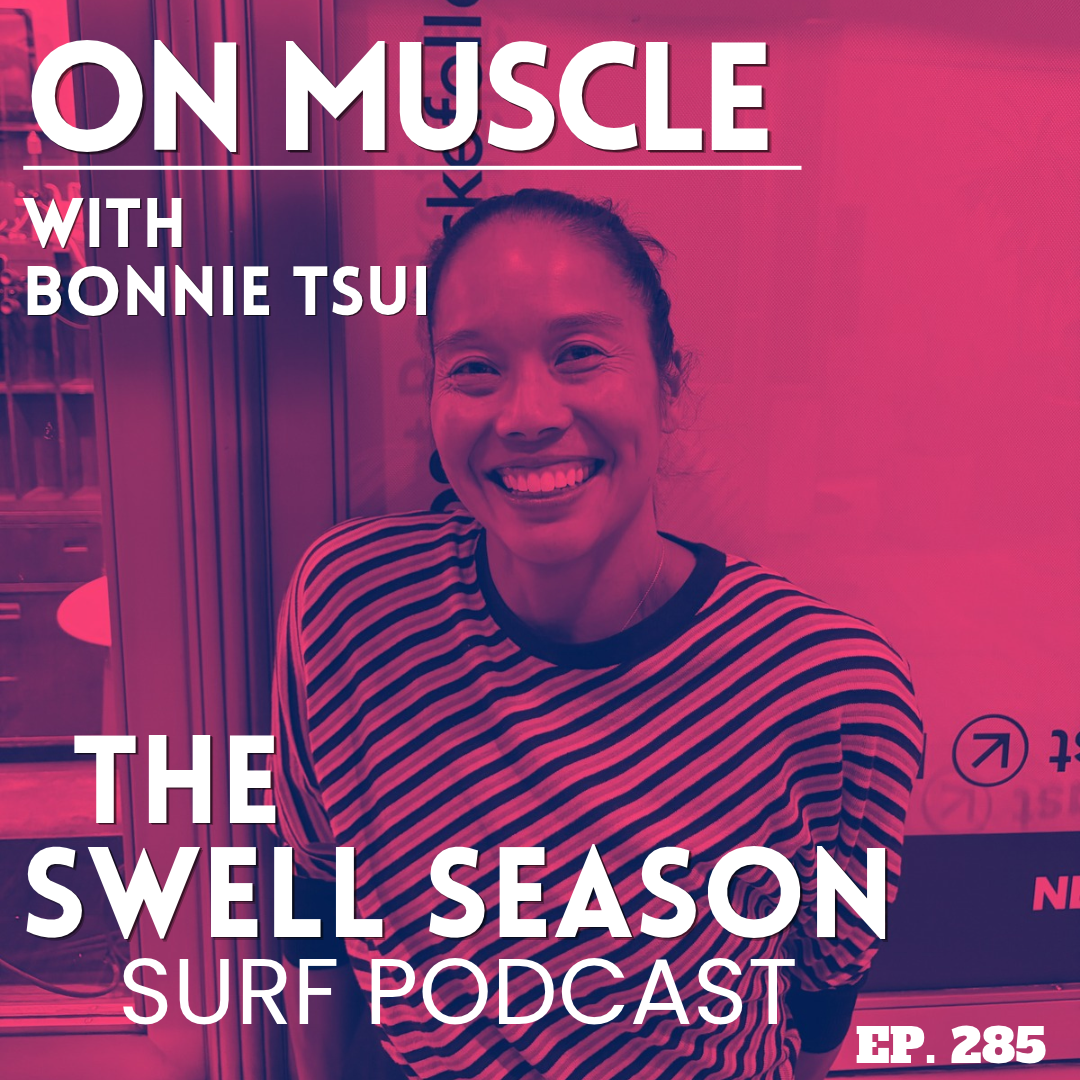
Bonnie Tsui Ep. 285
Hello, and welcome to the Swell Season Surf Podcast. I'm your host, Tyler Brewer. Bonnie Tsui is a former guest on Swell Season. The last time she joined us, we talked about her best-selling book, Why We Swim, her beautiful exploration of humanity's deep and complicated relationship with water. Now she's back with her latest book, On Muscle: The Stuff That Moves Us and Why It Matters.
On Muscle is a scientific, cultural, and deeply personal [00:02:00] exploration of the stuff that quite literally moves us. Bonnie takes us inside the world of cardiac, smooth, and skeletal muscle, exploring not only how our bodies work, but how muscle shapes our ideas about strength, beauty, gender, resilience, aging, identity, and what our bodies are capable of doing.
And much like we, Why We Swim, Bonnie has this incredible ability to take subjects that could easily become dense or overly scientific and make them human. She takes the science and connects it to people, history, culture, and these deeply personal and emotional stories. And I honestly could not put this book down.
I came away feeling smarter, but I also came away understanding my own body differently. It made me question some of my assumptions about strength, athletic performance, aging, and even what we consider a strong or capable body to look like. [00:03:00] But there's another reason I'm particularly excited to have Bonnie back.
Bonnie is an old friend. We worked together many years ago at Blue Magazine, an adventure travel magazine that was probably a little ahead of its time. And I was an intern back then, and we have some wonderful memories from that bygone era of New York City. So on a personal level, I can't tell you how much pride and stoke I feel seeing everything Bonnie has accomplished since then, and the incredible life and body of work she has built for herself.
She's someone I admire tremendously, and I hope that after this conversation, if you aren't already familiar with her work, you'll become a fan too Bonnie, welcome back to Swell Season. Super stoked to have you in real life, in person, be able to give you a hug- I know ... not over the call. Vo- You know, not over Zoom or anything.
It's, like, amazing. I'm a little verklempt from that, uh, intro. Thank you. I feel so touched. Yeah. Talk amongst yourselves. Let me give you a [00:04:00] topic: Partridge Family. Neither partridges nor family. Discuss. Good callback. Good callback there. Oh, it's so nice to see your face. Oh my God, it's awesome, and it's like, it's unreal.
Like, it's, it's so wonderful to see you. But also, like, like I said, like, it's amazing to see the work you've done and, like, over the years. And, like, these two books that I've read are just some of my favorite books that I'm always recommending to people. I'm always- Thank you ... telling them, and I'm always referencing-
like, fun facts at cocktail parties. I'm always like, "Well, did you know?" Did you know about the erector pili? Well, let me tell you about the erector pili. Exactly. Let me tell you about this Icelandic guy- ... who has a layer of blubber on him somehow, and he's able to swim in cold, freezing water for hours at a time.
Ah. And survive to tell the tale. I know. We love, we love an Icelandic shipwreck. We love a good Icelandic ship... Who doesn't, really? Who doesn't? A good dinner party always has to have one. And, and listeners, like, I brought a [00:05:00] couple issues of Blue magazine. Amazing. The first one that Bonnie had an article written in, and it's about urban scuba diving, which was...
Do you remember anything about this? I mean, I kind of remember. That was a reported story- Yeah ... but I also remember thinking, "Oh, those shipwrecks seem cool. The water will be freezing, and also you probably would not have any visibility." Yeah. You wouldn't see nothing. Off the coast of New York, you know?
Exactly. Surprisingly, it's actually, like, more people are doing free diving around those places- Yes ... and doing a lot more fishing with, like, uh, with the free diving guns, which is kinda crazy. Wow. I know. That's next le- well, we haven't... we know what our next issue... our, like- You know, what anniversary would it be?
What year is that? Oh, third anniversary of Blue. That was in the issue. But what year is this? This is probably 1999- Oh my God ... I think. And- So maybe a, a tw- oh yeah, established 1997. Mm-hmm. So, like, '99, 2000. So we could do, like, a, we could do, like, a 30th anniversary throwback [00:06:00] And then the other one, which we were just discussing, where you did a whole thing on the trapeze, which was- That was so fun
like very well-written, by the way. Thank you. And really fun, and also, like it was really cool 'cause not many people have done trapeze and like it- Mm-hmm ... kinda wasn't even around. Yeah. And like there were only a handful of places, and then you wrote like how it was starting to pick up. And one of the things you wrote about there was like at a Club Med they had- Mm-hmm
they were doing them. And I was seven years old at a Club Med- Yeah ... and there was a trapeze. And I remember waiting in line, walking halfway up the ladder, and turning around and not doing it. Really? I was too scared at a height. But not our day- At a fear of heights. ... in New Paltz. Oh my God, that was... I just remember how I mean, it's so cool that you brought this issue in, that we're talking about this, because, like, I just remember standing on the edge of that board and just, like, throwing myself off of it, and just thinking, "This is..."
I mean, the moment of [00:07:00] suspension before you start falling- Yeah ... it's just unreal. It's really cool. It must be... I haven't done it, but you know what's wild is, like, where I lived, where I used to live in, uh, Bushwick- ... there was an indoor trapeze- Yeah ... there too, actually. Yeah, yeah. And, like, kinda circus acts as well you could do, which is kinda wild.
It's now... I remember after that story, and then of course you have, like, confirmation bias, right? Yeah. 'Cause you see it everywhere. But I just remember after that I moved to the Bay Area, and I just, I s- I saw these places popping up everywhere. And I was just like, "Oh, circus arts. It's a thing. It's a thing."
Gonna join the carnival, man. Yeah. Gonna be carny folk. I mean, yeah. It's not... Well, it's probably a little too late for me. Well- A little too late ... it's never too late. You know, just as long as you have the harness on and- Yes ... you know, uh- A healthy dose of fear. Exactly. You know, and trust. Trust, yeah. And a lot of trust.
A lot of trust. Yeah, and those cables to hold you up. But it... Yeah, that was, and that was, like, also when I couldn't even go. We did the field trip, and I had the broken leg from- So sad ... bike [00:08:00] surfing at OR. Listeners, it's a long and embarrassing story. I wanted to show off for all my coworkers at Blue, 'cause I was like, "I surf.
I can do bike surf." And, and Ian was driving the bike, and I fell off and snapped my tib and fib. I do remember you hobbling around on crutches for a while. I do remember that. I would... I was, hobbling around from, like, my dorm on West 8th Street- Mm-hmm ... over to the office, you know? And I remember being, like, struggling-
just sweating by the time I got to the office too. It just- And I wanted to be, like, one of the first there too. It just made you stronger. Well, it kinda, you know... It's funny you mention it, because your book talks a lot about muscle memory- ... and also recovery- It does ... and how that changes how your body is.
And it's interesting, 'cause I remember then, like, I didn't surf for, like, nine months. Mm-hmm. And I remember my first surf, it was really fun, like chest to head high. Mm-hmm. And I was like, "I'm just gonna lie down. Like, I'm [00:09:00] not even gonna get to my feet," I was telling myself. Mm-hmm. And I took, like, a bigger board, like an eight-foot- Yeah
kinda mid-length, and I remember paddling to this wave thinking I'm not fucking lying down for this, and I jumped to my feet- ... and got barreled- Really? ... on my first wave back. Yeah. Right out, right out of the gate. Right out of the gate. Oh, that's amazing. Got fully barreled, you know? And I was just like- I'm back
still got it. I'm back, baby. So it's like that muscle memory is a really interesting thing you kinda talk about in the book, and whether muscle has memory. Mm-hmm. And you went to Sweden, was this? Or, or, or- It was Norway ... Norway. Sorry. It was Oslo. Oslo. Yeah. And it was interesting. So what, you know, we're talking about what you're describing- Yeah
is this, what we traditionally think about as muscle memory, right? Just sort of the motor pattern of a movement that we're so used to. I mean, you've been surfing your whole life. Yeah. So, like, it just, it's ingrained. And you don't really need a lot to activate it, right? But for the rest of us, You know, it takes a few, it takes a few tries.
But then [00:10:00] it's because, like, that pattern is all over the place when you're learning something, and then it gets smoothed out, like your movements do. And then, you know, when you don't do something for some years, like riding a bike is such a classic example, you're kinda wobbly at first, but then you don't have to relearn it from scratch.
Yeah. But one of the things I was super interested to learn is that muscle itself, like your muscle cells themselves- Yeah ... have a memory of prior exercise, which just blew my mind. You know, that- Yeah ... that muscle cells themselves, it's not, they have an epigenetic memory, so it's not like the, the genes d- themselves don't change, but the which ones are turned on and off do, like with exercise.
And then your muscles remember how to grow faster, more efficiently in response. Do you think that can be passed down genetically? I mean, that's interesting 'cause, like, epigenetic- Yeah ... changes to our genome, you know- Yeah ... can be passed down. And so, I mean, certainly it would seem - Right ... a little bit like that with, athlete [00:11:00] parents and, like, ki- I mean, I don't know.
But you also see kids from athlete parents who just are couch potatoes, so it's not- Yeah ... you know, but just, like, the things, there are traces again, like our epigenetic profile is something that is, can be passed down in some ways and, and the research is really interesting on that. But I don't know about, like, am I, my capability of, like, building muscle.
Uh, like, I just- I don't know ... I was just, like, thinking, I'm like, 'cause there's so many ... Right now it feels like there's so many, like, parents whose kids surf- Mm ... who are, like, profess- Mm-hmm ... were profe- their parents were professionals, and the kids. And obviously there's so many factors that- Mm-hmm ... play into that.
But it, it does sometimes feel like when you watch a surfer and then you watch their kid- Yeah ... you can see the style, which is a very unique- Mm ... uh, imprint almost- Mm-hmm ... of the personality, of the physicality. And you can Nat Young, who's a very famous surfer from the '60s. His sons surf just like him.
They surf like modern [00:12:00] versions of him. Mm-hmm. Like, it's crazy and it's kinda wild. And you're like, "Is that genetic then? Is that- Nature or nurture? Yeah, it is. I mean, but so much like... And then imagine these kids being exposed to this. I mean, that certainly, epigenetics is really your environment, right?
Yeah. What are you experiencing in your life? And so absolutely they are shaped by that, right? Totally. So that's, it's really cool actually to think about that, and think about how our bodies are shaped by that, that we experience externally. And, you know, the changes that happen- Yeah ... because of that.
I mean, and so also, like when you think about twin studies- Yeah ... like, that is the most interesting. It's crazy, right? Yeah. Mm-hmm. Like, how they could be separated at birth, and then the personalities are so similar. Right, right. And it really does, like, the nature-nurture is- Yeah ... it's such a It's such a rabbit hole of a conversation Mm-hmm.
And, and study, I imagine. Yeah. You know? But it is interesting also, like the parent is there. Like Nat Young surfed, so I'm sure his son surfed with him. Mm-hmm. So he saw him. Mm-hmm. And saw what [00:13:00] he did. And probably just, just absorbed it too. Mm-hmm. And that brings me to your father. Mm-hmm.
And, you know, your father is like this quiet character throughout the whole book. Mm-hmm. You know? And your dad's an artist. He's also a martial artist. He was an immigrant, and he first taught you to think about your body, you know? And I'm curious, like why do you wanna begin this exploration of muscle with him, actually?
I just wanted... I just had this thought- Yeah ... which is that my dad, because we're here in Rockefeller Center- Yeah ... my dad worked at NBC. Yeah. For, you know, when I- That's crazy ... when I was, the year I was born he won an Emmy for his graphics for Live at Five. Wow. No way. You know, working at NBC Studios, working with, and so I just had this like weird moment- ... of like, wait, we are- Full circle ... full circle moment. Like, you know, place of like, again, bodily like- Yeah ... a little bit. Oh, I'm physically in this place where he, you know- [00:14:00] Where he probably walked up those stairs- Right ... or went up that elevator- Yeah, yeah ... or something.
And are we just following our parents' footsteps? I mean, in some ways, right? Like, it's really interesting. It's hard to break out of that mold. Mm-hmm. You know? And like your parents have such a huge effect, both genetically, but also- Mm-hmm ... you know, nurturing-wise- Yeah ... as well. So it makes total sense, too, that you would fall into that loop almost.
Yeah. You know, that rhyme of your parent. Mm-hmm. You're- The rhyme. I like that ... like I think you're a rhyme of your parents a lot of the times. Mm-hmm. Yeah. You know? And so you're not exactly the same, but it's this- Yeah ... you're kind of like that. Yeah. And you know, a, a new version of that. So yeah.
And, and, and with him, like he, he would taught you martial arts. He taught you to think about your body in a way, made you really strong. So I'm- ... yeah, so I'm like wanting to explore this with it, with you. Like was he- Yeah ... when you con- conceptualized this book, like was he front and [00:15:00] center of that concept?
Or was that something that happened later- Hmm ... as you researched for the book? I think from the conceptual, conceptualization of the book as a book about the body and movement and sort of how we move through the world, absolutely, because he was such the You know, inception point of that. Mm-hmm. You know, again, like we grew up the child of this martial art, children of this, my brother and me.
Um- He, he went to school with, um, you know- Bruce Lee ... Bruce Lee, by the way, listeners. High school. He grew up in- That's freaking cool ... he grew up in Hong Kong and went to the same high school as Bruce Lee. Behind him by several years, but you know, like- Still ... again, walking in the f- hallways that Bruce Lee was walking.
I mean, pretty cool, right? That's so sick. And then he, you know, in a similar way to Bruce Lee being someone who was ahead of his time with mixed martial arts, my dad was a black belt in karate and also practiced like TaeKwonDo and all of these other martial arts, [00:16:00] but you know, was really mixing them.
Mm-hmm. And also we, when we were growing up, it, in his downstairs studio, which was both the, exercise studio with the heavy bag and the speed bag and all of the weights and all that, and the bench, and, and also his paints and also- Yeah ... the canvases. And so he'd be working on, you know, he'd be doing something for NBC or be doing some you know, romance cover or choose your own adventure book.
Mm-hmm. And, and then he would be asking us to, like, do some modeling for him. And then he'd be like, "All right. Let's go out to the garage and work out." You know? I mean, it was all like, jump rope. It was just so, so part of my childhood landscape. And I remember- Kinda I understood at some point that was not normal.
But obviously this is what I grew up with. When you kick the crap out of some kids in school- Yeah, exactly ... you realize, like, "Oh." I was just like, "Oh, you know, this is what I do." My d- uh, actually my dad has some stories about beating people up in dark alleys in New York City- ... when people would say rude shit to him.
So [00:17:00] he actually wa- He put it to use ... I mean, he would so cavalierly say these things. Like, we would pick him up from the train station. He'd be like... We'd be like, "Oh, what happened today?" And he's like, "Oh, I, I beat someone up." He was like, "You know, tried to mug me." I mean, for real. And, and we would just be like, "Okay."
This is New York City in the '80s, you know? Yeah, exactly. Early '80s. So anyway you know, he, we just kind of... That was my pond- Yeah ... growing up. I was immersed in that. And then thinking about what's the next book, after Why We Swim, and I wanted to be in conversation with it. I wanted to kind of continue, 'cause I felt like there was more to say, and then of course it just kind of traces back to my dad.
And I didn't know how much of that I wanted to be in the book. Yeah ... but it... I think there ended up being this nice through line that you couldn't have predicted. You know, I did write it in part during COVID and at the... You know, my father lives in China now, and so I didn't know when the next time I was gonna see him was, and that was really, you [00:18:00] know, years, to the tune of years.
And- Yeah ... by the end of the book, I actually do see him again, but in person. But it's, it was strange 'cause I didn't know if I was going to. I didn't know when that was gonna be. And he, he lives in Guangzhou? I've been there. Have you? What a cool city, by the way. What? Yeah. I had to go for starting my company.
They have the Canton Fair. I was gonna say. So- Oh my gosh. I've been to the Canton Fair. What? Dude, I walked- Manufacturing ... 16 miles in one day. Wow. I mean, that place is huge. Massive. Wow, I love that you were there. I love that city- ... so much, too. It's awesome. It's good eating, my friend. Dude. I mean, food of course, but just so massive and beautiful.
Mm. And, uh, you know, like walking through, you know, there's so many parts, too. You know, went to, like, by accident, to the Ritz Carlton there- Oh, yeah. ... you know? And then- Right ... ended up walking one day through a whole area. I got so lost, and I was like, "Where am I?" You know? But and I was like the only white guy, you know, around, but it was like- I love the beat [00:19:00] of the city.
It was absolutely stunning. I can understand- Mm-hmm ... why he, he probably enjoys living there. It's a really interesting East meets West place too. Did you ever, did you end up going to Shamian Island by any chance? I did not. But you know about it. Uh- It's kind of like the colonial- No. No, I'm not too familiar.
Well- No one gave me... My, my, my- ... sourcing agents took me then to you know, Dongguan- Mm-hmm ... and, you know, Shenzhen, and other places. So I didn't get to you know, I just was on their kind of- Yeah ... trip. It's where the the, the European concessions were for the French and the British so they, where they could trade.
Yeah. And, um, so they set up... So the architecture there is, like, very colonial. Really? It's very interesting. And it's beautiful, but it's also, like, a very weird spot. Yeah. Like, there's you know, it's along the Pearl River, and, but you'll see, you kind of see echoes. You're kind of like, "What?"
This was where there was, like, friendship between- Yeah ... East and [00:20:00] West, and these little sculptures. And these bronze sculptures are so funny 'cause there's a trend of, like, it's a little, Chinese child with, like, a European child. Like, you know, like- ... y- "We're friends." And then there's, um, like, an old Chinese scholar, and then there's a, I don't know, someone who looks like Ben Franklin or something Yeah
I mean, like, hanging out. And it's, um, this is where we meet. Mm. Um, so historically and culturally it's just a really interesting place to go, and it's a beautiful park. Yeah. So there's a lot of people practicing, Tai chi ... yeah, tai chi or, like, other group sports and dance. And I mean, you'll see made up things, like a whole group of seniors, like, hitting a ball in the a- I mean, it just...
You're kinda like, "What's happening?" But it's... What I loved about it the last time I went there was, like, this is where fitness happens You know? In a really... Like, across all demographics. Yeah. Like, women, and men, and kids, and [00:21:00] families, and just kind of figuring out how to move their bodies in a public place, a public space.
Well, it's interesting, like-
Had no concept of muscle- ... almost before- Mm-hmm ... their interaction with the West. It was chi- ... and flow- ... instead. And- Right, energy. ... Yeah. And I'm like, kinda, I wanna, I wanted to kinda explore that with you, actually. Yeah. 'Cause I think that's really unique 'cause it changes the perception of strength.
Mm-hmm. And how strength is very much, like the way we perceive strength is s- is so ingrained in us, and such a Western- ... you know, Eurocentric, American-centric kind of view of strength. Right, right. You know? It's like lifting boulders- Mm-hmm ... and, and, you know, being really huge, you know? And, and in China, like the strength, you could have a guy with a potbelly, you know, but he would be considered strong because of his flow and because of this strength- Right
that, that appears. [00:22:00] Right. It's I was really curious about where that perception of muscularity, like the bulges and ripples of a body- Mm-hmm, yeah ... became so quintessentially like, "This is a strong person," like, and, "This is a good thing, and this is attractive, and this is the ideal body." And, um, there's a really great there's a really great book that I read, um, that was about, like, the divergence of these perceptions of muscularity and the body, perceptions of the body, um, between Western- Basically Greek medicine- Yeah
and then, like, class- uh, you know, Chinese medicine and where that happened. And and there's... It was interesting because it was, um... You know, if you get- you look at, like, old acupuncture maps of the body- Mm-hmm ... right? And where the flow and the meridians and the flow of chi. And again, like you talk, as you talk about it, it's like- Yeah
it's like a yogi with a full belly. Yeah. And [00:23:00] then you'll look at contemporaneous drawing, medical drawings I mean, let's say- The Michelangelo- Yeah ... and Leonardo da Vinci ... like, or like Vesalius- Yeah ... you know, and it's all, like, bulging. And it was so interesting because the ancient Greeks had these sculptures of, like, Hercules, and they put all these bulges and ripples where there weren't actually any muscles.
But they had some sense of like, this means power. This means strength. Yeah. Because when I exercise, this is what happens to my body. There is some kind of visual change, right? And that is a cue for, like, also, you know, it's, it's about disciplining the mind and the body, and these two things go together, and all that.
And it's it wasn't until we start to get, I think I would say with Vesalius, like looking- Yeah ... at these anatomy books and, like, dissection, where you kind of see that muscle is distinguished from flesh more broadly. Right. You know, and that's sort of like that tradition of dissection and, in the Western world of, in [00:24:00] medicine.
And then that- and then in, you know, in China there wasn't really, like for a long time there wasn't a word that distinguished muscle, yeah. And but that, that divergence happened later than you might imagine. And so like, it just... I think just understanding and peeling back some of the layers of, I mean, really literally peeling back layers-
to be like, "Where is it? Where we get these ideas from?" So you look at the, um, Sistine Chapel and you see like the, you know, the Creation of Adam. Yeah. It's so quintessential. It's like, man, very strong. Yeah. Like from the beginning, God also looking pretty strong. He's looking pretty buff. Right. And then, but then, you know, Michelangelo was actually pretty subversive in his day- Yeah
because he portrayed his female characters with the same robust muscularity, and part of that was he really, he was attracted to this like muscular androgyny, right? Yeah. And part of it obviously was because his models in the studio were all men. Mm. So he made his figures anatomically correct, but you know, using male models.
And so I don't... [00:25:00] You know, one can't actually kinda look into his head and be like, "Why did he do that?" In terms of the final depictions being as, truly muscular as they were. But they're so beautiful, and they're actually, they look very of our time now. Yeah, now. You know, if you look at athletes- Totally
these days. It's... I find it really interesting how here he draws these idyllic- ... visions and of the Sistine Chapel, but that totally crippled him. Right. And like- It did ... it really like ruined his body actually, and like made him the opposite of what he was portraying. He wrote these terrible poems about like how he got a goiter-
like in his neck from craning up to look at the ceiling. I mean, he was broke. I mean, he was an old man by the time- Yeah ... he finished. Yeah. But what a feat of right physicality and strength and endurance to create that ceiling. Well, painting is muscle memory too. Yeah. Yeah. You know, it's all about the strength and using all of those muscles and- Bringing it full circle.
I know, right? Like how I did that there? I like what you did there. [00:26:00] But it, I also can't help but wonder like how much religion has played into it, and that's something like you didn't maybe get into as much in the book. But I sometimes thought of, think about like- Calvinist work ethic- Hmm ... and this disciplining of yourself- Mm-hmm
this almost like torturing of yourself, "I need to suffer-" ... in order to get into heaven or to experience- Mm-hmm ... that, you know? And I, I sometimes wonder if that plays into our modern time- Hmm ... of how we view a, a healthy person, right? Mm-hmm. Like, there's people who think they should be working out every day, doing tons of reps and, and working super hard, too.
Mm-hmm. Like, it's not like- Yeah ... you look at even, like, the training, you know, of, like, athletes. Mm-hmm ... you had that coach recently who hired a Green Beret or whatever to train the kid, and the kid died. Yeah. Uh, you know, in the NHL. Yeah. Right? Like- Yeah ... and it's, like, this attitude of, like, "You have to work until you're, like, totally-" [00:27:00] Near death.
Yeah. Yeah, yeah. Uh, but in your book, you actually discuss how the rugby player- alana Maher? Yeah. Yeah. And the, and the guy who... Uh, no, the guy who got injured, I think. Oh. Um, Adam Sharples. Adam Sharples. Yeah. You know, and how he got injured, and realized, you know, when he started talking about muscle memory- Mm-hmm
and started researching, but he realized rest- Mm-hmm ... and actually he didn't need to work as hard. Yes. And actually, if he didn't work as hard, he could've been actually better. Yeah. I mean, it's... He- You know, we all kind of have, I think athletes have anecdotal experiences and stories of, like, you know, if you take...
If, even if you... You know, even you were talking about- Yeah ... we kind of bring it back to your surf experience. Another circle. Another circle, back to, like, post-injury. You know, you don't go back to square one, actually. Yeah. And it's because your muscles do have a memory, again, of prior exercise. Uh, they also have a memory of atrophy events, injury events, illness.
And so I mean, it's kind [00:28:00] of a little we, we discuss this with much more specificity in the book. But if you think about our lives and when we get ol- as we get older, it's really like a tug of war, a push pull between how many of these experimen- experiences of strength and health versus experiences of illness or injury that we kind of accumulate over our lifetime.
So it's kind of like a, a tug of war between those. Yeah. And the more experiences, of course, you have of health and strength and like regular periods of exercise, you can shore up against those times that you are injured or are ill and have to take time off and that your body has to recover. And it's really interesting because we're really learning, we're just learning how much of that is-- lives in ourselves and is something that does affect our lives overall.
And also like, this is not just about physically being able to do [00:29:00] things at a later age- ... um, or strength or how you look. It, it is really important, and I wanna stress that, like our muscles have such an influence over our entire body and all of those other body systems because our muscle is an endocrine tissue, which means that our muscle is like constantly sending these messages all around our body to talk to our brain, to talk to our immune system, you know, ramping up, um, you know, metabolism.
All the stuff that happens when you move, uh, your body, it feels good for a reason because like this is like, it's a constant ebb and flow, and it's a constant conversation that our muscles are having with the rest of our body. It's not just about How we look and you know- Present ... present, or even, like, being able to run a fast mile or, you know, whatever.
It's, it's that all of this is, like, all of our mu- our muscle health is our cardiovascular health, is our immune health, [00:30:00] it's all of these things. It also, like, a healthy body is a healthy mind- Mm-hmm ... a lot of the times. And it's our cognitive health. Yeah. Exactly. You know, it really, I can't tell you, like, how when I'm depressed or sad or whatever, like, the moving, movement really- Mm-hmm
does help. Mm-hmm. You know? It helps your mind. And when I'm active, I am feeling so much better. Mm-hmm. I am emotionally more stable. Mm-hmm. I'm able to make better decisions, and when I'm, you know, in winter particularly, when you get more stagnant and you- Yeah ... become more isolated and you don't move as much, like, it really can affect, like- Mm-hmm
your whole mental outlook and your decision-making. Yeah. It really, it is a really important part of the cognitive aspect of life, I think. Mm-hmm. Yeah, it's the pharmacy in your muscles thing. You know, that's the whole... It's such a great I'm blanking on the Stanford psychologist who has that phrase, but it's in the book.
Yeah, it's in the book. But it's really, like, I think that phrase is so, such a great little encapsulation [00:31:00] of all that our, that our muscles do for us. I wanna know, like, how you found the, the characters in your story- Mm-hmm ... in your book. Mm. 'Cause there's a lot of really fascinating people from all different walks of life.
Mm-hmm. And then the same with, like, your Why We Swim book. Mm-hmm. Like, how do you come up with that? Like, what is that process like? That's such a great question. You're like, "I don't know." As I'm thinking about, like, you know, new projects and the next book. Life just happens. People just land in my lap, and that's it.
They just write to me. Actually, that does sometimes happen. I mean, you know, one of the characters in Why We Swim Coach Jay, the, the coach of the Baghdad swim team, he wrote me a letter one day. That's so wild. I think he'd read a, an essay that I wrote in The New York Times about swimming, and he actually wrote to me because his mom, who was, had become a swimmer late in life and had started racking up all of these records- Wow
at the, you know, at the masters. At the... Yeah. Yeah, at the wor- [00:32:00] yeah, those at the elite meets, and she said... And he was, you know, we started, he became my pen pal. That's so cool. And then he mentioned something about Hillary Clinton, meeting Hillary Clinton, and then something about swimming, swim team, and for a swim club in Baghdad, and I said, "What now?"
What? Hillary Clinton. Tell me more, Coach Jay. Did she join your swim club? Like, did she do water aerobics with you guys? But it was like, you know, it's, I think that the, to answer your question, it's kind of like being open to the world. Being ready to listen, and really, like, anyone who wants to tell me a story, I mean, I pretty much am gonna be there for you.
How do you decide when you're gonna travel- Mm ... to see them? 'Cause that, that's- ... one of the coolest things is n- 'cause you're not just corresponding, you are there. Right. You're seeing- Mm-hmm ... the evidence. You got to see a cadaver in this book- Mm-hmm ... which is really interesting. Yeah. Well, I- That was really mind-blowing and life-changing, for sure.
Oh my God. [00:33:00] Yeah. That's you know, I try to be... obviously in a book you've got to make really good choices about what are the scenes that you wanna have- Mm-hmm ... and who are the people you actually need to be in person with. Yeah. Who are the people you need to be immersed, like, literally sometimes w- in wa- you know, with Why We Swim, there's a lot of swimming.
There's a lot of water. Yeah. There's a lot of getting into this environment with people. And I do feel like for myself I am I w- I like to think that I pra- I practice participatory journalism. Yeah. Like, I, I am. From the moment of Chapi- From Blue, exactly ... is like we're going back- Yeah
another full circle. Just like, I feel that there's something Sensorily important about inhabiting that space with someone, right? So I love that kind of- ... journalism. And I also think that being there, there's no substitute for being there and there's a richness of s- sound or smell or feel or temperature.
Yeah. Like, or even the fact that you know, when you were in Oslo, [00:34:00] you noticed how many pairs of shoes- Yes ... and different types of shoes- Yes ... these people at work had, you know? I would never... And actually, it's, I love that you picked up on that because that was a detail that I never would have had I just interviewed this guy on the phone.
Yeah. When I went to Oslo, it was the dead of winter, and then I just, and I, and for the most of you listeners will not have read the book, but it was to witness this experiment that was happening of, like, what happens if you to your muscles when you- Atrophy ... when they atrophy over like...
It was, like, six weeks or something. You have volunteers who- You have volunteers ... who volunteer to atrophy one leg. Yes. They're just like- At a time ... "All right. I'm just gonna, like-" I'm just gonna chill out on my crutches. Volunteering- Yeah ... to be on crutches- Yeah ... for six weeks, and then to recover, and then to do it again because they wanna see do your muscles remember atrophy.
Do they bounce back faster? But in the process of doing this so I was going to Oslo to the lab where they were going to take the [00:35:00] sample of this wonderful very generous, uh, volunteer. Is it Gustav his name? Or- Magnus, I think. Magnus. Sorry, Magnus is- Or Magna. Magna ... Magna. Yeah. Some really, like- Yeah.
kind of Northern European- Totally ... big burly guy kinda name. He was awesome. And and he talked about how... You know, okay, so he did the first phase of the experiment where he voluntarily atrophied his leg. It was the fall, so it was fine, then the second time he did it, it was winter, and it was snowing.
Right. And so of course, Norway in the dead of winter is just atrocious. Like, they had all these different kinds of descriptions of, like, when it's snowing, um, but then when the snow freezes, and then there's another layer, and it's kinda wet, and then it gets slushy and whatever. And I noticed in the lab that all of these researchers had, like, 20 pairs of shoes.
Different thing, things with spikes, thing, boots, um, sneaker, like, all kinds of things because of the different, [00:36:00] what they c- you know, they said, like, precipitating conditions. Yeah. And it, and this was so related to what we were stu- what they were studying and what we ended up talking about because in Norway and in other Scandinavian countries in the winter, like fall risk is a big- Yeah
big deal, especially for- Yeah ... elderly people. And so we got into this whole conversation about they even have like public service announcements- ... on the television about like, this is how you fall properly. That, that fall classes- Yeah, fall classes ... that are regulated by the government. Yes. Which is, it got me thinking like, that's a new business I'm gonna start.
It's so but it's so smart because- Yeah ... they were really, you know, obviously the country is really mindful and like devotes a lot of resources to like researching aging and longevity and how to live better as you age, and that includes really strength training, understanding how to fall, which is like really, like that is like advanced, [00:37:00] right?
Um- This is what happens when you have universal healthcare, people. I know, it's lovely. It becomes more preventative. Really caring about the people. 'Cause the government... Yeah, exactly. It's lovely. It was wonderful to see the concern, you know, as like a civic duty. Um, but it was fascinating because in real life in this place, like it was just sort of how people lived, it was built into the culture. That's, it's really cool. And- So getting back to like how you found these people- Mm-hmm ... right? Like there's one I really wanted to talk about was Jan Todd. Mm-hmm. How did you come about her, and can you tell our listeners like, who she is? Mm-hmm. Yeah, Jan.
Okay, so Jan Todd is, um, a pioneering powerlifter. She won the first women's powerlifting world championships, and she has... Let's see. She set world records in five different weight classes. Um, she a- was the first woman to lift the Scottish stones of strength, known as the Dinnie Stones, [00:38:00] which weigh a combined 733 pounds.
And they're attached by like a chain? They're like, like, yeah. N- uh, yeah. You have to lift them. They have r- these iron rings- Rings, yeah ... which are very slender, so when you lift them up they really cut into your hand. I mean, it's just like nuts. You look at... If you... I encourage you to look up the Dinnie Stones online because you need to see like who- So I'll post it.
Yeah. I'll post it with this. Yeah, who normally lifts the Dinnie Stones- Yeah. ... what they look like, and then and then that Jan Todd lifted them in the s- late '70s. She was the first woman to lift them, and then she was in Sports Illustrated. She has this amazing story about her, and it's called The Pleasure of Being the World's Strongest Woman.
And it's just like unreal. Like that she... And I, I thought that was actually pretty revolutionary that they talked about how good it felt. Yeah. A woman talked about how good it felt to be strong in the '70s. I mean, that was like before Title IX, before all of, just [00:39:00] really- when she did not have the ability to compete in sports when she was a kid.
Like, when she was coming up, her dad didn't even let her do ballet when she was 12 because he said it would make her, make her legs too muscular. Like, she didn't get to do any of these things. She d- had no idea how strong she was until she went to college, and then got discovered, you know? Yeah.
And, By accident almost. By accident ... you know? Yeah, and so she... Yeah, so she, so she is pre-Title IX, pre-Ilona Maher, pre-WNBA, pre all of this, like, opportunity. And over the last 50 years, it was really remarkable. I wanted to talk to her because she's, she's not only could talk about what it was like to inhabit a body that could do all these things.
Yeah. But she talked about what it meant. She's an academic. She's a very respected sports historian. She, um, she and her husband, Terry Todd, founded the Stark Center, um, which is, uh, like one of the only International [00:40:00] Olympic Committee sanctioned, like, research centers in the United States. It's i- at UT Austin.
Mm-hmm. It's in, like, on the f- I think it's the fifth floor of the football stadium. That's awesome. It's amazing. Um, and Jan Todd also runs the Strongman and Strongwoman events at the Arnold Sports Festival every year- That's awesome. ... in Columbus, Ohio. Right. So she's had both this very practical experience of physicality and also academic, meaning-wise.
Like, she can talk about what it is to be strong as a woman over time, you know, like the last 50 years, and she's also, like... You know, it used to be... I love this quote that she has that I have from her in the book. She said, "Used to be that people thought that women were half as strong as men." Yeah. Then it was two-thirds, and now it's like, okay, we don't actually know.
What women are capable of. We're just learning it because we- Yeah ... women have only been doing this stuff for like the- Couple decades ... very recent [00:41:00] decades. Yeah, and then compared to men, which is like across human history. Yeah. Well, it, it brings me like this question I had, like, you know, it's like for most of modern sports history, we've invested enormously more money- coaching, attention cultural encouragement, myth-making even- Mm-hmm ... uh, into what male bodies do. And my question is, like, do you think if we had spent the last 100 years giving girls and women exactly the same encouragement, resources, permission to be strong how different do you think our understanding of female phys- physical capability would be today?
Oh my God, it would be night and day, I mean, we are, even in the last, I don't know, 10 years, like focusing on for example, a very small example of this would be like, you know, women and ACL injuries- Yeah ... in sports. And just understanding, like, the changes that the female [00:42:00] body goes through, you know, cyclically, normally, hormonally, what that does to your tissues and your ligaments and your muscles and sort of how that might affect w- like what those, what susceptibilities you might have in your joints o- over time.
And just like, and it's not that it's makes you... I mean, I think there's a lot of different ways to weaponize that information- Yeah ... and say like, "Oh, look, see? Like, women can't do X, Y, and Z." But it's really about understanding, yes, men and women are different, and yet if You know, a woman is strong, it doesn't take away from men, you know?
Yeah. And should ... You know, like it's not a zero sum thing. Strength is not zero sum. It's interesting, like, and I, I look at it like surfing, right? Mm-hmm. Like bringing it back to surfing- Yeah. Yeah ... 'cause it's a surf podcast. Like the women over the last 10 or 15 years have ... uh, basically in the last 10 years they've gotten equal pay on the- on the WSL. [00:43:00] Mm-hmm. But there's also been a much bigger, being able to see it, a visibility of women surfing, which was hidden- Yes ... for the most part- Yes ... for the, from the, you know, '50s onwards, you know? And there were plenty of women who surfed, but there weren't that many of them.
Mm-hmm. And when they did have the women's contest, it would be held in less than ideal conditions. Yeah, for no money. Exactly. They were- No one ... Yeah ... they were treated the, as less than, too. Mm-hmm. They had to deal with harassment- Mm-hmm ... uh, in the lineup as well. And it ... I dunno if you've saw, saw the movie Girls Can't Surf.
Mm-hmm. And it's, like, beautiful, but it is ... It ... I always, I've always thought this, especially in the last 10, 20 years, I've thought if women just had the same resources, I actually think they can compete with men. Mm-hmm. No problem. Lisa Anderson did it in the early '90s. Carissa Moore did it when she was, like, a teenager- Mm-hmm
and beat guys. And now you see Erin Brooks- Mm-hmm ... and it's like- Crushing it, yeah ... dude, the level is insane, and I can't help but wonder, [00:44:00] like, if we had just devoted the same amount- Right ... of resources- You have to have the investment. You have to have the investment in these kids being able to do it- and access it. And also, like, investing in the opportunities for them to actually be doing it, you know? It's not, it's not just like ... it is the competition and the investment and the pipeline of these kids coming up. And the pool of talent. And the pool of talent. Because- Yeah ... only around 30% of surfers worldwide are women right now- Mm-hmm
still. And that's growing, but can you imagine if it had the s- to p- to pull from the same kinda talent pool as the men do right now? Right. Like that enough, the numbers of people- Right ... you would see a difference, I think. And people have to be also able t- ... this goes for sports and youth sports more broadly, but it is a financial investment- Yeah
for families to be able to have kids to doing this. And so, like, that is a huge impediment to the development of various sports and surfing, is [00:45:00] not exception to that. I'm curious, like, how much technique plays- Hmm ... in these, in these athletic adventures, you know? Mm-hmm. Like how much does technique trump strength even, you know?
Mm-hmm. Like I, I sometimes, especially when it comes to surfing, I'm like, well- You could be super strong and your technique could suck. And you can have someone- Right, you're not putting yourself in the right place to catch the wave. Yeah. It doesn't matter. Yeah, you know? Or you look at, like, I mean, you can have, like, a Craig Anderson, who's very slender- Mm-hmm
for men, who is absolutely incredible, and he's got the most amazing, unique technique. Mm-hmm. And he's not as built or big as- Sure ... you know, uh, Italo Ferreira or- Yeah ... Gabriel, you know, Medina even. But I think with surfing so strength plays in different ways, like with endurance, obviously paddling, but that's combined with technique of positioning.
And then also you know, when you're doing [00:46:00] maneuvers, when you're landing them, are you vulnerable physically to injury because you haven't been strength training? And, and I, I did a story actually in the lead-up to the Tokyo Olympics about, um, for Popular Science Magazine- Nice ... in which I was talking with Caroline Marks and all of the USA, like just- The team, yeah
the team, like just what is it that they're doing. You know, talking to Carissa about strength training and conditioning and injury prevention, which at that time, I think it's s- it's still, like, exponentially growing, like even since then. But even in the lead-up to the Olympics and in, for Tokyo, and that time, I just remember all of the coaches like you know, talk- And the medical directors, like, talking about how, Kevin Dean was the medical director for USA Surfing at the time, and he was talking about how- We're so behind. Like surfing as a sport is so behind like say the NFL with like- Oh, yeah ... strength and conditioning. Well, [00:47:00] yeah, NFL's like, they've been- Yeah ... doing this forever. Yeah. But like understanding what forces your body- Can handle
yeah and especially these very fragile joints that we have and the torquing, and just like what to do to, again, like anticipate and prehab I guess- Yeah ... is really the, the term that he used. And I just thought like, oh, this is so fascinating. It's, you know, it's just revolutionary when you can actually...
I mean, and, and it's not as fun, you know? Like- Yeah ... when before he, he would joke about like, all the surfers would just be like, "Oh, you know how you get better at surfing? Go out and surf more." Which works for- It, it definitely works ... you know, to some extent. Yeah. And then, you know, and then you start getting injured.
Yeah. And so there's this you know, I think we all more broadly understand that we have to do some amount of strength and conditioning, and especially for us folks aging. Yeah. You know, aging athletes, like you're just, your body is telling you every single day you need to be doing [00:48:00] all the things. So we have like a built in alarm system.
Yeah. Because if I wanna be surfing, another 10 years down the line, another 20 years down the line, I, I have to be doing all these things. It's true. And it takes so much time, but it's worth it. Do you think like women could compete with men then, do you... Like, I wonder, like especially when it comes to surfing- Mm-hmm
I sometimes wonder if it would be better almost done by weight category- Mm ... as opposed to- Right, like, um, wrestling. Yeah. Yeah. As opposed to gender. And that would eliminate a lot of issues potentially. Mm-hmm. Like it would eliminate trans issues if they, if they were to compete. Mm-hmm. It would eliminate, you know, who has an unfair advantage.
There are, in bigger waves, bigger guys have an advantage, you know, over a lot of people, you know? And I sometimes wonder if like- society and how we've structured our athletics- ... is wrong. Yeah. Basing it off gender as opposed to physique. I have often [00:49:00] thought about this in different sports because we have categorized and organized sports in this way- Mm-hmm
by gender. And it's like a rough, right, it's so rough. It's such a rough way of sorting. Yeah. And, you know, there are so many flaws in that. And I've thought about it w- with reference to weight or size, but, you know, that also run- runs up against its limits too. I mean, it's, it's a sticky... It's very sticky and, but I so think that it's important to try to figure out how do we get everyone who wants to play- Yeah
to play? I mean, that is the basic, that is the basic, concern here. Do you think, like, you know, in terms of, like, trans athletes- Mm-hmm ... you know, do you feel they have an advantage when they compete? Uh, I know it's a bit of a sticky- Yeah ... topic, but it's like- For sure. For sure ... you know, I'm curious, like, what you found in making this book.
Yeah. Like, that type [00:50:00] of, how that changes your view. Mm-hmm. Yeah. Uh, and did you have, like, a notion going into this book- Mm-hmm ... about, like, particularly, like, trans athletes- Mm-hmm ... or women who have more testosterone- Right ... than others? Like- Yeah ... did that change your view as you studied and researched for this?
Well, it's really interesting because, um, what I learned is that hormones are so vastly- Yeah ... variable. So, like, um- In the norms of hormone levels, some women naturally have more testosterone than some men. Yeah. I mean, this is like a reality. And so this is like our... We are not, it is not as stark and clear as we think it is, and that is absolutely clear.
And in terms of like the differences, but, in trans athletes and, and sort of how we should structure sports so that trans athletes get to play as well. Um, you know, the reality is that, [00:51:00] you know, we talked about earlier, as we talked about earlier, that like the bo- like human bodies basically up until about 10 years of age, like there's not a lot of difference between boys and girls.
Yeah. You know, they all compete pretty well together actually. You used to kick your brother's ass, you know? I used to kick my brother's ass. Before age 10, you know? We were pretty much the same size until puberty. Yeah. And, um, you know, we were only a year apart. And and then once puberty hits, the... Again, like this is facts.
Like hormones change, development skews men towards, you know, longer bones, greater height, more muscle mass. And so in general that is true. And so how do you create, again, organize sports such that- Everyone gets to play and compete against each other fairly. And that depends on the kind of sport, right?
Yeah. You could see where, like, for example, again, wrestling is like, it's pretty [00:52:00] size-based, so, like, you could have men and women wrestling together who are the same height and weight , you know what I mean? Yeah. Like, I don't know that people would really... Like, if you do people have objections? Again, like, there's a lot of stuff that's not, that is very culturally, societally, and, like, um, what's the word I'm thinking of?
Taboo- Yeah ... based. And it's also about, like, what is proper, how do we, you know, and I put these in air quotes, like it just depends on where you're coming from. And what the, and what, um, I really explore, one of the, w- one of my main preoccupations in On Muscle is also to get at the fact that muscle is not just muscle.
Yeah. Muscle carries so much weight, metaphorical weight, how we think about each other- Yeah ... how worthy we are, success, like all these character attributes, and then across gender, like, what does too muscular mean? [00:53:00] Yeah. You know? Like, it means oftentimes for the female body, it's so often applied to the women, that means that you don't belong, that you're, quote-unquote, "wrong" in some way.
Yeah. In whatever could be that you're, in a, a, a male-dominated world or a a white-dominated world, that your body somehow, it's like it's mushing together all these issues of, like, uh, race, gender, and power, and it's very interesting to kinda start tease those apart, and I talk about them a lot in the book.
There's so much complexity. But I think just to understand what it is that we're talking about, when we talk about trans athletes and the complications and knee-jerk reactions we have around that, whoever we are, we have to talk about these underlying questions. Yeah. It's I get frustrated when certain people s- oversimplify it.
Mm-hmm. And they say, "Well, I don't want my daughter getting hurt by a trans athlete." Mm-hmm. And you're like, "What do y- what do you mean, getting hurt?" Like you know? Mm-hmm. And I [00:54:00] also like, I just think it, it is such a It is way more complex- Mm-hmm ... and it's, and it really does broaden. It's not just about the physicality, it is how we as a society view- Yes
How someone performs, and what they look like, and how they are. And, and we don't, you know, like ... And when we talk about fair, what is fair? Mm-hmm. You know? Like someone born in January competing against someone born in December- Right, right ... is totally unfair in many regards when it's, comes to, like, elementary school- Mm-hmm
and high school sports even. Mm-hmm. You know? They have a, almost a whole year on someone. Mm-hmm. So it is like, there's so much more nuance that is not being discussed- Mm-hmm ... and it's like so frustrating to see. It is really frustrating. And it's, um ... And I think a lot of the argument and discussion around transgender participation in sport I think people are a lot closer together [00:55:00] than they realize.
Yeah. But again, because of the political, um, polarization, cultural polarization- Yeah ... we're just unable to really have conversations about it. 'Cause I think when you actually do talk about very granularly what we're talking about Yeah ... which is harder to do, right? Yeah. Than just yelling at each other from the sidelines.
It's also, again, like it comes back to also technique. Right? Like we go back to the wrestler, like it's not just about the mass, it's about the technique and being able- Mm-hmm ... to do it. I've watched, you know, I don't know if you follow Rachel Lord, who is a surfer shaper. She's phenomenal, but she does mixed martial arts- and jujitsu, and she fucking throws boys- ... no problem, you know? Yeah. And takes them out. It's ... And it's because her technique is so good, too. Mm-hmm. And I, I can't help but wonder, like, how much all of that plays into it, and it's so much more, again, like nuance than- Mm-hmm ... I think is discussed.
Mm-hmm. You know? And that, that is really one of the bi- biggest things, and it's also that muscle [00:56:00] memory- Mm-hmm ... with that, that kind of- ... with that as well. And I love, you know, I love watching women surfing right now because it is, it's such an explosion of what's possible. Yeah. And like what athletes are capable o- of and constantly pushing the envelope and just- So impressive and proving, constantly- Exactly
proving- Constantly. Mm-hmm ... wrong the misconceptions that we have- Yeah ... or the, you know, like we didn't think a lot of women could surf, you know, big Teahupo'o- Big waves, yep ... until Keala Kennelly freaking did it- Mm-hmm ... you know? Right. And it's like, oh, they can, and then more people see it, and then more people do it.
Mm-hmm. I think that's really important. And those big wave challenges, and Peahi, and just, like, understanding the women can rock- Yeah ... the same crazy conditions. Yeah. And, you know, and then, like, the men's competition can get shut down because of safety. I know. I just remember Paige Alms being like, [00:57:00] "We just surfed that."
We ... Yeah, they can. And you ... And the men can't hang? Okay. Yeah. But it's also, again, like, getting the opportunity to surf- Yeah ... and, and the time, you know? And I think that was, like, that's ... That, that example really stands out to me of, when you get the chance- Yeah ... to show yourself and perform This is what y- you know, then you see it, then everyone sees it.
Yeah. And then there's like a, a, it's like a, you know, it's a, it's a s- re- self-affirming, kind of thing of like now we push the envelope more and more and more, and more people can get, can participate and see themselves. What was, like, the most surprising thing you learned? Or one of the, the experiences in making this book- that really sticks out to you that was like you weren't ready, you, you didn't expect to experience? Yeah. I'm just curious, like, 'cause to me, what, what popped out in the book was the adaptive, um- Yes ... that really- I was, that's, yeah, I was thinking about that, too, [00:58:00] Matthew Sanford. So I wanted- And can we talk about who he is also?
Yeah. Yes. He's, um, he's a pioneering yoga teacher for adaptive yoga, and so he is a paraplegic, and he was injured in a car accident when he was 13 and lost the use of his legs, and came to yoga as a 25-year-old. But what he was kind of, it was informed by his experience of, you know, being told through his rehab and various physical challenges in, in, learning how to live in this body now that he, to forget about his legs.
Yeah. Just to build up his upper body and, you know, and, and there was, like, this, he was constantly showed, shown, pictures of, athletes, Paralympians, you know, like really developed- Yeah, top torsos. Yeah, torsos. And then, like, it was just, like, this way of thinking about the bottom, the body, sorry, thinking about the body that felt, like, wrong to [00:59:00] him 'cause he was like- Mm-hmm
"Well, I still feel," and what he meant by, he was, he wasn't saying like, "I feel, have sensation in my legs. I have some recovered nerve," "growth" or something like that. He was just sort of like, "I feel that my whole body needs my attention." And he would often talk about, um, you know, sometimes when things were aligned in a particular way, that he felt a hum.
Mm. You know, it was like, and if you think about it, it's, just because nerves are s- severed doesn't mean that your this bod- this, your body is not receiving signals or sending signals around to, um- Or having blood flow through there. Exactly. There is- You know? Your, your legs are still alive.
They're still part of you. You know? And still part of you, and so you're getting signals that are below consciousness of there is information being sent around your body. And so again, this is, like, kinda heady stuff, but we talk about it in the book. But he talked, he, what he ended up teaching me was- even for [01:00:00] everybody, you know, we all exist on this continuum of ability to disability.
And I was kinda like, "What do you mean by that?" And he said, "We're all moving on this continuum." Yeah. You know? And disability comes, it can come suddenly, like with, like as it did for me with an accident, or it can come slowly, you know, you get sick, or you're aging. It's like- Over time
this is all of us. Yeah. You know? Exactly. And to kind of see all of us moving on this continuum together, and also what the yoga that he practices, like, and practicing yoga with him taught me was like It was just so mind-opening- ... you know, to, to w- which is interesting 'cause it's a way of thinking about inhabiting and sitting in your body.
Like, he was... I mean, one of our first times talking, he, I, I attended a yoga class that he was teaching over Zoom and a lot of students from around the world, um, some of them, in various, you know, were in wheelchairs, [01:01:00] some of them needed caregivers to help them do yoga. But they all were present.
Mm-hmm. And, like, just going through this yoga practice, and even, like, you know, sitting up, and this is real- You know, we can do it now. We're just sitting on our, in our chairs, like- Yeah ... I mean, we can't, I can't put my feet on the ground here, but, like- I can't either, really. ... feet on the ground. You know, head over shoulders over spine over your seat, and, like- Aligned
aligned versus, like, slumped over. You're so much more alert and attentive- Totally ... when that alignment happens. And he's like, "That's true for me, even though I can't feel my feet." You know, like, and it's just, like, when you kind of readjust and your body is all aligned, your spine is aligned- Yeah ... um, there is so much benefit from that.
And again, this is, this has to do with muscles as well. Muscles we are both very voluntarily, all voluntarily, can control or can't. Yeah. We all also have in- involuntary muscles doing, performing things in the [01:02:00] service to the whole of our body that, that no one has control over. So it's like we are all, again, on this continuum, and we're related to each other, and we can learn from each other in this way.
I also think it kinda goes back to the A- the Eastern- Mm. Mm-hmm ... kind of look of muscle- Yeah ... and that flow. Energy, yeah. And energy flow. Yep. And that maybe our problem in some ways in, in Western society is we think of the muscle only- Yeah ... instead of the flow. Yes. And so we are neglecting these areas when they get injured or- Mm-hmm
lose mobility somehow, and then we forget about them. We don't treat them the same that we do the rest of our body. And maybe- Mm-hmm ... it might be h- it's healthier probably, I imagine, to treat it as one big flow instead of- Yeah ... isolated. You know, and, and the way you said that actually does remind me, bring me back again to surfing.
Yeah. 'Cause, like, when you talk about surfing and good surfing- Yeah ... it's speed, power, and flow. And you're working with the [01:03:00] wave. You're not... If you see someone- Who's fighting the wave and not actually dancing with the wave- Mm-hmm ... and not use it full util- u- using that dance partner. You know it.
Yeah. It's wrong. Yeah. It feels wrong, and it looks wrong. And one of the things that I was talking to Matthew Sanford about was I said, "You know, what is it... What does yoga feel like to do to you when you're doing it right?" And he said, "It feels like a really good hug." And I was like, "Okay, tell me about that."
And he said, "Because when you hug someone and it's a good hug, the reason it feels good is that it's it's unified. You are integrated with that person." Yeah. "And the energy is great, and you're also, like, s- you see each other. You identify each other." Yeah. "And when it's wrong, it feels like a bad hug "- Yeah.
'cause you're not in flow with each other." Yeah. You're not, Things are moving in different directions. And it is about energy- [01:04:00] Yeah ... and all of that. It is. And it, like, I think... Yeah, I think if we adopt a different kind of outlook on this, it would make probably recovery for people better too, right?
That's a huge thing. Sorry. And how much is the ... You know, I'm curious, like, then, like, how much does muscle memory still play into that too? Like when Matthew does the yoga, right, you mentioned something about how when it being pressed on his- Mm-hmm ... sacrum.
And how that kind of made him feel, like, almost like he could feel his legs. Mm-hmm. It's like m- mobilizing your hips in a way that kind of reminds you of when you're walking. Yeah. You know, and there's all kinds of reasons for that, but it's, you know, w- we kind of go back to the signals being sent up your spine.
Like, he can't walk. Yeah. But if you simulate that motion with his legs of walking, it's sending signals up his spine that are what he would receive if he were walking. [01:05:00] How has this changed your view on aging and muscle? Like, you talk about your father-in-law- ... um, who had, who got ALS- Mm-hmm
which is this deterioration- Mm-hmm ... of your body- Mm-hmm ... basically. Mm-hmm. It's all shutting down. Mm-hmm. And I'm curious, like, how that all of this kind of learning from Matthew and how you've been able to apply that in your life right now. Mm-hmm. Yeah, my, my father-in-law passed from ALS, like, mm, I think right around the, when the book came out, um, last year.
And yeah, it was, it, to kind of learn these, You know, this practice from Matthew, and, and you know, and he's like, "You know, these are things that you could try with your father-in-law," you know? I mean, he has a lot of he's worked with a lot of students, yoga students, and very, Parkinson's, ALS.
And he said, you know, doing that walking motion with the knees and the sacrum he's like, "That would, that's something that you could [01:06:00] ask him if he w- " You know, and, and he said, "I think don't be afraid to ask." "Can you use your body to be in service to someone else, in service to the whole?" And we did, and we did that thing where we were walking.
Oh, wow. And it was really amazing, actually. And you know, we, we're all, again, like we- we're all on this earth for a limited amount of time, and if we're lucky enough to have bodies that work and, like, bring us joy and pleasure and movement, like, we're, it's awesome. Yeah. You know, like I, you know, every day I get to go out for a surf and, like, experience that dance with the wa- with the ocean- Yeah
like is, that's a gift. And I, again, like I want that to last as long as it can but I know that it ends, so it's like sort of how can I, how do I keep that going? How do I write about... You know, for me, like writing and sharing stories- Yeah ... is, like, such a big part of, like, my work. And so how, I learned so much- Yeah
writing this book, [01:07:00] and so I wanted to share it. I love that. And, like, I'm curious then, like, how does that affect how you're viewing your dad now? And, you mentioned that you were there with him when he fell and hit his head- Mm ... and had a brain injury- Mm-hmm ... as well. Mm-hmm. And I'm curious, like, how that's kinda changed your view or how you see him as he's aging.
Well- Str- like crazily, he recovered from that. That's great. I mean, it's- Yeah ... bananas, right? So like, and one has to also expect that, uh, and the doctors did say that his strength, like his physical health from having spent his whole life really in committed to physical practice, was so huge to his healing.
Yeah. Like just... and so this is actually something that I think that I did learn from this book is like muscle [01:08:00] is not is like a resource for- Yeah ... your body to draw on in times of injury and in times of illness. Like, uh, my mom, my mom has been in and out of the hospital like over the last few years with an autoimmune condition.
And I remember once being in the hospital with her, I was working on this book, and the doctor comes in, the rheumatologist, and he says something that I did not expect him to say. He said, "You need more muscle." And I was like, "What? She has an autoimmune disease." And he said, what he meant by that is like you need the, the muscle mass, you know, strength training to build muscle mass, especially as you get older.
And I'm talking about like from your 30s. Yeah. Yeah. 'Cause that age-related loss of muscle starts happening in your 30s. It's, it is not just about, again, like about looking good or like getting, being, you know, getting that marathon time or like, you know, surfing the big waves this winter. It's that if something goes wrong, that your body doesn't go into crisis, and, and it's like muscle is shoring up against that. And I don't want [01:09:00] it to seem like, you know, I want this to be like something that is inspiring and motivational- Yeah ... for people who might not think that they want to go to the weight room- Yeah ... or might not think that like a strength training practice is like so important for them because they don't wanna be spending all that time doing that.
You don't have to spend that much time doing it, but having strength and flexibility and mobility in your life is about longevity, and it's about having that, you know, what you wanna do for joy, like last longer. PT sure is not gonna cut it alone. But it's, but yeah. Like I, you know, over the last few years my wife and I have started doing a lot more weight training- Mm-hmm
a lot of kettlebell stuff. Mm-hmm. And movement, you know- Yeah ... which, uh, and it's Been a godsend, 'cause I was struggling to get to my feet surfing, and I'm a big guy, and I'm, you know, it's definitely not gonna be easy as I get older. I gotta lose some more weight probably, but [01:10:00] still, like I have a lot of muscle underneath there, but- Yeah, I see it
you know, it's the muscle, but- but it, you feel a difference. Yeah. You feel a huge difference. Um- It's crazy. Yeah. And when I fall, I don't... It doesn't hurt as much- ... surfing- Right ... because of that. Right. It allows me- You're not getting wrenched around, yeah. Yeah. In the same way. You know? It's holding me in place- Mm-hmm
a little bit more, you know? Yeah. Which I think is really important. And yeah. I mean, I'm, you know, it's... And also, again, cognitively- Yes ... it helps you as well. Yeah. You know? So, like, my dad had a stroke earlier this year- Mm-hmm ... and it was pretty bad, you know? Mm-hmm. But he started going to the gym a lot- Mm-hmm
and walking a ton, and it really has helped a lot. Mm-hmm. And now I'm, like, trying to be like, "Hey, Dad, you wanna do some tai chi with me too?" Yeah. And, like, get the flow- Right ... and, and flex as well 'cause that's a, that's a thing that you mention in the book is, like, yoga is really important, too, because- Mm-hmm
you still need the flexibility. Mm-hmm. You can't just bulk up either. Right . You know? Yeah. And, you know, [01:11:00] and then there's all kinds of... Like, those two thing, your strength and flexibility work together, yeah. And and also, like, again, I don't even think that we talked about it that much in this conversation, but, like, your muscles, bulking up your muscles bulks up your brain.
Yeah. It literally does. Your, you know- Well, to a certain extent. I mean, there's a lot of muscle guys that probably- Yeah. ... they're not geniuses either, right? But yes. What... Yes. You're discovering your entire potential. Yeah. Yeah. Um, they probably achieved their, uh, you know, cognitive potential too- ... along with their muscles.
But, you know, it's really, like, it is protecting, it protects your brain to be strength training. Yeah. You know, to be exercising. I know you have limited time, so I could keep talking, honestly, Bonnie. Oh, me too. I wish I could, you know? But I'm going to dive into my surfer's questionnaire.
Okay. I do this. It's kinda like inside the actor's studio for surfing. Don't think too hard about it. Okay. Just let it flow, and we're gonna have you [01:12:00] answer these, and then you can plug your book and shamelessly sell it, what is your favorite surf term? I mean, I love grom Right. It's a great word.
And, like, I love perpetual groms in my lineup at home who are, like, just turned 60. You know? I just have that- That's right ... joy. You know? Grommet hood for life. Yeah. What is your least favorite surf term? Hmm. That's such a good question. I, I wanna... I'm laughing because, um, my surf buddy, Zia, and I we were sitting out in the surf one day, and we just saw, like, a bunch of bros, just sitting off, just, like, l- be loud, taking up a lot of space.
Yeah. And we bo- we s- we decided that we wanted to coin the term murder of bros. Murder of bros. And I was like, "I think this is surf noir." Ooh. This is, like, you know, this is free. You know, someone could take this. Murder bros. Murder bros. Murder of bros. Murder of bros. Take that, make [01:13:00] this book. If, if you could go back in time and grab one surfboard from your past, what board would it be, and why?
I'm gonna turn this one around because, like, I haven't had that long a past with surfboards. Yeah. And actually my friend Zuhair has been building me a qu- like, he shapes boards for me, and he has made me so many boards. And I have to say, my newest board really is my favorite. Ah, that's fair.
It's actually, it's like a- Doesn't have to be in the past to be present ... 9'2" long, like a proper nose rider, which I've never had before, and it's really fun. And like- What's the difference you can feel in it from, like, your other boards? Um, the tail holds, and, like, I can walk and, like, engage the rail and feel like I'm not gonna just eat it every single time.
It's awesome. Isn't it nice, like, when you get that ... When you ... Especially when you're learning and you start to get to these next levels- Mm-hmm ... and you start to maybe plateau, and then you get on a new board- Yeah ... that does something different and just o- unlocks. It does something ... And I always wanted ... You know, I've been, like, on mid-lengths and shorter boards for a [01:14:00] while, and I just was like, "I really want to practice walking."
Yeah. You know? And I wanna have a board that really supports that, so I'm having so much fun. You have to get one of those, like, uh, not balance boards, but the rope that you can walk on to help with the- Oh, God. You know. It's a great way to break your ankle too. Yeah. But ... My ankle is, my left ankle is already glass, so I don't need that.
See, they need to invest in booties that have ankle support. That, like ... Do they just, like, inflate, like, if you fall? Uh, no, no, just, like, like, a little stiffer ankle. Oh, I see. You know, like a little plastic insert- So, okay. Okay ... that you have there, so then you have a little bit of support so you don't roll it as hard, you know, if you fall.
Mm-hmm. And, like, I'm ... I actually think wetsuits are totally underutilized. Like, they could be performance enhancing. Okay. Okay. You know? Next, uh, entrepreneurial project. Yeah, right. I'm throwing in a wildcard question that I normally don't ask, but because of your book what is your favorite muscle? Well, I, I flicked at this earlier but the arrector pili-
[01:15:00] is the muscle. Such a great name. Not what you think. It's- Um, it's, it, it is the muscle that controls your goosebumps- Ooh, yes ... which I love so much. I loved how you talked about that in the book, how your hair and your skin is connected to this muscle- Mm-hmm ... basically. Yeah. It's so cool. And it's, like, so feelingsy.
It's like people don't think about goosebumps when they think about muscle, and yet, like these, these little muscle fibers that control your, your goosebumps and raise your hairs, it's like it's giving you information about your body. Yeah. You're cold. You're experiencing awe. You're just
You're in the world. You're sensitive to something. And that's ... And I feel, I often get goosebumps when I'm surfing in the water, like looking at something amazing. So I feel like it's, it's about, it's giving you information about yourself. Goosebumps happen for me when I hear a song from an old surf movie that I used to get pumped up on.
Yeah. And I'll like ... And it comes up the back of my neck- Yeah ... and then I feel it. You got feelings. And I'm like- Your extreme emotion. [01:16:00] And like, "All right, I need to shred now." I'm alive. And finally, if heaven exists- Hmm ... what kind of wave would you wanna surf for eternity? Oh my God. This is so good.
It would be a, a point break left for sure. Goofies unite. Boom. I'll be there in the afterlife. See ya. See ya. Looking forward to it. See you on the other side, on that left-hand point break. Can't wait. Have you ever been to Peru yet, or Chicama? No, and, um, someone was just talking about Chicama, and I, and I mean, I've seen the videos.
It's ... I've spent months up there. It- Really? Yeah. It's the best. It's such a fun, easy wave. Why did you ever come home? Oh, uh, ran out of money. Ran out of money, uh, you know, like I, I loved it, 'cause I would stay in Trujillo- Mm-hmm ... uh, like kinda e- uh, and, and then, like, you go drive up- Mm-hmm
and, you know, when the swell gets too big around there, and then you go up, and it's just, like, I mean, leg [01:17:00] shaking. Yeah. Leg shakingly long. I remember, like, doing, like, five different variations of a turn- ... and I was like, "I don't know what else to do. My creativity's run out." It's so weird when you're on a wave so long that it's n- it's your legs that are hurting, not, like, your shoulders and your back from paddling.
And, and you can think on the wave for once- Right ... you know? Like- Is it, it's slow and friendly enough that you're thinking, you can have time to think- It is- ... about what you want? You can be like- Wow ... "I'm gonna put my hand here this time." Amazing. "I'm gonna do this." Mm-hmm. "I'm gonna bend my knees a little more."
Like, you can really be super aware there- Mm-hmm ... and, like, think as oppo- What board were you riding? I rode short board, like a- ... I sh- nowadays I would be, like, on a long fish or something- mm-hmm ... 'cause that's just perfect for there. Right. But, um, yeah, fish would be perfect for that wave.
Yeah. But it's, mid-length, too, are great. Yeah. Short boards just look funky when I think- Yeah ... of it now. Yeah. Like, when I look at it, you're like, you know- It's more [01:18:00] cruisy. Yeah. You know, there's a section on there that gets- Mm-hmm ... really hollow toward the El Hombre section they call it.
Mm-hmm. And, and it can get pretty, pretty heavy. It's ... Yeah. But oh, my God, like, you just, you're just thinking. You're just like, "Okay, I wanna look like Tom Curren. What do I need to do?" Like, "I gotta get my arm here. I gotta do this," you know? Wow. And you can really, like, be cognizant of what you're doing on it, whereas- I'm gonna put Chicama on my bucket list.
Yeah, and it's easy, it's affordable, and Peru is freaking rad, and it's beautiful. And then you can go into the mountains and go hiking- Mm-hmm ... and then you can go to the jungle and take ayahuasca with a shaman- ... and then you write your next book on that. Done. Done. And then we- And, and you have a big wave spot there, so you can explore
and we achieve, we just, like, ascend. Exactly. We're- Exactly. I, I- ... at a higher plane. ... ascended to it for a little while when I, when I saw that shaman in the jungles, but that's another story. Wow. Amazing. Bonnie, where can our listeners find this book? Where can they find you? Plug yourself. You can find On Muscle and Why We Swim and other books, [01:19:00] including Surfing the Big Wave, my picture book- Love that book
of Sarah Gerhardt, first woman to surf Mavs. One of my favorites. One of my favorite people in the universe. And also, like, incredibly smart doctor. Isn't she a doctor? She's a professor of chemistry. Yeah. She's amazing. Yeah. Um, you can find me Bonnietoy.com or on Instagram @bonnietoy8. Yeah. And yeah, love to hear from you.
Listeners, go give her a follow Buy this book. It is freaking awesome, and I... It's a quick read too. It's, it's really fun, really enjoyable. It will make you think a lot more about yourself and your body. And yeah I really encourage everyone to look to go buy it. And then, um, gotta give a shout-out to Joe here in the Newsstand studio.
Thank you, Joe. Appreciate it. And- Yeah, Joe. And then listeners, don't forget to follow us at Swell Season Surf Radio on Instagram, and you can go to our website, swellseasonsurfradio.com. And, uh, we'll see you all down the line [01:20:00] soon. Yew. Yew.