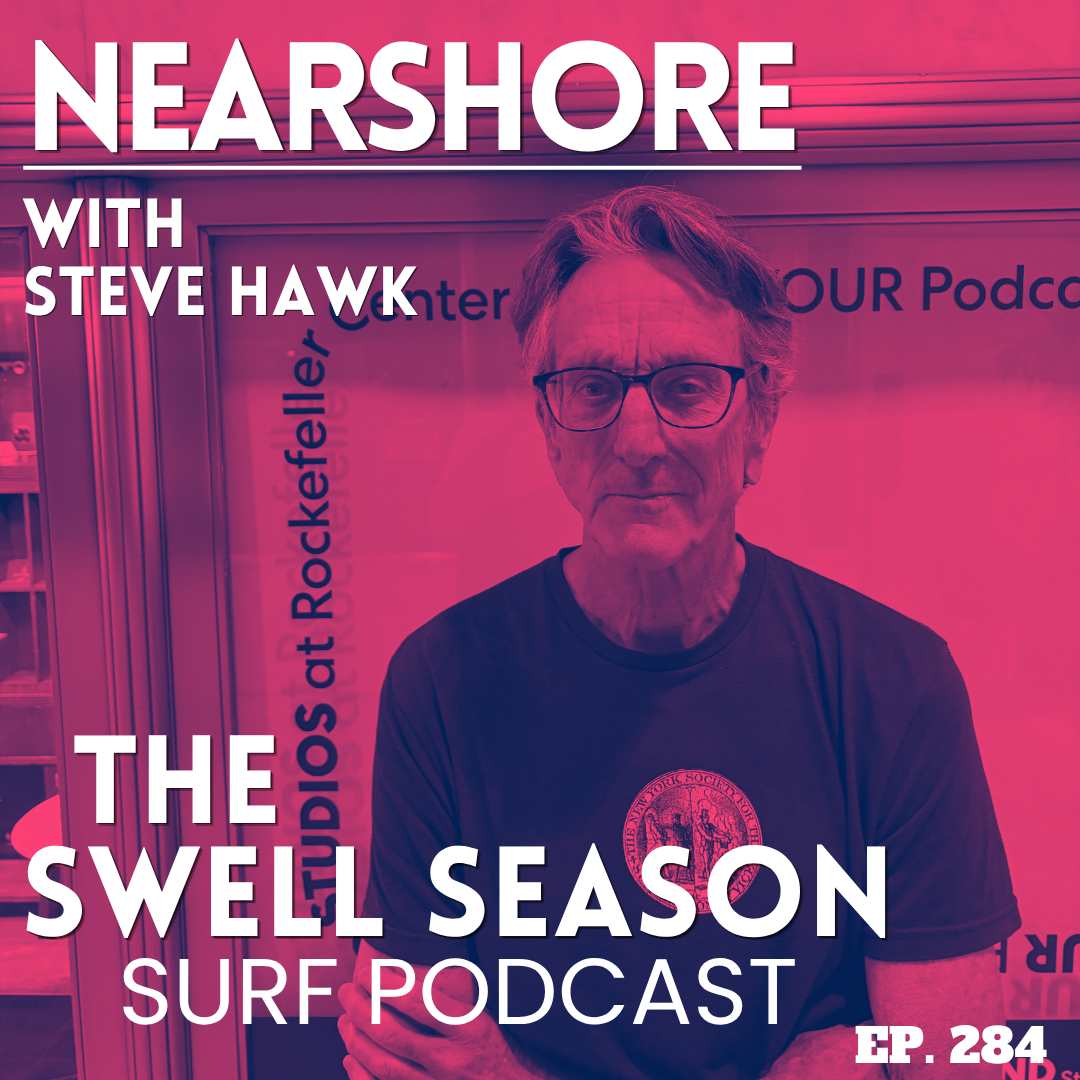
Nearshore with Steve Hawk
[00:00:00] The Swell Season Podcast is recorded by the Newsstand Studio at Rockefeller Center in the heart of Manhattan and is distributed by The Swell Season Surf Radio Network
[00:01:00]
Tyler: Hello, and welcome to the Swell Season Surf Podcast. I'm your host, Tyler Brewer. I imagine there are a lot of surfers today who will never fully understand the influence surf magazines once had on surfing and surf culture. Before influencers, reels, blogs, vlogs, even before the internet, surf magazines were our conduit to the wider surf world.
They told us what was happening, who mattered, where surfing was going, and helped shape how we understood surfing itself. And the editors were the stewards of that culture. They decided what was newsworthy, culturally relevant, worth celebrating, questioning, or [00:02:00] remembering. When you think about it, that was an incredible amount of power.
Luckily, we had people like today's guest at the helm. Steve Hawk was the editor of Surfer Magazine, AKA The Bible of the Sport, from 1990 to 1998, a period of enormous change in surfing. The momentum generation was ascendant, VHS surf videos were proliferating, surfing's art and design were shifting, the internet arrived.
At the beginning of Steve's tenure, Surfline was 976-SURF, a phone number you called for the surf report. By the time he left, surfing was entering the digital age. After Surfer, Steve's career took him through Surfline and Swell.com, the Tony Hawk Foundation, and even HBO's John From Cincinnati, the Sierra Club Magazine, and eventually Stanford Business, where he translated complex research a- and ideas into stories the rest of us could understand.[00:03:00]
In all those experiences, the surfing, journalism, environmentalism, Silicon Valley, science, politics, and storytelling seem to have found their way into his first novel, Nearshore. It's a fast-paced ocean noir that explores the collision between technology and humanity, greed and responsibility, and the increasingly uncomfortable question of who gets to shape our future I burned through this book, and I absolutely loved it.
But what fascinated me most is that Nearshore feels, in some ways, like the culmination of Steve Hawk's entire career. All these different worlds and experiences packed into one story, and that gives us a lot to talk about. Steve Hawk is our guest on this episode of Swell Season Surf Podcast. Steve, welcome to the show.
steve: Thank you so much. Wow. That's, uh, an intro. I'm gonna have to put that on the jacket of my next book. Thank you. Oh, all right. Let's do that. [00:04:00] No, that was very flattering. Thanks so much. Yeah, no worries. I, I mean, obviously, I think I told you already, we, listeners, if you are just listeners, we did a talk last night at Pilgrim before this recording, and I totally gushed all over Steve-
Tyler: and told him how much an impact he had on my surfing life, and my overall life, and politically as well. Um, I wanna dive just straight into some things, though. Sure. I'm not gonna fluff around with origin stories here. Okay. You took over Surfer in 1990, at the beginning of what would become an extraordinary decade in, uh, of change in surfing, basically.
And I'm curious, like, when you look back at the guy who walked into Surfer's office in 1990, and how different is he from the person sitting here today? Wow. Um Uh, so when I, when I walked into Surfer, I w- I had been a newspaper reporter [00:05:00] for 10 years. And, uh, um, I was a little cocky, um- Yeah ... because I thought that I could, I could bring some kind of traditional journalism skills to a publication that, that didn't really have, um, to- just didn't know a lot of the, the kind of deeper ethical issues.
steve: Um, and, uh, also just some of the, the tricks of the trade. Um, but, uh, I was also scared shitless. Yeah. Uh- As anyone would be. Yeah I think. 'Cause I, th- just like you said, I, as you did, I grew up with it. So, so, um, the magazine in the 90s was to you what the magazines in the late 60s and early 70s was to me, and that was Drew Campion.
Tyler: Yes. And, and actually, you know, I, I might take you to task a little bit on the notion that, that the, the 90s were an exceptional period of change in the surf history, because every, every ... You could [00:06:00] say that about every decade- Of course ... I think, you know? Yeah. And the 60s. Yeah. You know, when we went from short board to long board.
steve: We went from, from clean cut. From John Severson himself, the founder of Surfer, you know, actually wrote about, "We gotta keep the ruffians out of the sport." And, and- To, to going full Pacific Vibrations. To going, yeah, to dropping acid and moving to Maui. And, uh, um, so that, that was, that was an incredible, intense period of change, especially from like '66 to '70 or so.
Right. And then also you could say, uh, the 80s- Yeah ... where there was a lot of change there. Some of it, stuff that people probably look back and wince on now. Well, the professionalism- Professionalism ... of surfing, for sure. And certainly the co- And the corporate, the growth ... the commercialization. Yeah. Um, and ta- and going, the, ta- taking this commodity into Middle America.
Um, and, you know, people who don't surf are wearing Quicksilver and Billabong. And, um, and then after, after the 90s, [00:07:00] 2000s were, there was also just a ton of stuff that happened there. Yeah. So th- th- every editor of the magazine you could probably say that- Of course ... about in terms of, of the ch- the change.
But w- to, to get back to your question, um, a couple of things, and we talked about this a bit last night. Yeah. Uh, I, I was a terrible boss. I, I was a, I, I, I was a pretty good editor. Um, but I did not know how to manage people. I didn't, I didn't know how to kind of be proactive about things. I hated doing performance reviews, so I would just put them off.
And- Do you, do you dislike confrontation? Oh, I'm, yeah. My wife calls me, uh, pathologically non-confrontational. For sure. Uh, yeah, I- We're, we're very much alike then. Yeah, I will avoid conflict at all cost. I, I do often, you know, I'll have an encounter with someone who's rude and then, you know, two hours later I'll, I'll think, "Oh, I, if I were, if I were ballsier I would've said X."
I, I do that a lot. Yeah, same. For profit, it's just as well I, I don't do that. Um, but I remember I, I, [00:08:00] I was very, uh ... I just ha- I hated doing performance reviews. I, and, uh, so I would put 'em off, which meant that the people who worked for me w- couldn't get the, wouldn't get a raise, you know? Oh. So, like, they were supposed to get a raise at a certain time, but until I did the performance review.
And finally, I remember one of the assistant editors came to me, this woman, Lisa, who was just so sweet, just in tears like, "Do you not care?" And I realized I was just so busy doing all this other shit, I didn't ... I, I, I kind of neglected, um, being a good boss. Being a good boss means taking care of people.
Tyler: Yeah. But the hard part for me, so there were two big things about being a boss that I didn't like. One was, was telling people that they had to do something they didn't wanna do, but, but even harder was telling people they weren't gonna get to do something that they wanted to do. Mm. Um, and you know, there's budget constraints and, uh, creative differences and all that stuff.
steve: Um, so the, the Steve Hawk sitting here- Yeah ... is, and, and I went on to be a boss [00:09:00] elsewhere, and I learned, and on, at Stanford it was all about teaching people how to be a good boss- Yeah ... even though I didn't have any direct reports there. Um, but I learned much more about how to be a manager later in life, and I wish I had had those skills back at Surfer.
It would've been a, would've been a much better magazine. What do you believe about, like, surfing and your opinion of surfing before going there and then after? Like, going in, I imagine it must be a little jarring to see how the sausage is made, you know, in some ways when you come- You talking about the, the, the sport or the, or the industry or the magazine?
Tyler: Magazine industry. You know, I think the industry and magazine kind of all kinda go hand-in-hand. Mm-hmm. You know, the actual sport and act of surfing is obviously a different thing- Right ... you know, I think, uh, and it's much more personal. Right. But I'm curious, like, and we were just talking before we even started, like, how I feel like every time money gets involved with surfing for me, it, it does not end well- Yes
for my perception [00:10:00] of surfing. Yeah. And I'm curious, like, how you, you navigated that and how, like, going into it, what your view of surfing was or the, the industry and the magazine and the culture, and then upon leaving it, what was it and how did, were you able to maintain that same level of enthusiasm for, for the sport or the culture?
steve: You know, the, the good thing about it is that no matter how greasy you feel trying to monetize it, um, in the end you can always go back to the thing- Yeah ... which is jump in the water and rinse all that shit off. Um, but, uh- Unless you're wearing all the free wetsuits and gear that you got. Riding the free boards.
All that stuff. All the swag that you got by selling out. Yeah. Um, but, uh, a- and I, you know, so that will, that will forever be true about surfing. The, the, the act itself is gonna always be kind of a purifying element- Yeah ... process, uh, and something [00:11:00] that kind of saves us all. Um, but when I was in the middle of it, yeah, like you, you know, the, there were a lot of times when I just kind of wanted to take a shower at the end of, of the day 'cause I, I just felt like I had allowed myself to be part of this, um, this rush towards profits and m- making more money and capitalizing on things.
And how do you sell this? Well, the best way to sell it is by, you know, being as cool as possible and pretending that you're not trying to sell and, you know, all that, that, that, um, hypocrisy. Um, and, uh... And so I was glad I was always on the editorial side of things- Yeah ... because I could kind of pretend to not be part of the, the money-making machine, even though I very much was.
Tyler: Yeah. Um, and you know, I could, I could throw out these kind of shallow purist arguments about, about, "Oh, we can't do that." Um, but you know, the, the, the profit motive kind of infiltrated everything as, as it [00:12:00] will. Um, you know, like, like I look at, at what Stab's doing right now. Yeah. Which I, you know, I think they're kinda winning the game online.
steve: Absolutely. And, uh, and there's so much stuff there I wanna watch. And, and Sam, Sam McIntosh is, he's just unabashed about, you know, "Yeah, we had to partner up. Like, we couldn't bring you this content if we didn't have these big sponsors behind it, so live with that." Well, the honesty, I, I really appreciate when it comes to, like, Stab.
Tyler: They're, they're upfront about it. Mm-hmm. They're not trying to hide it. Yeah. And it's not what, uh, to quote Tom Curren, it's not grassroots marketing. You know? It's, it's, it's upfront. Is that Tom's? Yeah, he, it- That's very smart ... it, it's, um, Matt Warshaw's article, Green on Blue, in Surfer's Journal- Mm ... in like the mid-'90s, and it was about, like, the people making money off surfing.
Right. And Tom goes, "Well, it's kinda grassroots," you know? Like, the search gives this whole soulful look. Right. But really at the end of the day it's capitalism. Right. You know, it's un- un- you know, unfiltered capitalism if you think about it. Yeah. You [00:13:00] know? There's no real ethos actually. Yeah. Um, you know, when I was a newspaper reporter, there was a, a very- clear line between editorial and advertising, and you weren't allowed to talk to advertisers.
Yeah. Um, and, uh, and if you, uh, you certainly weren't allowed to take swag from advertisers. Yeah. Uh, if you did that, you would, you would've just been bum rushed out the building- Mm-hmm ... you know, and probably never gotten to work for another newspaper. Um, but, uh, when I was at Surfer, like literally within the first two weeks I was there, um, it was either Pesman, Steve Pesman, who hired me, or the ad sales director, um, just took me on a tour to meet all the CEOs of all the big companies.
steve: You know? And, and a lot of them, the first thing was, "Here, here's a, here's a box. Go into the warehouse, and- ... and they'll set you up," you know? Um, and, and, and everybody... I don't know anyone at [00:14:00] Surfer who paid for a stitch of clothes for, you know, the whole time they worked there. That's hilarious. 'Cause that was just, it was just, it was just part of the deal, you know?
Um, and- I'd be like, "Your stuff doesn't fit me." So if the, so the trick, the trick you learned was if you were going to Billabong- Yeah ... um, you walked in in a Quicksilver shirt.
Because they'd go, "You gotta take that shit off." "Put that..." That is so funny. You're like, "I'm going in. I need to get some new gear. Need to get my kid some clothing." Well, that's the thing is yeah, yeah, I ne- I didn't need any of it, you know? No. Like, you know. Well, especially because your brother too- But- ... is getting all the swag too
yeah, yeah, my brother, yeah, the, the, the skateboarder got, he got so much free stuff, and we're, we're pretty much the same body, so, uh, um, same height, same weight, all that. So I would, he would... I'd get his hand-me-downs a lot. Shoes, I got tons of shoes from Tony over the years. Oh, my gosh. Now, now I'm wearing like, you know, like, you...
Tyler: Does [00:15:00] he get like, you know, the, the like crazy now orthotic-like shoes because he's getting older- No, he's got, so he, he finally- ... and suffer plantar fasciitis? ... he finally got his, he finally got his, um, his, I think he got his license back, and he's now, he's now doing his own shoes again. They're doing it for middle-aged, uh, older- No
steve: older skaters? Skate, you know, skate shoes, no. Come on, man. Make it for my- But- ... plantar fasciitis with the high rise and the, you know, and the arch support, man. He does, he has plenty of, of, of sponsors in the 55 and over club- I know, right? ... for sure. He was on the, he was on the cover of AARP Magazine. I know.
Tyler: For, for our listeners, we didn't make it abundantly clear, his brother is Tony Hawk, by the way. Yeah. But who's, who's actually is just, he's in town. He just landed last night. Oh, no way. Yeah. Nice. He, he got in too late to go to our thing. Ah, missed out. Let me ask you then, like again, like kind of going back to this, so like did you- Did you feel weight or understand how much cultural influence you'd [00:16:00] have going into Surfer?
And, and do you feel like when you left, you were like, "Yeah, I really did have an impact," or- No, no, I don't ... felt like you had control at all? I, I never felt that, and I kinda still don't feel that. Like, I don't feel like I... I was just part of a team, you know? Yeah. And, and, and we were just sort of responding to things, as a surfer would.
steve: When you stand up on a wave, you know, it's, it's, you, you, you, you ride the thing that's in front of you. Yeah. Um, but I never once, and I still really don't think, uh, I had any kind of significant influence on the culture. You know, I just- Really? Yeah. No. You don't think so? No. I mean, I, I don't think it would be at all different if I had, if someone else had been at the helm of that magazine.
Tyler: I do- I mean, I, I, I would push back on that, and the only reason I would say that is because you get to decide what runs and what doesn't run, what stories. And there were certain stories you didn't need to run that you did run, especially, like, the environmental stuff. The things that, you know, um, that actually [00:17:00] did have an impact and actually educated us.
Mm-hmm. You know? Uh, especially for young, impressionable people like myself at that time. Like, those were things that weren't really being, to be honest, explored in surfing as much. Yeah, so that- And some of the Australian mags ... that was where we did some, some real journalism, I think, was on the environmental stuff.
steve: But, uh, but that, that's, was the, had been there for five or six years before I arrived. I think, I think Paul, either Paul Holmes or Matt Warshaw started the, the- Yeah ... Our Mother Ocean column. Yeah. And, and I, I just continued on with that tradition. Um, so, you know, I, I, I... And, and there's only so many surf-related environmental stories to tell.
Another editor probably would have told the same stories. I don't... I mean, that and, like, again, like, how you kind of, you talk about how you did, you pushed the writers not to write about the surfing, but the people. Mm-hmm. You know? And those were interesting stories. Like, uh, I was listening, even, like, you had that Pat Curren story.
Yeah. Like- That was a fun one ... listeners, like, you know, he had a journalist who was being rejected [00:18:00] from Pat Curren to do a, a story, but he just showed up with beers, and- Mm-hmm ... you helped push that. Like, no other- Well- No, surfing was not doing those... They weren't... Like, surfing was very youth, youth focused at the time.
Tyler: Mm-hmm. And you had, like, Eastern Surf and Wave Action and all these other things, but they were all so youth focused. You gave us some medicine with our, you know, like, sugar with our medicine, I feel like. Um, yeah, and I think that p- part of that just came from having, you know, having not just had a newspaper experience in my background, but my mentor in college was a, was a f- a guy named Barry Farrell, who was a very, uh, successful magazine writer.
steve: Did, broke some huge stories. Um, his best friend was, best friends were Joan Didion and her husband John Dunne. Wow. So I got, I met them a few times. Wow. I, I, I read up, I, I, I deeply, I g- became deeply familiar with, with Joan's work and, [00:19:00] um, and I was, I was reading a lot of the best nonfiction writers of the era.
Um, and that influenced a lot of what I did. But, um, let's just say we didn't have any Joan Didions on our, in our, in our quiver. Um, but, uh, that story about Pat Curran, that was Bruce Jenkins- Yeah ... who was a legitimate sports writer for the- Yeah ... San Francisco Chronicle, like a legend- Phenomenal ... in the sport.
Um, and, uh, but also a keen body surfer, grew up in Malibu, would spend a month or so on the North Shore every, every winter, and he loved writing about big, big wave guys. Yeah. He loved writing about old, older big wave guys. But, um, that was actually all him. So he, he wanted to do this Pat Curran story, and I said, "Absolutely, let's do it."
He reached out. Curran said no. Um, he decided just on his own, I told him I'd pay for it, but he was the impetus there. He said, "I, I'm gonna go, go down to Cabo and find him and see if I can get him to talk to me." And he talked to, to Tom beforehand, and Tom said You know, maybe, maybe bring some beer. Well, uh, I [00:20:00] beli- If you showed up with a case
Tyler: I think it went more like, "Um, uh-" Yeah. "... well, maybe-" Yeah "... bring some beer." Yeah. You might wanna- That's how Tom would say it. ... maybe, yeah, like, buy a, buy a 12 pack. Um, and so I think he showed up with a case, and, and Pat just kind of reluctantly let him in on the next thing. And Bruce is such an engaging guy, and so, kind of able to get things out of people in a quiet way, and just kind of put his tape recorder down, and they started talking, and then he got the whole story.
steve: Yeah. But it was that, he- Which- He also did, didn't he do the Jose Angel piece for you guys too? Yeah, yeah. Which, that, I mean, like, I started doing back flips on big waves because of that. 'Cause I read, like, Jose Angel would just do back flips- Yeah ... in the tube at Waimea. That was ... I, I actually like that Jose Angel story almost as much as the Curren story, yeah.
Tyler: That one was one that stood out to me. Yeah. And was very im- I was very, it was very impressionable on me- Yeah ... that story, for sure. I think the quote from that story that we put on the cover was from Greg Noll, "The gutsiest surfer there ever was." [00:21:00] That's right. Greg Noll said that. Yeah. Yeah. We're gonna get to him too at some point here- Yeah
'cause, uh, I, I heard you talking about The Bull, which is one of my favorite books. It's, uh, may- maybe my favorite surf autobiography. It- Yeah ... it is- Hard to find. I know. And it's, I, I was, I was gifted that book, uh, from, uh- Someone liked you. Well- Because I looked it up recently. It's hundreds of dollars on eBay.
Well, I was 17. I was in the hospital for a week. I almost got meningitis. And, uh, my, this guy, John Hannon, who was the first surfboard shaper in New York, and he, him and I struck up a... He was working at my dad's store, and he became like a grandfather figure to me, and really instilled a lot of values in me.
And he came and brought me his hand-signed, uh, The Bull book- Wow ... from, from Greg Noll and everything. Wow. And, uh, and I've, I still have that book, but oh my God, like, that book is... It's a shame [00:22:00] they, they don't reprint it, 'cause that would sell. I know. They should. Somebody should. It's, it's incredible. Yeah. Uh, I wanna explore what it was like at Surfer.
Like- From the outside in, being very far, uh, you know, and, and being in New York, I think we, we all kind of felt like red-headed stepchildren to the surfing world at large. And I... But it, it always felt like you had this really unique community in the office, and I want you to kind of ex- kind of describe what the vibe was like in the office.
Mm. Can you describe what it was like? How, how the, uh, dynamics were? Did it feel cohesive to you? Did it feel like a- Yeah ... like a close community? Ki- kind of... Ki- Yes, it did, largely because we worked really long hours. You know? And so when you're in the office at 10, 11, 12 at night with somebody, w- you know, you, you, you better get along.
steve: Um, and, uh, a- and it was a creative process. And- [00:23:00] Yeah ... um, so at the end of... You know, when it was all done and the fin- the issue came out, there'd be like, "Look what we did." You know? Yeah. Not... I m- We never actually said that, but we, we... At the... Every month w- after the issue came out, I made a point of having the staff sit down, and we would page through it and look at what we did well and what we could have done better.
And that was always fun, 'cause for the most part, you're like, "That was good. That was good." Um- But it was... Th- there were stories about what it was like before I got there- Yeah ... back in the '60s and '70s when it was, it was a whole different scene. Like, they were, they were smoking pot in the, in the dark room and-
um, there was a, a p- there was rumors at one point they had, like, a, um, like, a cash fund for expenses that was used to buy a variety of drugs- ... for the parties. That, that, that wasn't, that wasn't going on when I was there. Um- Imagine the '80s, you know- Yeah ... they must've had a lot of coke at least going on. I, I th- I think there [00:24:00] might've been some blow, yeah.
Um, and, uh, but that, that was all done by the time I got there. Um, but it was... So there were a couple other mags as well. And it was, the space was cool. Yeah. You know, just the, the, it was, um, this kind of two-story thing, but the, but the top story was like an, like a, a loft. Um, and, uh, you could see it from, from down below, so there'd be a lot of shouting up and down.
That's where the art directors all sat, and the, and the photo editors, so that's kind of where all the artsy stuff happened. And then- Yeah ... all the edit- all the editors who did text and the writing were all down below. And, you know, I was, I was right next to the editor of Powder Magazine. Oh, wow. A guy named Steve Casimiro, who's gone on to do great stuff.
I don't know if you've ever seen The Adventure Journal that he does. Yeah, yeah. Um, and, uh, and he was m- actually married to our art director, Joanie Casimiro. Joanie, yeah. Um, and then, uh, there was, um... They launched Snowboarder Magazine and they launched Bike Magazine, trying to just apply the same, um, same kind of journalistic, [00:25:00] um, style and attitude to mountain biking, where we'd make it more about the pictures than about the, the gear and the competition.
Tyler: Yeah. Um, and, uh, so there was just a lot of creative energy and a lot of, lot of kind of crossing over of ideas. Um- But, you know, we were understaffed. It, it occurred to me after a thing last night w- w- I was talking about how the magazine size would, would grow and shrink based on how ad sales were going.
steve: Yeah. So very much the size of the magazine was very dependent on the strength of the economy. Yeah. If the surf industry was doing well, we would get, uh, 100 pages of ad, which meant we, we had to do 100 pages of editorial, 'cause we tried to have a 50/50 ad edit ratio. Yeah. Um, and when it was doing poorly, we had 50 pages of ad, we only had to have 50 pages of editorial.
Well, if as the, as the magazine grew, let's say I suddenly I was making, producing 50% more editorial pages, I didn't get a bigger staff. You know? I [00:26:00] got, maybe I'd, I'd get like a part-time assistant editor or something. But we, um, so we were just working harder or fudging by saying, you know, let's- Do a photo issue
let's, let's do a photo issue. Exactly. Or, and then, then we actually created, once we, the magazine was kinda consistently big, we can, we created a, a, a section in the back of the, the, um, the center well, which was, um, just we called it Some Stoke. And th- that was where we would just run big pictures for- Yeah
12 pages, 'cause that's eas- that's a way to fill up some, some inches. Yeah. It's all you gotta do there is write captions. Pick good photos and write captions. Photographers were stoked. The photographers were stoked. Yeah. Readers were probably stoked, you know? Like, um- You feel like you accomplished something when you finish the magazine, and mostly it was photo.
Yes, exactly. Um, but we, but we had, you know, so the way the magazines were built, most magazines traditionally are built where you have what's called the front of the book, which is where you have the fractional ads, the one-page ads, the half-page ads, and then you fill up the [00:27:00] editorial space, um, in there.
And that's where you have the recurring departments. That's where, like, letters to- Mm-hmm ... the editor, the editor's note, the- Curious Gabe ... Curious Gabe. I love it. Who I just saw at my book event in New York. No way. Yeah. How's he doing? He's doing great. Yeah, he still looks the same. That guy's never gonna get old.
He's so good-looking, him and his wife and the kid. Yeah, yeah. Like, they, they spent a bit of time in New York, and I got to- Yeah ... hang out with him. Yeah. 'Cause he was a girl magnet when he was at Surfing Magazine. Dude. Dude, are you kidding me? I mean, he was responsible for the black and white Rusty ads. Like, dude, I mean, come on.
Yeah. But also just a sweetheart of a guy. And he did a great job with that Curious Gabe column. Yeah. Where he would go out and man on the street questions to different people, and he'd come up with really clever questions, and he'd spend a lot. He'd interview 30 people and pick the best eight, you know?
Like, he was- He- ... really good at that. Well, he was basically, like, kinda doing hot takes or subway takes, kind of like that's really popular now- Yeah ... before that. Yeah. And, and I'm like also, like, kinda surprised he hasn't brought it back and tried to [00:28:00] do a video version of it for social media. Yeah. He... That, that's a great idea.
He could do that. Yeah, that would be very, very popular. It would be- That's a great idea ... really good. Gabe, if you're listening- And, and, and, and, yeah, Gabe Sullivan, if you're listening, do that. Um, uh- Because also, but the, but the, the key to some, making something like that good is in the curation. You know, not just, not just doing the six f- the first six people you talk to, but- Yeah
talk to 30 and then pick, pick the best six. Um- Exactly ... that's, that's the hard, that's where the work happens when, in those kinds of things. My claim to fame was being featured in one of them. That was great. You were, you were one of the- Yeah. One, one of my favorite memories when I, uh, when I left Surfer was he did a mock-up fake Curious Gabe, uh, with everybody I worked with.
Tyler: No way. Yeah, yeah. So- What do you think of Steve Hawk? You know, something like that, yeah. Tell me, tell me your worst Steve Hawk story. Um, yeah. Who, who were some of the cast and characters at that time, you know, when you were there that, that really stand out to [00:29:00] you and, and, and I'm cur- Personalities- Yeah
steve: uh, that I worked with? Yeah. Uh, wow. Well, everybody. Um, uh, Art Brewer was, was kind of the assistant photo editor when I started. He, he was sort of in and out, but he was a big personality. He ended up becoming a, a, a pretty good friend. We spent a, a month on a boat together, uh, go- in Antarctica with some, a bunch of other people in 2000.
Tyler: Yeah. And, um, yeah, you know, a month on a boat in Antarctica, you get to know someone pretty well. And, and I had always been a little bit, kept him at arm's length, 'cause he, he could be kinda grumpy. Yeah. But, but once you re- he was just a big bear, you know, with ... He looked ... He could, he could, he could rear up and put his claws out, but I, I really ended up loving Art Brewer.
steve: So he was, he was a, an, a talent, talented motherfucker. Yeah. Like, so, so talented. And then Jeff Divine was the photo editor when I was there. He's one of the luminaries of, of surf photography. [00:30:00] Um, and, and just the sweetest dude. As you said last night, somebody said about him that y- you've never heard... Oh, Pesman said, "I've never heard Jeff say a bad thing about anybody," and that really was true.
Tyler: Yeah. Yeah. I mean- Yeah ... he would, he, i- from what everything I've ever read about him, he just seems like the coolest guy. Yeah. You know? And would be, like, one of the more fun and enjoyable people to work with, you know? Yeah, for sure that, yeah. Like- Um, and you know, he, h- i- his, his favorite moment of every year, I think, was when we were on the North Shore.
steve: So we would rent a house on the North Shore for six weeks to two months every season, because we'd end up getting a significant percentage of the photos we were gonna use for the year in that tight little ... 'Cause every, every pro surfer was there. It was the most photogenic place in the world. You had this wide range of waves, you know, from ripple Rocky Point to heavy Pipeline to giant Waimea.
[00:31:00] And, um- And the other thing about the North Shore that I didn't realize till later was that because it faces north- Mm-hmm ... and it's in winter- The lighting ... the, the lighting, it's front lit all day. Yeah. It's front lit all day, and it's, it's only kind of partly back lit in the morning and, and beautifully back- back lit in the evening, but the rest of the day it's a studio.
Tyler: Yeah. Um, and, uh, and the wind blows offshore, you know, and the waves are c- most of them are pretty close to shore, so you- Yeah ... um, but in those days, there was no digital cameras. Um, so, and the, and there, there were no ... Early on, there was very little video being shot where people could go back and watch it.
Yeah. Um, Taylor, uh, Steele was just starting to do that. So, uh, in the early years I was there, um, we would- Mm ... we would send all the photos off to be processed, and then we'd get the slides back, and Divine would cherry-pick the best shots and [00:32:00] put on a slideshow- Oh, freaking out ... at our, at our house. Or, or at one of the, one of the big sponsors.
steve: Someone who could, who could handle a crowd. Yeah. And, um, and everybody on the North Shore came to those slideshows. Wow. Because it was their first chance to see what they got. Like, that bomb I got at Pipe, I haven't seen a photo of it yet. Oh. This would be, you know, sometimes three weeks after the fact. Um, maybe more.
Maybe a month after the fact. And, uh- W- what was the vibe like in there? Oh, it was so, so cool. That must have been insane. And, and, and, and the coolest part about that was Jeff has always ... He k- kinda can come across as sort of not that articulate and a little bit shy, and, um, but he fucking held court, man.
He was be- he was, he was running the slideshow, and he would heckle. Um, and, uh, but he also knew what, like, what was coming, 'cause- Yeah ... um, and, and you'd be, you'd have sequences. But I remember one, one time I, uh, one time I brought my wife and [00:33:00] my, my four-year-old son, uh, Wilson- Yeah ... who's now 34. And he was at the- At the event last night
thing last night. Um, but, uh, they came over for a couple of weeks while we were there, and, uh, we decided we were gonna, we were gonna feed everybody. So we bought, like, pounds and pounds of swordfish or something, and, and we rented this giant grill. Um, and Tom Servais, you're gonna hate me for telling this story.
Tom Servais was in charge of firing the grill. Yeah. So he, um, he did, and then he walked away, and I think he got high. Uh, 'cause he, both he and Jeff, uh, liked their pot in those days. Um, and, uh- And then, and they, and they never caught Oh, no So he comes back like 15 minutes later thinking that it's all ready, then he, he lifts it up and they're cold Oh, no And, and everybody's in line, like with their little paper plates-
waiting for this. Uh, so he starts [00:34:00] throwing it on and, and it's, you know, it's, it's dudes like, like Sean Briley and Mark Healey when they were young- Yeah ... and frothing, and hungry- ... and poor. Yeah. And so it's like, "Free swordfish? Are you out of your mind?" So they go through and like after the first 10 guys, like half the food was gone Oh, my gosh
'cause they just piled it on. And my wife, who's, who's got a, the deep sense of kind of being polite in situations like that, was just so appalled at this feeding frenzy. Like, it's on, and there's people at the back of the line who'd like ended up getting, you know, like a little bit of salad or something.
Tyler: Eddie Rothman's at the back of the line like- Eddie, yeah ... "Sorry, Eddie, we only got salad for you." Yeah, I think if Uncle Eddie had been at the back of the line, those guys might have been- ... a, a, a little more polite. But, but it was really cool to watch. The, those, those slideshows were, were really magical, you know, 'cause you'd see the first time, like, yeah.
I, I remember reading about those, and it just [00:35:00] It's, it feels like something's lost these days because of that, you know? It's like you don't get that anticipat- anticipatory buildup- Yeah ... for that, you know? Yeah. It's a, it's a kind of a shame. And also, you know, they helped to make surfing feel smaller, I think.
steve: And, and, and it helped build a sense of community. Yeah. You know? Like, if, if, if you're standing shoulder-to-shoulder with somebody hooting, like, if, if, if I'm, uh, at that slideshow next to, uh, Tamayo Perry- Yeah ... and he, and there's a, he's, he's in a bomb at Pipe, and I'm like hitting him in the shoulder, giving him a high five- Yeah
I paddle out at, at, at sunset the next day, you know, he might, like- He might be nice to you and let you get a wave ... he might be a little bit nice. Yeah. He might say, "Okay, you..." Um, and, and I think that's true of all, of all surf gatherings, you know? They, they, um, they cause you to, um, to treat the other people in the lineup not as the enemy, but as just, like, a partner that's a human.
Tyler: [00:36:00] Humanizes everyone, you know? Where, where I live in Half Moon Bay right now, it, to me, it, it's, it's the most, uh, it's the closest community of surfers I've ever been a part of. Um- Interesting ... and there, and there's a few reasons for that. Um, and one of them is there, this, there was this surf club started at the local high school and junior high school by some, some of my friends back there.
steve: Shout out to Marty Phelps and Oliver Keaton and Tom Fyches. Excuse me for this. Um, and, uh, oh, and, uh, Michael Wallace. And they, at a really ear- early age, taught these groms to, like, be polite. Yeah. Especially respect your elders. But treat each other well. Um, and, uh, part of that crew was Luca Padua, who's now dominating out at, um- At Nazare and other big wave spots.
Yeah. And then there was another thing that happened. Um, so one guy, I mentioned Tom Fyches. His oldest son, Malcolm, was, was kind of a leader of [00:37:00] that crew. Malcolm pushed Luca Padua into his first wave- Wow ... um, because he ran the local, uh, junior lifeguard program for a while, and he had a saying to the kids every time they showed up, which was, "Show up and be kind."
Um, and, uh, and he drowned at the age of, like, 21 or 22- Whoa ... at one of the local beach breaks, one of the state parks that's in my book, uh, called Pomponio. And, um, uh, in front of his friends, he had a seizure. Um, and, and they were all lifeguards- Yeah ... and they couldn't... Um, so the paddle out, which was right in the heart of Half Moon Bay by that, that wave where the jetty is there- Yeah
I don't know, 400 people, 500 people. It was huge. Um, and then his parents, uh, started print- Tom, uh, printed up these bumper stickers that said, that say, "Show up and be kind," Malcolm [00:38:00] Fikes. And, uh, and every surfer I know in Half Moon Bay who's kind of, of my age or in their 40s and 50s and, and, and, uh, all his friends, you see that bumper sticker everywhere, you know?
Uh-huh. And it's kinda hard to be an asshole when- ... when you have that on your car in the parking lot, you know? Um, and, uh, and then I, I started organizing a party, uh, that I, I called, um, Dudes I Met in the Parking Lot. So about two... There, there were all these people I knew and who my buddies and I had kinda nicknames for, but you never, like, I had no idea what they did.
Um, Barefoot Bruce and- It's like- ... Longboard Joe. Um- It's like every community has that, like- Yeah, yeah ... you know, like, we've got a guy at Rockaway we call Panhandle Steve, you know? And like other- Exactly. Yeah ... you know? We have a Crazy Steve. Yeah. Um- We used to have a Crazy Larry and like- Yeah, yeah. Um, and so all these c- [00:39:00] these people who sort of like just kind of would nod to each other or talk a little bit, but you only kinda knew their first name and no idea what they did for a living or anything.
Tyler: Uh, yeah. Um, they al- they'd just show up at my house. And there was this one dude Who was, um, he, he kinda, he rode soft tops a lot, and he kind of rode oversized boards, and he was super keen, but he was, you could tell he kinda came to the sport late. Yeah. Um, but he would go out in big NorCal days, like double overhead days- Yeah
steve: and, um, get some waves, uh, go over the falls some. But he just seemed like this goofy young guy, and I, and I, I had him pegged as a guy who's like, okay, he just finished junior college, and, and he had this, this beautiful, uh, girlfriend who seemed a couple years younger, and she had, like, a, an accent. Um, and he comes to the party.
I realize he's a tenured professor at Stanford- ... who's, who's, uh, graduated from MIT in math at, like, you know, [00:40:00] 18 or something, this, this super math whiz, who helped me with some of the math thing in my book. No way. Remember, you know that equation I had? Yeah, yeah. He corrected that for me. Um- He's like, "No, it's gotta go like this."
Yeah, yeah, yeah. Um, and, um, uh, and his wife is now, uh, in, getting her, her MD or her PhD at UC San Diego, so they moved to La Jolla now, and she's at the top of her field and doing research on some particular medical issue. Um, and you just, you just never know, you know? Well, that's one of the things I love about surfing, and, and particularly surfing in New York is kinda really surprising and fun in that way, 'cause you just never know who's gonna be in the lineup.
Tyler: All day. All day. And then it's like, could be a plumber, and it could be, you know, fucking executive, uh, CEO or whatever. Right. You know? Like, you just never know. Right. Um, so it's always taught me to be nice to everyone in the lineup. Right. But also, I do love the fact that surfing creates this great equalizer in that way, [00:41:00] where the class and other stuff outside has no bearing in the lineup.
That's right. If you suck- Yeah ... and you're kind of a kook- Yeah ... and, or act like a jerk in the lineup, you know- Right ... doesn't matter what you do. That's right. You're gonna be low on the totem pole. So I've c- I'm really curious. Now, I've, I've never surfed in New York. I've, I've actually never- We should've gone the other day.
steve: Well, I, I'm, I'm maybe going tomorrow. I'm, I'm hooking up with John Cohen down in... Yes. But, so tell me. It's looking bleak- Oh ... wave-wise, but Okay. Um- Uh, what, what, in your mind, what's the difference between the New York surf culture and, say, like, the NorCal surf culture or the Southern California surf culture?
Tyler: I mean, I would say that it's, uh, surfing here is more a novelty, for sure. So when you, you mention a lot of people you surf here, it's definitely not, uh... It's becoming more pervasive. Like- Mm-hmm ... there's a lot more people learning to surf here. I would say it's a lot, it's very inclusive, uh, particularly Rockaway.
Uh, uh- Hmm ... Rockaway is very unique. So not a lot of localism there. No. [00:42:00] Well, it's 'cause it's sort of public domain, right? Like, that's, they know it's- It's a city beach, so it's free. Mm-hmm. Uh, whereas other beaches on Long Island, you have to pay to get on. What? Yeah. So Long Beach, which is, you know, only, you know, just next to Rockaway, in the summer you have to pay anywhere from 15 to $20 a person to get on the beach.
steve: What? Yeah. To the city? Yeah, to the city of Long Beach. Right. Not the city- Sure ... that's not part of New York City. Right, right, right. Um, Robert Moses is another beach. Uh, you, it's a state beach, but you gotta pay to park. Uh, same with Jones Beach. Then if you get out to the Hamptons- Can, can you buy annual passes, or it's a- You can buy annual passes, and you can do all that stuff, but it's still like, the fact is you have to pay access in the summer.
And do you have to buy, you have to buy all these different annual passes. Yeah. And if you live out east, like, if you go out east, you wanna go surf parts of the Hamptons, um, during the summer you can't park at those beaches because you have to be a resident to go to those beaches. You can't... Like, go to surf Montauk, Ditch Plains, you actually can't park there in the summer.
So how do you [00:43:00] surf it? You know. You, you have to know someone, or there is, like, maybe some area you can park, but for the most part you have to have a sticker on to park, or else they will give you a ticket. Um, so Rockaway is- That doesn't sound inclusive. No, it's not. But Rockaway is, is very unique, where you have beachfront property with public housing right on the beach.
Tyler: So you have this interesting mix of people. Um, towards the western side of Rockaway, it's more localized, and it's, uh, it's more s- more like, uh, suburban looking. Mm-hmm. And it's, uh, and you can't park up there during the summer. You need a permit to park on the street and things like that. Um, and it- There's no paid parking lots or?
No, you would have to go to Riis, Jacob Riis Park, which is the furthest end. And, and then you can walk into those places. Um, and that's probably a little bit more localized and more regulated, and it's all, like, [00:44:00] cops, firemen, Irish, you know, who live up there, and they're, like, generational, too. Mm-hmm. So- And, and, and there's a surf culture there?
There's a sur- there's a surf culture there that's been there for, you know, decades, and it's much more, I would say, localized and, and a little tougher to get in. Uh, but then as you go down the beach towards the, the east, um, you start to get to the ac- public access area from, like, 116th Street. It, like, Rockaway goes from, like- 20th Street on up to 140th Street.
steve: Oh, wow. That's several miles. Yeah. Okay. And so about 116th Street is where it becomes open to the public, mostly the beaches, and you have a boardwalk that goes along, and it's beautiful. The boardwalk is built, newly built after Hurricane Sandy, and you have, uh, like, big restaurants on the boardwalk with drinking and music and other stuff, which is cool.
Tyler: Mm-hmm. And as you go down Rockaway, the, in the street numbers, you see more [00:45:00] public housing, and you see m- what we call, you, there are lots of Mitchell-Lama, uh, buildings as well, which is, like, government subsidized. And, but you have it mixed in with regular homes and duplexes and condos and, you know, really nice condos as well.
So then you get this mix, and then you get all the people from the city coming out from all over the place. Right. And so it's this huge mix, and it's probably one of the most diverse lineups you will ever see in the world. I'll bet. It's, and it's also class-wise diverse. Uh, obviously, uh, you see, uh, m- a lot of the time it'll be 50% women, 50% men, maybe even more women outnumbering men sometimes- Really?
in the lineup. But that, that's must be fairly new. It's in the last, you know, I would say 10 to 15 years. Um, you've also seen a huge, uh, influx of people of color in the water. Yeah. Um, especially since Black Lives Matters- [00:46:00] Right ... movement in 2020. You saw a much bigger push. And then there are groups like La Rubia, which is a nonprofit organization that works to take kids, uh, from different backgrounds and teach them how to surf.
Right. And it's- Right ... been phenomenal, and it's given birth to so many amazing surfers. We have, like, um, this girl, Farmada Dia, who, you know, just got back from a mentee-wise trip with Salima Messakela and other people- Wow ... and they filmed it, you know. And she's a beautiful surfer, like, stylish, incredible, but also active, active in the community, constantly- That's so cool
giving back. So it's really- What's her name again? Uh, Farmada Dia. How old is she? And she's probably in her mid-20s now. Okay. And, um- I'll look her up ... and she's just so cool. And all of their friends, they have this wonderful crew of people. Um, and we actually, on the Swell Season pod- you know, network, we host a show called We, We, WeSurf, and it's BIPOC surf podcast, and it's all about [00:47:00] inclusion and bringing people from different- Very cool
backgrounds, you know, into surfing- Wow ... and highlighting that. And so that's been, like, really cool to see, and it's, it's made the lineup more enjoyable. I'll bet. And it's made it more fun. And everyone is, at least for me, like, I never have ... I mean, I'm a big guy, so I never have issues. Yeah. But I also just find it, like, it's, it's a, it's a great community of people who are always helping out and always, like, there for each other, and I, I think it's actually beautiful.
And you, and all these people are connecting with people from different backgrounds all over the city, and- And are they surfing year-round? Yeah. Yeah. You know? Holds up. Even during the hot, the cold, middle of winter. You know it. I mean- Yeah. That's cool ... you know you're not a real New York surfer unless you surf a winter, some would say.
steve: Unless you, unless you've got snow on the beach at some point. That's right. Yeah. You know? So I would say, like, it's a very unique place. And I would say even, like, it's given me hope in the sense that I feel like surf clubs particularly, and these, [00:48:00] these groups that have been forming, are helping to regulate the lineup and make it a much closer place.
Tyler: And you've seen huge proliferation of these surf clubs. Like, you have the La Robella group, but then you have Benny's Surf Club, which was an LGBTQ+ club. And then you have this other group that was called Yeasty Boys, and it was for all mostly new beginners to go out and surf together. But they also do education and teach them about etiquette and, you know, really trying to, uh, make people aware of surf history and culture.
So it's like- That's really cool ... you know, and I look at those things, like your parking lot crew. Yeah. Those are the ways we're gonna be able to, uh, manage the new influx of surfers and to- Mm-hmm ... pass on the traditions, I think. Uh, you know, the other thing I, that I'm hopeful about is that, um, in the There, there's such a backlash these days about, about tech and screen time, and now AI, that, um, [00:49:00] uh, I'm very much a believer that gatherings like the one we had last night- Yeah
steve: at Pilgrim are gonna become, uh, much more popular. And because people are gonna wanna know, like, s- I, I think live music is gonna start to boom because- Yeah ... people wanna know that the thing they're hearing was made by the person who's playing it, and that's- Totally ... the way to do it. I think that, uh, that, um, dramatic theater, live theater also, you know, musical theater.
Dude- But just, but every time I've ... E- Every bookstore, I've been to a lot of bookstores in the last month- Yeah ... or so. Yeah. Um, and they all tell me that their business is ratcheting up. There's new bookstores opening up. Independent bookstores are, are ... They, they've been hanging on by their fingernails, you know, since Barnes & Noble, since- Yeah
Amazon, Barnes & Noble came around. And they're all, they're starting to kind of gain a foothold back, I think. Um- It's, it's because they're building community, too. Yeah. That's the huge part of a lot of these stores. The ones that are thriving now, I think- Yeah ... are the ones doing- Big mailing lists, lot of [00:50:00] events.
Tyler: Exactly. Yeah. They're engaging with the- Yeah ... people around them. Yeah. And so people come in and support- Yeah ... which is amazing. And, and, and Pilgrim has been at the- What a phenomenal store ... it's, it's been at the, the heart of that. Yeah. You know? They're, it is- Yeah ... a very important part of our community.
Yeah. And Chris and Aaron have done such a phenomenal job- Yeah ... of fostering that. Yeah, and you can tell that it's in, that their personalities infuse it, too. I, I don't know them well, but the little bit I've dealt with them, they're both so generous and gentle and, um, no pun intended there. Yeah. Um, but, uh, uh, yeah, I, I, I like that part of it.
steve: Um- It- I, you know, we did a thing when I was at Surfer, uh, I, I haven't really explored this, thought this through very much i- in recent years, but, you know, surfing was, has always been sort of snubbed as, by, by, by, by intellectuals and certainly by writ- by, by real writers- Yeah ... um, as just this goofy, spicoli-ish- Of course
sport [00:51:00] that you, you know, as I, as I've talked a lot in my book about how the act itself is very much, has nothing to do with language and abstract thought. It's all very much your lizard brain- Mm-hmm ... and you're in the moment, and it's sublingual. Um- But, you know, like, so like the, the, the, there's a tradition in New York especially of writers writing, finding deep meaning and subtext in baseball.
Tyler: Yeah. Of course. Um, sports. But, but baseball particularly, right? Yeah. 'Cause, 'cause the, you know, when it, when it first got popular, the best teams were here. Yeah. You had, you had the Yankees. The Dodgers. Yankees. You had the Giants. Yeah. The Dodgers. Yeah. Um, and we did a thing at Surfer once where we had all these kind- We had this what if scenarios, and I, and I postulated, what if the, um, the bathymetry around New York were such that it was like the Mentawais.
steve: So that, so that you had beautiful, groomed, world-class surf here [00:52:00] going back hundreds of years. Yeah. And, and surfing was as embedded in the culture here, essay as it was in California, but you also had this kinda intellectual overlay over it. Mm-hmm. We- That exists now ... it would've been... It kind of exists now, but, you know, Fin- Bill, William Finnegan, who won the Pulitzer for- Yeah
Barbarian Days, he had to hide from people that he was a surfer. Yeah. You know? Um. Well, but, but that's like, but that's his own insecurity, I think, you know? As to... Well, to some degree, yeah. I mean, I, I, I did that a bit when I was a reporter. You know, you just like, "You're, that guy's a surfer." You just know there are people who are, who are never gonna get past their bias over it, you know?
They, they always see Jeff Spicoli. Yeah. I think that's- Yeah ... changed, though, in today's climate. It has changed. But would've, it would've been- Yeah ... different. 20, 30 years ago- Yeah. Yeah ... it, it would be different. It was funny, like, I remember- There'd be a Cooperstown- Yeah ... for surfing somewhere on the East Coast.
Tyler: Yeah. Well, that would be nice. Yeah. [00:53:00] I, it, it's, I feel like- When I grew up, it was a very small community I bet that was pretty cool. It was awesome. I loved it. And like, when I did, uh, the New York Surf Film Festival in, like, the mid-late 2000s, it was awesome because, uh, it brought the whole community together, from Out East, Montauk, to here, and everyone kinda knew each other.
Out East? Yeah. We call it Out East, you know? Oh, Out East. Out East. Oh, okay. Yeah, Montauk, you know? Yeah, yeah. I thought you said Outies, like they're- No ... they're the Outies. No, no, no. Okay. But it was, it brought everyone together, and everyone kinda knew each other. And w- if you did, like, the ESA competitions too, you got to know everyone.
Mm-hmm. And, and so it would be really fun as like, uh, when I first got my license, I could go to Hampton Bays and getting in with the locals there. Right. Because I knew Bruce and Java Bailey, these really good young surfers, and so they let me surf there. And then if I went to Montauk, I knew Charlie Wymer and all these other guys, and so I could surf.
steve: That was all [00:54:00] through the ESA? Yeah. Yeah. You know? It really opened doors because you got to get to- Right ... know all these kids. And now it's so much bigger, and now you're seeing these sub-subgroups- Right ... I bet, you know, more so. But s- but the downside to that, of course, is that the lineups are more crowded, right?
Tyler: Yeah, but like you said last night, you can always find an empty wave. Yeah. And it's so surprising. Like, on, on S- on Sunday, we had a paddle out, um, for, for Palestine, but it was so funny 'cause literally the two beaches next to us were packed, like hundreds of people. Surfers? Yeah, on foamies, a lot of beginners, a lot of surf schools.
How, what, what were the waves like? It was, like, waist high. Really beautiful, clean conditions, really fun peaks. But on our beach, there was only a handful of people surfing, and there's no rhyme or reason. I've had that experience in Rockaway so many times when I just, like, look at the crowd, I go to [00:55:00] the next beach over, and there's no one out.
Right. And I'm getting waves by myself, and I'm literally watching the crowd next to me. Yeah. It's, you could still find it. I think there's a, there's a lemming effect with begi- beginners especially. Yeah, yeah. Yeah. You know? Which is good. It ju- Yeah ... it's great, you know? Concentrate all that. Yeah, people like to surf together.
People- Mm-hmm ... surfing is social- Mm-hmm ... in many ways, you know? It, it can be a very social thing, and I, I, I love, I love the social aspect of it here. I love talking to people. And like you said, though, I would never, uh, say, "Oh, here's a set, but let me finish my point." Mm-hmm. Right. Yeah. Um, I'm, I'm curious, like, do you, do you ever miss the fact that surfing was smaller?
Do you miss, like, going back to a time, like the '90s for me felt, surfing felt small. It felt like you, one, like, the magazines could kind of dictate the culture. Mm-hmm. And I'm curious, like, how you feel about the [00:56:00] democratization of it all now, that everyone can produ- be a producer of content. Everyone can put their own kind of spin on surfing.
Right. Like, do you, do you embrace that? Do you, do you- I, I, I can't say ... I mean, I, I, the only thing I miss about the old days, quote, unquote- Yeah ... is, um is probably that there were some waves I used to surf that weren't as crowded as they are now, and now I won't go near them 'cause they're packed. Yeah. Um, but that's about it.
steve: You know? Like, the, um, uh, I, I love being able to watch what Nathan Florence is doing, you know, a week after he, he's been at some slab, you know? Yeah. And, um, and, and everything John John drops, I'll watch in a heartbeat. Of course. I, I particularly love, you know, that there are, there are women like Keavy Simmers out there who ar- aren't just ripping, but are, are making really cool little funny movies that I can tell are not for me.
Tyler: Yeah. You know? Like, they're for, they're [00:57:00] for other, other girls who are excited about that stuff. Mm-hmm. But I, I'll watch them, you know? Yeah. Um, and so I think that the, you know, the democratization of that has been fantastic. It's, it's enabled my brother to ... You know, he's got just under 10 million followers on Instagram.
steve: Um, and h- and he's really creative. He does, and he does all his own posts. He doesn't have a team. He's got a video guy who helps him shoot and edit stuff, but, but he writes all his own stuff. And, and it's how he talks to his, his people. And, and I think you get a good sense of, you know, just what a thoughtful, um, kind of, uh, caring guy he is, and, and how much he loves watching young talent come up.
Um, so I, I think in some ways, you know, the, that part of the internet, I don't mind at all. And in s- in some ways, like you said, it makes it ... It's bigger, but it also, it makes it feel a little bit more intimate, 'cause you can, you know, you can DM somebody- Yeah ... if you want to. [00:58:00] And, um- It's, it's crazy- Yeah ... when you see, like, if Kelly Slater likes a post or something of yours- Yeah, yeah
Tyler: it's, like, freaky, you know? Yeah, yeah, yeah. Exactly, yeah. How many, how many blue stars like my post? Um, but, uh, um, but I think, yeah, the only thing, the only, the only downside to it is that the line-up are just more crowded. You know? And you gotta, you have to go further afield. And, and I'm, you know, I'm at that age now where I'm, I'm not doing five hours a day.
Yeah. Give me an hour and a half- Yeah ... and I'm good. Totally. G- some, 45 minutes sometimes, and I'm good. So, um, I'm not as frothing, and not as, there's not as, nearly as much FOMO as there used to be. Yeah. Um, and so I'm not, I kind of just relaxed about that stuff. I, I feel like when I, when I, I talk ab- I, I've talked about this a lot, you know, with, with a lot of guests, like the democratization of surfing.
And- On one hand, I love it because it allows, um, different regions to have influence on surf [00:59:00] culture and put their own spin on it. Whereas- Sure, yeah. And d- different subcultures also within surfing. Totally. Yeah. Like, you talk about the whole LGBTQ and the BIPOC and all that stuff. It's really interesting.
It's, it's phenomenal. And, uh, and I look at, like, when, for me growing up, like, it was dictated down. It was a top-down kind of- Kind of, yeah, we're gonna tell you what's cool. Yeah. Yeah. The, the, the industry would- Yeah ... feed you the surfers that are gonna go on the trips. Mm-hmm. And you would write about them, and obviously- Mm-hmm
they would run the ads. Right. And it was, like, a very much top-down dictation of what surf culture was. Yeah, yeah. And now it's a bottom up. Yeah. And I also... Like, it's interesting 'cause I feel like everyone talks about the, the decline of the surf industry, and I think the, the main sin of the surf industry was not, uh, listening to the base- Right.
Yeah ... and ignoring the base of surfing. Yeah. Um-
steve: [01:00:00] I, yeah. And you know, the, the, the fact that, that a guy like, uh Nathan Florence or, um, uh, what's his name? The, the crazy guy on the North Shore. Um, the pipe guy that wears a helmet. Um- Which one? Uh, the, the, like, the most popular YouTuber. Oh, Koa Rothman. No, no- Oh ... the, the other guy. The white, the, the, the... Oh, my God.
Can't believe- Benji? Jamie. Jamie O'Brien. Jamie O'Brien. Yeah. JOB. Yeah. You know, the fact that those guys can make really good livings b- uh, just by creating their own stuff, yeah, I think that's pretty cool. It's, it's phenomenal. Yeah. It... The, the only thing is I feel like it, um, we, we lose a sense of cohesion sometimes with it.
Tyler: And so, you know- Mm-hmm ... uh, I think it, it's harder to get people to back something, back a cause, especially, like, environmentally. Mm-hmm. I feel like the magazines could educate us a little bit more, and now there's just so much- Yeah ... [01:01:00] information. It's a, it's a fire hose coming at us. Yeah. And the, uh, I feel like we're missing some of the important things- Yeah
because of that. Yeah. And we're, we're kind of drawn to the superficial things sometimes. Yeah, well, the algorithms push the superficial things on us, you know? And, it, and, and if you watch it, you're gonna get more of it, so. And, and that's, that brings us kinda to your book almost, actually. Mm-hmm. Yeah. You know?
Where you kinda delve into this. Mm-hmm. And, uh, I- Not, not in, not necessarily how internet affects surfing, but yeah, just how the internet's- Well, the algorithm. Yeah. And, and you, you have this wonderful part that we, we kinda talked about. You, you read a p- you know, passage last night about- Yeah ... you know, asking your, your main protagonist if he's scared of white sharks, and he's like, "No, I'm more scared of the tech billionaires-" Yeah
"and their algorithms-" Yeah ... that are kinda deceiving that. Yeah. And, um, and I'm curious, like, what is your thought on the tech oligarchy, basically? You've had a, a very close, upfront view of it, you know? Yeah. Being in close proximity to [01:02:00] Silicon Valley, but also, um, working at Stanford. Mm-hmm. You know? You've gotten to see it up close.
steve: Yeah. I, I mean, I think that's, I think that's the, that's ... You know, I, I ... In, in my book, nuclear terrorism is the great threat. Yeah. Um, but in some ways that's a, just a metaphor for the nuclear bomb of, of the, um, the internet and AI and all of that. Uh, but I think that's the great existential threat of our time, for sure.
Um, you know, they're, they're ... Elon Musk is the most, is the richest man in the history of the world. Yeah. And he's a fucking weirdo. Um, and you know, that's, that's a dangerous combination. Um, and I think that a lot of those guys, once they, once they hit a certain level of wealth, the, it's almost like a, like a switch turns, and they have to protect it, and they, and there's, you can't get enough.
Like, do you really need more than a [01:03:00] billion dollars? Do you need more than- $10 million. You know? Like, if you can't live on $10 million a year, you're an asshole. Yeah. Um, and, uh, uh, but, you know, they have to have their, their $500 million yachts and their $3 million weddings and, um, uh ... And, and then they ... You know, I, I, in the book I, I, I make a, I draw a parallel between the, the nerds who create this, like Facebook.
So Facebook kind of started it, like that- Yeah ... that what, what will they click on? Yeah. What, what entices them more? You know, he started in ... That, that, that fucking website started by him downloading pictures without permission of girls, and then who's hotter. Yeah. And then, and then that, we got people excited and, um, and, uh, and then that
But that same, um, kind of algorithm behind that is, is the way that, that it works. Um, [01:04:00] and They, so when they, but when they built those, the guys who actually built it, they're, you know, they're, they're, they're coding nerds. Yeah. And they just want to, to make the thing as cool and efficient as possible, and I get that.
It's like, it's like a puzzle. You wanna solve the puzzle, like a chess player or something. And, um, and e- that's exactly what the Manhattan Project did, you know, the ... Except those were much smarter and more thoughtful people. Yeah. Oppenheimer arguably the smartest person to walk the planet for f- several decades.
You know, even, even Einstein said- Yeah ... Oppenheimer was the smartest guy in the room all the time. Yeah. Um, but and then he gathered, you know, he gathered all those guys. Incredible people. Yeah. Um, and, uh, e- every top physicist and scientist and engineer was working on that project, and, and they had their heads down and, you know, they, they split the atom.
They did the thing. They created- They weren't thinking of the repercussions. They were just doing the thing, right? Yeah. Like, but, but they also, they were fighting a good fight- Yeah ... in their minds. Um, and [01:05:00] they were. You know, there, if Germany had gotten the bomb before we did, it would've been a horror show.
Um, and, uh, and I think that, that, that same logic applies to the guys building these websites. They, they, you know, they wanna ... Except, except there it's all about profit motive, so it's u- it's ugly from the start. Yeah. Um, and, you know, they're not fighting to win a good war. Yeah. Um, the, you know, the ... Don't let anybody from AI says, "We're trying to make society better."
No, you're just trying to, to, to become a, a multimillionaire, billionaire. Trillionaire. Yeah, trillionaire. Fuck. Um, and, um, um, but that's the thing. They, they, they have no ... They have ... At least the, the, um, the Manhattan Project scientists, they, when they first saw photos of the, of what they had done in Hiroshima, um, you know, they, a lot of them ran out in the room throwing up, you know.
Yeah. They, they realized what kind of horror they'd caused. I, I don't think that same kind of reckoning [01:06:00] has come yet to the people behind AI or behind ... You know, like, there's, there's so many ugly things have happened because of the, the refusal by Twitter, now X, and Facebook to, to monitor the shit that goes up, the, the lies that go up that, that rally people to kill each other- Yeah
you know, through, through falsehoods. And, and there's no, there's no curation. And, and, and, and they killed magazines where there was some curation. They killed newspapers where there was curation. Um, and, and it's, you know, the, the thing that makes you angriest and that scares you the most is gonna win.
Tyler: Yeah. Um, and, uh, that scares me a lot. Did you have much dir- direct interaction with some of these people- No ... or at all? No. Or people- Well, a little bit ... or adjacent, you know? Well, yeah, adja- adjacent. So when I was at Stanford, one of the guys there who was a, um, professor of organizational behavior, [01:07:00] uh, Michal Kosinski, super smart guy, very engaging.
steve: When, he had come to Stanford from Cambridge, and where he and another guy created the algorithms that turned into Cambridge Analytica- Yeah. ... which was the company that was able to figure out, um, personality profiles based on Facebook likes- Yeah ... basically. Um, and, and that's all just pattern recognition.
And because the data sets are so huge, um, and he, he ran a bunch of really scary experiments with Facebook where he would, um, uh, do... U- he used facial recognition software to determine whether someone was, uh, was gay or not. And, and it ended up being more accurate than what their families predicted. Wow. Um, because it just, there's just, I don't, I don't know what it was, but um, there was something about the looks of these, and it [01:08:00] wasn't that, I'm sure it wasn't about bone structure or anything like that, or ethnicity.
Tyler: Certain twitch in the muscle or something. Some- something, yeah. Yeah. And, and then, you know, there have been other people who've tried to apply the same kind of algorithms to determine whether you can determine someone's intelligence through facial recognition, or if they, whether they have a proclivity for violence.
steve: And, and, and that's all just based on gathering a shit ton of data and running pattern recognition software through it. Um- And you see that with Flock now, you know, and it's like cra- uh, you know- Yeah ... it's crazy with the cameras and the AI, and they can tell if you are- If you belong there or not. They're, they're talking about, you know, pre-crime- Mm-hmm
Tyler: basically. That's exactly. Policing pre-crime. Yeah. You know, it's, it's, it's kinda wild and scary. Yeah. Um- Um, yeah, that, yeah, pre-crime. Um- Your, your antagonist in, in the book, the, the bad guy, quote unquote- Mm-hmm ... you know, I guess, um, you know, Simon Gray. Who, who [01:09:00] did you model that after, would you say? He's, he's kind of a, um, he's kind of an amalgamation, a Frankenstein of all the worst parts of all the, the worst billionaires.
steve: So he's got some Musk, he's got some Peter Thiel, he's got some Andreessen, he's got some Bezos, um- Karp ... uh, and they, uh... So, you know, he's, um- He, he has this worldview that is kinda lifted from some of the stuff that Peter Thiel has written about in the past, uh, which is that, um, that society is, is all about competition.
And, uh, actually he, he ... Thiel was, was a, um, was a philosophy major at Stanford, and his mentor was this guy named Rene, Rene Girard, who has this theory of, um, mimetic, uh, organizations, um, which is that people just are ... They covet. They want, they wanna ... [01:10:00] Whatever they see, they want, they wanna mimic, and, and that's what drives society.
Um, it's, it's kind of a capitalist impulse, but it's more of a, "I want what you have." Yeah. Um, and he wrote this paper once that I did a deep dive into called, um, The Straussian Moment. Peter Thiel. If you can find it, you should read it. Really? It'll scare the shit out of you. Yeah. Great. But, but in there they, he, he talks about this guy Strauss and Schmitt, um, who, and the, about how they
Well, he, but his, he has a section in it where he talks about this, the, what he calls the sa- sacrificial scapegoats. Mm-hmm. Um, where, uh, back in the day when the, the powers that be wanted to maintain order, they would pick a, a person to scapegoat- Yeah ... and then sacrifice them in order to, to make people rally around an enemy, and that's kind of the fundamental philosophy behind my bad guy.
But he does it by creating these small nuclear bombs. I believe The Simpsons did a wonderful [01:11:00] episode on that actually. Did they? Yeah. Wow. Where, uh, a bear wandered into Springfield and caused some damage. Everyone was terrified of bears, so the, the mayor spent all this money on bear patrol and all these things, and then everything else was shit.
Tyler: And, you know, the, the, the, the, the, they had no money for the government- The infrastructure's starting to fall apart ... and all these things. Yeah, for sure. Yeah. And so they go- Yeah ... "Well, you know, what's the problem?" The mayor's like, "It's immigrants." You know? Yeah. And then everyone's, like, rounding up and, and Willie the Scottish guy is being- Yeah
rounded up- Yeah ... and all this sort of stuff, and it's like, it kinda blows my mind that we have- entertainment and media that point this out to us, these lessons- Yeah ... and yet we still- Yeah ... can't see it in our real world for some reason. Yeah. Or we can't identify it. Yeah. It's such a weird thing that- Yeah
I'm like, how, how is it that we have Star Wars and all these stories with lessons and- Right ... all this stuff that we should be aware [01:12:00] of, and yet we still get fooled every time. Yeah. Um, the, in, in the book I, I, I refer to this, um, interview that, that, uh, Don DeLillo gave to, I think it was New York Times way back, that my, m- my son Wilson w- w- played a big role in, in some of the, the bigger ideas in the book.
steve: He, he pointed me to this interview and, and DeLillo, w- who wrote ... I don't know if you ever read Libra, um, about the- No ... JFK assassination. No. It's really amazing. Um, uh, it's kind of a fictionalization, but a lot of it's based in fact, and, and, um, he actually puts you in the head of the, of the shooter in the Grassy Knoll.
Um- Wow ... but, uh, um, he talks about how, um, how, how a- artists for cen- centuries thought that they were the ones who were gonna try to, through their, their art and, and, uh, this kind of subconscious [01:13:00] manipulation that goes on there, um, help to, to help to kind of better society, make things better. But that, that, that it has been, that notion has been wiped away by, um, modern terrorism.
Mm. That, that terrorism is, um, is, is so much bigger than art. So for instance, what you just said, like The Simpsons do this episode about look at ... It's clear that, that they're scapegoating immigrants here, right? Yeah. They're, they're the, they're the bears, and it's all just to rally and to give Trump an excuse to build an army- Yeah
that he can then eventually, through Flock perhaps, you know, turn towards- Or whatever technology. Yeah. Yeah. Turn towards non-immigrants who he's calling anti-fascist or whatever. Yeah. Um, uh, but, but- I believe communist is now the, the dij- the, the word of du jour right now. Yeah. Marxist. Actually, uh, uh, I, I, I heard someone interview recently like, "Someone should, should raise their hand at a thing and say, 'So, [01:14:00] uh, President Trump, you talk a lot about communists these days.
What's, what's in your mind is the difference between a communist and a, um, democratic socialist?' How, where's, where's the differentiator there?" They're the same. They're the That's what he would say. But, but imagine- Yeah ... if, um, in the next six months, or sometime between now and say the, the next presidential election, um, there was a mushroom cloud on American soil.
Tyler: Yeah. Like if, if there was an act of, of nuclear terrorism on American soil. All bets would be off. Yeah. Right? Like, th- everyone would say, "Yeah, I agree with what The Simpsons were saying, but we gotta round all those fuckers up." Like, who's respon- Was it the Palestinians? They're- Yeah ... let's, let's kick them out.
steve: Was it the, um- I mean, 9/11- Yeah ... we saw that already. Exactly. You know? Yeah. It's- Exactly. Could c- That... What a p- incredible image We gave up so many freedoms to, quote-unquote, "feel safe." Right. I mean, for 20-plus years we were taking off [01:15:00] shoes to get on an airplane- Right ... 'cause one guy- That's right ... you know- One guy
Tyler: did a half-ass version of it. Right. Yeah You know? And y- it's, it's, um, it's mind-blowing, and I, I, I appreciate the fact that you kinda highlight this in the book. Yeah. You know, that for listeners, like, this book is phenomenal because it, it gives that scenario of, like, someone trying to create the scapegoat and trying to rally the country and create a fascist, uh, regime out of it, you know?
Here's- And get rid of elections ... here's a crazy factoid. Yeah. When my, um, uh, oh, I, so I g- I got an agent final- th- at Jane Klau and Nesbit here, one of the really cool a- My, my agent Chad, who was at the event last night. He's great. Um, the day he sent the... H- he had me do a really... He had me do a rewrite, which was the...
steve: It was great, to like, f- took me five months. Um, he, he's a really good editor and, and a good salesman. Uh, but the day he sent my book out to, like, 40 publishing houses- Mm ... trying to get... Oops. Yeah. Trying [01:16:00] to get a bidding war going, um, he... Somebody, a friend of mine, sent me a link to a b- a Bloomberg article about the fact that one of Peter Thiel's subsidiaries, um, had invested in a uranium enrichment mine.
Because as part of... Because th- they're, they're doing it for, for nuclear power. Yes. Quoting- 'Cause you have to enrich uranium for that, too- Yeah ... just to a lesser degree. Um- He's probably making a bomb in a data center right now- Yeah. He's ... much like in your story. Yeah. Sorry to ruin that, everyone. You know?
Well, there's a spoiler, yeah. Spoiler alert. Um, but, uh- Yeah, so I tried to bring, you know, I tried to bring that... I, I, I've al- I had, I've had an abiding interest in nuclear bombs since I was a kid, 'cause my dad was in World War II- Yeah ... and he might have died if, if we hadn't dropped that bomb. And, um, uh, and then, uh, and then I was working at Stanford, um, where I was, I was starting to, to gain some interest in, in all the, the kind of worse parts of the [01:17:00] internet.
Um, and then I was driving home over the hill and surfing. Yeah. In, in a, in a really wild coast, you know? Yeah. The coast be- where I live between Half Moon Bay and, um, Santa Cruz, there's a lot of spots there where you can be alone- Yeah ... and you can scare yourself if you want to on the- Yeah ... on big days. You know, there, there's a lot of...
We- there are many weeks out of the year where we wait for the surf to get smaller. Yeah. Um- That's a nice problem to have. I mean, you, you can go, you can, you can, you know, you can go down to Santa Cruz almost on any swell and, and- Yeah ... surf waves. That takes the starch out of it. But once you get around the corner at Santa Cruz- It's rough.
It's rough ... it, it, there, it's, it's exposed, yeah. Um, so that, I decided to b- kind of bring those worlds together. So the b- the book's got a lot of surf stuff in it. Yeah. It's not just about terrorism. No, it's, it's, uh... Well, it's a, it's really interesting, like, I, I actually wanted to discuss this, like, there's this contrast that I keep coming back to in the book where you [01:18:00] have the ocean cannot be controlled, but then you have these tech people who are trying to control everything, you know?
Tyler: And I'm wondering, do you think being an ocean-going person is almost an antidote to that mindset? Absolutely. Yeah, yeah. That, I mean, I think all surfers kinda have this Um, somewhere inside them, this realization that they, um, the best way to get through a day is to sort of surf it. You know? Like, just respond to what's in front of you and not worry if it's not exactly what you wanted.
steve: Um, and, uh, kinda gracefully make your way around it. Um, or use it to get to, to gain speed- Exactly ... you know? Or have fun. You know, put it on rail or whatever it is. Um- It's about adapting as opposed to controlling. Yeah. And it's also very much about living in the moment, right? Yeah. You know, surfing is, is, is all about, um, [01:19:00] uh, the, the, the present.
You know, waves are, waves are defined by time. That's, you know, th- just in their- Yeah ... when, when you wanna measure a wave, frequency is part of it, and frequency is defined by time. So it's, i- it's, it's, um ... Like right now we're, we're, you and I are on a wave. Yeah. You know, the past is, is rushing, it's, it's ahead of, there's the future's ahead of us, but, but we're just in this little moment, and it's, it'll never happen again.
That's how waves work. I wanna ask- That's as, that's as, as transcend- transcendental as I'm gonna get. Thanks. Yeah. Sorry about that. Um- I, but I wanna also, 'cause you, you kinda, the way this story ends, and I'm not gonna give away totally the ending, but it- It is damning of the, the system that is in place.
Tyler: It's not so much the tech oligarchs as it is the actual system is the problem. No? Hmm. [01:20:00] Like, do you feel that way with your book? 'Cause it, it feels like at the end of the day, you know, the system is what the problem is. It's the system that, that gave these billionaires that level of access, that allowed them to be- Define the system Uh, capitalism.
Capitalism has kind of allowed the- ... the unfettered capitalism, which is where we're living in- Right ... has allowed these, these people to get ultra-rich, so rich that they become untouchable. Right. And government doesn't wanna regulate them- Right ... because they threaten jobs and all these other things. Right.
Uh, they can get away with doing whatever they want. Epstein got to get away with whatever he wanted for however long- Yeah ... you know, and all these people are still out there. But, so the key word there is unfettered. Yeah. Yeah. Um, because, you know, capitalism, uh, I think at its core is probably as good a system as we're gonna, we're gonna have, um, for how to l- [01:21:00] live in a society where people are trading goods and all that.
steve: But, but deeply regulated capitalism by beneficial overlords is, is the, is the best thing you can... You know, we're supposed to live in a democracy where the people elect the, um, most competent and caring leaders they can- Yeah ... um, who are out, who are looking out for the best interests of the, of the world, and they're not, they're not beholden to the, to the corporate people who give them money.
And the fact that, the fact that... So here's an interesting thing I've, I've realized only recently is that we were the first. Yeah. America w- was the first kinda true democratic society- Right ... when we, when, when, when they- Well, Greece, right? ... the Constitution. Well, the c- Yeah ... well, our, our Constitu- You're right.
Modern- Modern, modern times ... modern day we're talking. So, um- All the ones that came out, like the, if, you could argue that the best working capitalist societies right now are, are [01:22:00] probably in the Netherlands. Mm-hmm. Um, you know, they've got the highest level- Yeah ... the g- people are happiest. The, the taxes are super high.
Uh, all, all the taxes there are public record. Mm-hmm. Um, as I think they should be. Everyone's should, taxes should be public. Absolutely. No reason to hide that what, that what you earn. Um, uh, but they wrote their constitutions after they saw how fucked up ours was. Yeah. You know? They don't, they don't have an electoral college.
Tyler: Yeah. They don't have a state like, you know, Wyoming with having the same number of senators as a state like California- Yeah ... which just makes no sense if you're trying to be democratic. Yeah. They don't allow, uh, big money into the politics. A lot of them have mandatory voting. You, m- you have to, have to vote.
steve: Have to vote, yeah. Um, uh, instead of systems where we're now trying, openly trying to suppress the vote based on complete bullshit, uh, lies about, um- The system ... how [01:23:00] much fraud actually happens. Yeah. Like, and they, and, and they know. Like, that, that's, that's cynicism at its worst. Yeah. They know that there's no real voter fraud going on.
And, and, and even if there is, like a little bit, there's gonna be a little bit of fraud. If anything's gonna work, there's gonna be a tiny bit of fraud i- in it, you know? Otherwise, you, you block everybody out. Um, my son was talking about this the other day, how he, in his job, he works for a nonprofit that helps people with mental disabilities kind of come back into the world, and he spent a lot of time with them helping them navigate the, the bureaucracy to get, like, welfare and all that.
Dude, it's insane. And the time tax for that, and it's because they're so worried about a, a small percentage of people being fraudulent that they end up making it really hard for people who... And, and it's, it's, that's what's gonna happen with, if, if they, if these voter suppression acts happen. You know, they're so worried about this minuscule 0.001% of people who might vote twice, they're gonna keep 20% of the people from voting.
It's [01:24:00] just bullshit. Reagan with the welfare, welfare queen. Yeah. Ex- exactly. You know, that same kind of argument- Yeah, yeah ... that has been made. You, you have to live with a certain... You have to realize, it's almost like, it's like breakage in a restaurant- Yeah ... or, or, you know, a certain amount of stuff. You're gonna live with some thievery in a, in a small store.
There's gonna be malingerers out there, you know? Yeah. And, and if you, if you build a system to have zero malingerers, then you're just gonna end up making it really difficult for the people who deserve it to, to get the, what they need. Was it your intention in the book to, to kind of critique the system?
It's just, just how I walk through the world, I guess. You know? So it was gonna come out. Um, but, uh, you know, it's my, my, lot, lot of my kind of, my core beliefs are, are pretty, uh- Pretty liberal. Yeah. Um, so that an- anytime there's any kind of politics and anything like that, that's gonna come out. Yeah. I, I, I, I, I tried not to be preachy.
Yeah. You know, I wanted to tell a story. More than [01:25:00] anything, I want the book to be en- entertaining. Of course. And I wanted it to, I wanted to be really legit to the surfers. Yeah. You know, like I didn't want there to be anything where someone might go, "Well, that's not how a surfer would talk," or, "That's bullshit."
And, and- The, the surfing part was, was dead on. Everything. Yeah. Like, we talked about it last night, like how your main protagonist, uh, Palmer, Jamie Palmer, he never outwardly says, "I'm a surfer." Mm-hmm. You know, especially at the beginning, we're kinda like left, you know, like, oh, he's a lifeguard. He likes the ocean.
Tyler: Like, and then it's just these humbled brags- Mm-hmm ... not from him, but other people- Yeah ... talking about how he's a great surfer, was a former... Like, we don't even learn till more than halfway in that he was a former pro surfer- Right ... that finished in a competition, you know- Right ... like really high up. Like, it's- I have a story about that.
Oh, yeah? Yeah. S- so, uh, w- when, there, there's a scene in the book where he's, he's, this, he's with his colleague, this woman, and she's brought a guy in who's an [01:26:00] expert on, on, uh, nuclear terrorism to, um, to meet with him 'cause he wants to tell the story 'cause he's started to uncover this plot. And, and the guy is, only agrees to meet with him because he's like a, he'd lived in Hawaii and he was a boogie, a boogie boarder.
steve: Um, and he- Body surfer ... uh, uh, a body surfer. Yeah. I'm sorry. Body surfer. Right. It w- which, which- Don't, don't demean him too much ... sorry, sorry ... okay? No, well, well, so, so that, that gets Palmer's attention. Yeah. Like, "Oh, you're a purist." Yeah. And he goes, "Where, where do you body surf?" And the guy says, "Well, Ocean Beach and Montara," and, and Palmer-
like goes, "Oh, okay, you're the real deal." Yeah. "I, I see." Um, and then the guy s- says some stuff about seeing him in a contest, and that's when you realize he'd been a pro. And, um, and, and this colleague of his says, "W- w- what, are you like some kind of f- f- Fanboy ... celebrity?" Yeah. And, and the dude says, um, the, the, the body surfer says, "You don't know about this guy?
He was, he was, uh, sixth in the world one year." And Palmer has to correct him and say, "No, actually it was fourth." Fourth. Um, I did that. I, so I, I was, [01:27:00] uh, on a trip to the Mentawais with Dorian and Rasta, Shane Dorian and, and Dave Rastovich. And, um, uh, and I knew Shane. We traveled together a bit. Yeah. Um, one of my favorite p- people in the surf world- Yeah
by a lot. Um, even though our po- politics aren't exactly aligned right now, but that's all just bullshit. Yeah. You know, he's, he's a solid, solid dude. Um, but, uh, uh, we were at dinner and, and the, somehow there was a guy on this trip who didn't r- real kinda know who Dorian was. That's so cool. So, like, kinda knew, but like- Yeah
"So you, so you were on tour at one point?" You know, it, it... And, and I was like, "You don't know this dude? He was like sixth in the world." And, and Dorian went, "You know, like fifth." And, and, and I could tell he hated having to correct me- Yeah ... but he wasn't gonna let it go. So I, I j- I just stole that directly from...
I stole a lot of shit in that book directly from my life. As you should. Yeah. Like I said, it's like- the big bag It's a big bag of hodge ... you know, of your- Yeah. ... of everything [01:28:00] together- Yeah ... basically, you know? I, I also, I find it interesting, like you mention in another, sorry, podcast, um, one of your favorite books right now, or something you rediscovered, is Williar- Willia- Willard Bascom's Waves and Beaches.
Tyler: And- Yeah, it's the opening epigraph in the book, yeah. So what I find interesting, and, and it's funny, like I had a, I did a podcast about maybe a year or two ago with someone doing a film on, on a guy who actually knew him. Wow. Yeah. Really? Yeah. And he was kind of a racist asshole actually. Oh, wow. But- Who, B- Bascom?
Yeah. Oh, no. Yeah. Wow. But, but also brilliant, you know? And- And, and, and, uh, intrepid. Yeah. Like gnarly. Yeah, super gnarly. But it was fascinating. We start, we got into this g- discussion about how, um- All of the wonderful benefits we have for surfing [01:29:00] come from destructive military technology. Oh, yes. Things that are, is built on blood- Yeah
basically. Um, you know, Bascom was basically trying to understand bathymetry and waves so that they could land at the right time and attack and kill people. Right. Um- Wow. Yeah ... surfboard foam comes from military airplane wings- Right ... which were used to- Yeah ... you know, your dad probably used airplane wings that had that polyurethane foam in it.
Right. You know? It- No, that's a really good point. Yeah ... wetsuits too, you know? It's all from the neoprene that was used in airplanes, you know, and all of that stuff is built on blood in some ways. It's kind of- So much. Well, y- you know, Silicon Valley- Yeah ... was, was founded by a guy who came from ... Well, s- Stanford's kinda STEM program, it's, it's science, uh, all of its- Yeah
steve: biggest science fe- uh, 'cause a guy from MIT came to Stanford, uh, during World War II when they were trying to figure out how to [01:30:00] work around the radar systems that Ger- Germany had in place. Yeah. 'Cause they were, they were, they were killing, like, they were knocking down, like, 25% of the bombers in some of those, some of those raids because their, their radar was so good, and we were trying to figure out how to defeat it.
And, and that's, was those guys who went off and started Fairchild Electronics and, and Hewlett-Packard and- And IBM and what ... the birth of, all the birth of Silicon Valley. Yeah. That's crazy. It was because of war. Yeah. Yeah. It's- Well, well, war, th- th- that's through, all through history. It, isn't that wild? Or at least, yeah.
Tyler: Yeah. Like, I just find it fascinating, uh- So d- I mean, you know, the f- when the Wright brothers flew a plane, for sure it, some, some general saw that and said, "Okay, there we go. Just gonna have to do that now." When, when, uh, when Oppenheimer and Teller and Bors and everyone realized that, that, um, I think it was Leo Szilard figured out that it, we could, was possible to, to have a [01:31:00] chain reaction to split the atom and get the power that's, that's in the, in the, the binding of the atom, release that, they all went straight to the bomb.
Yeah. Like, like, their first thought was, "Okay, that c- that could be the end of society, 'cause someone's gonna, someone's gonna use that to build a bomb." Yeah. I mean, that's ... And that's the thing, right? Like, it's- It's, uh, the technology... Are you scared more of the technology or the people who make the technology?
steve: Right. Right? Of course, yeah. Like, that's the big question. Well, no, well, the, the scary thing now is that it's the technology itself that we should be the, we can be afraid of, right? Well, the, well, it's because the people who are making that technology are instilling their amoral, immoral- Well, it's, it's, it's just a free-for-all.
They, they're instilling their kind of libertarian, let it be what it's gonna be notion about it, and- Yeah. It's, it's crazy. You know? Yeah. And, and- But when algorithms start writing their own algorithms and, and the people who wrote the first algorithm don't know what's going on down deep below, that's when it's time [01:32:00] to get afraid, and I think that's starting to happen.
Tyler: I mean, how do you feel, like, when you see, uh, you know, Dario, whatever, yesterday or two days ago, say, "We need," writes an op-ed this past weekend saying- Yeah ... we need to slow down AI. Yeah. And I'm curious, like- Well, people have been saying that for 10 years, yeah. True. Yeah. But for the head of the company to- Yeah
come out so forcefully about that- Yeah ... and, and be, be willing to almost... I mean, obviously, there's a, an agenda to it, you know? Right. Like, he wants as minimal control, uh, you know, from the government as possible, I think. But- It's, it's, it's, it's almost like, you know, once their, once their s- uh, stock option's vested, they've all grown a conscience, you know?
steve: And hence, the system maybe is- Maybe ... maybe is the problem, right? Yeah. Um, I wanna just, I wanna take a turn to something a little more [01:33:00] light and fun- Okay. Good, yeah ... and go back to surfing a little bit. Good. Um, I wanna talk about, you know, the rivalry that existed between Surfer and Surfing Magazine. Mm. And- It was a good one.
When I c- uh, because, uh, um, I was up against Nick Carroll for most of the, my tenure at Surfer, and he was a really, still is, you know, he was one of the best surf journalists ever to come out of Australia. And, um- Uh, and he had a really good staff. Dave Gilovich was there, Bill Sharp. Those guys were super sharp.
Tyler: Dave Gilovich is- They had- ... a saint, man. I love that guy. Yeah, he is. He is. He's such a saint. Um, and, you know, Bill Sharp is sharp as a tack. And, um, they had Flame, you know, who was, who was the exact opposite of Jeff Divine. Yeah. He was so fiercely competitive, and he would scream at people. You know, he would tell them exactly what to wear when they paddled out so he could get the right shot.
steve: And Jeff [01:34:00] would, you know, um- Jeff was amazing ... so, so they, you know, they, they... What they did with Cortez Bank and, you know, they, they... He was fierce. Um, but, uh, you know, it's funny you should bring that up because, uh, I, I actually talked to Nick about this not too long ago, that when... So, you know, he was, he, he I think got second in the, in the Australian Amateur Nationals at one point.
Tyler: Yeah. He was almost as good as his brother, Tom Carroll. Yeah. Nick's a really, really good surfer. And that weighed heavily on my mind the whole time I was at Surfer, 'cause I'm like, I was like an above average surfer. Yeah. I was not, I was never gonna be a pro, um, for a lot of reasons. But, um, uh, and I always kind of felt like, like the s- kind of the nerd on the, uh, uh, on the playground waiting to get picked for the baseball team.
steve: It w- it, uh, compared to Nick, you're like- Yeah ... um, so, uh, um, I, uh, but I thought, "Well, maybe I can just try to out-report him," you [01:35:00] know? Like- Uh, but, uh, or, and also I think that he was under orders from his bosses to go after a younger audience than us, you know, maybe a couple years younger. Yeah. So, so he was, um, his stuff tended to be a little bit lighter and a little more surfacey, and whereas I was, you know, sending Bruce Jenkins down to Cabo to talk to Pat Curren, you know?
Yeah. Um, so I, I felt like we differentiated ourselves a little bit. We each had our lane. But, um, but, uh, yeah, th- that, those guys kept me up at night, 'cause that magazine was really good. Yeah. Tell me about some of the pranks that would be played on each other. Oh, you were talking about the donuts- Yeah
episode? Yeah. Can you, can you talk about that real quick? 'Cause that is- Well, that was after Nick left. Yeah, I know it was after. Yeah, yeah. But it's still, like, still pretty amazing. Um- So, uh, what happened was we were at Surfer, and, uh, w- this, this, it's actually not that clever of a prank. Fraternities do it a lot [01:36:00] to each other.
But it was, it was a fraternity prank. Um- It's still a good prank ... so what they did was they bought, they bought a dozen donuts. They, um, they took the donuts and they, they put them in their ass cracks. They took photos of themselves with the donuts in their ass cracks. They put the donuts back in the box, then delivered the box on the front door of the house that we were staying in at, at, Surfer Gu- Crew was staying at on the North Shore.
Um, and I think Jeff Divine or somebody went out and, um, and said, "Oh, look, the..." 'Cause we had, we had, we had had a party the night before with, like, the, the, the Roxy team. Um, and, uh- I remember that distinctly 'cause I had to call my wife and say, "Honey, the Roxy girls are playing, um," Uh, what's that li- that limbo game with the dots?
Yeah. What was that game called? Oh, Twister. Twister. They're playing Twister in the living room. I'm okay, though. Um- I didn't get involved. But, yeah. I just, I just kept score. Yeah.[01:37:00]
Um, but so they, uh, um, so then w- we have these donuts, and they look fresh, so we ate, we finished the bo- polished the box off, and, uh, um, and then they delivered Polaroids, photos, like- How, how far after? Uh, uh, hours. Oh, really? Like, like same day. Like the- No. Yeah. Like, right, so we, we, we knew right away, and then they, they, they put it in their magazine.
But, uh, and then I w- I had to write a kind of rebuttal about that whole thing about, "Yeah, that was really cool, you guys." But in my rebuttal, I, um, what they never realized ... So this was after Nick had left. Yeah. And they had some people who weren't, uh, my favorite journalists in the world on staff at that point, and their, their cover blurbs were just atrocious with like, "Get gnarly," an exclamation point.
Yeah. And, and like, uh, uh, they actually had one cover that had like s- eight exclamation points on it or something. Um, so I, so [01:38:00] in my rebuttal, I, I just lifted a bunch of blurbs off of their magazine. Like, "That was so gnarly what they did." And I'm not even sure they ever got it. Um, but, but I, what I did point out in my rebuttal to that whole thing was w- so we, we blissfully ate those, those, um- Those-
those donuts. Never tasted anything amiss. Nobody got sick. So Who gives a fuck? You had fucking sugar and maple you had to get out of your ass hair. Like, how long did that take? And I can guarantee there was no bidet on the North Shore back then. Oh, there were no bidets. I, I wondered if they were out there like hosing each other's asses off.
Bend over more.
Tyler: Did you guys ever do any pranks to them or any sort of- No, I don't... Nothing, nothing like that, no. Um, uh- They live up to their juvenile name. Yeah. You know? Or- ... or their target audience, I guess. Um, I gotta, I [01:39:00] gotta roast you about this. Okay. What was the deal with having an East Coast cover and a West Coast cover?
steve: Oh, yeah. So that was a... That was not, uh, my idea. Yeah. I think that was an ad sales thing. Um- Why? Like, what did they say to you guys? Like- Um ... "Hey, we're gonna split the covers." Like, we wanna, we wanna try to... You know, East Coast people are complaining that they don't get enough coverage, and, um, so I, I think we did that just once.
Tyler: Yeah. Once. Maybe twice. Twice, at least. Twice. Uh, actually three times, I remember. It was, um, one from, uh, I actually had them with me yesterday. Oh, wow. You know? One was, um, of the Outer Banks on a cover after a hurricane, I think it was like '93, and you had a different one for, uh, you know, the West Coast there.
steve: They weren't, they weren't back to back to back? No. They were over different years? Yeah. Oh. Then you had another one where it was, uh, Paul Reinecke in Puerto Rico at- [01:40:00] Oh, yeah, yeah, yeah ... I think the, the gas chambers, and there was, like, I think Ross Williams on the cover of another. I, I think I remember... Y- you know, you know who gave me more shit about that than anybody?
Who? Were the, um... It's because I think Evan Slater was on one of the, the- Yeah, yeah ... the West Coast covers. Yeah. That they, uh, he said, uh, "I can't tell people I got a surfer cover 'cause it, I didn't get the whole cover."
Tyler: And then there was one from, like Rhode Island, Block Island- Mm-hmm ... where we had a, a cover from a New York surfer, and it was- Mm-hmm ... you know, half and half. And, and, and how good were those photos on those covers? They were sick. So- They were amazing. The, the Puerto Rico one with, uh, Paul Reinecke was absolutely stunning.
steve: It's definitely cover worthy. Should've run the whole run. Totally. Yeah. It was so- Hmm ... like, it was fucking Puerto Rico. Yeah. It's not like- I'm not, I'm not exa- We also used to have an e- a, an Eastern edition- Yeah, I remember ... that we had, like- Inside ... 10 or 20 pages of, of East Coast coverage. With black and white and pink- Mm-hmm
Tyler: in the- Mm-hmm ... the mid to late '80s, you know- Mm-hmm ... to make us [01:41:00] feel a little better about ourselves. Even though, to me it f- it was insane because it was almost just as big a population on the East Coast- Yeah ... than the West, and we went, went through more gear. We- Yeah ... especially in the Northeast- I know ... we had to buy board shorts for summer- I know
and all, every wetsuit. Well, that's what, well, that's why ESM killed it, like- Yeah ... when, when Mez went off and started Eastern Surfman, he crushed it. They were so smart. Yeah, they were, they were rolling in money for a while there. Do you know what was great about that also, and you, you kind of made light of it in the comedy issue, but it is, like, anyone on the East Coast could potentially be in that, be featured in it- Right, right
or mentioned at least. Right. You know? And so everyone picked up a copy just to see. Right. Like, I remember surfing a hurricane, and there was a photographer on the beach. It might have been Dugan, actually. And I started thinking, "I got a couple good waves. I wonder, maybe I might have made it into it," you know?
Yeah, yeah, yeah. It was ... You know, so I think there was always that attainability- Yeah, yeah ... that you could somehow- Mm-hmm ... be in, and that was part of the allure- [01:42:00] Right ... you know, with those guys. Right. Um- But I, but, so just to defend that just a little bit. Yeah. Um, really good photos of the East Coast were hard to come by back in the day.
Yeah. It, it wasn't like now- Yeah, it wasn't- ... where- ... it wasn't pipe. No. You know, it wasn't backlit and blue, and it didn't sell the dream. It was ... Now, now it'd be different, 'cause people like to see just good, gnarly photos. Doesn't matter what the watercolor is and, but- But y- yeah- ... you know, it was- ... and also, like, now it's like- And, and there were, there weren't that many, you know- Photographers
steve: it was hard to swim, you know? Yeah. And there weren't that many photographers. It was Mez and Dugan and- And you got- ... a handful of other guys ... Mike Nelson towards the late- Yeah, yeah ... '90s, you know? Who's, like, the, the blonde guy from Florida? Uh, uh His name. Super nice guy. You know? And then, you know, they were able to make a nice cottage industry out of that- Mm-hmm.
Tyler: Yeah ... with Kevin Welsh and the Energy movies and all of that. Yeah. Um, we should also set the record straight on this one. It's the, um, Joel Tudor cover that we talked about [01:43:00] yesterday. Yeah. So listeners, Joel Tudor contends that he was gonna be given a cover of Surfer, but he says, uh, one of the advertisers complained, uh, that they shouldn't be giving a non, like, non-mainstream sponsored surfer the cover who is on a longboard for Surfer, and that it should be one of their riders.
And so the cover is split with Luke Egan on one side and Joel on the other, and it says, "Can't we all just get along?" as a cover blurb. Right. And can you dispel that now? Well, so I, if, if there were discussions with advertisers about who was gonna be on the cover, I was blissfully unaware of them. Okay. So no one ever, no one ever...
steve: And they knew they wouldn't come to me and say, "Hey, an advertiser wants you to do this on the cover." That just wouldn't have flown. Yeah. Um, and, uh, I think the debate would've been more about do we put a longboarder on the cover? Yeah. Um, because [01:44:00] we were a short board magazine. Yeah. And, um, uh... And, and that would've been not from the advertisers.
That would've just been an internal debate. Yeah. Maybe the advertising staff might have been the ones who were fighting against it- Yeah ... because all their ad sales were going to, to s- the short board companies and people who, you know, that was, that was their market. Um, but, uh, but I, but in my memory of that, um- We had this idea to do a, a can't we all get along story- Yeah
about, and it was about the kind of the, the birth of shortboarding and all the people complaining about it. Uh, Sam George wrote that piece, I'm pretty sure. Yeah. And, and Sam was really good at coming up with these kind of bigger ideas about these, you know, the conflicts in the sport. So I'm nearly certain that the cover i- the reason, the rationale for the split was based on this idea that Sam presented to, "I wanna do this story on the, the fight over longboard versus..."
And, and he was kind of the guy to do it, 'cause he rode both. [01:45:00] Yeah. Um, and, uh, a- and was an aficionado. Loved really good, you know, longboarding, and I didn't know much about it at that point. So that, that's how I remember it, was that, uh, that we, we wanted to do the shortboard versus longboard thing. It was a way to get a longboarder on the cover without making it be just a longboarder.
Um, but I could see where that kind of idea could trickle down to Joel. Yeah. You know, f- maybe someone on staff told him that or something. But for sure we never had that conversation in my presence. That, that I can guarantee. Thanks. You just gave me a good viral clip.
Tyler: Uh, one other issue I wanna kinda discuss was the, the first big issue, and it was the future issue, too. Mm-hmm. The predictions you guys made, pretty fucking spot on. Have you, have you gone back and revisited that issue and, and kind of like- I, I remember some of it, yeah. I haven't looked at it in probably 15 years, but- There was, like, [01:46:00] consolidation and the corporate takeover of the surf industry- Mm-hmm has basically happened.
Private equity owns- Right, right ... you know- One, one ... Authentic Brands basically owns all the big major surf brands. Mm-hmm. Um, sea level rise and battles over coastal development. Mm-hmm. That was, that's happening right now. We're seeing this happen right now in Southern California- Yeah ... with this hurricane, and the erosion of all the beaches- Right
that are happening. Um, artificial waves away from the ocean. Yep. Like- Yeah. Yeah. You- That, that was already ha- that had already happened a little bit, you know, Typhoon Lagoon, et cetera. Yeah. But, but the, yeah, I think that it had exploded. And Chris Dixon did a thing also on, on the internet, I think, on that, right?
steve: Yeah, yeah. Yeah. You did, uh, a divide between wave pool surfers and ocean purists, which is where we're kinda heading towards now. Yeah, yeah. And you're... You know, these were predictions of 2035, so we got about 10 years- Yeah, yeah, yeah ... till we get there. Right. Um, hydrofoils [01:47:00] and futuristic surf equipment. And the fu- Wow.
Tyler: I forgot about that ... and the future where Kelly Slater somehow refuses to go away. I mean, you- Didn't we also have a thing on, on giant waves, and we, we- You did ... we shrunk Laird- Yes, you did ... uh, l- at, at a toe-in, and, like, now- That is- So it looked like he was on an 80-foot wave, and people have since ridden waves that big.
And bigger. Yeah. You know? Yeah. And, and it's like, it's crazy. And you talked about an outer reef- Mm ... in the middle of the ocean, which basic- Oh, yeah ... basically predicted, you know, the Cortes Bank. Cortes Bank, yeah. You know? Um, my thing- And I think, and the one, the one I wrote, I think, was about a cruise ship that, like, goes through the Mentawais and- Which is
steve: and gets boarded. But it was a cru- it was, like, you know, had hundreds of people on it. Wow, that's, that's probably in the near future maybe. Yeah. And, uh, the Brazilians kinda taking over and doing kinda barrel rolls at Pipe, which is kinda, kinda Italo and, uh, Gabriel- Yeah ... and [01:48:00] Fili- well, maybe not- That's funny
Tyler: Filipe at Pipe, but- Yeah ... you know. It's, it's crazy, you know, how spot on you guys are or were. Yeah, that's really something. What do you think it looks like 25 years from now? Wow. Um, well, I'm, I'm most worried about, uh, I think, um, a lot of the places I love on the West Coast just disappearing with sea level rise and, um, you know, the warming ocean and the...
steve: You've seen the scouring that's going on in Southern California. Yeah. There are beaches I used to surf as a kid. We would-- There are beaches I used to skim board as a kid that are now just all rocks and will never be, they'll never have sand. Um, uh, all from like... Have you ever spent much time in, in, on the California coast, like Southern California?
Tyler: No, I went to Sasquatch Surf Camp. Oh. So from like, uh, the south end of Oceanside, p- basically Carlsbad There's a, there's a couple places where there's [01:49:00] sand, but once you get from, like, Ponto south to Swami's, that's, that used to be all skim boardable, and now it's all just cobbles. Wow. Um, that whole stretch.
steve: And they'll, they'll never, you know, and, and the cliffs cave in, and, um. So that, and then of course, you know, some kind of to- horrifying pollution event, uh, that will close down vast swaths of co- you know, especially if they, if they reopen oil drilling, which I don't, I don't think is likely to happen, but I know there's a push for it.
Tyler: Yeah. Um, but all, and then algae blooms and things like that, you know. Like, that, that, that scares me a bit. Yeah. Um. Red tides, which we've had lots- Yeah ... of issues. Yeah. Florida, it's horrible with all the, you know, the, the agricultural waste that- Right ... gets- Yeah ... let out. I mean, and God, you see it right now, like the direct reaction to, uh, you know, the war in Gaza- [01:50:00] Yeah
or the, the slaughter in Gaza, and now they have algae blooms that are affecting their desalinization plants, you know. Wow. And it's like, way to kick yourself in the ass. Right. Yeah. By doing horrible shit. Yeah. I, I've said this often over the years, which is that I, I just can't understand. Anyone who's a serious surfer who loves the ocean, who's not also an environmentalist, and is not voting for politicians who will, uh, impose stringent environmental laws, is just shooting themselves in the foot.
Do you, do you think it's weird that, like, I don't know, it feels like to me that surfers have actually gotten more conservative over the years. And may- I could be wrong. Maybe it's just my own interpretation. But it feels like surfers used to be pretty pro-environment, used to kinda accept climate change, and now you've got, you know, like, guys like Peter King, who deny climate change.
Mm-hmm. Yet also produce A New Earth. Mm. Which is, like, such a weird thing. Talks about plastic pollution, but is unwilling to recognize all these [01:51:00] other things. Yeah. And other surfers that you see kind of denying climate change, which is wild, 'cause you can see it. Yeah. I, I think that's probably true in almost any subculture, you know?
steve: That as, especially as people, um, dive deeper into their own little information bubbles, you know. There's a lot of people, I'm sure, surfers who their, all their news sources are, are, you know, Fox News and the equivalent online. Um, and, uh, they're- They're, they're just, they're just not getting the information.
Tyler: What's your media habit like or diet like now? Um, uh, I subscribe, I try to subscribe to some, uh, and to the outlets that I support. So my wife and I subscribe to The New York Times, New Yorker. Uh, we donate to ProPublica, which is, I think, probably the one, one place I would recommend people to- Mm ... to go to is ProPublica.
steve: Um, [01:52:00] and, uh, but a lot of it I just really try to fucking ignore. Like, I, I just don't, I don't, I won't spend hours a day 'cause it's just so stressful. Um- Do you ever, like, go on Substack or, or explore that at all? I don't, I don't. I rarely go on Substack. I'll Reddit a little bit sometimes. Um, but, uh, no, I'm, I'm not a big Substack guy.
I, I get some newsletters, you know. Um, but, uh, one thing I do is I'll often, if there's a big story, I will go to I'll go to Fox News, I'll, I'll go to The New York Times, I'll go to, uh, CNN and The Washington Post and, uh, some other right-wing outlets, and just see how they, how they're playing it up. Like, who- if they're even talking about it.
Mm. And the... if... I dare you to do this sometime. If you just, like... There's a big story about, I don't know if you saw ProPublica piece today about, um- No, not yet, no ... the Russian oligarch who played for Donald Trump's- Ugh ... uh, wedding. That's blowing up, yeah. Um, see how much of this... Scour the Fox News website- Oh
and see if they even [01:53:00] mention that. It's gonna be way down- Yeah ... and won't even be mentioned. Which, and, and imagine if that reversed. Imagine if, if Biden's son had gotten married and a Russian oligarch had paid for it. Yeah. I mean, that's the, it's, it's, th- that website is just true propaganda. You ever check out Drop Site News?
Never heard of it. Highly recommend it. It's purely independent. Um, I've gotten away from, like, New York Times and, and Washington Posts because I do, I see them becoming more and more corrupted and censoring a lot more in the way they kind of speak about certain issues. Mm. Uh, the way they attack, like, a lot of the more progressive, uh, candidates, particularly.
Tyler: Like Mondami, in my opinion, I think he's been doing a pheno- pretty phenomenal job, and he's not without criticism. But the way they talk about and obsess over certain things, it's like, "Dude, what are you talking about?" Like, this is a guy, Randy Fine, who's in Congress, who has more control probably in some ways, who says the most Islamophobic shit, but you don't cover that.
You know? It's like, really [01:54:00] I, I've kind of turned away from a lot of those places, and I've had to look for more independent, uh, places because it's, I feel like I'm not getting- Mm ... the full story anymore even. I've had to kind of really try to find stuff. And I, I do recommend Drop Site 'cause they really, especially for foreign policy stuff, they're really good at, uh- Okay
really getting into a more local- So let me ask you this ... perspective, yeah. Is, is, is that, is that pretty lefty? Do you feel like that's a bubble? Um, yes and no. I think it's fair. I think it gives me another perspective. 'Cause I can go to Drop Site News- Then I'm gonna go to... I actually watch Tucker Carlson, which is crazy.
Mm-hmm. But he's actually spoken up on a lot of things, and I'm like, "He's not wrong." Mm-hmm. You know? I don't, I don't agree with a lot of his domestic policy stuff, and I abhor a lot of it, but I'm also like, his foreign policy stuff has been anti-neocon. So I've kind of, I balance those things. Mm-hmm. Uh, I try to find a more cons- [01:55:00] like, you know, a lot of it's my wife, who i- influences me to go and watch a wide variety of opinions- Mm
that are independent, uh, of the mainstream stuff. And there, there are people who I don't agree, vehemently disagree with when it comes to certain cultural things- Right ... but on the foreign policy, they're, like, pretty on the money sometimes. So I, I definitely, I- Mm ... I balance it out- Mm ... quite a bit. But I would say Drop Site is a, is a good one- Mm-hmm
for sure to check out. I will. Yeah. Sorry to get all preachy, listeners. That's okay. Um, man, I could... Steve, like, I could talk to you for hours. Yeah. Like, I- We could, we could go online, yeah ... I really could. How long we been here? And, uh, uh, long enough. Been a little while. Wow, okay. But I know Joe probably has Martha coming on in a little bit.
Okay. And you've warmed her seat up enough. Good. Um, so I wanna finish this up. I do this, uh, surfer's questionnaire. It's kinda like the Proust Questionnaire or, like, Inside the Actor's Studio. Oh, wow, okay, cool. So [01:56:00] gonna put you on the spot here. Okay. Um, but they're really fun. Okay, good. All right? So no overthinking.
What is your favorite surf term?
steve: CFO.
Which stands for a couple of fun ones. Couple of fun- Which is a- I love that. It's a, it's a, uh- It's in the book ... it's a term that the, a buddy of mine and I use in Northern California to signify when someone has gone out and had, like, a really gnarly session. Yeah. But they don't wanna brag about it. This happens, ha- happens with maverick surfer a lot.
He'll, they'll come in and you'll s- and you'll know it was, like, a, a 100-foot day, and, and they'll come in, and you'll say, "How was it?" And they'll go, "I, I got a couple fun ones." I love that. Yeah, CFO. What is your least favorite surf term? Wow. Uh-
Hmm. Um[01:57:00]
I'm gonna, um, this is just off the top of my head. I'm sure if I thought it through, I'd come up with something better, but, uh, filthy, I think. Because, not because it, it's a bad word, but because I feel like anyone who actually u- uses the word filthy is trying way too hard- ... to show how, like, how hip they are to the- Oh, it's filth, mate
to the lingo. Yeah, it was filthy out there. He's a core lord. Yeah, yeah. Can I have a couple cones, mate? And all that. Yeah.
Tyler: Um, if you could go back in time and grab one surfboard from your past, what board would that be and why?
steve: Wow. Um, I think it would be the first stub vector that Dave Parmeter made me. Wow. Which was like a 6'4", 6'5". It, he, he was, I think, the first person to k- kind of get away what he called, from the, what he called the glass slipper board. Mm-hmm. You know, everyone wanted to ride Kelly's boards, but no one could ride [01:58:00] Kelly's boards.
And, and realized that you needed a little more foam, but he knew how to hide the foam. And it had- The Thalia article- Had ... where he wrote it in. Yeah, yeah. The, yep. And it had, had a, had a, kind of a diamond tail, I think, and, um- Fuller nose ... fuller nose. Caught, caught waves easily. You know, and I was never one to, like, really kind of blow the tail out the back, but I could, I could do, I could do, like, a s- pretty good roundhouse and that kind of thing.
And, and it was, it would... You had to ride a little bit farther ahead of the curl, you know, so, but it, it smoothed out my style. And, um, uh, and it just, it looked really cool. It was a little bit different than what everybody was riding. And, um, and I, I s- I surfed about as well as I ever surfed, I think, on that board, yeah.
Tyler: If heaven exists, what kind of wave would you wanna surf for eternity? Um, a, uh, a, a, a beach break that has got good, [01:59:00] um, kind of a random wedge so they, so it changes up, it's not always the same, um, and has kind of a little chip shot, uh, roll in, so you're not air dropping into it, but that maybe will set up for a, a, a barrel and, uh, but also offers a chance to do a couple of turns, and that isn't too long, so you can paddle right back out.
steve: I love that. That's great. Steve, where can our listeners find your book, Nearshore? Um, well, I encourage everyone to, uh, order it through their favorite local bookstore, um, 'cause they need the business. Um, if you, uh, if you want an autographed copy, uh, you can go to my website, and there's a link to the bookstore in Half Moon Bay.
That's kind of my, my local bookstore called Ink Spell Books. Mm. And, um, they-- You can just i- in the customer checkout, uh, when you check out, there's a box for customer comments, and you can [02:00:00] say, "I'd like a signed copy." You can even say, "I'd like you to sign a copy to blank." That takes a little longer 'cause I have to be in town to do that.
Yeah. But they've got like, they've got a stack of signed copies there now, so they'll ship it right out. They charge a, a little bit more for the shipping. Um, but, uh, you know, anywhere, Amazon, uh, Barnes & Noble. Um, there's audio- It's on audiobooks. It's in e-books. So who did the reading? Uh, uh, uh, two people.
There's like, a man does the Palmer monologues- Mm-hmm ... and then there's a woman who does the rest of it. Nice. Yeah. I, I can't remember their names. And, uh, where can our listeners find you if they want to, uh- Uh, I have a we- ... check out- I have a n- new website for the first time ever. Ooh. Uh, it just launched a couple months ago.
It's- Exciting ... it's called stevehawkauthor.com. Nice. But it's just, um- Kind of fancy. I like that. And your, your Instagram? Uh, s- what is it? It's, uh,
Tyler: SteveHawk6211. All right. Well, listeners, go. [02:01:00] I highly recommend you get this book. It is a really fun, easy, quick read. It's a really fun premise. It's really cool. Uh, if you're a surfer, non-surfer, you're gonna love it. It's a great gift as well. We have the holidays not too far off, so I recommend getting them for the surfer in your life or the ocean-goer in your life.
And of course, you can find Swell Season at swellseasonsurfradio on Instagram, and of course, you can find our website, swellseasonsurfradio.com or swellseasonsurf.com, whichever. And gotta give a quick shout-out to Joe here, our engineer, and the Newsstand Studio here at Rockefeller Center, which keeps us sounding good and really nice.
And, uh, yeah, we all appreciate you guys listening, and, uh, thank you. We took a bit of a hiatus this summer, needed to focus on some important stuff, but, uh, we're back, and we're starting to record more episodes, so expect more for this autumn and going into winter. And we'll, uh, see you all down the [02:02:00] line soon.
Yew.