Around the World in 80 waves with Yvettte Cave
Around the World in 80 waves with Yvettte Cave
[00:00:00]
Kwame: [00:01:00] the ocean remembers us even when we forget ourselves. It remembers everybody that ever approached it with fear, with curiosity, and with hope.
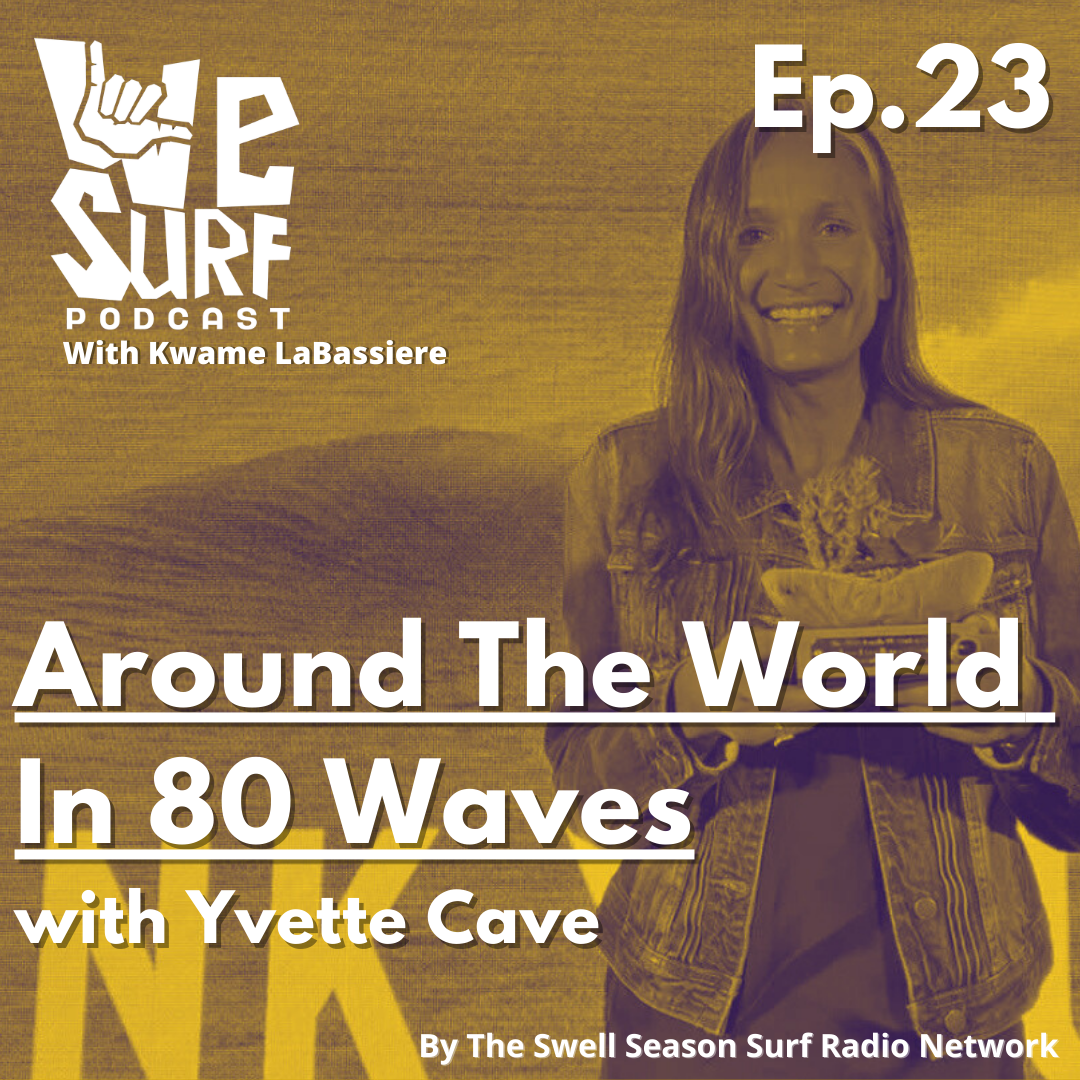
Surfing is not just about standing on the board. It's about learning to listen to the wind, to the water, to the stories that move beneath the surface. So today on the We Surf Podcast, we sit with my next guest, Yvette Cave, surfer creator and founder of Wave W heis, and a Churchill fellow who follow, who is following waves across borders, not just to conquer them, but to ask better questions.
Questions about access, about belonging, about who gets to feel at home in the water. This conversation is about surfing as culture, as memory, and as a way of returning to ourselves and to each other. This is, we surf, so let's paddle out. Yvette, welcome to the show. Thank you for joining us.
Yvette: Thank you very much for having me.
It's an absolute delight to be here.
Kwame: Thank you. Thank you. So for those of you, so our listeners who are of course watching and listening, you may have noticed Yvette has a slight [00:02:00] accent. So would you let us know where of you, as listeners, know where you are from?
Yvette: Just a slight accent. Um, I am from the southwest uk, so a little place called Devon.
I live in Cro. Which is a world surfing reserve and I am currently traveling as part of my Churchill Fellowship. So I've never felt more British than I currently do. Uh, the first thing I did when I checked into my little Airbnb was go and find a, a kettle so I could get some breakfast tea. 'cause I was absolutely desperate for a cup of tea.
But I really am aware of my British accent right now.
Kwame: Um, I actually should have brought you some tea. I, I should know better. I should have brought some tea. So, so for our listeners who are meeting you for the first time, let's break it down. This, who is Yvette and how did Surfing first enter your life?
Yvette: Well, I am a mother of three. First and foremost, I've got three children surfing entered my life. I had [00:03:00] my first surf lesson when I was 30. It was very much a bucket list thing of this is something that I would like to try and, and then didn't really think anything of it after that lesson. It was, it was really fun.
I was really terrible, but enjoyed myself nonetheless. And then my eldest child, when they were 12, we'd relocated from Bristol, um, a city in the UK down to the southwest where we live now. And. They really wanted to surf and surf lessons are incredibly expensive. So I was a single mother at the time, so couldn't really afford that as a cost.
So we looked at surf lessons, surf clubs that were local, but they were all quite boy heavy. You know, my sort of then daughter was. Obviously at the age where she didn't necessarily feel that confident and that comfortable around, you know, big groups of boys and, you know, we didn't have any kit and everything was, you had to supply your own kit and [00:04:00] stuff.
So I just sort of, I was a personal trainer at the time with my own business and for me, sport was everything. You know, finding a sport was my. Primary focus for all my children and always has been. And you know, it's just my luck that, that my child picked a sport that I had so little knowledge of and could not teach them at all.
Kwame: So it always works out.
Yvette: My God, honestly. And I spoke to a couple of female surf coaches and just said, look, there's obviously gotta be other parents like me within. At the local area that can't teach their children, but really want them to learn in an environment that is more geared towards, you know, non-competitive surfing, just being in the water, having fun, being safe and is less sort of judgemental.
'cause it felt like a really sort of judged space. And if you didn't have the right kit, you probably stood out a bit more. Mm-hmm. You know, a local surf school, surf Southwest just took a chance on us and said, actually, here, have a season as long as you can pay the coaches. Let's see how it goes. And that was 10 years ago.
Nice. So, yeah, it, it went pretty well.
Kwame: Epic [00:05:00] definitely heard a lot about that, about I think every. Person who's ever sat at this table or whether physically or remotely has mentioned at some point about the judgment that they feel when they, when they first startling on the surf. Unless of course, like you started when you were like, you know, kneehigh to nothing and you didn't care what anybody thought.
But otherwise, once you started to develop your own ego and so on, then you know it, it becomes a, it definitely becomes a thing and people mention that. So you also formed the Wave Ws.
Yvette: Yes.
Kwame: And so where did the name Wave of Vaahini come from and how did you, how did you start that up and why?
Yvette: Well, the club started just as a direct response to my, my eldest wanting to surf.
Mm-hmm. And just creating that space that was more aligned with their demands and their needs and needs of our local sort of, you know, girls community. Um, and something that was that, that safe non-judgmental and fun space. So it kind of came from that. And, and we wanted a name that [00:06:00] reflected. The sort of real roots of surfing.
Mm-hmm. You know, I sort of, I'm quite a geek when it comes to certain things, and so if I am gonna do something, I really like to learn about it and learn the history and the reasons behind things. And, and so we wanted to kind of keep the name rooted within sort of Polynesian roots and Hawaiian roots.
And w is obviously the name for female and particularly relates to female surfer. So we decided like Wave Vaahini would be the perfect way of paying sort of homage to that cultural history. And just also being really focused on the fact that it was a female led club.
Kwame: And the tagline Surf like a girl.
Yvette: Surf Like a girl. Yeah. It was surf like a girl. Love it. We have, we do still obviously use surf like a girl on a lot of our stuff, but we've also changed some of it to, I've got another one somewhere, but it's Powered By Love.
Kwame: Powered by Love
Yvette: because my eldest one actually identifies as Aiden now. So our family has changed.
Mm-hmm. So it felt like actually to incorporate, you know, my son's identity and he's run some trans and non-binary [00:07:00] surf sessions with us, we kind of decided that actually, whilst we didn't wanna. Ever lose the surf like a girl ethos. We also wanted to grow as a family and decided actually the club began as a family thing and it has always been powered by our love for family and our love for communities.
Yeah, we kind of incorporated powered by love alongside,
Kwame: so like with like. In surfing. Anytime you're surfing on a wave, you know you can't be stiff, you can't be rigid. You have to go with the flow. Yeah. And just be as flexible as you can as you ride that wave. Love it.
Yvette: Exactly.
Kwame: Love that. So let's talk a little bit about the, about the fellow.
You are a Churchill fellow, which has given you the opportunity to travel and study surf culture more deeply. You're gonna make our listeners very jealous right now. So currently you're in your New York. Mm-hmm. Obviously. And what are your next steps?
Yvette: Okay, so I am obviously here mm-hmm. For the next 13, 14 hours or something, and then I fly out to California.
Kwame: Mm-hmm.
Yvette: Um, so I'll be driving up the coast [00:08:00] from La Jolla up to San Francisco. Um, and I'm there for three days, and then I'm flying across to Hawaii. So I'm on Oahu for six or seven days. Then I fly over to Australia. And I'm there for two weeks. So driving the coast from Noosa down to Byron. And then I was going to be going to Bangladesh initially, but now they've got their elections due for the period of time that I would be there.
So there's sort of a high chance that actually the country might be in lockdown. Mm-hmm. Or it just might present some political issues with me traveling. So I decided to kind of change those destinations. And so now I'm going to the car, Norwegian of India, and then onto Sri Lanka for my final stop. And then my husband is bringing out our two youngest children to meet in Sri Lanka after six weeks away from home.
So yeah, so it's an amazing list of countries and I have not been to any of them ever before. So for me it's just, yeah, it's mind blowing.
Kwame: I got tired just listening. [00:09:00]
Yvette: It's a lot of time zones in a very short space of time.
Kwame: That is, that is definitely a lot. So what initially pushed you to apply for the fellow for the fellowship to get and then, 'cause you knew, I mean you must have known there would've been a lot of travel into it.
So what initially pushed you to get to that point Will where you said, Hey, I wanna do this and we're gonna apply for it?
Yvette: Yeah, it was a really good friend of mine, um, Chris Hines, who is the co-founder of Surfers Against Sewage in the uk and I've been friends with him for a number of years now, and I've always been campaigning and talking and highlighting the lack of.
Particularly ethnic representation within the UK surfing, it's such a, a sort of predominantly white sport as we all, you know, as we all know and we talk about quite a lot, but in the UK it's really significantly underrepresented at any level of governance within the structures of, of surfing. And I think kind of the only places where you see any, any sort of representation is generally in grassroots.
And that's down to organizations like Wave ies [00:10:00] who have been putting out there and talking about it for a really long time now. And so he knew I had this, this sort of real passion and drive to understand what it is that is. Stopping that representation and why isn't it sort of reflected? 'cause there's so many different communities that can benefit from surfing and that could access it if there was opportunity there.
And so I've just wanted to really immerse myself in kind of learning about that. And I, you know, like I said earlier, I'm a bit of a geek. So I do learn about the history. I do learn about. People's background stories and, and you know, when people say, oh, and stopping people going to the beach, it's like, actually that's not necessarily true because, you know, there were things that were actively stopping people going from the beach, you know, particularly in, in the States and in South Africa and other countries.
So I think it's, there's a lot to be said for learning about that history. And he'd suggested. To me, he was like, have you heard of this Churchill Fellowship? And I was like, well, no, isn't stuff like that for academics to do and people who've got, you know, more [00:11:00] experience and I'm not an academic in any way, I, you know, don't have university degrees and stuff.
And he just said, no. It's actually designed for everybody to apply. If you really care about something and you want to make a positive change in the UK and you can see other countries that are doing, doing it better. Then chances to go and learn from those countries and actually look at them and travel around and really engage with community, with the structures that you want to influence.
Mm-hmm. Back in the uk. And so I applied and it was a really, it was a really easy application process, but it was really short in that you had to answer questions in like 200 words. Right. And that's really tricky when you are like me and you tend to ramble and get excited and emotional. So it took a long time for me to get everything down to 200 words, and I got through the first phase and I got through the second phase, and then I was being invited to an interview in London and amazingly.
I did turn up to the [00:12:00] interview with a minute to spare 'cause I'd gotten on the wrong tube three times. This is why I can't be trusted alone with direction. So my husband's panicking that I make my way around the world alone. And amazingly they decided yes, that hot, sweaty mess that turned up in our office that day is the right person to do this research And.
And for me it's such a validation because I was brought up in a city. Mm-hmm. I didn't grow up surfing. I grew up very much in mainstream sports of like athletics, netball, all the other sports where I saw reflections of me. So to suddenly go into surfing where. I had no idea that actually it was so underrepresented until I was in it, and then suddenly you can see those barriers because I wasn't brought up within the sport.
And then to kind of be in that area, in that room and have somebody go, yes, we think your experience and your, I guess your view of. Of it from an external perspective, but now I'm very much in these spaces. Right. Is really [00:13:00] different and it's really unique and I think it brings a different perspective to what somebody who's grown up surfing Yes.
Yes. Would bring. So I think that's probably why they chose me. 'cause I do have that outside view despite being in it for 10 years now.
Kwame: No, definitely. Um, I mean, there is. One thing, which as you, as you're speaking one thing, which always, I'm always thinking about, and it, it comes across like when I speak with my students, when I teach surfing, that we always have to remember that after a certain period of time, after a certain, it becomes almost reactive to us.
You know, we, we know what we're looking at. We see the ocean, we know what to do, we don't even think about, it just happens. And so that the only time it takes from some, from something to move from our brain to our body cut drastically. You know, we decide we wanna do a turn on the wave. We just do it, it just happens.
Whereas, and I take that, I associate that with someone who grew up with surfing and or even someone who was, um, you know, their, their parents surfing and they saw, I teach 'em at a very young age. So to them it's just, it just, it just is, it's almost as sim it's almost as abnormal as breathing [00:14:00] to them. And those of us who started surfing later on in life were like, okay, I remember what it was like to do this.
So now I can actually explain it to someone who hasn't, who doesn't have that, what it was like for me. And then break it down for them. Yeah. Because so many times I watch people and I listen to people and you hear them say, oh yeah, just, just, just, just get up.
Yvette: Just
Kwame: get
Yvette: up. Really. Just get up. But it's not that simple.
You know, just get up. Especially if you're learning later in life. Yeah. And you, you might have had injuries or you know, age and all those things and, and you've gotta be able to adapt those things. It's not as simple as like just getting up, but also it's, you know, I think when we started our women's group, it was really key that, you know, the primary objective wasn't necessarily to stand up.
It was about just being on a board and feeling what that's like. And you know, we'd always spend a lot of sessions just. Like, let's just lie on your belly for a while and actually just steer and feel what being on a wave feels like. Yes. And it's just that glorious feeling, you know? And, and it just enabled other people who had [00:15:00] back issues, who had other issues to actually enjoy surfing with us, but not feeling that they had pressure to stand up.
Yes. And whilst the majority of of women did stand up, it wasn't the primary objective and they took, you know, as long as they needed to, there was no, like, if you haven't done it. In the first couple of sessions, then you are not good enough. You're not good. There was none of that. It was all just like, but did you have fun?
Yeah. Mm-hmm. Okay. Well, there we go. Ashley.
Kwame: Just remember this is supposed to be fun.
Yvette: Yeah.
Kwame: So while you were. Writing this up because I took a look at the fellowship online and I clicked around on it. I mean, obviously the ones for the year was closed were closed, but I just like clicked around on one of them.
Did you ever think to yourself, and if the answer is no, then feel free to say no. But did you ever think to yourself, I am submitting this for surfing. They're just gonna think, yeah, you just want to travel and surf and I'll dime don't
Yvette: there? There was that bit. And then the disclaimer is that I'm a terrible surfer, so I knew that they couldn't see that that was my excuse for doing it.
So I'm still very much a novice. I am getting slightly [00:16:00] better now, and I can occasionally get out back if it's a nice, very small day. So, yeah, so I don't think my, my remit was to like go and catch as many waves as every destination as I possibly could. It was very much too. Engage with community and engage with the governance structures and actually learn from those communities.
And yes, if I am lucky enough to get a few weights mm-hmm. Then an absolute bonus. Yeah. You know, as far as I'm concerned. But I did think there's no way they're gonna go for this. Mm-hmm. This is crazy. But I, I was really lucky in that, um, someone else, and actually they were my panel of interviewers. Had done a similar study mm-hmm.
And a similar bit of research, but on terrestrial land. So they'd done it looking at like national parks sort of in the UK and said, you know, why are they so underrepresented from communities of color? Again, from exactly the same sort of standpoints that I was looking at, but I was taking mine onto the ocean.
So I think I was really lucky in the fact that actually there was a precedent set. [00:17:00] But then when I went and did the, the sort of research afterwards of like how many other Churchill fellows. Had done surfing as their fellowship. I think there were like eight in total, and five of those eight were actually surf lifesaving.
And so it was only me and two other people who were looking at it from surfing. And obviously in those eight people I was the only woman and obviously I was the only person of color. Mm-hmm. Of those eight and that's. In the entire history of Churchill Fellowships. So it's, I think it's a really exciting thing to be doing, and you know, it's all under the umbrella of ocean conservation.
It's all under the umbrella of we can change the face of ocean conservation by joy, by the joy that is surfing because it's completely changed my life and all of my life choices and what I do for a career and how I bring my children up and all of those things. But none of that would've happened. Had I not seen the impact and felt the impact that surfing has had on me and on [00:18:00] the children and on the women that I've surfed with over the 10 years.
And I just think if, if it's changed my life so drastically that I'm not one of the people who see myself represented within this sport mm-hmm. And this sector, then it can change so many other lives as well. And I think that's kind of what I wanted to bring to the UK systems to, to kind of really evidence that, because I am living proof of, of.
Kwame: Yes, very well said. Very well said. There's a, uh, line that from all places to take wisdom from, from the movie point break.
Yvette: Absolutely. So to source.
Kwame: There you go. Exactly. You know, it's like hope you stick with it. Surfing's a source, it'll change your life. Swear to God, thank God. And I have never heard a line in a movie said with so much truth behind it, because to those who don't surf, for those who have never surf, it's just a line in the movie.
But to those of us who actually do surf and started later on in life, it really did. And has changed our lives. And it is, it is the source.
Yvette: It really is now. Hundred
Kwame: percent is the source.
Yvette: Yeah. There's much, there's [00:19:00] much to be said for the wisdom of point break
Kwame: the original, not the, that they made afterwards.
'cause that doesn't,
Yvette: that is not point.
Kwame: That does not. As far as we know that. As far as we're concerned, that never happened.
Yvette: Absolutely. Okay. They should rename it something different. Extension. It was not the point break either.
Kwame: It's not my point Break. Uh, so what's one thing that the ocean has given? I mean, we've been speaking about, um, in general, you know, what you took from it and so on, but what's one thing you can say with absolute certainty that the ocean has given you, that you carry with you on a daily basis?
Yvette: My husband, I would say it's given me, my husband. I was pretty scared of being in the water. I loved being by the ocean. Mm-hmm. So this is before we started the club, obviously. But I was signed up to do a triathlon, so I was meant to be swimming like the 2.5 miles and I'd had an accident with my car, so I'd have been involved in a car wreck and I'd had [00:20:00] a, a sort of health scare, and suddenly I became really aware of my immortality.
And as a mom I was like, oh my God, what am I doing? I'm putting myself into this thing that could kill me voluntarily. Mm-hmm. For doing this accomplishment that I'm so keen to do, and it suddenly gave me this real fear in having panic attacks when I got near the ocean to then go in and swim. I just couldn't do it.
And I was actually training my husband as a personal trainer at the time. We were just friends. And I was explaining this to him because he is a real waterman and has been surfing for God 30, 35 years or something, and he's surfed all over the world. So he's incredibly jealous of what I'm doing. And, and you know, I was talking about this fear and he'd said to me, look, why don't I take you for a swim?
And I looked like mortified, but he just said, look, come with me. We'll go out in the sea and. Will just get used to being in the water again. And I was like, [00:21:00] actually, do you know what I, I trust you. I know you know. Sea in this local area. So I was like, okay, let's do it. And I remember we got in the water and I think it, it actually scared him because he was like, oh my God, I had no idea you were really that scared because I was full on ugly crying in the sea, you know?
He did get me in the water, but I then I cried. I was panicking. I was like, so it did take a lot for him to calm me down and just get me to swim. Like, and I must have only swam about. I don't know, 50 meters or something ridiculous like that. But it gave him the taste of actually that I was really scared, but it also gave me the confidence to know that I could do it with somebody.
So I then actually approached a local life-saving club and coach, and I got her to take me swimming regularly. So then that became like a real moment of overcoming my fear and getting back in the water. And then we started the club less than a year after that moment. And then. My husband and I started dating, and then we got married, then we had a child and all [00:22:00] of the things.
And so, yeah, I think I put that down to, you know, we just found the ocean together and he, well, he knew the ocean already, but he definitely helped me find the ocean in a way that I don't think I would've done on. In fact, I know I wouldn't have done on my own, and I feel forever grateful to him for that.
Kwame: Oh, it's beautiful. It's beautiful. I'm like, I'm like these know all my other questions now seem like I shouldn't ask these and
Yvette: it's
given
Kwame: all, but that is a beautiful story.
Yvette: It's given all of our kids, you know, this lifeline, like mm-hmm. My eldest obviously surfs a lot. Right. You know, the club was, was for them anyway.
And so they surf all the time now and they've got a beautiful style middle. My middle daughter, she's surf load and you know, and now she doesn't, she doesn't tend to go out with me so much. She goes out with my husband more. 'cause a, he's a better surfer than me. He can go out back properly. But also apparently I, I'm too enthusiastic in the water, so Yes.
Whereas my youngest one hasn't got that embarrassment yet, so I can still whoop and cheer for her. Right. And that's fine.
Kwame: Nice. I have a friend who, I'm [00:23:00] not gonna say her name because I don't wanna embarrass her. But, um, I gave her a, she was a surf student, was surf student of mine, and then she graduated to the point where she didn't need us anymore and she was out surfing and she hurt her foot.
The guy who was there, who's just a friend of hers. Carried her back to shore. They returned the board that they rented and then he brought her home. And the rest is history. Now they're married with a dog. Oh my God. And living in Connecticut. And so it's, it's a beautiful thing
Yvette: in the ocean. It brings together marriages and children.
Wonderful.
Kwame: With dogs and all kinds of stuff.
Yvette: Oh.
Kwame: Uh, it was beautiful. So as a mother, um, a woman of color, and now a traveler, what does belonging. The surf culture look like? Or what do you imagine it to be? I,
Yvette: it's so layered. I think for me, I didn't really have much concept of what it would be until I was in [00:24:00] it, and I'm, I still find that I'm learning quite a lot about the culture and community, but what I do see is it, it's just about friends.
It is about community. You know, the women that I get to surf with are tremendous. The girls that we surf with as a club are wonderful. And you know, it's been 10 years of surfing with those particular girls. So they're now, they've all finished university and they're all grown up and you know, and they still come back and they still talk to us and they still fondly remember the club and, you know, many of them are surf coaches and have been surfing around the world.
And, and I just. For me, it's just watching that growth and watching that, that sort of home, that everyone is often doing their own thing, but they've still got this one connecting moment. But I think it's, it goes deeper than that in sort of the way of connecting globally. And I think that's where I've discussed it with other.
Particularly other women of color when I've been [00:25:00] talking to them is I found that for me, the ocean has been this place to connect all the bits of me and I feel really interconnected with like my history, with my ancestry, with my family, wherever we are in the globe. It's like I'm always, I'll always seek out water and know that.
It takes me back to where they are in the UK and it takes me back to my heritage in Mauritius or in Bangladesh and all of those things and, and I think that's what's really beautiful about being connected to the ocean, whether it's through surfing, whether it's through body boarding and belly boarding, and all those things that I do love doing.
It's, it's a connection that's global and I don't think you get that unless you've got that ancestral heritage in other parts of the world. I really don't. I think you get it maybe if you've traveled surfing, but it's still different somehow. But if you, if you come from like mixed heritage like me, or if you are from backgrounds where you've got [00:26:00] ancestors in other parts of the world, I just think it adds a different layer of depth to your connection to the ocean because you know that.
Your actions where you are, like, you know, for example, I'll pick up, you know, litter on the beach and I'll do things and I'll change what I buy. But I know my acts where I am in the uk, where I am in in New York at the moment, that directly impacts my ancestors and my family that are still based in Mauritius, that are still based in Bangladesh, right?
So I'm directly responding to part of that sort of climate emergency by the small actions that I take in the uk. I just think that's, you know, it's one of those crazy things, but I do think that is a really big part of why I do it. 'cause I do feel that I then can have an impact on something so far away.
I, yeah, I dunno, dunno if that answered your question.
Kwame: No. And we all wanna feel like we're connected.
Yvette: Mm.
Kwame: Not just to each other, but especially to our ancestors. And if you are a person of [00:27:00] color, of, uh, a mixed heritage especially, so you really, you may not be, I'm not, say you are not, you may not be aware of exactly where your ancestors and your nces within your ancestry.
Came from Brag, the big wave risk assessment group. They have a saying and their motto just like, drop the mottos today. Divided by land, but connected by water.
Yvette: Yeah.
Kwame: So, and you know, as water people watermen, water, women, water people, servers, like you said, body borderers. Even if you just go and stand up in the water.
Yeah. Up to your ankles. Or just sit down and listen to the ocean. You know, there's a sense of. Peace and calm there. And at some point, one of your ancestors touched water at some point, and it's a very good chance that that molecule or that drop of water is floating around in there somewhere. So, uh, Dr.
Iskey Britain actually in one of her books, she mentions it and, um, no, it's so, it's, so it's, it was definitely real that this water like follows. It's from 600 years ago. 700 years ago. Yeah, however long. So it's still there. And you can definitely connect in that. Through [00:28:00] there in that way. So, no, you did answer the question.
I understand. Fully understand and agree with what you're saying with that.
Yvette: Thank you. I did say to my youngest when, 'cause we are really lucky in that. We live with a walking distance from our local beach. But on the way into school, we drive around sort of the point, um, at cro and it's gorgeous. And I said, like, and usually in the mornings we say morning to Mother Ocean.
Mm-hmm. And like, how, how's she feeling today? And you know, is she, is she tired? Is she looking grumpy? And, you know, my, my youngest, you know, is like, oh, I think she's a bit crossed today. Maybe this 'cause the tide was out and it gets really low in the uk. Don't. We have massive tides. And she said maybe she's a bit upset because the sand isn't going away.
So we are like, oh, maybe if she changes then she'll start to come back in and people want to go and play in her. And it's, we, we always have this chat about her in the morning and I remember saying to her a week before I was due to leave, you know, I was like, now I remember when we talked to, you know, mother Rohan and we say Good morning in the morning.
You can say good morning to mom in the morning because you know that that [00:29:00] same ocean that you say the good morning to and drive past is the same ocean that I'm gonna be seeing when I'm in New York, when I'm in California, when I'm in all of these places, it's gonna be there. So you can say good morning to me, and you can say goodnight to the moon.
And those two are those constants. And, and I just think, again, because we, we always talk about the ocean in that way with. With our children, that it is this connector and this constant, so that we hope that we give that feeling of connectivity, that regardless of where we are in the world, that we're always kind of together.
Kwame: Yes. Good morning to the ocean. Goodnight to the moon. Yvette. We're writing a book. We're writing a children's book. Oh, don't steal our, don't steal our idea. We're writing a book. Yeah.
Yvette: Trademarked next.
Kwame: It's, it's funny, uh, because so new every, on New Year's Day when my mom was, um, before she passed, I would go down to the beach on New Year's Day and, uh, video chat with her as the sun came up.
And literally I would sit down and with her, so with the two of us, can listen to the ocean and Oh, I love that. [00:30:00] Watch the sun come up on the new, so it was a new day and the first sunrise on the first day of the first of the new year and so on. And we would do that and we just felt connected that way, even though I was here and she was in another country.
So, but still, we just felt connected. Yeah. That way. So I've, uh, again. Completely understand and trademarked. Mm-hmm. So don't try to steal our idea. What's one thing you hope to bring back or a few things that you hope to bring back with you once the travels are done and you've had time to like, 'cause I know you'd be taking like tons of notes and writing and so on, and you also have to present what you, um, what you've been doing.
So what's one thing that you really hope, the main thing you hope to bring back?
Yvette: I really want to. Have that pathway. I really want to understand what it is that other countries are doing that the UK isn't doing to enable greater representation within their organizational structures within not just surfing, but within their ocean governance type structures too.
'cause the other countries seem to [00:31:00] be just much more representative. At every level of governance, whether it's grassroots, whether it's right up to CEOs, trustees, and all of those things. Support staff coaching, you know, and I just, I really want to understand what it is that the UK isn't doing or hasn't got in place.
Or what, what are we missing? What needs to, what's that magic dust that we are not, we are not sort of sprinkling on stuff. I think that's the big thing. 'cause I really wanna be able to look at that. The system that we've got. And see where that gap is that isn't enabling that progress or isn't enabling people to come in or isn't attracting people, you know?
I want to understand that, but I think, in fact, I don't think I know I'm gonna come back with so much more just from like the conversations I've had here in New York. I know that I'm gonna come back with such a wealth of information and stories and just ideas of. Of the things that I wanna dig into [00:32:00] further.
And you know, I met with Karen Song yesterday and I now, I said to her, I was like, I really wanna talk to you again in more of a like, we'll record a podcast together. Mm-hmm. And because so many threads that we were starting to talk about, I just wanted to kind of be, I could have spoken for hours with her and, and I just, I think there's gonna be a lot of moments where I want to explore things deeper, but they're not necessarily.
With the case in point that I'm trying to achieve with this particular fellowship. 'cause I guess I've gotta try and stay as focused as possible on the outcomes that I wanna have. But I think the reality is I'm gonna find so much more and so much more depth into what surfing has created within certain communities, and I think that's gonna be a really powerful thing.
But where that will lead, I'm not quite sure.
Kwame: Yeah, I mean it's that, that's generally. At least I've found kind of difficult for surfers in particular because, not going off on that because we are so accustomed [00:33:00] to just a flow and just let, let the conversation go away with me. But then you, if you are focused on one thing in particular, then you know you have to, okay, I have to remember to, to stay here, to stay here.
But, you know, surfers tend to just like, like I said, just go with this flow and. It definitely helps us along in life and with surfing because if we're so focused on that one wave that's coming in, we'll miss the even better one behind it or,
Yvette: or you miss the dolphins
Kwame: or you miss, I was just gonna say, or you miss the dolphins or you miss the sunrise, or you miss the sunset because there's nothing like a sunrise surf.
There's nothing like a sunset surf. It's beautiful. But if you're just so focused, okay, I have to surf now and have to catch six waves and I have to go to this, then you're gonna miss it. So, yeah. So I understand what you're saying. We're trying to balance the two because even with, um, some of the research that we do, we still have to take a look at it and go, okay, um, this is not what we were asking.
This is great information, but not really what we can use right now. So let's try to get back on on point. Um. On point with list.
Yvette: Yeah. I think that's gonna be a problem. So I'm, I mean, I'm looking forward to it 'cause I'm meeting with [00:34:00] sort of the ISA mm-hmm. And things like Surfing Australia and you know, so meeting with those big governance structures there and you know, the surf rider team save the waves.
So I'm getting to meet people within those structures, which I think is just gonna lead those really vital conversations. Mm-hmm. But it's meeting, you know. The people on the outsides of it as well, and kind of seeing what their perspectives are. I think that's just gonna add those different layers as to why it's so different in those different communities.
And I think in particular, I'm most excited about, if I'm allowed to say. Yeah,
Kwame: please.
Yvette: Okay. I'm probably most excited about going to Hawaii. Mm. I'm hopefully going to be meeting with Cliff Pono. Mm-hmm. Talking to him at sort of, you know, great length and I've got so much in my head that I want to kind of talk to him about.
But I think for me the, the most interesting element to, to discussing surfing is gonna be, you know, coming through like that colonial lens. Mm-hmm. Because you're literally [00:35:00] talking about a colonized sport on a colonized
Kwame: land. Right.
Yvette: That has been, you know, taken. Curated and then repackaged to us via California, which is kind of.
Bespoke sort of surf culture that people tend to associate with surfing. Yes. And it's, it's so far removed from what actual surf culture Yes. Was initially, you know, whether you're looking at the Polynesian Hawaiian roots or whether you're looking at the roots within sort of, you know, the African roots.
Mm-hmm. It's, they're just so different to what we see in that curated, we packaged version.
Kwame: A hundred percent. And you know, it's funny you mentioned, um, uh, uh, Dr. Capon. And he's one of our guests for this, uh, 2026. We're trying to get him on the, on the show. We're trying to find time where everyone's schedule works out well.
Yeah, I know. He's, um, getting ready for the, for the Eddie.
Yvette: Yeah. Yeah. Yeah. The window's open for that. And I think when I'm in Hawaii, I [00:36:00] think the window for the DEI out is actually on, and I'm like, oh my God.
Kwame: Amazing.
Yvette: I know. I'm really hoping.
Kwame: That'll be amazing. And you know, so to our, again, our listeners and viewers, I know you're listening to event Talk and you may be thinking, she says, oh, she's gonna go to all these amazing places and she's gonna surf all these amazing places.
But one thing I realized some time ago is that when you are there to work,
Yvette: mm,
Kwame: it's. You're actually working.
Yvette: Yeah.
Kwame: So there are times it's actually almost even worse.
Yvette: You feel like watching it?
Kwame: Yeah, just watching it. 'cause you're like, okay, I can go surf right now, but I know I'm not getting out at the time.
I gotta get out to go do this and go do that. I.
Yvette: Although to be fair, if I'm there watching the Hooi, there's no way I'd be putting a toe in that water.
Kwame: I hear you.
Yvette: It
Kwame: would
Yvette: be terrifying. I'll be waiting for the little baby waves.
Kwame: But again, this is Hawaii, so their baby waves could still be,
Yvette: this is true.
Kwame: This could still be double overhead for us. Regular mortal. So with all of this, let's talk, let's question about the future. So what do [00:37:00] you, what do you hope for. The, that this will bring for the surf culture where this direction of surf culture is going for the next generation, or even the generation after that.
Because like our generation is really the ones that are the ones that are dealing with it, but are immersed completely. Like the, the previous generation they were immersed in. They're like, Hey, yes, you know, people of color, you know, we don't surf, they you don't surf, you don't go in the water, whatever. I feel like our generation are the ones that grew up, or at least Google was invented.
While we were up and coming, and so now you Google Surfer and that's when you see the dude. Yeah. And
Yvette: it's always a guy. Yeah. Yeah. Always. Always. Yeah. That is literally it. Well, it is. It is point break, isn't it? Yeah. It's, it is that, but without the
Kwame: liberal little rubber people who don't shave.
Yvette: Who don't shave it.
Yeah, exactly. Oh my god, that's, see so many gems from that show. There you go. But I, I think, I guess the dream is when like, communities are actually, it's not just grassroots anymore. You know? I think what's been [00:38:00] really interesting is. It's kind of listening to all the grassroots movements that have been doing this stuff for years now and have been working really hard and getting more people involved and getting more people engaged with surfing.
And it's like, when is that gonna be creeping up the, the progress ladder? Especially in like competitive surfing, I guess, because, you know, I, I mean, I watch competitive surfing. It's not my, you know, our club's not built around competitive surfing in any way. It's very much like a fun session, but the worldview surfing through that competitive lens, like whether it's the Olympics or Right.
You know, all of those things. And I just think those structures to be able to see that you can go in at any level as any ethnicity and. Feel that that's, it's a safe space and that it's somewhere that you can be, and you can be your, your full self in those moments, or that you can be a surf photographer.
Mm-hmm. And you can be a surf writer, you can be a surf [00:39:00] journalist. All of those things that previously have been quite an elite and exclusive area. I'd really like to see those being opened up more. And I just, I kind of think it's something that I guess. This particular saying, sort of this generation, we've been talking about it.
Mm-hmm. So we've been the ones that have kind of been going, this is an issue. You know, we, I guess we are sort of lucky in the sense that we weren't sort of the age when, you know, you were competing in, in South Africa at the Times Apartheid. We weren't in that generation, which was just horrific. But we are now at the generation where we can talk about this stuff.
Whether it's, you know, it is, it's wrong that it's so exclusive, it's wrong that it's so elitist. It's like, how do we change that narrative? How do we make sure that we're pushing a narrative that is accessible, is inclusive, and you know, and it is really difficult to, to say those things in the political times that we're in as well, because it's like, are we gonna [00:40:00] be.
I kind of going backwards now with, right, with everything that is happening globally, but surfing's this one amazing thing that has always prided itself, whether rightly or wrongly, on being like counterculture and being pushing those boundaries. It's clearly none of those things because hasn't pushed any boundaries.
You know, it's pushed the boundaries that it wanted to, but it's actually a very boundaried sport, so I think. Now is the time maybe for, for surfing to be that counterculture, to actually be the one that pushes against those systems of, of oppression, those systems of like, here's a strict narrative of what we've believed.
It's time to break those and, and you know, and surfing is a fun way of doing it, but it just takes more than our voices to do that.
Kwame: Mm-hmm.
Yvette: And that's the hard thing is because it's tiring to also be those voices. Yes. Because you're constantly the one going, well, it's like this, it's like that. And you're like, how many times do you need the conversation?
Because I remembered, you know, people going, well, at least we're having a conversation about it [00:41:00] now. And I'm like, well, yes, that's good that we're having the conversation, but that was. Five years ago, like we're still having the conversation and it's like, where's the action? And I know these things, they don't change overnight.
I, I'm, you know, not that naive, but there has to be some change. And I think it's been great to see globally that there is more change. You know, the UK isn't having that rate of change, which I think is really sad, but. The global outlook is brilliant. I think when you look at countries like India and Sri Lanka and even Bangladesh, which are such young in terms of their surf culture and community, they are really changing that lineup.
You know, even like things like the Philippines and you've just got some great surfers coming outta these areas and. I just think that is fantastic. And they're coming from, they're not necessarily coming from wealth or, or sort of money or any of those things. They're coming because there's opportunity and, [00:42:00] and that is so vital because sport was always seen as, as a ladder.
It was always seen as a tool for change. And I just, I don't want surfing to lose that, you know, I still want surfing to stay this tool for change, but. It needs to get away from that elite side to do that and to be really, you know, like some of, I guess some of the Mexican surfers have, you know, they've come from that element too.
And I just think that's, it's just amazing. And some of the Brazilian team, you know, they've come from really different lifestyles and they've really worked their way up and they've created a sport that is. Amazing. And it's completely transformed their lives. And I just think it's got the opportunity to do that for, you know, surfers in India and surfers in and other countries.
And I just think if it's only the elite and the wealthy countries that are dictating what happens within the sport, it's not gonna grow at the rate it should. That's right. So I went really off topic.
Kwame: No, no, no. I mean, it's always amazing to me. I use the example of. It's amazing to me that a [00:43:00] country like Fiji only got their first sponsored athlete recently.
Yvette: Yeah.
Kwame: And I am like, how is that possible? How
Yvette: crazy
Kwame: is, is that It's Fiji, the home of Cloudbreak, home of lefts rights, restaurants, all these other, other waves, swimming pool. But they only got their sponsored, first sponsored athletes recently. So that, that, that definitely, that's amazing to me. Um, okay, so I know we're running.
Close to time, but so want to give you a chance to ask because we always do the, you ask questions, any questions you may have to the host. But at the same time, I also wanna ask you a, a couple fast fire
Yvette: questions. Ah, okay.
Kwame: So, first and foremost, longboard or shortboard? Longboard. Single fin or quad, not quad.
I'm sorry. Single fin or two? One setup.
Yvette: Definitely be a single fin.
Kwame: Okay. Classical. Uh. Favorite pre and post surf meal?
Yvette: Pres surf. I don't tend to eat. I'll just have loads of water.
Kwame: [00:44:00] Everybody says that. I don't know where this image of us just like eating nothing but burritos and pizza before we paddle out came from
Yvette: and posts surf.
I would say my favorite surfs have been at Royd When we finish at Sunset and we go to Downing Cafe and have a really lovely Sri Lankan Curry.
Kwame: That actually sounds pretty good right now.
Yvette: Yeah, I have to say, I have to say kudos to, with Santa and his Sri Lankan curries, they are the best.
Kwame: I'll get the, um, I'll get the social media link or the Instagram link or whatever and we'll, we'll drop it in there.
So
Yvette: amazing.
Kwame: Give, give them all some props on that one. Okay. And my final question is what is the one question that you are chasing? Whether in water or in life.
Yvette: Wow. That is huge. The one question I'm chasing, how, I guess the question I would be chasing is what can impact I can have to make the world a better place for my children?
That was really wooly. 'cause I'm like, I don't dunno how to answer that. No, but I just wanna leave it [00:45:00] in a better place for them.
Kwame: Absolutely. I mean, you're taking it on, you know, literally asking what can I do?
Yvette: Yeah.
Kwame: For this? So thank you. I hate this part. Do you have any questions for the, for me?
Yvette: Oh, yes, I do.
So I'm gonna ask you
Kwame: mm-hmm.
Yvette: What you think, what you. Who do you think holds the power within surfing? Where do you think surfing's power lies?
Kwame: Hmm. Hmm. That's a good question because, so it's, I can answer it in twofold. Mm-hmm. Based on the definition of power in itself, right now, the quote unquote, big corporations are losing the perceived power that they thought they had because they kind of took it too far.
They saw this and they've milked everything and they're like, Hey, you know, let's just throw as much as we can out there and people are gonna suck it on me. I've seen commercials for surfing that have nothing to do with the water whatsoever, just 'cause it looks cool. You know? I remember when the Nothing against Apple, but I remember when the [00:46:00] iWatch first came out.
One of the first commercials I saw was this man out in the lineup with his eye watch. He got a call and I was never miss a call and I looked at it and thought to myself, you obviously did not run that by any surfers. 'cause anybody any surfer with worth their soul will know. The last thing I want to do is get interrupted from a call with a call while up to go to work while I'm surfing.
Yvette: Yes.
Kwame: So the, the corporations used to have it. I think that it's, it's leaving now, now I think it's, it's a little bit, I, I feel like it's in limbo because it's now up to the people who are the tr, I don't wanna say true surfers or the people who are, who enjoy surfing. Lemme say it that way. People who enjoy surfing to literally take that back.
And to say this is an activity. This is something I can do. This is something I do for my health, for my wellbeing, because it makes me happy. So what if I don't get paid, you know, [00:47:00] millions of dollars to do this? So I feel that that's where the biggest disconnect is because like you said, a lot of times when people look at surfing, they look at it from the perspective of competition, big wave nare, you know the competition that you see, the Olympics and so on, and they think, okay, that's what a surfer is and that's what they have to be and that's what they have to do.
And usually it's as what he looks like and that's what he has to be, and so on and so forth. Not realizing that. You take a nine foot, and I know I'm going to get flack for this, but you take a nine foot foamy and you paddle out. On a two foot day, if you come back in with the grin that I know you will have
Yvette: mm-hmm.
Kwame: Then who's to say you're doing it wrong? So I think VALIC is up to us as layman surfers then to take back that power. So I feel like the power is up in is it's in limbo.
Yvette: Nice. That's a good answer. I like that. Yeah, I like that. We can take the power back.
Kwame: Yeah. We have to know our history and how we are connected.
To it as well. So it's not this [00:48:00] foreign concept. I mean, you know, so many people of, you know, we're based in New York, but so many people in New York never think about New York as a ser. A place where you can serve. And, uh, we've had, you know, WSL competitions out here. Very few people think about it.
Yvette: It's incredible.
I, for one, I originally wasn't coming to New York mm-hmm. As part of the, the travels. And a friend of mine was just like, no, you've gotta, you've gotta see New York. And I was like, for surfing. And we kind of spoke and then I'd obviously listened to Likewell season. I'd listen. Then I was listening to like your podcast.
We surf and I was like, oh my God. New York is like the most diverse surf place I think I've ever heard. And so immediately it was like writing a note. New York has to be on my list and, and it was wonderful going out to Rockaway yesterday, like I was so stunned and it, to be fair, it was like UK surfing.
Just looking at it. It was like surfing in the uk. It was cold, it was small, it was onshore, it, you know, it was everything that a UK surfer lives for. So it was [00:49:00] like, wow, this, this really is surfing here. And I think the fact that you have. Such access on the beach is really impressive. Just the access to get to the beach.
Mm-hmm. Is, is one thing, like in the UK we can't, I think I remember Gina was like really shocked when I told her that we're not allowed to take surfboards on any public transport. Yes. Yeah. Get that. You're like, well, so if you're not based by the ocean or you have a car, you can't get there because we can't use public transport with boards, which is horrific.
Kwame: Wow.
Yvette: It's just another barrier.
Kwame: I mean, it's interesting. New York is, New York surfing is very interesting. We describe it as surfing in New York is like New York itself. You know, there's one day where it could be just completely calm. You have like a little two foot wave, you know, nice and mellow and like around now it's cold.
And then there are days just out of the blue, a hurricane. Swing up and it is 80 degrees outside. It's six to eight feet pumping boards broken everywhere. Wow. It's just like, yeah. Those are the days that you're like, oh, you know, calling in sick to work. But it, [00:50:00] it is just, it's just really like, and then it'll just go right back to the way it was the day before that.
So it's just really back and forth. But hey, it's home. We love it.
Yvette: It's moderation.
Kwame: Yeah.
Yvette: Doing what
Kwame: she does, you know, like we say, sometimes, you know, being ever so crumble, there's no wave like, oh.
Yvette: Exactly. Yes. Nothing is quite like your own surf break.
Kwame: Exactly. Any other questions?
Yvette: Any advice for me on my travels?
Do you have any must sees, must dos. 'cause I've never traveled to any of these
Kwame: places. I mean, there is so much in California and Hawaii. Um, I can give you a list, like just going down the lines. I mean, I know the people that you'll be speaking with. I'm not sure if they're already on your list, but, you know, uh, David Fin is one person that pushed people.
Hate popped into my head, you know. Do you have Gregory Rashelle who's on also on the podcast for Black Surfers Collective then? I mean, you're, you're speaking with them. You're speaking with like one of my heroes in Hawaii, cliff Capto, so
Yvette: I'm so excited.
Kwame: Yeah. Sorry. You know, I'm just gonna say, I'm just gonna say it because when he was in [00:51:00] New York, he was, um.
He was, he was, he had his, uh, one of his short films and he was showing in Rockaway. Mm-hmm. And I mean, and I told him point blank. I was like, dude, I'm fanboy right now just to be able to sit down and talk about science a little bit with him. So that was, that was great. But yeah, I think that doing that is definitely, you have the people already that you wanna speak to.
So my experience when I travel, I travel to surf and then I travel to do research on surfing. And that's how I know out of form from experience that there's a very good chance that I will not get into the water just because of the work that I'm doing. Yeah. But you know, I think about it as. This is, I'm doing this to bring it to people so that they can see it
Yvette: Exactly.
Kwame: And bring that forth. You know, a perfect example was a great day in the Stoke when last time we were out in LA
Yvette: that always looked so fantastic.
Kwame: It was so much fun. And if you look at the videos we were having, I mean, we were, we were having ama a lot of fun. Yeah. I didn't get in the water once. [00:52:00]
Yvette: Yeah. No, that doesn't, not once, but I know what you mean.
We, when we do our contest, um, 'cause we have like a, a women's surf contest now every year. It was the first, I still can't believe it, the first female focus contest in the uk and that was in 2022. We ran our first one. First one. How bad's that they'd had like participation days, but never like a, a female focus contest.
So we, we put one on, and we've been running it every year. It was also in a memorial to a, a sort of dear friend that we lost. So it's been an emotional one, but fantastic and I feel the same. 'cause the day is amazing. We run it over a weekend and I have the best time. But yeah, very rarely. I managed to get in the water this time once for like one of the heats.
'cause I, we do like a crazy relay and it's so much fun. So I decided no, I'm gonna do it. I'm going in. But yeah, same thing. It's just one of those things, isn't it? You see the joy that it brings other people. Exactly. And you, and you still get that feeling of excitement. Exactly. Even though you've not been in the water, which is, I don't know, there's many more sports that do that, to be honest.
Kwame: Exactly. Yeah. I remember afterwards, I remember [00:53:00] thinking to myself like, when the day was finally done, because we got, I got down there early and I was, you know, we sponsored some athletes mm-hmm. To take part in it and, you know, getting people food and whatnot. By the time the day was done. I got back to my hotel room, which was literally just across the street, lay down.
And I'm like, why do my feet hurt? And then I realized I'd been literally walking on running back and forth and walking on sand. Yeah. Or running on sand all day. And then I was flying out the next day so I didn't stick around like all the fun. Then
Yvette: you sit down on the plane. I think a friend of mine's competed in that, I think, um, from the uk.
Yes. I, under Hewitt. I think he's come over to compete at Great Day in the Stoke a couple of years ago maybe.
Kwame: So, I mean, it's, it's, that's, yeah. I mean that's, it's always fun. And, um, I wish, I wish you well and I just, I'm really gonna be following
Yvette: Thank you.
Kwame: Your, um, your travels really closely to our listeners and viewers.
You know, I suggest you do the same because there's gonna be a lot of information and a lot of this coming out of this, [00:54:00] Yvette strikes me, the type of person who will be a little bit not, not. Put herself out there, but pay attention to her Instagram because some of the pictures and stuff here, I saw you like posting.
I'm like, oh, I wish I was in Central Park right now, as opposed to sitting down at work. But, um, I'm, I'm glad that New York treated you well and that you were able to touch base with people and thank you so much.
Yvette: New
Kwame: York's gonna
Yvette: make,
Kwame: so I really appreciate it. 'cause I know you are like go, go, go. Like moving quickly.
Talk about a New York Minute.
Yvette: It's been, it's been amazing to be here and yeah, new York's been fantastic and now, you know, next stop California. But yeah, getting to see Central Park today, I was literally just living my, every film I've ever seen. It was just, yeah, it's been truly amazing and I cannot thank you enough.
It invited me in on the PO podcast. I listened to it, and I'm such a fan of you. I'm such a fan of the show that to do this while I'm here was just like, yes, absolutely. I'm here.
Kwame: Okay, perfect. Thank you. Thank you. So, like I said to our listeners and viewers, we will be posting, um, Yvette's contact in [00:55:00] Yvette's Instagram on the, in the show notes.
And, but before we do that, is there anyone you want to say hello to or give a shout out to before we wrap up?
Yvette: A massive, massive hello to my lovely, wonderful family. Huge, huge thank you to my husband, Steve, for holding down the fort and enabling me to come and do this. Six weeks away from home is really challenging.
And yeah, hello to all my children. So hi Aiden. Hi Juno. Hi niv. I love you all and I cannot wait to see the two youngest, so Juno and niv. I cannot wait to see you in Sri Lanka and squeeze you so hard 'cause I've missed them. But just hi to all my friends and every wave heini that has surfed with us and is still yet to surf with us, we are in for a new year.
Kwame: Okay, great. So, uh, we're gonna wrap up and I want, I'd like to close with this. The ocean remembers us even when we forget ourselves. It remembers everybody that ever approached it with fear, with [00:56:00] curiosity, with hope. Fear is not just about standing on the board. It's about learning how to listen. The waves do not end.
They return. Every set carries something forward, a lesson, a lineage, a reminder. Today, Yvette shared with us more than just her journey. She shared with us a way of seeing a reminder that surfing is not owned. It is offered that access is not accidental. It is built wave by wave, person by person, story by story.
So whether you meet the ocean every morning like you do, or still standing on the shore, know this. The water is not asking you to be fearless. It's only asking you to be present. So this is we surf where culture moves, like the tide and the lineup is wired enough for all of us. Until next time, stay connected, stay salt minded and keep listening to the water.
It has a message for you. Thank you.
Yvette: Love it. [00:57:00]