Surfing Saves with John Angiulo
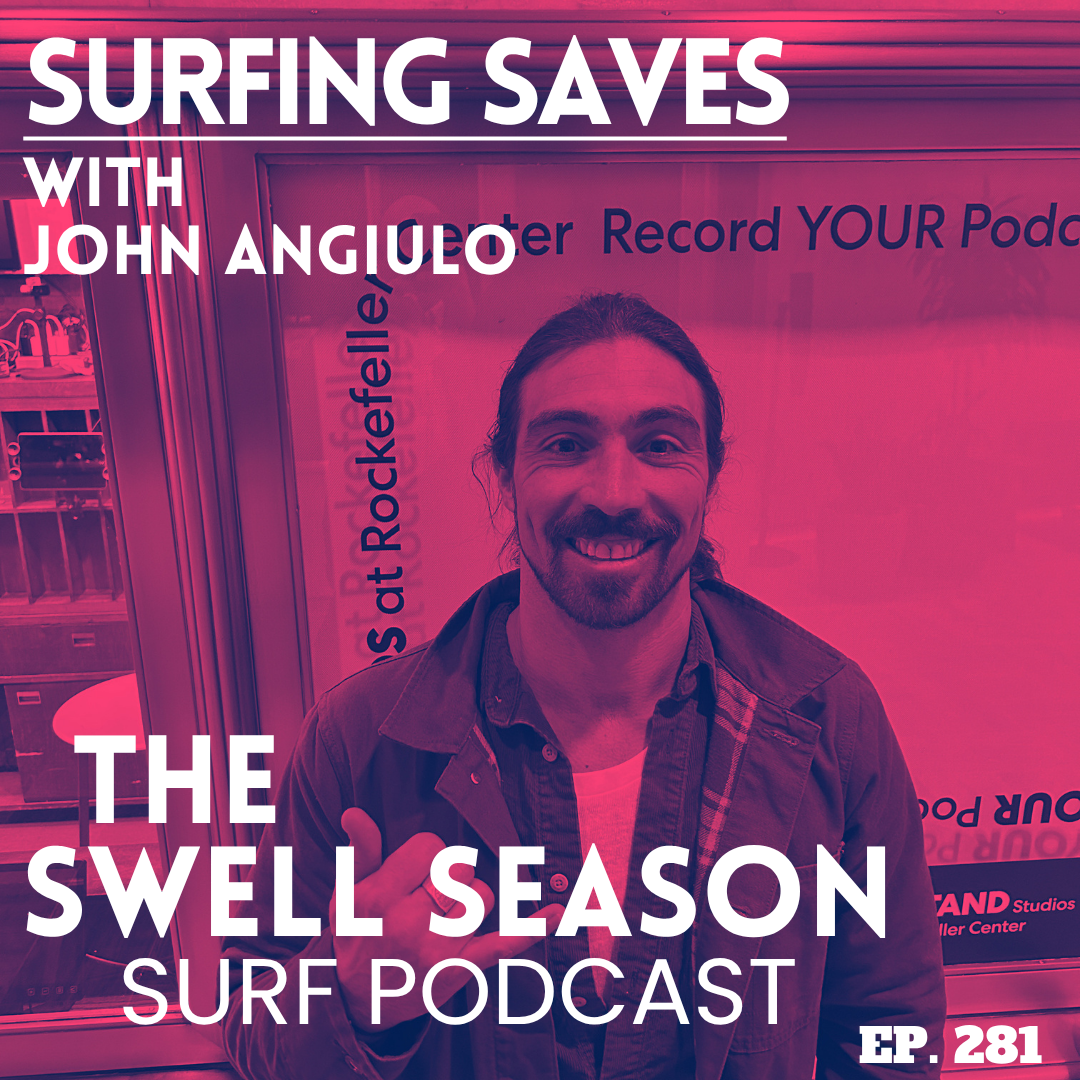
Surfing Saves with John Angiulo
[00:00:00]
[00:01:00] [00:02:00] [00:03:00] [00:04:00] [00:05:00]
Tyler: [00:06:00] Hello and welcome to the Swell Season Surf podcast. I'm your host, Tyler Brewer, our guest, John Angelo, professional, surfer, surf educator, author, filmmaker, and one of Montauk's most thoughtful voices when it comes to deeper meaning of surfing is our guest. John grew up in a family that helped shape east coast surf culture.
His father. Kenny was one of New York's standout surfers during the golden era, often mentioned alongside legends like Ricky Rasmussen [00:07:00] and his uncle Michael Mick Angelo wasn't just part of the surf scene. He helped make it possible. As a pioneering attorney and longtime legal director for the ESA, Mick fought the legal battles that opened New York State Park beaches to surfers transforming the coastline from a place where surfing was illegal into one of the east coast's most vibrant surf communities.
John himself started surfing at just five years old at Ditch Plains, and over the past three decades, he's built a life around the ocean, teaching thousands of people to surf in places like Montauk, Indonesia, Costa Rica, and Puerto Rico. But beyond the lessons and the waves, John has developed a philosophy about surfing that goes much deeper through his books, including a word on waves.
And his latest project Surfing Saves. He explores the idea that surfing isn't just a sport, it's a lens for [00:08:00] understanding life itself. His work blends surf instruction, philosophy, environmental thinking, and even a little quantum physics built around the idea that everything in our world moves in waves.
And that learning to read and ride those waves can help us navigate life, community, and even the future of our planet. John is also behind the Surfing Saves Project, a book, film and educational initiative aimed at using surfing as a metaphor for regeneration of ourselves, our communities, and the places we love.
So today we're talking to Mon. We're talking Montauk history, surf access battles, teaching the next generation, the philosophy of waves, and what surfing might be able to teach us about the future. John Angelo, welcome to Swell Season.
John: Thanks so much and, uh, what an incredible introduction. Thanks a lot.
That was a lot.
Tyler: There's a lot nailed doing research, man. Like, I'm like going through it and I'm just like, damn [00:09:00] man, there's a lot here. Um, and I was like, there's so much like the history of, of your family and surfing. I really appreciate as someone who grew up as a lineage surfer too, my dad owning, uh, you know, one of the oldest surf shops in New York, so I know what it's like kind of growing up in all of that and being surrounded by everything.
So I, in my research just felt kind of an affinity. But also I remember last year, uh, we were surfing a place that I can't talk about. It was a really good wave. And I remember just seeing you fly down the line on a couple really good sets on an epic day, and I was just like, who the, who the fuck is this guy?
Man, he's looking good. I was like, damn. But I'm also like. Obviously a little competitive. I'm like, I could kind of do that, but maybe, I don't know man. You can do that. But yeah, I was, it was great. And then you, you kind of reached out and I was like, oh, this [00:10:00] is perfect. So it's been real fun kind of learning about you in, in preparation for this.
John: Yeah. Thanks a lot. I mean, this podcast is amazing. It's a really cool platform you built, so I'm super stoked It lined up and that day was epic. Yeah, that spot when it's on is pretty much my favorite. On the island of one of 'em in the world. Really
Tyler: Agreed
John: when it's good. It is world class. And that day was really special 'cause I hadn't been there in a while and it was just
Tyler: same,
John: really doing its thing.
Mm-hmm. And I think everyone was in like one of the best, like it was, it was a much less competitive vibe I felt.
Tyler: Yeah.
John: Uh, but yeah, that was great. And you know, it is part of what you were talking about is having a generational surf family. 'cause part of the reason that. If my surfing is very accessible for other people.
If you wanna surf like me, I'm sure that you can with some work. But it's just like, um, having spent time with the places, that's usually the key I think is' when you know the places. Mm-hmm. Surfing is so much easier and starting with, you know, my dad and my uncle and my cousins who all surfed, uh, around me and before me.
Tyler: Yeah.
John: It kind of [00:11:00] like gave me a insight into those places so I could, could be in rhythm of 'em.
Tyler: Yeah. Well especially when you grow up surfing those places and you know, some of the locals and you know, a lot of the people there, it like helps also, like, you know, who, who, who not to burn, who to be respectful to, who to paddle battle.
You know, you kind of puts you a little bit at ease also and, and you got an asce up your sleeve. You can just be like, well my uncle fought for rights to surf here and we wouldn't be surfing here without him. So wave pass.
John: Well his accomplishments came pretty much before I was born and have so little to do with me.
He's
Tyler: fantastic and he is a, he, he's a
John: great influence, uh, just like my dad. But um. But yeah. You know, I wouldn't take credit for anything. So even the good things that I do, I honestly can't particularly take credit for, are big on the fact that things happen through us. So it's like, yeah, no, I just try to have a really good time.
Tyler: Well, you, but your family has like super deep roots in Montauk and I was like curious, like, if you can tell us a little bit about the [00:12:00] Angelo family and like how far back it goes into Montauk and kind of that kind of story of like, and also how surfing got introduced to your family.
John: Yeah, it's, it's a really special, cool story.
Like, you know, a lot of things, um, just are these blessings that you can see. Like, you know, no one even could plan such a thing.
Tyler: Mm-hmm.
John: But anyway, um, my great-grandmother, my father's uncle's, uh, grandmother, uh, glass, she, her last name was actually Thurston. Uh, but she was actually one of the first female lawyers in the us Wow.
First, first graduating class at Columbia Law. Female. Uh, amazing. Really brilliant woman. I actually got to know her. She lived till like 97 eventually.
Tyler: So she was like, probably with Ruth Bader Ginsburg. Right. You know,
John: something like this. Like, she was badass, but she was really, really brilliant woman. And four runner.
And then her daughter, who also in her own right was, 'cause she was the head of like, I believe secretary unions, very istic, like write letters every, like, you know, awesome women, matriarchal women. And anyway, um, so they actually bought the property across from [00:13:00] the dirt parking lot ditch plains. Wow. In 19, like, I think it's like 63.
And then built the cab and the foundational part of the house, um, in like 65.
Tyler: Wow.
John: Yeah. Uh, which is like crazy 'cause it's like that dirt lot is like, you know, a fable. Like, it's like, you know, it's like it's a store. It's like San I, I've, I've posed the whole place like a surfing's like. Field of dream sandlot scenario mm-hmm.
Where you get there and like people stop aging and things go backwards and like, it's just like magic is like everywhere. It's, it's pretty real. So, but anyway. Yeah, that's a right across, it's the front yard.
Tyler: Wow. That's really cool. And then like how, 'cause your, your, your father and your uncle, like, I mean, your dad was probably one of the top surfers in New York, uh, around that time, like the, the early seventies, I would say.
John: That's what people say.
Tyler: Yeah. So they
John: said, I mean, people have told me that, which is cool, you know, so,
Tyler: I mean, like, do you, did you get any stories from them? Like, do they pass down a lot of that stuff? Like, I was [00:14:00] curious, like, you know what, so what, what does your dad talk about? Like, surfing was like back then and how does that shape your view of surfing today?
John: Yeah, I, I mean, I guess like I have a pretty deeply poetic, romanticized view of surfing, as you can tell. Like, it's like all to me as we do, right? And it's just this amazing experience for anyone who hasn't done it. Uh, it's just amazing. But anyway, um, with my dad, it was just, he always just. Viewed it and spoke about it and had in this light of something really amazing and magical.
When he taught me it was this like super deep connection with us and nature and always being at the beach. So, I mean, that shaped how I viewed it. I, from that moment, like my first experience surfing is literally him pushing me on wave. My mom hugs me when I get to the beach, you know, the whole thing. Do you
Tyler: remember that wave?
John: I, I do. That's my, that's like literally the foundation of my existence is the first, you know how you have an inner monologue mm-hmm. Or dialogue depending on how your brain works. But uh, anyway, [00:15:00] um, the first thoughts I ever remember having in my own head were right after that wave. And I literally thought in my head, I'm gonna do this for the rest of my life.
Those are my first conscious words in my head. Were about surfing and I was certain that no matter how long life lasted or didn't, I was gonna do this. And 32, 33 years later now, and I will say literally that kid was right. I say it all the time and like. I love it more than ever. I surfed like a one foot wave the other day and had so much fun.
I was like, how is this possible still?
Tyler: Yeah. Well, I mean, I think it depends on your mindset too, you know, and how you approach surfing, right? Like, you know, if you're going with the attitude, I'm just gonna rip, like, yeah, one foot's not enjoyable, but if you go in thinking like, I'm just gonna see what I can find, I think it, it, that opens you up to different experiences and different fields, you know, that comes with surfing.
Uh, and your dad, where was that? Was that at ditch your first, uh, wave? Yeah.
John: Actually no, my first wave was, um, [00:16:00] actually at Gilgo.
Tyler: So you grew up like Babylon bouncing between Babylon and Montauk?
John: Yeah, my parents. So my parents that, that's a family home that's there. Mm-hmm. So we got to go there in the summers and you know, eventually a bunch of our family has made a life there now.
But, uh, then that was like the dreamland and then I would come back to Mid Long Island, Babylon. And though it's like a beautiful place to, you know, live and there's all the amenities of modern day culture, I basically viewed Babylon as like, it was like this di uh, dichotomy between mediocrity and magic that my, my soul had to just choose between how to get back to Montauk san.
So that was,
Tyler: you know, I mean like, you know, Babylon's got some, you know,
John: it's, I love it now. No, the thing is, I love it now when I, I spend a lot of time there now going visit my folks and like going back in town.
Tyler: Yeah.
John: And I love and appreciate it much more now. I love it.
Tyler: Yeah. But.
John: Then I was like, I gotta get outta here.
Tyler: I mean, you got Glen's Diner, which is nice. And the Delphi, I grew up in West Islip, just [00:17:00] down the street from there. So, you know, I know, uh, a little bit, you know, and, you know, were you like a bunker kid as well then?
John: A little bit. I mean, to be fair, I was, it was West B, not B, which if you, you know, the difference is like, Bab one's a bit nicer, but, uh, just a little.
But, uh, in the, any case, um, yeah. Yeah. Um, let's see. Bunkers were one of the first people that ever hooked me up, and it was actually Ed Orian lived on top of Bunker, and he was a teacher at St. John's.
Tyler: Mm-hmm.
John: Uh, where I went for a bit before they decided it was best for me to move forward at a different school.
Oh, it was, it was better for you. It was better for everyone, for me to go somewhere else. Uh, wish we could go to that, but, uh, in any case, uh, but yeah, um, ed Ricky and helped me get hooked up with first Hanley Surfboards, but then Bunker.
Tyler: Mm-hmm.
John: Hanley was a friend of his, and he made long boards. So I got, my first boards I ever got hooked up with were handies.
Tyler: Dude, I remember riding one of his fishes like early two thousands, you know, or maybe even like late nineties, you know, when, [00:18:00] when people were, weren't even still riding, weren't riding fishes a whole lot. Even back then, you know, those things were sick.
John: That guy's a good shaper actually.
Tyler: And in New York Native too.
John: Yeah. And he made it out in California with all the other shit. So actually shout out to, uh, you know. Well, I'll get to Bonger, but to Ed and, uh, Chris Corner. Chris Corner was an og. Do you remember him? He was a, I don't, no, he's a goofy footer. Real, one of the og like around Toby Smith era type of thing.
Mm-hmm. Yeah. Uh, bit more performy. But he was a super, just amazing, talented lawn boyer that I looked up to. And he also, he wrote for Hanley before me. And like the second time I ever went to California, I stayed with him in Pacific Beach, which was like, wow. I had stayed with my family beforehand, so now I was like a kid in Pacific Beach staying with this dude I looked up to and like he had worked, so I was just like wandering around.
It was, it was pretty cool. But that was 'cause and then after that everyone was like, doesn't it make much more sense for you to just have us make you boards? And I was like, well, that really would make more sense. Great.
Tyler: Dude. That's amazing. Did you do the ESA at [00:19:00] all or were you like kind of averse to the competition side of things?
John: Um, I wasn't necessarily averse as much. I definitely wasn't into it, but I just, I just really wasn't. Into it. Yeah. You know, like meaning like, it wasn't even like a choice. I just wasn't part of that thing. And then I, I saw a few of 'em, but I always thought that they made me feel weird and I wasn't as, I wasn't as like competitively competitive like that I don't think.
I, I, it made like when I was young, I used to get angry easier, which is why all this spiritual stuff came in my life in order to like, you know, not be that way.
Tyler: Yeah.
John: But like, I was like surfing so fun and I just want to like, enjoy it. But then as I got older, I started to do a few things and, and that, that was cool.
Tyler: Let's explore that for a sec. Why were you angry as a young, young man?
John: Do you have the couch? Is there a couch in here?
Tyler: There's a couch
John: down.
Tyler: Get, lemme think.
John: I
Tyler: mean, let me get my pipe and let's un let's unpack,
John: I'm, let's pack the pipe and then unpack. Let's be perfect. I think it's a great two piece combo.
I'm happy to explore. Uh, [00:20:00] well, you know, actually it really all comes back into this, into surfing Saves. And the reason I wrote it as this like lens. Yeah. Because I here why is someone angry? Yeah. The same year I learned how to surface the same year I went to preschool. Mm-hmm. Now imagine these juxtapose experiences.
Mm-hmm. Right. I experienced ultimate freedom with the love of my family all around me in a natural setting where I, the only way to really use words is, you know, ecstatic bliss. Mm-hmm. Like, this is amazing. And then they're like, here's school. And yet everyone, I'm sure most of you who are hearing this have been to school.
Would you describe it as ecstatic bliss?
Tyler: Like, like. I mean, uh, I enjoyed the, the animal crackers and the bug juice that we would get. You know, those were always fun things.
John: I know. And if they, but,
Tyler: but the rules, you, you seem like someone who doesn't like to fit into, uh, confines
John: a a lot. And the most, mostly the thing that I really have always dislike, and one of the things I've always kind of said is I love [00:21:00] conversations.
So I'm always willing to talk about things with people and work out like what's going on. I like that. But anything, any experience I've had in my life where someone assumes they uniformly can tell me what to do, I've always viewed that as completely invalid from a fundamental, like you could say my soul, but even as a very little kid, I was like, what is that?
Like, like why? And then surfing sort of sparked this recognition of me, of from a young age of like how beautiful things can be. And then I really think that holding that in my heart as like a, the baseline of reality and then viewing everyone el going through the actual baseline of reality. Mm-hmm. I think that's a deeply upsetting experience for someone.
In fact, I, I don't know about someone, but for me it was, you know, I was like, you know, I was like, I can do this all the time. You guys want me to do this? Like, this is horrible and you're all bummed, you admit it and no one's happy. You know, I, I was like, I, so that was, that was why I was bummed.
Tyler: It seemed like you, you, you probably rebelled a bit and, and probably I think surfing,
John: [00:22:00] outrageous.
Tyler: I think surfing at that time too, like spoke to that, right? Like surfing had had, you know, for, you know, better or worse had the reputation of being a rebellious thing that was anti-authority, anti doing anything, told what to do type of thing. And um, you know, surfing lends itself perfectly to go against that.
And I think like when you're young too, you embrace that type of. Energy, you know? And it definitely, like, I definitely was, I like to think I'm still anti-authority to a certain extent, but, uh, I didn't, I wasn't as much of a rules breaker, but I embodied that attitude of like, oh, the man is trying to keep us down.
Or, uh, you know, I remember even like, thanks now to your, your uncle, but I remember going to Moses and having surfboards confiscated and stuff being, you know, you'd get in trouble. You'd get fined. Like, I remember watching kids get like, arrested for having surfboards [00:23:00] just carrying, weren't even surfing, you know?
John: Mm-hmm.
Tyler: And it's like, you know, we definitely, surfing kind of, kind of provokes that, I think.
John: Well, it is meant to, one of the amazing things about like, well, one, like the way that I understand reality is through this model, right? Yeah. So it's like I can scan through things and it's amazing the way that it's infiltrated this corruptive nature.
And myself, everyone, but in every, at every level, like for instance, like a lot of things we inherently feel like are wrong with professional surfing have to do with like how these larger industries are now the ones that leverage and take over everything. Yeah. And no matter what you say, it corrodes soul, it corrodes the inherent nature of like our soul's expression and how we feel free and less judged and able to exist in harmony.
They just, just the nature of the hierarchal structure.
Tyler: Yeah. I mean, capitalism sucks.
John: Yeah. Yeah. Yeah. I mean, it really does. I'm excited though. I'm excited. I mean, it's a, it's a funny thing to say about where we are, where we are, but you know, in my worldview,
Tyler: yeah.
John: Uh, which, you know, there are many who share, many who [00:24:00] I'm sure do not, but we're going through this amazing evolutionary period.
And part of that has to do with this, uh, the collapse of the old systemic structures that we relied upon. Yeah. So that way we can experience real sovereignty. And that doesn't include economic sovereignty, and all that means is working in rhythmic reciprocity with one another.
Tyler: Mm.
John: You know what I mean?
That's really all that entails. Mm-hmm. Um, which of course, in reality that entails a lot more, but phrases open things up. So
Tyler: I'm curious then like, where, where did this awakening start? When did this start? Like when did you start to become like less angry and more kind of looking at things like wanting to kind of find harmony and find more balance?
John: Well, even prior to like an awakening to like a spiritual side of me, I recognized that one I wanted do something that would last in the world from a really young age. Mm-hmm. Like I saw like, uh, George Washington's name in a textbook, and I was like, his name is Ebola. I was like, I'd like to do something to be remember like that, which I thought was an interesting notion to have.
Tyler: Yeah.
John: Um, and then [00:25:00] I really just didn't like. How I was when I was angry. Mm-hmm. Like I just, like every result of it was like me looking like a jackass and nothing good happening. So I was like, okay, that's not working. And then, um,
Tyler: how old were you, would you say? When I was thinking
John: those things?
Tyler: Yeah. When this stuff started to kind of formulate for you.
I'm
John: curious. Young. Like I was when I wanted, when I wanted, when I started wanting to not be angry.
Tyler: Yeah.
John: I was like 13 or 14.
Tyler: Mm-hmm.
John: And I was like, and then this, that's what happened. So instead I replaced like anger and like I would cry about things to just laughing and making jokes. So then I didn't even get, I would not let myself really get upset, but I would false like make it funny for like 20 years.
Yeah. It was crazy. Yeah. But, um, in any case, and then when I was 18, 'cause I had my daughter when I was 19. Wow. Um, and so, wow. Yeah, so she's in college right now.
Tyler: Wow.
John: Uh, her first year of college, she's 18.
Tyler: Amazing.
John: So, um, but I had her, and that was obviously something like, I thought I was gonna go travel the world and then, you know, that's very, it was very grounding and saved my life.
But, you know, when you're 18 you have these ideas in your head, you're like, well, that's all gone. Right. Which, thank God she saved everything in my life. She's [00:26:00] vast. But in any case, um, so that brought, I, I was given these amazing books, one of which is about this man Walter Russell. It was given to me by a chiropractor, um, Barry Fabricant, but he gave me a book called The Man Who Discovered The Secrets of the Universe.
Yeah. That's a by Glen Clark about Walter Russell. Walter Russells is Polymathic genius, who in one 40 day stint wrote what's called the Divine Iliad, which is essentially what you can consider to be a, a God translating instructions for what the universe is through a human form. And then that book describes everything literally in wavelengths actually.
And how, like in the seventh chapter of my book, it, it references this and talks about how like if you God or whatever you prefer for the universal loving creator is, um, weaves world literally with waves. That's how, that's, that's how God's how found with everything. Mm-hmm. You know what I mean?
Tyler: Is Well, it, it, it makes sense, you know, it's like, um, everything seems to move in waves or patterns of sorts, you [00:27:00] know, from light to sound waves to everything, you know, and it stands to reason Yeah.
That, that would make sense, you know, and. You know, and I think like the beauty of that is also then understanding like the ripples you make
John: mm-hmm.
Tyler: Have impacts outside of you, you know, and, and obviously like butterfly effects and things of that nature. You know, you start to, to really ponder
John: and that like, so that started the spiritual awakening like that gave me like this kind of spiritual like boom.
Like okay, this is what's real, this is what's really real here. And then that, you know, really spurred on the desire to change, which honestly took about 18 years, I would say from the time I was 18 when I first read that book to, I'm 37 now, I'll be 38 in May. So really it took about 18 years for me to integrate and actually feel like I'm not particularly honestly in myself, mostly angry.
Like my general response to reality is like, this is awesome. Even my now, a lot of times my general response [00:28:00] to death is, this is awesome because of this pullback perspective and the nature of how I view reality and the un. Excuse me, the undestructible nature of the soul, um, for, while we're in a physical form that obviously can go through all these transformations, like is it was, it is just this really amazing thing.
So that internal, uh, barometer for balance has definitely shifted now.
Tyler: Mm-hmm.
John: And so that's good. But I would say it took about a 18 years. So yeah, more or less
Tyler: if everybody wants to give it a shot.
John: Hope you got some time.
Tyler: I'm curious, like, um, you know, your, your dad was, was very influential in, in your life, you know, does he still surf first?
I'm, I'm curious, like, is he still involved with surfing?
John: Yeah, he still, he serves less, I mean, he's like classic like old school guy. Like let himself get like, not in the best shape, but he still serves, still has great style and just like, he goes to the beach a lot, it's always a sacred thing. He loves being part of it.
He's friends with all my friends and like, they're like some of our [00:29:00] better surf friends who are like family. He's got his own group text with them. Like not, I'm not in them. You know what I mean? Um, and I also have two, you know, younger brothers who also are all involved in all of this. So, you know, he, he's, he's involved through all of us.
Tyler: I'm curious though, like you wrote in your book, in the intro, you gave a dedication to your mother. Mm-hmm. Uh, and you, you thanked her for teaching you how to pray, and I'm curious like what impact that was and how so?
John: Yeah, my
Tyler: parents because, because I always hear like about the father teaching the kid about surfing, and I'm always more curious actually about the.
The feminine aspects of it too. And I'm really curious how that is, has shifted or shaped your, your overall philosophy.
John: Well think about having the time of 18 years to feel like you can work on yourself. Most people don't give themselves that. And that's a testament to unconditional love. 'cause unconditional love turns what would take forever into 18 years and comparative forever.
18 years is pretty quick.
Tyler: Yeah,
John: right. So my mom's ability to her love of life, she had this amazing, I'm not religious, but [00:30:00] even through religion in its different doctrines, she just found the love part of it and that was what she always focused on. And I can't, how many times I'm sure I've come close to death that I don't know about.
Mm-hmm. Is insane. I can't imagine how many things my, the dumb young me must have done that like.
Tyler: It was like, and like a knife goes by my head,
John: you know? Or just, just like an explosion. I was just doing anything stupid I could, I guess. And you know, she prayed for us so much and the, when we talk about frequency and like the quantum physics aspect of it, if you hold within yourself and you have mind heart coherence, then it o operates in the to field.
And that actually carries things in what's called scalar waves. They're nonlinear waves, which, uh, operate outside the constraints of space and time. And so if you have the ability to hold prayer, thought pattern, waves in your heart coherence and expand those in the world, which sometimes people just do through the mere act of the love in their heart, you actually set things into reality.
And, um, I honestly would say if everything that we feel is true on that level of quantum [00:31:00] physics thought and understanding mixed with spirituality, then I would say my mom's probably saved my life about a million times.
Tyler: Oh, there you go. Mom.
John: Shout out. What up ma? She'll love that. I didn't plan that.
Tyler: Will you?
Um. It's interesting, like, I love that you, you bring this up about the energy and spreading it out. It reminds me, I dunno if you ever saw Surfers, the movie?
John: No.
Tyler: Back in, oh, so it's like 19, late eighties, early nineties. But there's this one thing with Shane Noran talking about how surf con, you know, the Native Americans used to have these gatherings, these ceremonies where they would, you know, celebrate and spread positive wave energy around the world with their gatherings.
And he, he always thought, well, these surf competitions are kind of like that. And I was like, it's kind of bullshit dude, because you're in a competition. But at the same time, like you're getting these like-minded people together and getting them to kind of harness that energy in different ways and hopefully it spreads outwards, which [00:32:00] I, I always found an affinity to.
So. Just being surf nerdy about that.
John: Yeah. Well that's really cool. I have to check that out. 'cause that's literally what, that like short film I just made is about. Yeah. And it's literally like, what, you know, this whole Pal of the Peace thing is about is, well yeah, that what I just spoke about. There's the, the Maharishi Effect, which is a documented study.
Tyler: Yeah. I was heard, I heard this on your, uh, another podcast you did. And I was curious like if you could expand on that a little more, like what, what the studies found and what the effects were.
John: Yeah, so they did, uh, for those who don't know, the, basically Maha Rii was the spiritual practitioner who postulated that.
And this has been, you know, done throughout human history, but this is the, the most recent iteration of this knowledge. Mm-hmm. But in any case, uh, that when we get together as humans and do, uh, certain transcendental meditations where essentially we interlock and harmonize ourselves, then we become these, uh, frequency nodal points that can alter what's manifesting in reality.
Mm-hmm. Um, and then they did this, this [00:33:00] actual study, and they, you know, they did everything they could to account for all the variables when crime is forecasted to be the most, which is like, you know, early summer. Mm-hmm. Everyone gets out and they're like, let's go. Um, and they did these meditation groups and they found that relative to forecast the overall, including crime, uh, you know, violence, domestic violence, all these different factors, all decreased by 23% altogether.
Tyler: Mm-hmm.
John: Right. And they found that the largest. Uh, spike in the decrease right. Was when they had the most people in the longest meditation.
Tyler: Mm.
John: Right. Which is makes perfect sense. And it really has to do with the collection of the most amount of nodal points. Each human is a node in the electromagnetic network of humanity that is then coordinated with the electromagnetic nature of earth itself.
Uh, which is why we feel so good when we're barefoot. Why surfing lend so many health benefits to us when we're just out there. Even people who don't surf.
Tyler: Mm-hmm. Just
John: being there barefoot in the sun is so much better. The longevity. So, but in any case, uh, yeah. So when we joined together, um, our [00:34:00] fascia, which is like the things in between
Tyler: Oh yeah.
I have, I have plantar fasciitis, so I'm very familiar with the fascia.
John: I have, I have something that can help you by the way, I got into all these wave based technologies, so I can help that.
Tyler: Yeah, man.
John: But so the fascia itself is actually this crystalline. Uh, semiconductor. And so when you clear yourself and you start to use these vibrational techniques, they, it's a lattice.
And then when you connect with the other people, they literally build. And then the energy it creates is then this field effect and is greater than the sum of its parts. So you can actually ripple out this frequency of what you're holding the intention for and that can alter outcomes in reality.
Tyler: Damn.
We need some of that.
John: That's alright. So if everyone doesn't know what I, I keep referencing, we're doing surfing phases of the project, but we're doing paddle outs to peace monthly.
Tyler: Mm-hmm.
John: That the first one in February and people actually showed up, which is incredible. It, especially
Tyler: in February.
John: Cold coldest winter ever.
So, uh, but then we're doing the second one on, uh, this March 22nd Sunday. And we're gonna get, continue to do them monthly, starting locally in [00:35:00] Montauk. But the goal is to have people coordinated. So we do them together, um, along the coast, globally, internationally, and. Um, any way that we really can in that coordination, the whole idea is to, one, we do these Dallas meditations, people do 'em, I lead people on the beach, and then those of us who wanna go in the water, go in the water and hold the circle there.
Mm-hmm. Connecting with the earth grid and then putting that in there so it actually carries further. And then when all, a lot, when there's multiple, uh, points of us doing it together across the earth's grid, then you can actually see this wave of facilitated, uh, behavior change because of, and even if, if you don't want to get into, say, the electromagnetic nature of reality, you can simply go to what humans now, uh, recognize as an important thing is a nervous system regulation.
Tyler: Mm-hmm.
John: And if you can't regulate your nervous system, anything that happens will upset you, which is like what we were talking about. So I learning to regulate my nervous system that is resonance. Like staying aligned with my actual self. And then that is what allows me to stay balanced in the waves of the world.
Right. And same thing. [00:36:00] So when we gather, we help to co-regulate each other's nervous system. Through this resonance, we align and harmonize our each other. And then that allows for us to move in the world in a different way. And the goal is I want to do a wave, like a sunrise wave. So everywhere in the world that they're surfers, I'd like them to paddle just for like 10, 15 minutes.
Mm-hmm. Do this meditation. 'cause that, that's the goal is like instead of things being difficult, by us being separate, if you do, if like you get with your friends and do like 15 minutes of this work right. At sunrise, which is fun anyway.
Tyler: Yeah.
John: And, but we all do it. That's 15 minutes when we all do it is the same as us doing like a thousand hours when one of us has to do it.
Or like, you know, a couple of us. So, uh, imagine ev everywhere at sunrise, boom, boom, boom. There's people gathering for peace. I can imagine that having a really cool ripple. So this is the overall goal of what, uh, I'd like us to, it's like an experiment, but it's, it can't hurt.
Tyler: Well to me, even like on a metaphysical, you know, layer, even like.
Community, right? Like what you're doing is just basically building community. And when people feel part of [00:37:00] something, like, I feel like that helps regulate your emotions, right? Like, you know, and, and just, you know, you have like the whole example of like, you know, the, the husband yelled at the wife who yelled at the kid who yelled at the dog.
You know? But if you have a community where everyone is able to kind of balance those energies, you know, or balance the, the behaviors, like if someone can be upset, but then if there are more people who are happy and relaxed around that person, that can calm them down too, and that can spread outwards.
And I think that's like for, for those who aren't into the more metaphysical side, that is the more pragmatic way to look at it too. I think
John: a hundred percent like that, that's part of just how my brain works and what turns me on. Yeah. But the fact is, is like. When, if you look at the world, I view it as the waves of our world.
But if you just look at your world that you live in, yeah, and you're like, things are more difficult when you don't have people around you who can support you. And all the science shows that the main marker for longevity and happiness and health and life is your social circle, your interactions, your community, [00:38:00] your family.
So yeah, the biggest thing is how we work on our relationships within community. I'm just that guy that gets off on this weird stuff, but like, it doesn't matter. Like, listen, well, it's not
Tyler: weird. It's like, but
John: it's, well, you just, yeah. You know. But what I mean is like, I love it and however people can find it within them that they want to get together, you're nailing it.
It's like, it's all about the community. It has to be whatever way people want to get involved with it too.
Tyler: Yeah. Because we, you know, we live in such a isolated world, it feels like, right? Like we're, we've got the technology to connect with everyone, yet no one feels connected. And so people start looking for things to connect to.
And sometimes it's more extreme things even, you know, and, and, uh, some are more healthy things and some are destructive things, but it's, you know, everyone is looking for that connection and to be able to provide that. And, and that's what like, I think surfing has been always great at, and, and providing like that, um, you know, I hate to use the cliche, but only a [00:39:00] surfer knows the feeling.
But it is that when you meet another surfer. Yeah, there's this already community built in and there's already this understanding, you know, that Oh, you know, I know, we know
John: a hundred percent. I mean, I came back from traveling and I, I was like doing a bunch of different stuff besides surfing, and I was like, I literally just wanna hang out with surfers.
Like, I, I, I was like, like they just get it all the, you know, the things I'm not like, why I'm so sandy. Like, you know, like people just, you know, surfers mostly just get it, you know? Um, so yeah. And, but that's like, uh, that's part of being part of your own subculture and community and tribe. And, uh, the biggest thing, like even when people hear or see this, even if, you know, obviously this listener, this audience is about surfing, but even if they're not necessarily surfers, it's really just finding those groups.
That's why the invitation with the, with the paddle outs thing is if you don't surf, come to the beach. Yeah, we're gonna do meditations on the beach. Hold that there, you know, but getting us together in real life, you know, like, you know, you gave me the opportunity to either, [00:40:00] you know, stay at home, which is only like, yeah.
40 miles away from here or whatever, or um,
Tyler: come into the studio.
John: Come the studio. It's a much better experience.
Tyler: Absolutely. You know, when, whenever I can, the studio is a much better, better environment for, for doing interviews, but it's, it's, yeah, it's that human level of connection and being able to read body language, read movement, read the physical emotional aspects that you see with everyone is, you know, in the sub subliminal stuff too, like, helps tremendously.
John: Yeah. Read the room.
Tyler: Yeah. Yeah. Read the room. Exactly. Read the room. Read about two, two. Sum it up. Uh, read
John: the room.
Tyler: You know what I'm saying?
John: Look around, read the fucking room.
Tyler: I'm, I'm curious then, like, where did the teaching for surfing come and how did that come into place?
John: Well, so my Uncle Mickey's, um, daughter is Kristen.
Yes. And my cousin. And, um, she is. Um, awesome. What's interesting is she surfed less when we were younger and now she's turned herself. Phones really one of the best [00:41:00] female on boards ever come out. Wow. Of New York show. Her switch dance game is unparalleled in female longboarding on Long Island. I'm almost certain of it.
I've never seen anyone do it, but any case she all, before all that, um, she was just a, a surfer and, um, she, um, loved the beach. And Corey, it's actually a really cool story. So our family, um, had that house and that was kind of like a little haven for surfers.
Tyler: Mm-hmm.
John: My, you know, great grandma and grandma.
They make like stacks of pancakes and all the surfers would eat there. That's awesome. Afterwards and, you know, my dad and my uncle were like, you know, knew everybody and Steve Sinise was my uncle's best friend and, you know, my, my dad's younger than them, but they were all friends and Steve moved to California and had Corey.
And so Corey would come back in the summers with Steve and that he was the best surfer I'd ever seen. Really, one of the best surfers any of us had ever seen. He was super talented. Uh, still is, you know, the whole surf lesson company's built. But he's incredibly talented, surfer, uh, and became a really, really great teacher.
[00:42:00] Uh, you know, a few people ter like, so anyway, they got together, they started dating and they had been giving surf lessons for like Main Beach Surf Shop and realized that like they had to go all the way there. And meanwhile, our whole family lives on ditch. Mm-hmm. Like they had trailers in the trailer park and we had the house.
It was like, and it's the best place to learn ever.
Tyler: Yeah.
John: So, um, they were like, you know, they said, after the summer I worked with them, they were like, Hey, next year we're starting our own company. And I was like, let's do it. Like, I'll, I'll do anything. Once I found out I can make money surfing, I was just like, I was like, you gotta be kidding me.
I never dreamed of that. Like, when they started handing me checks to teach people to surf, I was like, I'll do anything, anything. I didn't care at all. And then it was the classic thing like. Literally people in the family are like, you guys are gonna start a surf lesson company. You two owe you guys morons.
Like, you know what I mean? Like, it's like no one's gonna give you guys money to teach you to surf. And then it was like, boom, everyone showed up and then like that was Corey's wave and that they really, uh, they were kind of like, you know, at the frontier of like that surf lesson giving thing and mm-hmm.
It was pretty cool,
Tyler: dude. I mean, [00:43:00] like, we've had Corey on the show and like, you know, and just phenomenal guy and what they've done and what they've, what they've built out there is incredible. The question is, do do you ever go get to go to Simba with him?
John: No, I don't. No, I don't. Come on Cory. Like, well, no, that's, I mean, you know, that all depends on who contracts people are and you know, I eventually ended up going and doing my own thing after like 10 years.
But, um, but they also are the ones who taught me how to. Like literally do surf trips. Yeah. Like the idea that you, that someone would not just pay for you, but pay you good money
Tyler: to
John: guide, to, to guide them somewhere that you actually potentially have never been just simply 'cause of your relationship with 'em.
Teaching to surf like without them. I would never have viewed that as a reality. You know what I mean? And then they actually, so, and the reason that it became a reality, Monta is really amazing microcosm. It's magical. But, um, Tony Caron.
Tyler: Legend.
John: Legend in so many ways, but also [00:44:00] like, you know, low key, but was giving surf lessons before, like everybody.
Yeah. And then Terry Sims would show up.
Tyler: Oh man,
I
Tyler: remember God.
John: Terry Sims is the, Terry Sims is the fucking man, and he is also responsible for one of the greatest photos in all of like, yes, am I in cult? And I think in all of surf culture, but definitely all of longboard. So culture, I mean that the bomb turned, I mean, there's, there's not more Ste and Drip in any photo ever, ever
Tyler: listeners.
What he's talking about is, there's this photo of Terry Sims. Terry Sims is a, I hope we show them, is a tall, lanky surfer, like super rail thin,
John: even more than Joel.
Tyler: Yeah. Way, way skinnier than Joel. Joel Joel's packed on some meat since, uh, you know, starting doing Brazilian juujitsu. Mm-hmm. But Terry was just, and he has this.
This probably the greatest, one of the greatest bottom turns on a log ever. Where he's almost, I would say just, uh, you know, parallel with the base of the wave. Basically like it, the board is fully on rail. There's like no bottom touching. It's just all rail [00:45:00] basically.
John: It's all rail. Like literally 90% of the board's rails engaged besides the very tip of the nose.
And the fin is outta the water and just the tip of it is holding, which is why it's working. His body almost no muscles seem to be engaged.
Tyler: No, like
John: his hands, he's touching the water. But that's 'cause his hand is like, he's got a limp wrist, it's limp and he's just touching it and it's is. It is, it's, it's an incredible moment as a, I mean, he, honestly, people should be giving him more money still to this day, just for that photo alone.
That's how that, that's how good I think it is. Seriously. But anyway, he, uh, he was also a forerunner of surf lessons. He would show up at Klein traveling.
Tyler: Yeah.
John: He eventually, that's, that's why Cory goes assume Soah because, uh,
Tyler: yeah, because of Terry.
John: Because, well, he, I think they, the first time he went I think was actually somewhere that I could be telling this story wrong.
But I think that Terry was one of the first people reasons that Corey went to Indo to teach there.
Tyler: Mm.
John: Um, at like, I think this Ken Doy Resort or something like this. Yeah. I could be telling that story wrong, but I think it had, but in any case, regardless of [00:46:00] that one fact, uh, Tony and Terry, they actually, they were really instrumental in showing those guys.
And then they were the ones who set up like how to have a real company.
Tyler: Mm-hmm.
John: And they were the ones who showed me what. That these things were even real, like, you know,
Tyler: did, did you have any professional ambitions before this? Like, did you go to college? Did you have like, something you wanted to do? Or were you more kind of open at that age, you know,
John: you, you wanna do in the world?
Tyler: Yeah. Like career, life, job, like mm-hmm. As you were, you know, like you were new father, I guess. And, uh, you know, I'm curious like, what, what was your direction and then how, and how that kind of steered into the teaching?
John: Well, I mean, surfing, yeah. Was the, the, I mean, so for me, from the youngest age, the only thing I ever identified with really was surfing and surf culture.
Tyler: Mm-hmm.
John: And then the other thing, um, I had a, you know, a pension for articulation. I, I love words and books and poetry. And then when I found out I was having my daughter, [00:47:00] um. It was the books I was given, like I said, that essentially saved my life. Yeah. And that, and these guys were both dead who had written these books.
And I was like, wow, that's a pretty incredible thing that I don't know a single person alive who makes me feel better, but these dead people did. You know? And that's a fact. And then, you know, listen, my parents helped someone. Every, everyone was amazing. But no one was telling me things that made me feel better or made me feel I could handle what was about to happen to me except for the things that were in these books.
And so I was like, okay, I wanna be a writer. 'cause it's like I can help someone if I'm dead. That's a crazy thing to say. Yeah. Um, and so that spurred that on. And, and the surf lesson was already Ha And 'cause the surf lesson thing started when I was 16. Wow. 17. So it's like, in my head from that age forward, I was like, surfing is like the, is if once I found out I can make money.
Tyler: Mm-hmm.
John: That was like on par with people's jobs.
Tyler: Yeah.
John: I was like, that's it. Like, and then I was like, what else can I do when I'm not giving surf lessons and then was writing. And that, even though, I mean, yeah, that, that's really kind of been my entire real path when you strip it down. Surfing and writing to me, are the best ways to create [00:48:00] experience, share experience, and then be able to help people get the most out of their own experience.
Tyler: Do you ever find, and this is something I've, I've always struggled with, is making your passion, your career, right? Like there were, there are times in my life where surfing was, you know, it was also my, my job too, you know, in, in a sense. And it, sometimes those things collide and don't always fit neatly together.
And I'm curious like how you balance that and how do you, how do you turn off from surfing too? 'cause sometimes it could be too much also.
John: Hmm. Yeah. So I mean. Balancing that. I mean, when I was young, I didn't have like a necessarily the best blueprint for how to balance things. Like I, I've, I've always been very, like I said, mistrusting of society.
So I was like very much working to figure things out on my own, which is how this whole model I'm thinking about.
Tyler: Yeah.
John: That being said, uh, it was just one of these sort of destiny things where the surf lessons were happening. Kristen ran the company like a really, really amazing tight ship and just does how she [00:49:00] does things.
And so I was doing that and then I started putting out publishing my own books. So it was kind of a natural progression. And then like most people like me who are intense, I've had my, you know, really high highs, my really low lows. Um, and now if I can ever be accused of having and experiencing real balance in my life, the way, you know, viewing balance as this main rule in surfing and then in life and finding out what that means has been a lot.
Yeah. And I think that that period of time has really just started, like I said, in the last few years.
Tyler: So when you teach now surfing, are you teaching just the act or are you trying to incorporate all of these, uh, learnings and teachings of your own, like the, the philosophy side of it? 'cause one of the things I always I see is a lot is just people pushing people into waves and that That's fine.
That's great. I always feel like there's so much more to, to prep people like to even go in the water. There's, there's like a whole thing that I want to see happen sometimes [00:50:00] with lessons where it's like, no, you're gonna do the Chandler, you know, Chandler's gonna teach you to surf kind of vibe mm-hmm.
Where you're gonna sit and it's, it's low tide and you know, you're not asking questions, you're just observing. Or the Mickey Munoz way where the first thing he does is have people crawl into the sea like a seal. So they, and then body surf. So they get in the rhythm. And I'm always curious like how people teach surfing and how they teach the philosophy of surfing.
John: Yeah, that's a, it's a really cool question and I mean, it's definitely different with each person and what they're trying to accomplish. Uh, for me, I definitely am in the stage where that's what I'm looking to do. And the way I teach surfing is basically in these parts that allow for the, these things to happen.
'cause to me, the first part of surfing is, like you were kind of alluding to, is beforehand.
Tyler: Yeah.
John: And beforehand I talk about how you connect with your body, yourself, how you connect with the board you're about to ride, and the ocean do those things beforehand so that way you feel aligned with the things that you're doing and you have the vision for what's gonna [00:51:00] happen next.
Uh, which, you know, I, that's what I do when I, when, especially when the, but I do it all the time. Even the waves are six inches. Like you can get hurt. The thing you learn about surfing, you've been surfing your whole life. You can get hurt no matter what. It doesn't matter what you like, you like. It's like, yeah, don't make me wrong.
10 foot wave is potentially more dangerous than a one foot wave unless you crash that first into a fucking rock. 'cause then that's more dangerous. Like, so,
Tyler: well, your, your fir I mean, like one foot waves are probably more dangerous in many ways because your guard is down, you know?
John: Yeah, exactly. Exactly, exactly.
So, yeah, that, um, yeah. What, what was, I
Tyler: like how you introduce surfing to your students and like is there more, are you teaching 'em more than just the physical act?
John: Yeah, for sure. I try to give 'em these different parts so that way they can do it. So it begins with, you know, envisioning and then there's the parts in the water, which are, you know, going, getting out through the waves, being in the lineup and them riding in.
So they're learning about these different sections of surfing and so they can compartmentalize. And the last part is afterwards and reflecting and integrating. Um, [00:52:00] and so that without, I, I, the philosophy has to do with a larger part of what I, uh, look to do in the world and the numerics of that and stuff that can be a little heady for people unless you're in that world.
But the surfing part of it is the most grounded human part where it's just about how to use these simple structures and flows that help you. So it's about, you know, you need to, if you wanna get the most outta surfing, you've gotta connect with yourself. You're bored in the ocean no matter what's going on.
Tyler: Mm-hmm.
John: And then these are, so I just, the goal with teaching is really to allow for it to be as fun for people as possible while they're learning these real fundamentals. And then through the reflection, developing the mentalities and those, uh, kind of resonance based thoughts that help them use it in their life.
Tyler: And that's the thing, like surfing like many things, I think is a, is a great lens to view the world through, right? Like I, I always tell people, like, I look, I look at the world through a Surfy lens, you know, and like I [00:53:00] try to see things like, oh, well let's apply that to surfing, reply surfing to that type of thing, which I think is kind of what you've started to do with the Surfing Saves Project.
John: Mm-hmm.
Tyler: And so one, can you explain to our listeners what the Surfing Saves Project is exactly. Mm-hmm. And, and then like, I am curious like how it really started to formulate in your, in your head, like this is an actual project. In a thing. In a book, and then obviously beyond.
John: Yeah, so Surfing Saves is a book.
Uh, ongoing film project, uh, where I capture stories related to the concept of surfing saves and then the overall impact campaign. What has to do with,
Tyler: yeah,
John: utilizing this understanding of waves and frequency as the analogy, and really the baseline of our reality so that way we can use these things to activate, regenerate, and evolve ourselves individually, communally society.
Um, and so the whole idea is really [00:54:00] using surfing as this analogy so that way we can look at, understand and use these things in the world. 'cause I, I, the intuition is just simply that this really is what is going on. These are, this is how the world works. It's also a lot of the ways that we are being manipulated against our will and against our knowing.
And that once we become aware of it, that we then have a lot of the tools, techniques, we have a lot of the agency necessary in order to do those things, to regenerate and evolve ourselves and our world, um, as a people.
Tyler: I, I've always just wanted like to blend surfing and the Jedi philosophy, you know, did, is that kind of, that
John: is what's happening?
I was just thinking about, but truly it's just like, literally, it's like gather, gather the super humans, you know? Like, why do I think surfers are such an amazing group to get involved in the evolution of the world? Well, you're constantly, one, you're still connected to nature, which is key. Mm-hmm. And then you ha you're constantly doing things that most people consider to be almost deadly.
And so you have the ability to raise yourself up [00:55:00] and to actually deal with challenges, which is part of the philosophy. Surfing doesn't save us because it makes things easier. It actually saves us, because it brings us to real natural challenges that have real consequences and teaches us the lessons that we need in order to get through this world.
Which, like, if you don't have balance, you don't have connection with nature. If you don't have community, right? If you don't have a strong sense of value, all things you learn from surfing, it's gonna be super hard to hold your own frequency, hold your resonance, hold your own authenticity in the world.
Right. If you don't have those centerings, that ability to center yourself, you'll get thrown off and you'll get manipulated and you'll, you'll start following the pack. And that's, and that's what I mean, like when we have this level of self-awareness, then we have real agency in the world when all these things, which are waves, are impacting us.
Mm-hmm. And I want pe people to have the availability to use that, and they need to understand it to use it. And surfing makes that a lot easier.
Tyler: What I loved, uh, in, in, unfortunately I couldn't get a copy of the book. Would you like one before one? Yeah, totally. I
John: got one right here for
Tyler: you, sir. [00:56:00] Dude, amazing.
You know, but from what I've read and gathered on this, like, it's a philosophy of, uh, how like in surfing, we read the waves, we read the ocean, we read all the environmental things that are happening to find a good wave, right? Like it's learning how to read the conditions and know where the wave is breaking, know how it's gonna break.
But then also being able to get on that wave and read it. And, you know, some waves are, um, you know, closeouts, but we still learn to ride closeouts. Mm-hmm. You know, sometimes we do a nice little off the lip on it, or a floater, a quick floater or just pull into a closeout because it's fun, you know, and it's worth it.
And the, the surfing saves is basically applying that to the world. Like you said, the world is all waves and so we are just trying, you're trying to read all the conditions that are happening around you in order to kind of maneuver around this, this crazy universe.
John: Exactly.
Tyler: Is that, is that it?
John: Did I get it?
And, and when we [00:57:00] understand it from some, that's really it, it really is all waves. And then like for instance, like. Within each of us, there are our thought and our feeling waves, but these things are, these are known oscillations within us. Mm-hmm. People talk about chakras. Those are literally just wave vortexes that oscillate.
Mm-hmm. That mean vibrate. Um, and so when we can balance ourselves internally, right, that is the waves within, and then we start to find people who are balanced in those same ways you build, that's harmony. And when you start to have these coherent nodes around the world. That's real coherence. And that's actually, you know, you, you start to create a network and you know, from a practical standpoint, you know, if you look at the waves of the world, it's harder to get food.
It's harder, uh, you know, the cost of everything, including electricity. The way that we produce energy is archaic. I mean, just all these different things. Our leadership is not fit. Like, you know, there's all these different dimensions I go through. Like people have mental problems. People's sense of value is tied directly to a false financial system.
Mm-hmm. No sense of community and family is being destroyed. The way people socialize and interact sexually is usually really [00:58:00] negative. People have no sense of connection to their physical body and nature. These things are really, really crucial to our ability to go forward. So, and they have correlations in the world.
All that really means is if we build a network of things where we're providing those things, food. Positive social settings, community settings, a different sense of value that allows for economic exchange outside, outside of a really sick financial system.
Tyler: I, I loved one thing you said about extraction of wealth and extraction from communities particularly.
John: Yeah.
Tyler: That is like, I think the biggest plague that is happening in our world today is just the, everything is becoming extracted out of our communities, out of our, uh, land, out of our world, out of our culture. Even, you know,
John: extracted and sterilized. It's just like, it's like the, even the things that we're producing have so little nutrient value.
A lot of them. But that's not to say like these things are being done because I, we really are so powerful when we're together in both the energetic ways that I talk about and the simple practical ways. If you have a bunch of people working together on one thing, you can imagine how much faster it goes, right?
Yeah. [00:59:00] Um, and I think that that's the biggest thing. Like, you know, surfing teaches you true leadership in life. When you're doing a bomb turn, if you look around and ask someone what to do, when you get to the top of the lip, you're gonna eat shit. That's all that's gonna happen. You're not gonna do any maneuvers at all, ever.
But if you're aligned with yourself, you knew that. And when you're aligned with yourself, it just so happens that it allows for you to surf really well with all the other people around you, right? Mm-hmm. Even if they're blowing up, you don't hit them. And when everyone else is aligned, that's harmony. You, you can actually create this beautiful, synchronized coordination throughout the entire line where everyone's interacting perfectly in every way.
It happens all the time, actually. Mm-hmm. And so it's the same, same thing in life. And as we learn how to do that, take that metaphor and apply it to our, uh, communal and social understandings, that's when we're gonna start to see real sovereignty and community, real reciprocity. And that creates real, uh.
Really resiliency. That's actually how you're resilient. 'cause
Tyler: do you, do you ever explore the darker side of surfing? Yeah, because like, I, I feel like that is the one thing, like we're, we're talking about all the positive things, but there is like, you know, every [01:00:00] light cast a shadow and like, I, I always see like, 'cause there are a lot of surfers who I think, uh, you know, embrace more of the darker side of it, you know, and, and all the things that come with that.
John: Well, uh, and like, so it's all about balance. And I for instance, like miss some of the darker side. 'cause for instance, now there's a lot of the phys. And to answer your question Yes. And it's dealing with those negative things, like I was just saying before, that I think is one of the greatest positives.
Right. And I think that the desire to soften surface. Softens surfing to be like the rest of our society is part of that sickness that's gotten in. Everything is soft tops. And though I don't agree with violence, people have lost the sense of respect and reverence for these, these, the generations that came before and for the lineage and for the tradition and for the culture itself, because there's no one to enforce that any longer.
Mm-hmm. Because everyone's so afraid of being [01:01:00] sued.
Tyler: Yeah.
John: That they, everyone's become extremely
Tyler: or canceled, you know,
John: sued or canceled. Right. Yeah. It's right. What's worse? Get all your money taken away or get completely ostracized. So it's like, you know, you know, and it's, it's part of the program, it's also part of the programming.
I mean, listen, like if you don't have the ability to say what you feel is true mm-hmm. And to still maintain, um, positive relationships with the people around you, then you are in a toxic environment. I mean, for instance, like, I don't expect. Any longer that people will agree with the things I say. Yeah.
That doesn't change how I have to feel about them.
Tyler: Yeah.
John: Right. And creating that distinction is a difference between living in a really cool, creative, diverse community. Mm-hmm. Or almost, you know, getting towards a totalitarian authoritarian world. 'cause it's like, if you can't see things that are different than you and view them as beautiful, you, you know, you're the That's the dark side.
Yeah. Talk about the dark side of surfing. Right. It's like, and, and in that it's, there's always this duality. [01:02:00] 'cause for instance, now there's so much diversity within surfing and that's my favorite thing to see. Yeah. So it's like, yeah, there is this darkness, but the darkness of a lot of it is almost kind of getting better because dude, I see like a session where it's like.
Dudes are ripping on short boards, doing airs. Some dudes are just like style masters doing cars, longboarding foils. I mean, I like to see all of it, you know what I mean? I really do. And when I see all of it at once together, harmonize, that is the coolest trip in surfing.
Tyler: I love foiling. I just don't want to be close to them.
John: I don't I agree in the line. I know. Listen, listen. And all ERs know this and they feel a sense of power and they should. 'cause they have a samurai sword and we don't. Yeah. And they can cut you in half and that's a fact.
Tyler: And they're like eight feet above you.
John: It's like fighting with giants. It's a hundred percent.
So you, you don't pinch my salt. Right? Like, these guys are hilarious. So, so there is this, you know, he is, uh, Sterling's got those, the triple glasses. Yeah. And they have this clip and it's, I guess, you know, uh, I don't know who it is, but uh, they've got the wing. [01:03:00] The, the, the foil. Yeah. Right. And they're at like, um, jaws or something, and they take off.
The guy goes like 50 feet in the air and he's just like, oh, here we go. And then he is like, he's like, if I had a surfboard, I'd just break in half and give up. You know, I was out there. The guy is like literally 50 feet above the lip line. Seriously, he was crazy style. Real, really cool. But yeah, I like the diversity, but definitely That can be scary.
Tyler: No, but it is like, I think, you know, I, I, I. Like I stru, I don't struggle, but I have struggled in the past with the change of culture, you know, especially in surf culture and how it's evolved and changed, you know, from like a hardcore, you know, kind of aspect to a more embracing of everything type of thing, you know, where you can embrace all types of people and be, uh, cordial to the beginner and, and give them a wave, but also, you know, get the respect as well, you know, but it's like, uh, you have to be a surfer in depth to the conditions too, because you can't change all of that either alone [01:04:00]
John: a hundred percent.
And, but I mean also, you know, communication's a power.
Tyler: Yeah.
John: So people are under the impression that yelling and being mean is the best way to motivate people. Which is very much not the case.
Tyler: No.
John: Um, for instance, 'cause I've lost clients by yelling at them, you know, they're like, well no, you, you do. And then, you know, they cry or whatever the hell happens.
And, you know, when you're 22, you's like, why didn't that surfing? Yeah. Yeah, exactly. You're 22. You're like, why didn't that work? It's like, oh, 'cause you were being horrible. And that's a person now. It doesn't, they're not like a surf ground who wants to become the best surfer in the world. So yeah. That's, uh, you know, kind of holding that softness for people while being able to instill messages that matter.
Mm-hmm. You know, like, so I, you know, because if you, if you can approach someone the right way and let them know why. They're doing what they're doing is insane to you. Mm-hmm. You know what I mean? Yeah. Like, like, hey, just so you know, like, you probably don't know this, but you almost killed like a woman, a [01:05:00] child.
You dropped down this guy, you went the wrong way on a wave and crash into someone without knowing. That's called being a menace, right? Yeah. If you tell, if you say to someone, most likely, unless they're really, really like disturbed, they'll laugh a little bit.
Tyler: Mm-hmm.
John: And they'll be like, oh shit, did I really do that?
I'm like, yeah, dude. So here's what you gotta do. And if you do that with people nine times outta 10, they're, they're good.
Tyler: Well, I think one of the things I've, I've tried to adopt and do is try to acknowledge the people in the water when I come out and like, just, just say, Hey, at least. And, uh, just small talk even.
'cause when you do that, like you're humanized to them. Mm-hmm. And it's harder to get angry, you know? Yeah,
John: totally.
Tyler: I think that really has a huge effect too, you know, and I think that actually bringing a positive vibe to a lineup. And being cheerful and vocal even, uh, with other people. Especially if you are like a regular, at a spot and you notice that there's a bit of tension and you break that ice by being funny or saying fun stuff, like it [01:06:00] loosens things up and people start communicating more, I feel like, in the water.
John: Absolutely. And I mean, it's cool too 'cause I mean, it does it by itself. I just, you know, I'll get out there if it's even like a little bit good.
Tyler: Yeah.
John: I'm just frothing like losing is shattering and saying crazy, weird things. Just saying, I'm just amped up on stuff to people, you know? So it's like, that's kind of just, that's why I love it so much that, and it kind of invokes that nature in us and we just start being like, oh yeah, da da da da da.
And it's gonna be nonsense, but it doesn't matter. It's good nonsense.
Tyler: I think. I think that that type of responsibility is on more of the experienced surfers too, to provide that environment more than, than being quiet and kind of grumpy, you know? I feel like it's a, it's upon us actually to loosen the environment and, and make it more enjoyable to a certain extent.
John: Yeah. And I mean, like, if you can create a good structure that allows flow.
Yeah.
John: And so it's the same thing, like if you can kind of communicate to people what that structure is that makes [01:07:00] sense, or just have something in line, that's really the whole thing. 'cause then you don't have to, if it makes sense to people and it's simple enough and it, it's stable enough.
Tyler: Yeah.
John: Then everyone can use it. And so that's just like, you know, there's this sort of, this, I think a balance happening that's coming to surfing where it's like, instead of just selling out or being worried about canceling, being canceled, finding the way to actually use your voice in the real way with strength.
Mm-hmm. But without it being violent. Like, you know, like, like you can just make great points without that. Like people like what else?
Tyler: Yeah.
John: Nothing like, you know what I mean? Like nothing else. Like, here's a great point. You don't want to hear it. Fine, but I mean it's gonna cause you problems for the rest of your time surfing.
Mm-hmm. You know, people ask me how I know that be, well I've been surfing for 33 years and I've, you know, you just tell people what's up. And very rarely does that actually, you know, if you're honest and you're cool and you're not condescending, then usually you just make another friend. Exactly. As opposed to like, and another enemy
Tyler: to that, or I get passive aggressive.
And then I'm just like, what did I do to you to deserve this?
John: I drop, I drop kick from [01:08:00] behind. Always sends a statement. I mean, listen, that's why. True, true. That's actually why I started lawn mowing. It's more running room, you know? That's why I wear a leash. Just, I was just like, well, if I'm gonna get, if I'm gonna start tackling people, I need a real springboard here.
Tyler: If I get dropped in on, I just make donkey noises and that freaks people out.
John: Wait, let's see if I can do it. I use a chewba. I'll do that a lot. That messes with people a bunch in the lineup. That's a great way for you do that. You know, people definitely think there's something wrong with you for a bit. So give you some space.
Tyler: I wanna talk about this thing you've developed the, the Havens, waves and 90 model. Mm. Uh, because it, I found this to be really fascinating because you break it down in this structure. Let me see if I can recite it here. We have physical wave, mental wave, emotional wave, social wave, creative wave, economic wave, ecological wave, spiritual wave and frequency, consciousness wave.
And I was curious like how you came about this and if you could break it down for our [01:09:00] listeners a little bit.
John: Yeah. And when I talk about this, the best way to talk about it is, um, we live in a world of universe of waves. And just like you have a body to navigate it or like when you're in the ocean, you would have a board.
You want to truly understand the world, a, a wave based model that can make sense for you in order to ride. So that, that, that's what I've. This really is, is, is a thing that we can conceptually use to ride and understand our world, right? And, um, so the nine dimensional model is based off of some of the work of the greatest genius in wave and electromagnetic scientific, um, history, which, um, the rodent, uh, Royal, Royal Rodent, uh, sorry, Royal Rife is actually that guy.
But rodent is, uh, the one who created the magnetic loop coil. And he's actually the one who first used this nine dimensional model. It was made famous 'cause Nicola Tesla utilized it and referenced it a lot. Um, and what it is, is a circle with nine at the top, almost like a clock, and then one through [01:10:00] eight around, you know, nine's at the top.
And, and then it has a triangle, like really between nine is a point, and then six, and then three, and then it, it just creates this torrid loop. So what it basically is, is. How energy forms and progresses and moves and how the different dimensions relate to each other. And so it's called a topological ontology.
And what that means is topology is the relationships within geometry.
Tyler: Mm-hmm.
John: And what that means is, that's why I was referencing why you're correct. 'cause understanding what I just said now doesn't matter so much. What matters is that you understand the heart of it, which is that. All that matters. What dictates whether you continue to exist?
What coherence is, is how you maintain relationships through changes in geometry. So our world is geometry and all the things that we experience happen in these geometries. Our relationships are what allow us to stay coherent through those transitions, or for there to be a tearing and a braking, which we would then consider to be usually [01:11:00] negative in our experience.
Um, and so this provides those nine dimensions, which are uniform and scalable. And the most important thing that happened is that they are qualified the numbers. So that's what you were reading before. One that means is like, and then they work with the chakra system. Mm-hmm. They have a correlation there, but they simply incorporate the toal field and the still center vortex that makes all existence possible.
Every single one of us has these exact dimensions and these aspects to our existence. And so do all things from a holographic fractal standpoint, which reality is. Um, and so. The first dimension is your physical existence. The next is your experiential social right existence.
Tyler: Yeah.
John: Third being your familial communal.
Fourth I say, is values and values. Values and value. Your economical, value-based existence, they all build into each other. Five is your vocation, your voice in the world, what you're here to do as your work. Six is the mental state. Um, clarity, um, programming patterning. [01:12:00] Seven is the, um, spiritual, or really when all seven, eight, and nine are the spiritual aspects of our dimensional existence.
And seven is the supremacy of doing, which then, uh, integrates all seven of those chakras, builds 'em into curatorial field, um, through the action of the heart. And then the vortex pump action of the heart. And then the equatorial field, which is the eighth dimension, which is the circulation of all the energy, information, and knowledge that you have.
And then nine is your highest self. The leadership that stabilizes, um, all those parts of your existence
Tyler: and align some.
John: So in any case, yeah, like that's why I, you know, it's a lot except for that it has all these different scalable things. The next book is going to be about this and to make it really, um, graspable and palpable for people.
But it, um, from all the interactions I've had with scientists, people that work across these different fields, it is a unifying wave based theory. Mm-hmm. That provides a really usable model [01:13:00] for us to go through the transition phases that we're about to go through, and you can apply it to how you run your personal existence, how you.
Work with your communities and how you can build, um, a global network of these, uh, vibrational conscious evolution epicenters.
Tyler: I love that. It's
John: amazing. Yeah. Just the last thing I'll just say is Havens is an acronym that stands for holistically activated Vortex enabled network sites. And it really is the idea behind the entire thing that Wave Havens is about how you build these places off of the understanding of waves and frequency in accordance with the natural places on the Earth's grid that facilitate them best, which are key places, Montauk's one of them, and how we build this network of places through that.
So I think surfers are a great community to start with, but is in no way limited to that. It has to do with any beings who wish to join in the evolution of humanity and don't wish to succumb to a frequency of living in fear.
Tyler: How will um. How did you like, come about all the [01:14:00] research for this? I'm curious, like, 'cause it, it seems like you've done a lot and I am, I'm curious like what sort of research you've done, how, who have you been able to talk to about it and like what, uh, that that's done to kind of help inform this philosophy and this kind of, you know, uh, way forward for, for many of us?
John: Yeah. Um, so I mean a lot of it had to do with, um, spiritual insight and experiences, like kind of revelatory experiences. And then when you have these visions, um, then you are really looking for the something to grasp in reality. Yeah. That makes what you're feeling, that you feel must be true, but you're like, okay, if I'm gonna say something like this to people, I need to get grounded in mathematics and physics in reality here, or else is I'm just another hippie Yeah.
Woo guy saying some cool stuff. You know what I mean? Yeah. But how do you know? So then like then, you know. Utilizing that model and qualifying the, uh, qualifying the quantities, giving meaning to the [01:15:00] numbers. I started working with, uh, different people in cryptocurrency, uh, in Miami in 20 21, 22, uh, to talk about the, um, financial model, the gamification model that leads into how to build e economics, uh, that allow us to exit the system.
Um, then there were, because there's a physical component to the Havens, um, landscape developers and, uh, not landscape, sorry, uh, real estate developers and like how the viable financial model can work. So had a lot to do with people who were in real estate, people who were in fi uh, economics and finance from, and different standpoints.
And then, um, people who have a spiritual pension and a polymathic mind. Mm-hmm. You know, usually that's the people that it most spoke to. Mm-hmm. Because unless now it's really nice. I have a couple things on my side. These, you know. Everything is tools. So having, um, advanced intelligences that I can reference the model with and run through and test what I'm saying with like, for instance, like Claude or, you know, chat PT or these things mm-hmm.
[01:16:00] They instantly can verify, um, what fields this works in. And that's been the craziest thing is like, once I got those tools, all my intuitions essentially have, you know, been verified. I've written a, you know, I've been able to sculpt a couple different white papers that really talk about this and it's, uh, it's really, that's pretty exciting.
So that's going to, you know, those revelations are gonna be really the makeup. I'm going to ground them and humanize them youth surfing and talk about actual experience on earth now. But it is cool because it does have, uh, it is like, you know, essentially a categorical shift into functional philosophy based on ontology, which is all of our existence and the topology of that, which is our relationship.
So it's really cool and hopefully what it does. Uh, right now is not turn people off 'cause it's so much words, but just like literally being that, um, you can use it to help balance yourself and then hopefully as it progresses, it becomes something that's really usable for people who want to get involved in being coherent with themselves, community, and then this, this literal [01:17:00] continuously coming waves of evolution of humanity that if you just look past the negative things that you're being shown, you'll see there's so many of these things emerging.
Tyler: Well, it's interesting like this, I find that this breakdown in the nine D model, right? Like it makes it very digestible and makes it very, uh, feel more attainable, right? Like, and, and no offense, but like you use a lot of great heady words, you know, but it can be a bit esoteric for a lot of people. And, uh, what I enjoyed is like the, the breakdown in being able to, to kind of.
Bring it to a grounded level. You know, like, it's like, you know, the, the physical wave, right? Like it, that's pretty self-explanatory. It's the fitness, your breath, meditation, nutrition, all of that, you know. And then there's like the emotional wave, which is stress, fear, excitement, joy, and learning how to regulate that in many different ways.
You know? Um, you know, you also have like mental [01:18:00] wave, uh, controlling thought patterns and social wave, which is lineup culture. You know, it's just, I love how it can be broken down into those bits and make it more like, um, you know, it can be more accessible.
John: Yeah, it would be great. So for those of you who wanna, like when you, it's actually, um, it's in the introduction of the book, it shows you that.
Yeah. And also it's like, this is definitely the nature of. Um, what I'm building. But once you have the model in front of you, it's just a circle with these nine dimensions and you can essentially look at your life and what I'm doing right now, which I'll probably release before the next book and start making these available as handouts for the paddle outs.
Tyler: Yeah.
John: Um, but it's just going through these nine layers and starting to create the actual practical practices. So for instance, like on the physical level, and this has helped me tremendously, but when you think about your physical body, it really what, the first way to start changing that world is to change what you put in your body and where you put your body.
Like the spaces you put your body in dictates [01:19:00] so much of the things are gonna happen to you and so much of whether or not what you're doing is gonna be toxic or healthy. Like nature versus a bar. Yeah. You know, a walk in the woods versus going to a bar. Like, think about the difference in what could happen to you in those places or a
Tyler: bar in nature
John: now that I'm, for now that I'm for, and they probably have infused cocktails, like we talking about.
Really Nice. Bingo. B bingo. So
Tyler: bing bomb, boom.
John: Bingo. Exactly.
Tyler: Frank, a tank.
John: Sorry. But like a healthy tank.
Tyler: Yes.
John: Um, but in any case, um, so what was I,
Tyler: we were, we were talking about just like, you know, being, making it more grounded for people.
John: Yeah. And so, right.
Tyler: And so, and the physical aspect basically, you know, and so socially what you're eating and what you're doing.
John: Yeah. And it's really about, um, kind of creating these protocols that get people to stay in residence with themselves. You know, NCE is really vibrating authentically with your truest self.
Tyler: Mm-hmm.
John: And so, which is stuff I've. Struggle with stuff. I've, I've had to learn stuff the hard way. But like right now, for instance, like I have a really amazing regiment of what I put in my body
Tyler: mm-hmm.[01:20:00]
John: And what, where I'm putting my body, which is mostly the ocean saunas, uh, with people that I love, and then I'm having like an incredible series of superfoods. You know what I mean? Yeah. Like, and so that alone from the physical standpoint makes a difference. Curating your social circle to thinking about the community you wanna engage in.
Mm-hmm. Thinking about the value you wanna bring to that community. The these simple things can then help to reshape. 'cause they're the actual dimensions of our life that becomes a board you use to start to weave your way through your life from where it is. Right. 'cause the, it is just like the meta, the analogy's always there.
Yeah. You're starting wherever. Every time you're starting, you're starting on shore and you're trying to get yourself to this new place where you can get the waves that you want in life. Yeah. Right. And so this is hopefully a, a lot of people, given the nature of how difficult the world and how complex it is.
We can find it very overwhelming. And the goal is hopefully yes, like this can ground it and give you, uh, visible, usable, scalable markers for how you can build your life, ride these waves and actually activate, regenerate, evolve, move forward, uh, in a positive way. [01:21:00]
Tyler: Um, I'm curious, like then in the Surfing Saves, you are doing this film component and I'm curious, like, who are some of the people you're speaking to to include in this, you know, 'cause it's something that, uh, what you're trying to do, what I've seen at least is like, uh, snippets of different interviews you've done with some people.
And I'm curious like who you've included so far and who you're looking to, to bring on.
John: Yeah, so I, uh, it really, the way it started was really amazing, amazing, uh, person I know Sherry San and their foundation, they actually provide grants for me to begin the film portion of it. Wow. Uh, is the project is fiscally sponsored by the Redford Center?
Tyler: Oh, is a nice little feather in your cap there.
John: It was really special. Really special how it came about. 'cause I needed that to happen or else I couldn't get the grant. 'cause it needs to be, you know, uh, for those foundations you need to have like, be a 5 0 1 3. How
Tyler: did that come about then?
John: Uh, like, you know, this is what like the spiritual side of me is very alive because of like, I witnessed a lot of things, but like, essentially I was convinced I had to go see.
The, uh, [01:22:00] totality eclipse, which 'cause it was just a few hours away. And I'm, I've been fortunate that I've gotten to go to the Explorers Club, which is, you know, the greatest explorers in human history. It's just a few blocks from here, um, 20. But anyway, um, 20
Tyler: or so. Close enough.
John: It's not that far, but in any case,
Tyler: avenue blocks or or street blocks.
Street blocks is fine.
John: Streets,
Tyler: yeah, you're
John: good. Yeah. Not avenues. Yeah. Yeah. It's just that way north. But in that case, so, um. I got to for, for different environmental reasons, but it makes no difference. And long story short, uh, we got invited by these amazing twins who I hadn't even met yet, but to the sacred Native American ceremony there to watch totality.
And, uh, we went there, met these people. I often have sound and frequency instruments with me. So I was doing sound bowl as the totality happened, as someone was doing this prayer, these seven, like legit seven actual Native American sisters, like went to the lakeside, began singing. It was truly profound.
And it's like one of those things where my life changed. 'cause it was after that experience, we all hung out together all night talking about all the [01:23:00] ways we want to help the world, change the world and what we're doing and such. And it was from, on the way back down from that, that I got offered the grant.
Tyler: Wow.
John: Um, and then, then, uh, Sherry, who's, you know. Um, just a legend in regeneration. Sherry? Yeah. Uh, Sherry San. Yeah. She, um, she's an explorer, um, code blue foundation, uh, is her project. She's partnered with Sylvia Earl for Mission Blue, which is Sylvia Earl's, the greatest female aquanaut mm-hmm. In existence.
Mm-hmm. Um, and in any case, so that, that was, uh, really special. They did that. And then I got to go to, so it was really started with just the people that were in my life. Uh, shout out to Liam Bur, who's my filmer, and he's like the man. He's the man. Uh, but anyway, he is like a Swiss Army knife for production.
The guy's crazy. He like, yeah. But anyway, he has like a twitch about it, you know? It was what you want. You want the guy with the twitch.
Tyler: Yeah.
John: So in any case, um, yeah, so that was like people I loved. Annie Reza is an amazing artist, musician, surfer, Montauk Dalton, who's a legend.
Tyler: [01:24:00] Dalton Portella.
John: Dalton, he legend, he did the.
Pulp Fiction posters. Yeah. Do you know that? No. Back in the day, he, he's one of the greatest,
Tyler: many, many film posters that he, he, uh, you know, iconic. He's legend. Yeah.
John: Legend. Phenomenal. He's a homie. I surf with him more than anybody. That guy will not stop surfing. He's the biggest grom,
Tyler: heck of a musician too.
John: He's good at everything. It's nuts. Yeah. Love that guy. He's genius. But, uh, super cool. But in any case, him and then Eric Schwab Salt Division, who's like dear friend of mine, I've known him since we were 15. And then Will Scen, who I've known for a real long time, and I know Will, is just this, you know, absolute true living legend who I think that is like you wanna talk about being able to be a leader from being a surfer.
The man, the way he deals with and handles heavy situations in the water and in life, uh, is admirable to say the least.
Tyler: Seriously.
John: Like it's almost inconceivable actually, to say the least. Yeah. 'cause he really can handle things that like for sure would kill and crush other people.
Tyler: He's been through the ringer
John: every way.
You
Tyler: know,
John: he's the man so lot love and respect to Will, he's the man. And, um, [01:25:00] but those are the people I got to in, those are the first four people I got to interview, which I actually interviewed them before I got the grant. I started paying out my own pocket to get everything going and I was writing the book.
'cause at the same time I wrote the, the book went from non-existing to existing in nine months. It was on Amazon, it was crazy. It was a crazy stint. But then that happened. And then, uh, some of the people from Mexi Lock Fest, which I'm really grateful, I'm, uh, I've gotten to be an invitee of thanks a lot to Israel, who puts it on.
He's the man. And, um, got to interview a bunch of, you know, some of the better lum boarders in the world for it.
Tyler: Yeah.
John: Which is cool. And now. Now it's just continues. Just, I'm just like looking to talk to other people just
Tyler: to do a whole series.
John: Well, right now, the whole goal is really to find partnerships for mm-hmm.
With aligned brands. So I can, one, the Palo Al Coherence is, I really believe is a key integral part. There's also, I want do the daytime thing and have a nighttime power where we show the film, we talk about these actual practical ways to create resilience and actually create resilience within our communities through that practical resonance.[01:26:00]
And that's a, I mean, I honestly view that as the purpose of my life and I'm starting to get this book out there and go on these podcasts and do more than the book, more than anything, is to get this going. 'cause I really feel that, that when you, you'll, you'll see, you'll, I just feel that you'll really see the difference in people, how they behave, how they interact.
And when we get a global network of people resonating that way, I think that what can happen is something that like I have hopes for, I can't really say, but I think amazing things will happen. So my biggest goal is finding aligned partners. There's people I obviously have in mind, but for me it just needs to be.
Great people who have a brand who wanna see stuff like this happen. And me, once I'm in motion, I'm like, I'm not a very shy person. So if I get going, you know, it's like I'm just gonna be like, let's all go, let's go do this.
Tyler: When, when do we, when do we form the Surf Commune?
John: The Surf Commune? Well, the Havens, that's what they are, you know, I mean, listen, that's what, and the reason, the reason, when
Tyler: does Jonestown begin?
John: I'm kidding. Yeah. Johnstown. Uh, no, but like, so, and also the reason, another reason [01:27:00] for, uh, a model and why I'm so blessed to have such a thing is when you get into ideas of like, say you talk about this and how to. There's governance models that are really far more advanced than the ones that we use in our modern day world.
No, I'm saying within. 'cause if you create, yes. If you create nine councils of nine, they each have a correspondent that goes to each other council and it behaves like a neural network where they're all fully informed and because of different, uh, the, the, the model itself comes with a law of provisions to make it so that a person like myself or anyone else with a charismatic personality could never actually do anything.
The model,
Tyler: no, no. Cult of personality.
John: It's, it's impossible. Yeah. It's the, is it really is a special thing. And it has provisions for most of the corruptions in our world.
Tyler: That's the thing, right?
John: Well, 'cause you have to identify the waves. Yeah. So for instance, like if you understand and can feel that these, if you look like if they're based with your energy centers, you have physical root, you have your social sexual, which is your experiential connect, uh, experiential connection.
You have, you know, the solar, which is you're gonna be your family community feel, right? Mm-hmm. Where you eat make so much sense. Your heart, your sense of value and [01:28:00] values, which literally extend value and values are things from another realm. It opens your tutorial field up your throat, you speak into existence, that's your work, your vocation.
Mm-hmm. How you know your mind is the either the cloudy or the clear sky that allows for insights to come down from the spiritual. You know, I mean like these things all line up and work and when you view them and understand, then of course that leads to information, knowledge. And leadership, and you could look at the same thing.
If leadership right now is corrupt, it's uh, the eighth dimension, it's like it's using all of our information, all the feedback that we're supposed to have to better ourselves taking it and leveraging it to market against us. And so that way we buy more things that are bad for us. Yeah, right? And so, and then it's like, same thing, spiritually we have no, they've sold us on a middleman, so none of us have our own direct connection to the source, which is literally the benefit of being a human on earth.
Tyler: Yeah.
John: You know, then you're then, because you don't have the ization of the mind, which is what it requires for them to not be desperately firing, which causes mental I illness, you no longer have that coherence. So now you have two parts of your brain fighting each other. And from that, I mean, I don't do, I, do I need to go on like, I mean like, you know what I mean?
Like, if it's like that the education, then you have [01:29:00] the voice. No one can express themselves. Everyone's afraid to say what they really think. No, everyone's value is tied to money, which we know is from a fault. You know, so you could see like these things, and once you identify them, it's so much easier.
Like for instance, like if you don't know that there's something wrong or you don't know that there's a thing to address, like in the ocean, if, I don't know there's a rock, or if I'm afraid to, yeah. If I'm afraid to admit that there's a rock. I'm gonna have a problem. You know, there's not a rock there.
It's like, well, what if you crash into it, then there's a rock there. Exactly. Right. But it's like, you know, if you know it. So that's, that's the hope with this, is that it provides me that ability to view the world, see it, scale things and see like, if you know what's wrong, you can fix it and, and, uh, or improve it in some way.
And then hopefully it allows for other people to do that, and hopefully it also inspires other people. If they have great, if they have a feel for a model that they want to use and bring in their community, well, like, all right, well, this guy did it. Maybe I'll develop something. Like, it's like, don't, this is not the only board, the only way to mm-hmm.
To do this. But the idea that we need to get together is absolute to me.
Tyler: Well,
John: it's, and how we do [01:30:00] it is up to, you know, whoever, however people feel best, you know? Right.
Tyler: It's, it's about investing in that community again. Yeah. It comes back to that, like, to me, like I, I see where. How the world is right now.
And I see like we've, we've become, we live in this society where everything is extracted out of our communities. You know, our, we buy online, it goes somewhere else. It doesn't get spent here locally. You know, it doesn't help the local businesses or anything like that. We need a bank loan. We pay, you know, that bank loan goes to a bank somewhere.
We don't know. That's kind of esoteric up in these, up in the cloud. And, you know, you're paying an interest that goes somewhere else and it doesn't, again, get spent back into that community. Um, you know? Mm-hmm. You buy a surfboard from, not a local shaper, but from someone else, that money goes somewhere else.
Like, it's, it's really, I think like, and what you're, what you're kind of touching on a lot is just how we need to bring, we need to focus more on the community around [01:31:00] us, in front of us here, because then. That, you know, stops the extraction. And then if other people did that, we have a more healthy society, you know?
John: Yeah. I think if anyone wants distill anything, forget about the numbers and the miles. You wanna focus on, um, your real relationships through your own chosen, joyous service. Yeah. If you can remember that sentence, real relationships through joyous service. That doesn't mean your job, but like, for instance, like, I love this stuff.
I love talking about, I like developing it. I love teaching surfing. I love, I love. All those things.
Tyler: Yeah.
John: And now the go, the purpose of the project is to make that a service to humanity. Right. And I do that through real relationships. Like the people, the project started with my life story and the people I know.
Tyler: Yeah.
John: You know? And so that's the biggest thing. If we wanna, I saw someone say how they feel like they can't invest in anything 'cause everything's corrupted. Well, the thing is. That's a really powerful thing that you were just talking about. But the real investment is in your relationships. If you can invest in your real life relationships mm-hmm.
Through your chosen, joyous service, you can start to really contribute to the world an amazing way. And you [01:32:00] don't need to be so scared.
Tyler: Exactly. It's true. It's true.
John: Yeah.
Tyler: So what's the future now for Surfing Saves Project? Where, where, what's the next step for you and, and what you're planning on, on doing with it?
John: Yeah, so I mean, um, you know, obviously getting the book out there and, you know, doing those things is great, but the real goal is, 'cause I think that's all tied together really is, is creating these experiences, getting them going consistently, which is what I'm doing. The next paddle out is on March 22nd.
Mm-hmm. Whether there be a nighttime component where we can start to exchange ideas and I, the real next phase is. Holding that down locally until I build enough momentum to get it going nationally and globally. And that's really, I think, where my life would be best suited is time grounded at home with trips to inspire, educate, inform, and get that going.
And then to the point, and hopefully to the point where that wave is spreading, facilitating. And I don't really need to go anywhere. I can be a Montauk and we could all be cohered [01:33:00] through that. And I think that that would be, um, that would be ideal. And then we can, once we have that energetic coherence, that alignment, that trust, then we can really start exchanging ideas in a network fashion that get us out of, um, you know, these little bits of trouble we're in.
Tyler: I love it. I love it. Uh, I really, really appreciate. Uh, the knowledge you're imparting and what you're trying to teach people and trying to help people see, I think is really important. And really, uh, um, I'm so stoked you reached out.
John: Thanks.
Tyler: Now when we finish up here, I have my surfers questionnaire. This is kind of like, uh, uh, you know, kind of like the inside the actor studio question.
So I, I gotta ask these now.
John: I like it.
Tyler: All right. So we're gonna start here. Um, what is your favorite surf term?
John: Frothing.
Tyler: Ooh, I like that. That's a good one.
John: And I'll be honest. You fucking frothing.
Tyler: Fucking [01:34:00] frothing mate. F mike. Yeah. Ah, he's fucking sick. He's got froth on his mouth, mate. He's foaming at the mouth. What is your least favorite surf term?
John: Um, I. Beat it kook. Because when I, the, like, the first time I ever surfed in California, I literally was like so stoked and I was out there and I was like, look at this guy.
And he looks at me, I was like, dude, this is awesome. He goes, fucking beat it kook. And I was just, I was just like,
Tyler: damn,
John: dude. Like that, like that robbed my stoke by like 50%. So I
Tyler: That's your trigger.
John: That's not a trade. Just, I mean, like, you, you say that to someone, watch how they feel. They're not gonna like it.
I
Tyler: know. No, I know. Unless it's like
John: your buddy or like,
Tyler: yeah. Or, or if like Tom Kern or, or Kelly Slayer said that to me, you know, when I was a kid, I'd be like, they told me to beat it. It's awesome. That's
John: hilarious. That's
Tyler: hilarious. Um, if you could go back in time and grab any surfboard from your history, [01:35:00] what board would it be and why?
John: This is probably the most painful question you ask. 'cause my favorite surfboard I've ever had built and develop for me, which was made by Dean Purley, Osprey surfboards. Wow. The, I got stolen. Ooh. And it's the one that I designed with him. He was sponsoring me at the time because I was, you know, the first people ever wrote his board in professional contest and we had a great relationship.
He developed this sport for me that was pure magic, I think. Absolutely. I'm in my, like it was the best I had ever surfed on that thing for longboarding. And I was just too comfortable left on the beach in front of my house. Oh. And it's like, you know, I mean, if Dane made it fresh for you and it was, another thing is, so it was the first.
Singer ever made the, but he makes these boards that he, he's an innovator and he, the whole
Tyler: go on,
John: the whole outline and planning model is completely unique and different for the osprey surfboards versus everything, including the ta, the Michael Takayama, which are the premier long boards in the world right now.
But I think the Ospreys I like better, they term better. They have an incredibly different feel. They're really cool. He developed these two small fins that go in front of the single fin right here [01:36:00] like that. So he sh I, I had been innovating with him on, and like, he had given me a board. This next board was based off all my feedback and he's actually shaping it for me with my feedback.
And I was like, are you working on anything weird or cool? And he is like, I've only put this on eight six. So my board was nine five 'cause my birthday is five nine.
Tyler: Yeah.
John: And it was the first longboard in the world that ever had it.
Tyler: Wow. So it, it's basically you have one single fin and then the fins are aligned.
John: It's two singers. Imagine like, like saber tooth teeth in front of it.
Tyler: Right in front of it. Okay. All right. So they're not like
John: sail board fins almost small. And
Tyler: so they, but they're, they're not in the alignment, they're just off to each side
John: of it. Yeah, exactly. So
Tyler: that's fascinating.
John: He did. Now they're fairly popular 'cause it, but like I was the first like no one rides boards in the Mexi log fest.
'cause it looks so different. I was the first person who ever wrote in a professional heat besides him. Yeah. I then was the first person to ever have these, this Vincent put on a proper long board. It was really special. Like, it's gone.
Tyler: What does it feel like? I'm curious like,
John: oh, did it feel like,
Tyler: yeah.
John: What did it
Tyler: feel like?[01:37:00]
John: Well, I mean the, you can. All right. So the way that it's developed is actually because the tail's so wide and the very back is like this moon that's soft, but the rest of its hard rails all the way up. So the, just that planning outline is entirely different, but be to, to levitate nose riding, you need water to flow on the back of the deck of the board.
Mm-hmm. Usually that's accomplished through soft rails on the side, but because you made the tail strip big moon, it would actually float, fold onto the exact back of the deck, which created this crazy lift thing while it was still going. So he had, and the nose was thicker than the tail by a lot. Wow. The tail was raised a thin, the nose was thick, so your trim planning speed was absolutely unparalleled.
Incredible. You'd cruising through the water, the lift on it was fantastic. Then you had the, with the, um. With the fins and they, there was two different box setups. You could have 'em further, or, I mean, he's a g Wow. He's an absolute, I in my mind, the greatest longboard shaper, most innovative creative, my favorite longboard shaper in the world is Dam Perley.
Wow. And he's also the one who created all the Pearson Arrow surfboards. And when CJ Nelson was the best longboard in the world, yeah. He was the one shaping every one of those boards. Yeah. And then when they stopped being friends [01:38:00] and he stopped shaping for him, CJ's still good, but
Tyler: yeah, I mean like, well, not quite the same.
John: Well it's just, it's not that. I'm just saying. Yeah. It has nothing to do. CJ is one of the best home boards in human history. It's just, Dane is my favorite shaper. Yeah. 'cause of this. And so the, that combination allowed for two things that I thought other boards can't do when the section gets truly steep.
Mm-hmm. With that
Tyler: it holds,
John: it really holds and lifts, but moves forward. So it is really special. I mean, I'm talking like this much of your board's outta the water. Wow. It's pretty sick.
Tyler: Wow.
John: Yeah. I'll show you a photo with a different board actually outta marm made. But like these levitation is really cool, but then you can actually really get it on rail.
In a crazy way, and it'll turn and pivot and come underneath your feet in a way that a lot of lum boards really failed to do.
Tyler: Just gotta try to recreate the Terry Sims bottom turn with it.
John: You know, I, I don't, I, I, Jesus, John Angelo Obama turn. I can't really, you know, I mean that, you know, the other thing is like, you know, I do Obama, my hand comes up, you know, he's just really, I, [01:39:00] he's like six foot four of his pure length, you know what I mean?
I can't, I, I don't know if I'll be able to recreate that one. I'll go for it though. I'll let you know how it goes.
Tyler: I hear his handshakes are pretty limp though.
John: No, no. They're, they're tough. They're tough. You know what I mean?
Tyler: Um, last question. If Heaven exists, what sort of wave would you like to surf for eternity?
John: Well, since it's heaven, what it is is a perfect A-frame. Sorry. Perfect. A-frame that. Uh, it turns into an extremely long point, break in both directions, and I'm allowed to split myself into two people who ride them simultaneously. I like serving switch stands, and so this is what happens for me in heaven, is I take off the dead center of a peak, laughing my nuts off, and then I split into two people at once who are completely cohered, which is impossible through quantum physics.
Tyler: Yes.
John: And I just literally get sling shied into the craziest series of absolutely epic experiences, all the way down both points that comes around like this. And then the two paths, the two of me at the very end meet and then come together and there's [01:40:00] a bar there with all of my friends and family, and we have a massive.
Massive fucking party.
Tyler: So, so you basically took your notebook drawing and from, from grom
John: hood and a complete lack of grounding in reality.
Tyler: Well, not totally. I mean, the wave itself could be, you know, like that's a, that's totally like, I've drawn that many times. Have you ever
John: been to Indonesia?
Tyler: Yeah.
John: That place.
It's real.
Tyler: Yeah, I know there are a couple islands where you get it and it breaks all the way around. And what was it? Um, outer island surf, uh, has like a photo of like one of those that they use and like their, their ads and stuff.
John: Dude, when I first saw that stuff, I was having a conniption. I was freaking out.
Tyler: My dream is to find a way that you can just, it's like on a breaks around an island and you can just surf almost all the way around, you know? That would be, and then you just like do a hop, skip, and a jump walk back right up to the peak.
John: Well, I mean, our favorite waves, you know, there's, there's two on the island.
True. You know, there's one in Montauk, one where we talking about. Those. I got waved [01:41:00] recently. That was like a quarter mile or something sick. But anyway. Yeah. So totally believable. And if, yeah, so, and if anyone finds that surfboard, please let me know. Yes.
Tyler: This is a, uh, you know, we're, we're putting out a, a call for a lost stolen surfboard.
How many years ago is that? It's
John: like four now.
Tyler: Okay. You know, that's not beyond reason. We could find it still, we could still find it on Craigslist or something.
John: Don't you worry about it. But if anyone sees, you know, a really beautiful Osprey, you let me know.
Tyler: Yeah. Listeners. Be, be on the lookout. Be on the lookout.
John, where can all our listeners find you? Where can they get your book? Now's the time for the shameless plug.
John: Yeah, my, my favorite. That's why I came all this way. Uh, no. But, uh, so, uh, you know, surfing Saves, uh, you know, at Underscore Surfing Saves underscore is the Instagram or Surfing Saves at Gmail. Uh, the book is available through the link there, so definitely please get the book, uh, support the project, learn about this stuff.
Um, then, um, the paddle outs, like, look for that there. That's the biggest thing. I mean, [01:42:00] obviously I would love it if people will get the book and start to understand, apply these things, but the paddle outs starting to come to the ones that are gonna be a Montauk starting to, uh, reach out if you wanna host one, if you wanna coordinate, if you wanna get involved with this coherence, that's a big one.
So Surfing Saves on Instagram or Surfing saves@gmail.com. Super easy. Um, and really that's it. And then also, you know, if anyone wants to learn to surf, wants to expand their surfing, yeah, I can help teach anyone at any level and have a little fun in applying it to how we live our lives.
Tyler: If anyone wants to learn how to surf through life.
John, you know, John's your man right here. You know,
John: RER, refre re ride, reflect and render the waves of our world. So,
Tyler: Ooh, that's a good one to end on. I like that. Listeners, uh, thank you for listening. Gotta give a quick shout out here to Joe, our engineer and the newsstand studio here, which hosts us at Rockefeller Center.
Always a delight and a pleasure to be here. And, uh, John, really appreciate you coming on. This was so much fun. I [01:43:00] love these heady surf kind of philosophical conversations. They're just, I could just dive into them for ages and uh, I'm sure a lot of listeners, we might have lost a few along the way, but
John: hey, maybe we lost a
Tyler: few.
But the ones you stuck it out or are on board,
John: you never know. You might have gained a few along the way.
Tyler: Exactly.
John: You never know.
Tyler: Exactly. And
John: you know what, you'll get a book so you can dive in. So
Tyler: awesome listeners, thank you so much and we'll check you all down the line.
John: You thank you so much.